Get in touch with Suzhou Simitch Machinery Co., Ltd Company

Last updated: October 2026
The best servo press manufacturer for precision assembly depends on the joint and the equipment you need. SCHMIDT publishes separate continuous-duty ratings, Promess offers monitored EMAP systems, and Festo supplies integration kits. SIMITCH builds BP-series assembly equipment. Compare the complete pressing cycle and supply scope before choosing a supplier.
A servo press machine can serve different purposes. It could act as an assembly tool, a metal-forming machine, or as a servo-hydraulic press for precision forming. This shortlist mainly deals with electric assembly and press-fit machines. These electric presses use servo motors to drive the pressing axis. It brings together dedicated press builders, monitored joining systems and integration kits, so the first comparison is what each company actually supplies.
Quick Picks
- Best for explicit continuous-duty selection: SCHMIDT Technology.
- Best for a broad monitored EMAP selection: Promess.
- Best for compact electronics pressing kits: Festo.
- Best for modular ElectricDrive integration: TOX PRESSOTECHNIK.
- Best for actuator-to-turnkey purchasing choices: HyperCyl / Aries Engineering.
- Best for reviewing SIMITCH’s 10–200 kN BP assembly range: SIMITCH.
Disclosure: This guide is published by SIMITCH. We list ourselves first because this is our website, not because we claim to be the market leader. The other 19 manufacturers are grouped by what they’re best for, in no particular order within each group.
How We Selected These Servo Press Manufacturers
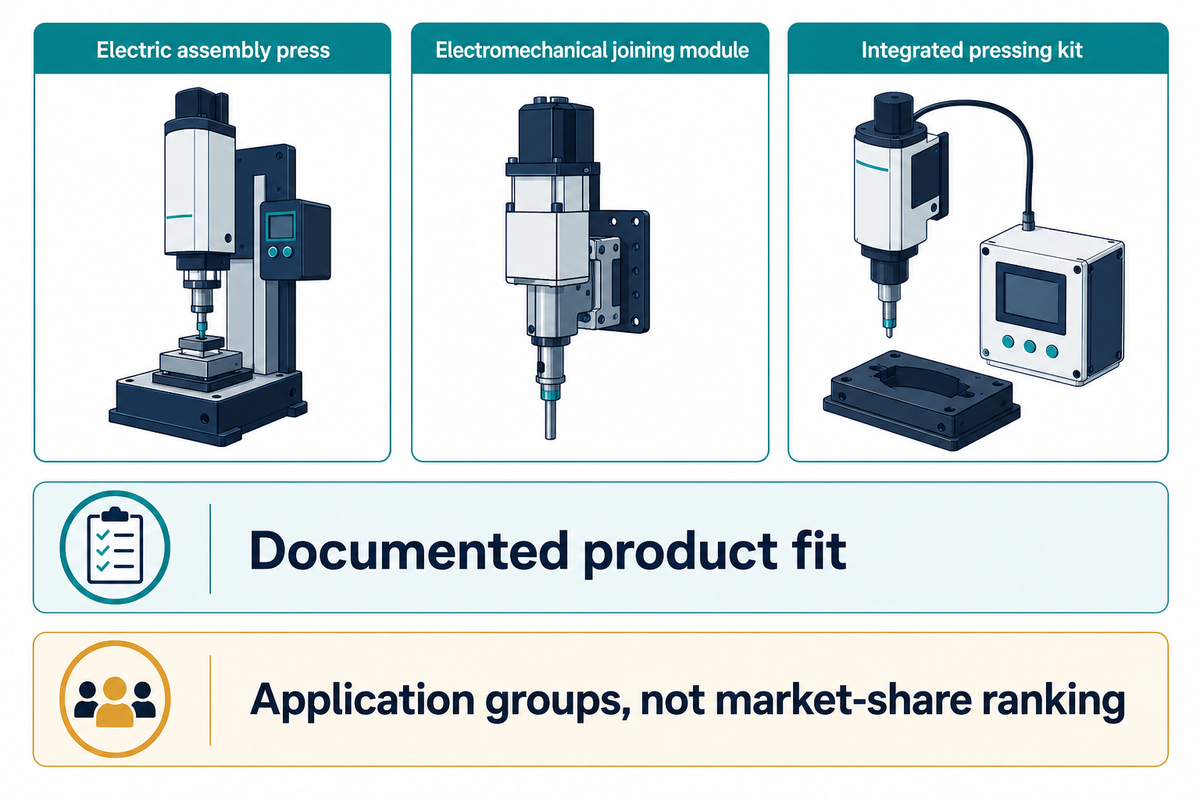
We chose companies with a clearly identifiable electric assembly press, electromechanical joining module or integrated pressing-kit product line. Company information has been verified against official websites, product documentation and public company sources in October 2026. The list covers manufacturers in Europe, Asia and North America. Stamping-only suppliers, generic servo-drive vendors and servo-hydraulic forming lines outside this article’s assembly scope have been excluded, as well as trading companies, sourcing platforms, directories, media sites and used equipment dealers.
These are application-based groupings, not a ranking from common performance tests or market-share data. “Best for” identifies a documented product fit. Dates describe company origins unless a predecessor or later corporate formation is stated. Quality-system information remains attached to the company or named site that published it. For the publisher’s own equipment, the servo press systems page holds the current commercial offer.
Supplier Comparison at a Glance
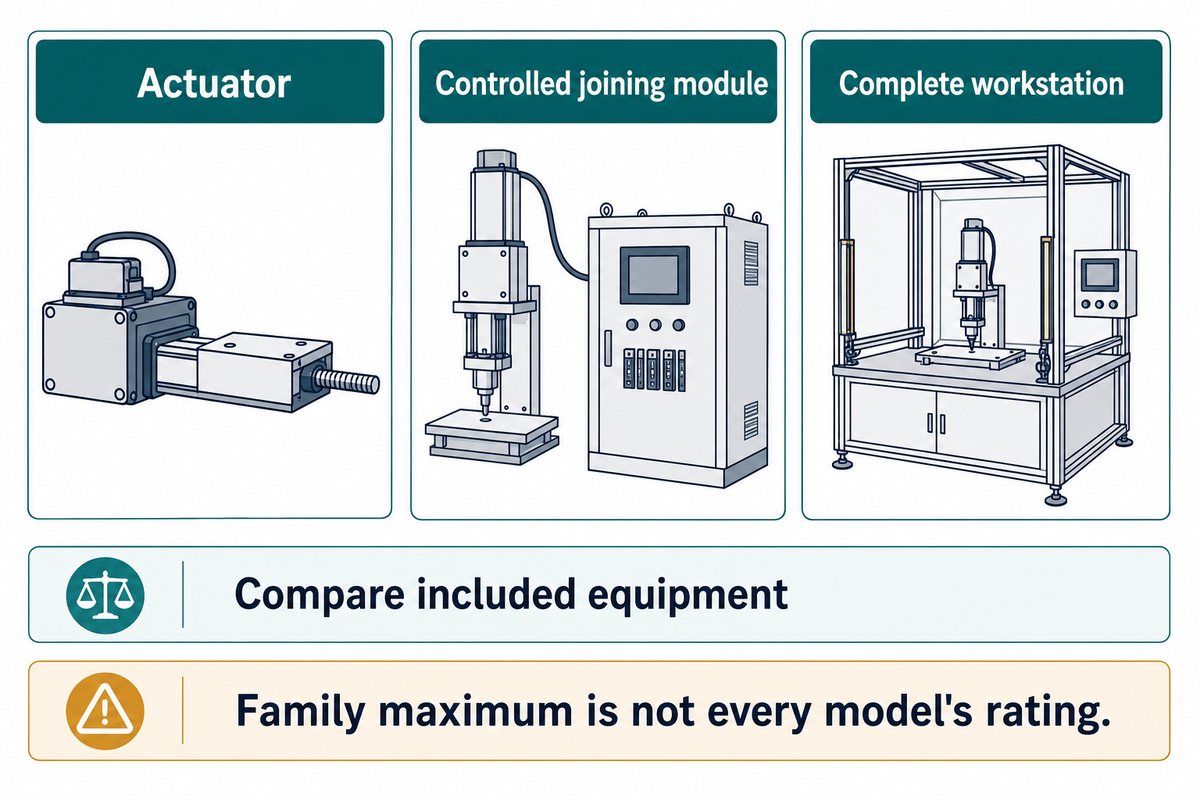
Now we’ll look at the scope of supply column. An actuator, a controlled joining module, and a complete workstation can all be appropriate options, but their quotes include different equipment. Figures below point out specific products. The largest force in a family doesn’t belong to every model. Short limitations flag the main purchasing distinction, with the detail in each company profile.
| No. | Company Name | Headquarters | Founded Year | Best For | Brief Introduction | Supply Scope | Key Advantages | Potential Disadvantages | Official Website |
|---|---|---|---|---|---|---|---|---|---|
| 1 | SIMITCH | Taicang, Suzhou, China | 2006 | 10–200 kN BP-series assembly integration | BP bending-type precision assembly presses | Workstation and joining-module manufacturer | Six BP sizes; model-specific speed and power | Stroke does not establish fixture clearance | https://simitch.com/ |
| 2 | Promess | Brighton, Michigan, USA | 1984 | Wide force ranges | EMAP electric assembly press | Joining-module and workstation manufacturer | 20 kN and 500 kN configurations documented | Speed depends on selected force and stroke | https://www.promessinc.com/ |
| 3 | SCHMIDT Technology | St. Georgen, Germany | 1938 | Explicit continuous-duty force selection | ServoPress with PressControl | Joining-module and workstation manufacturer | Separate intermittent and continuous force ratings | Peak force may be intermittent | https://www.schmidttechnology.de/ |
| 4 | Kistler | Winterthur, Switzerland | 1959 | Force-monitored joining with pretested modules | NCFE electromechanical joining systems | Joining-module and workstation manufacturer | NCFE 2–80 kN; pretested joining options | Module alone is not a complete station | https://www.kistler.com/ |
| 5 | TOX PRESSOTECHNIK | Weingarten, Germany | 1978 | Modular ElectricDrive integration | ElectricDrive Core with PowerModule and EdgeUnit | Joining-module and workstation manufacturer | 10 kN and 25 kN PowerModule examples | Drive package excludes the press frame | https://tox.com/ |
| 6 | Janome | Hachioji, Tokyo, Japan | 1921 | Choosing unit or standalone electro-press formats | JP Series5 and JP-S2 electro presses | Joining-module and workstation manufacturer | Standard and long-stroke JP5 variants | Standard and long-stroke versions differ | https://www.janome.co.jp/ |
| 7 | CORETEC | Soja, Okayama, Japan | 1972 | Integration with explicit normal-thrust ratings | AC servo presses and assembly automation | Joining-module and automation-station manufacturer | Instantaneous and normal thrust shown separately | The manufacturer’s normal thrust is lower than its instantaneous maximum | https://www.coretec.co.jp/ |
| 8 | IAI | Shizuoka, Japan | 1976 | Actuator integration with rated-thrust detail | RCS3-RA20R servo-press actuator | Servo-press actuator manufacturer | 25,902 N rated; 50,000 N maximum thrust | Controller and machine integration remain necessary | https://www.iai-robot.co.jp/ |
| 9 | Bosch Rexroth | Lohr am Main, Germany | 2001 current company | Configurable pressing kits with software | Smart Function Kit Pressing | Pressing-kit platform manufacturer | Matched hardware/software; up to 70 kN | Structure and sensor configuration affect included scope | https://www.boschrexroth.com/ |
| 10 | Festo | Esslingen am Neckar, Germany | 1925 | Compact electronics pressing kits | YJKP servo press kit | Pressing-kit platform manufacturer | 0.8–17 kN grades; calibrated full-scale accuracy | Handling and workstation integration remain necessary | https://www.festo.com/ |
| 11 | Sinto | Nagoya, Japan | 1934 | Press-fitting with workpiece handling | Servo press machines and electric cylinders | Joining-module and workstation manufacturer | 30 kN automotive machine example | Example ratings provide no guarantees above the 30 kN maximum | https://www.sinto.co.jp/ |
| 12 | AGME | Eibar, Spain | 1948 | Selecting a head, controlled head or press | PE electric servo presses | Joining-module and workstation manufacturer | PE50 5–50 kN; UC/UCC scope choice | UC and UCC include different control equipment | https://www.agme.net/ |
| 13 | Alfamatic | San Giorgio su Legnano, Italy | 1979 | Electric cylinders or complete presses | Electric presses and electric cylinders | Joining-module and workstation manufacturer | 10 kN EP10; electric family to 300 kN | Full-scale accuracy differs from applied-load percentage | https://www.alfamatic.com/ |
| 14 | Gechter | Obermichelbach, Germany | 1952 | Monitored 10–40 kN assembly stations | SRV servo presses | Workstation manufacturer | 10–40 kN SRV with process monitoring | Published SRV range ends at 40 kN | https://www.gechter.de/ |
| 15 | mäder pressen | Neuhausen ob Eck, Germany | 1956 | Compact own-brand S-PRESS workstations | Own S-PRESS servo press | Workstation manufacturer | 10 kN; 200 mm stroke; 100 mm throat | 100 mm throat restricts part access | https://maederpressen.de/ |
| 16 | Beckwood Press | Fenton, Missouri, USA | 1976 | Servo-electric C-frame assembly platforms | EVOx servo-electric presses | Workstation manufacturer | 2.5 US-ton C1-5; 12-inch stroke | Frame choice changes force, travel and access | https://beckwoodpress.com/ |
| 17 | HyperCyl / Aries Engineering | Dundee, Michigan, USA | 1994 | Choosing actuator-to-turnkey supply levels | HyperCyl EMA electromechanical actuators | Joining-module and workstation manufacturer | 5–230 kN EMA; several delivery levels | Bare-drive and turnkey prices cover different deliveries | https://www.hypercyl.com/ |
| 18 | ESTIC | Moriguchi, Osaka, Japan | 1993 | Servo tools paired with dedicated controllers | SPT servo press tools and controllers | Joining-module manufacturer | 5 kN SPT005-20 plus dedicated controller | Builder supplies the frame and safeguards | https://www.estic.co.jp/ |
| 19 | Dai-ichi Dentsu | Chofu, Tokyo, Japan | 1952 | DSP3000 controlled press modules | DSP3000 servo press system | Joining-module manufacturer | 10 kN DPL101R3-20FB; 200 mm stroke | Module limited to 10 kN / 200 mm; finished-part tolerance needs fixtures | https://www.daiichi-dentsu.co.jp/ |
| 20 | KINMARK | Jinan, China | 1996 predecessor | N-series modules and automotive press-fit stations | N-series servo press-fitting systems | Joining-module and workstation manufacturer | 10 kN N-series example; module/station options | Module and workstation equipment varies by model within the family | https://www.kinmark.com/ |
Publisher and Monitored Assembly Systems
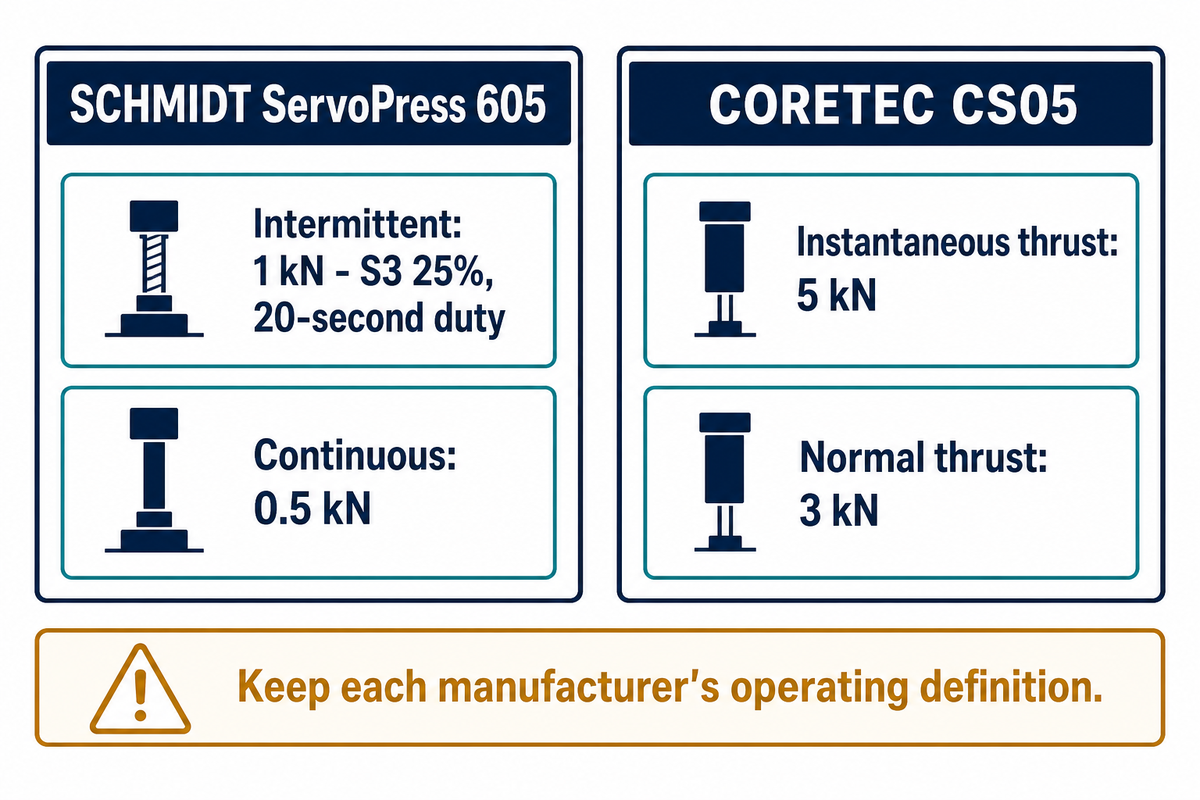
These manufacturers implement electric pressing with a structured approach to process control/monitoring. Variations abound in their configurations: Some provide an integration module, some offer framed equipment, and some do both. The company profiles keep force ratings attached to the relevant model and operating definition.
1. SIMITCH: Best for 10–200 kN BP-series assembly integration
Headquarters: Taicang, Suzhou, China · Founded: 2006 · Type: Workstation and joining-module manufacturer
Official website: https://simitch.com/
Main products: BP bending-type precision assembly presses
Quality system: According to its About page, SIMITCH uses ISO 9001 principles for process control.
SIMITCH manufactures joining modules and workstations from Taicang, Suzhou. Its BP series addresses precision press-fit assembly, with a published selection that spans light insertion work through higher-force component joining. The company's servo press systems page puts force-displacement monitoring alongside the mechanical specification, so the selection starts with the joint and its acceptance requirements.
Published capability: SIMITCH publishes six BP force sizes: 10, 30, 60, 100, 150 and 200 kN, with 300 mm standard travel. According to SIMITCH's model table, SMT-BP-10-300 provides 10 kN with 300 mm/s listed speed and 1.5 kW power, while SMT-BP-200-300 provides 200 kN with 140 mm/s and 7.5 kW. Both belong to the standard 300 mm travel selection; the separately stated 0.01 mm positioning repeatability and 1% force-measurement accuracy describe different measurements.
Buying limitation: A 300 mm ram stroke doesn’t specify the space available for the part and fixture. Frame access and the included workstation equipment remain application choices.
2. Promess: Best for Wide force ranges
Headquarters: Brighton, Michigan, USA · Founded: 1984 · Type: Joining-module and workstation manufacturer
Official website: https://www.promessinc.com/
Main products: EMAP electric assembly press
Quality system: Not publicly disclosed.
Promess develops electric assembly equipment in Brighton, Michigan, with company origins in 1984. The EMAP range combines programmable motion with force and position monitoring, making it relevant when the assembly process needs a recorded relationship between the applied load and the insertion distance. Its published selection gives buyers several force and travel combinations rather than one nominal machine size.
Published capability: The EMAP table lists a 20 kN configuration with 180, 350 or 550 mm stroke and 200 mm/s speed. Farther up the range, the 500 kN version has 400 mm stroke and a 70 mm/s speed listing. Those figures make the range useful for comparing both compact insertion and much heavier joining requirements, while keeping each speed attached to its own model.
Buying limitation: More force doesn’t preserve the same speed across the EMAP range. The selected force, stroke and speed combination determines which configuration belongs in the quotation.
3. SCHMIDT Technology: Best for Explicit continuous-duty force selection
Headquarters: St. Georgen, Germany · Founded: 1938 · Type: Joining-module and workstation manufacturer
Official website: https://www.schmidttechnology.de/
Main products: ServoPress with PressControl
Quality system: SCHMIDT lists ISO 9001 for its company quality-management system.
SCHMIDT Technology is a German press-system manufacturer based in St. Georgen, with roots dating to 1938. Its ServoPress range is particularly useful when engineering needs a clear distinction between intermittent and continuous force. The company pairs its mechanical press units with PressControl options for monitored assembly, rather than describing capacity through a single unexplained peak figure.
Published capability: For ServoPress 605, the official specification gives 1 kN at intermittent S3 25%, 20-second duty and 0.5 kN at continuous duty, with 150 mm travel. The larger ServoPress 680 likewise separates 250 kN peak force from 200 kN continuous force. These published definitions support a duty-aware shortlist for parts that need sustained loading or repeated pressing cycles.
Buying limitation: The larger force in a catalog heading can be an intermittent rating. Selecting that number alone can leave the sustained-load requirement outside the intended operating condition.
4. Kistler: Best for Force-monitored joining with pretested modules
Headquarters: Winterthur, Switzerland · Founded: 1959 · Type: Joining-module and workstation manufacturer
Official website: https://www.kistler.com/
Main products: NCFE electromechanical joining systems
Quality system: Kistler publishes group quality-system evidence for ISO 9001:2015.
Kistler, founded in 1959 and headquartered in Winterthur, combines measurement technology with electromechanical joining equipment. Its NCFE family gives an integrator a press module with a defined mechanical envelope, while the broader offering also includes pretested joining systems and semiautomatic workstations. That distinction helps a buyer choose between building a machine around a module and purchasing a more complete assembly arrangement.
Published capability: The NCFE range is listed at 2–80 kN. One documented example, 2162A010350NT, combines 10 kN capacity with 350 mm stroke and 250 mm/s speed. A named configuration is a more useful starting point than applying the largest family number to every unit, especially where the part envelope and motion sequence are already fixed.
Buying limitation: An NCFE joining module is only part of a production station. Its specification doesn’t include the application's entire frame, part-handling arrangement or guarded workstation.
5. TOX PRESSOTECHNIK: Best for Modular ElectricDrive integration
Headquarters: Weingarten, Germany · Founded: 1978 · Type: Joining-module and workstation manufacturer
Official website: https://tox.com/
Main products: ElectricDrive Core with PowerModule and EdgeUnit
Quality system: The company reports ISO 9001:2015 certification at its German headquarters.
TOX PRESSOTECHNIK supplies joining technology from Weingarten, Germany, and dates its establishment to 1978. ElectricDrive Core divides the electric pressing package into a PowerModule, an EdgeUnit and software. This modular arrangement suits machine builders who want to integrate a defined drive and control package into their own production equipment.
Published capability: The published EPMK010.226.250 example supplies 10 kN with 250 mm stroke and 200 mm/s maximum speed. A 025 variant in the same documentation provides 25 kN with 250 mm stroke. The product structure makes the electrical and control scope visible alongside the mechanical selection, which is useful when several automation systems must exchange production information.
Buying limitation: ElectricDrive Core supplies the drive, control and software elements; those components don’t constitute a complete press frame. The surrounding machine structure remains a separate part of the integration.
6. Janome: Best for Choosing unit or standalone electro-press formats
Headquarters: Hachioji, Tokyo, Japan · Founded: 1921 · Type: Joining-module and workstation manufacturer
Official website: https://www.janome.co.jp/
Main products: JP Series5 and JP-S2 electro presses
Quality system: Janome's corporate sustainability material reports ISO 9001. Product cleanroom classifications are separate from that company quality-system statement.
Janome traces its business origins to 1921 and is based in Hachioji, Tokyo. Its industrial electro-press range includes the JP Series 5 and JP-S2, with unit and standalone formats for different integration needs. That choice is useful for a buyer comparing a press head for an automated line with a dedicated C-frame workstation.
Published capability: Within JP Series 5, JPU1005 is listed at 10 kN with 100 mm standard stroke or a 150 mm long-stroke version. JPU2005 is listed at 20 kN with 200 mm standard stroke or a 400 mm long-stroke version. The format and travel choices give the machine builder concrete alternatives for the available working space, rather than an assumption that every member of the range has the same stroke.
Buying limitation: Standard and long-stroke versions differ. The older JP4 series is discontinued, so an old model reference doesn’t identify the current supply configuration.
7. CORETEC: Best for Integration with explicit normal-thrust ratings
Headquarters: Soja, Okayama, Japan · Founded: 1972 · Type: Joining-module and automation-station manufacturer
Official website: https://www.coretec.co.jp/
Main products: AC servo presses and assembly automation
Quality system: CORETEC's company history records acquisition of ISO 9001 certification.
CORETEC, established in 1972 in Soja, Okayama, combines AC servo presses with assembly automation. Its specifications distinguish instantaneous thrust from normal thrust, giving an integrator a clearer basis for discussing the load requirement. The company's definition of normal output relates to mechanical life and should retain that meaning when compared with another manufacturer's duty terminology.
Published capability: The CS05 example lists 5 kN instantaneous thrust and 3 kN normal thrust, with 100 or 250 mm stroke versions. The larger MS100 publishes 100 kN instantaneous thrust against 70 kN normal thrust. Those paired values are useful for a production-line discussion because they show why the largest catalog number alone doesn’t describe the preferred repeated working condition.
Buying limitation: Instantaneous thrust isn’t a substitute for a sustained-duty selection. CORETEC's normal-thrust definition concerns mechanical life, rather than another supplier's continuous-force rating.
Integration Platforms and Electric Pressing Kits
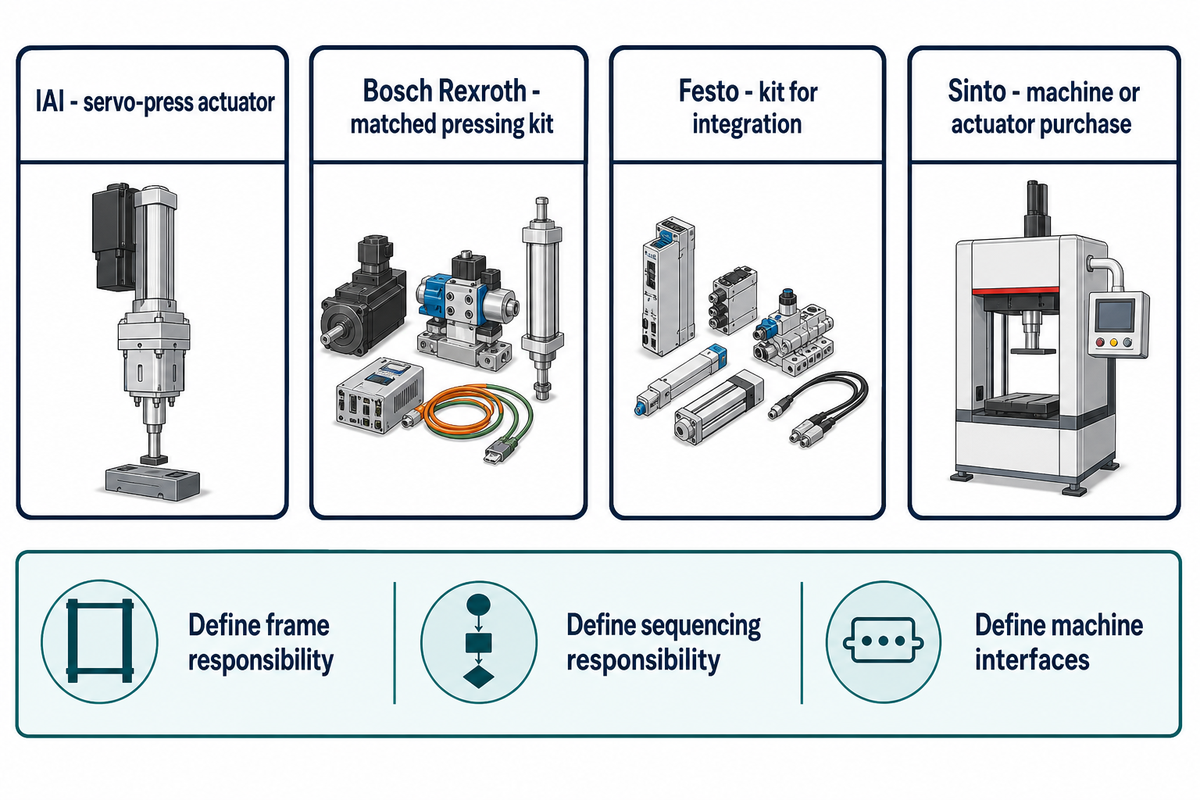
A machine builder with an existing automation platform may prefer an actuator or matched kit. This leaves more responsibility for frame, sequencing and machine interfaces for the integrator. The four suppliers identified here publish identifiable electric pressing products, although the quantity of hardware delivered around the pressing axis varies.
8. IAI: Best for Actuator integration with rated-thrust detail
Headquarters: Shizuoka, Japan · Founded: 1976 · Type: Servo-press actuator manufacturer
Official website: https://www.iai-robot.co.jp/
Main products: RCS3-RA20R servo-press actuator
Quality system: IAI's ISO 9001:2015 company scope excludes its agricultural business.
IAI manufactures electric actuators from Shizuoka and dates its establishment to 1976. Its RCS3-RA20R servo-press actuator is a component for machine integration, with rated and maximum thrust published separately. This makes it a relevant option where the builder already controls the frame, handling equipment and broader control system.
Published capability: The RCS3-RA20R specification distinguishes 25,902 N rated thrust from 50,000 N maximum thrust, with stroke selections from 100 to 500 mm. It also lists a usual pressing speed of 10 mm/s, which shouldn’t be replaced by a rapid-traverse figure in a cycle-time estimate. Reading the actuator's force and motion conditions together gives the builder a usable engineering starting point.
Buying limitation: The actuator requires a suitable controller and machine integration. Its maximum thrust doesn’t establish a continuous rated output for the complete customer-built station.
9. Bosch Rexroth: Best for Configurable pressing kits with software
Headquarters: Lohr am Main, Germany · Founded: 2001 current company · Type: Pressing-kit platform manufacturer
Official website: https://www.boschrexroth.com/
Main products: Smart Function Kit Pressing
Quality system: Bosch Rexroth AG lists ISO 9001 certification in its company certificate repository.
Bosch Rexroth supplies the Smart Function Kit Pressing as a configurable package for integrators and users with process knowledge. The company is headquartered in Lohr am Main, Germany; 2001 refers to the formation of Bosch Rexroth, rather than the start of every predecessor business. Its pressing kit combines matched mechanical and electrical components with operating software.
Published capability: The published kit range reaches 70 kN, with electromechanical-cylinder stroke configurable up to 400 mm. Preinstalled operating software supports the package's system approach, while force sensing depends on the selected configuration. The attraction for a machine builder is a defined set of compatible components for pressing and joining applications, leaving the application-specific structure to the surrounding machine design.
Buying limitation: The kit isn’t a complete workstation. Frame design, tooling and application integration remain outside the basic kit boundary, and sensor options change what’s included.
10. Festo: Best for Compact electronics pressing kits
Headquarters: Esslingen am Neckar, Germany · Founded: 1925 · Type: Pressing-kit platform manufacturer
Official website: https://www.festo.com/
Main products: YJKP servo press kit
Quality system: The published Festo SE & Co. KG ISO 9001:2015 certificate covers its listed automation sites and carries a 2025–2028 validity period.
Festo, founded in 1925 and based in Esslingen am Neckar, offers the YJKP servo press kit for electric pressing tasks. Its published application material includes smartphone assembly, making the range relevant to compact electronic products as well as other small-component joining operations. The product is a kit for integration rather than a finished handling cell.
Published capability: YJKP force grades include 0.8, 1.5, 4, 7, 12 and 17 kN, with working strokes of 100, 200, 300 or 400 mm. Festo states force accuracy of ±0.25% of calibrated full scale. That denominator matters: a full-scale specification isn’t the same as the same percentage of the force applied during a small-load pressing step.
Buying limitation: YJKP components don’t include the full workpiece-handling system or guarded workstation. Those items remain part of the machine builder's delivery.
11. Sinto: Best for Press-fitting with workpiece handling
Headquarters: Nagoya, Japan · Founded: 1934 · Type: Joining-module and workstation manufacturer
Official website: https://www.sinto.co.jp/
Main products: Servo press machines and electric cylinders
Quality system: Sinto’s publicly disclosed company history records JQA ISO 9001 certification at the Toyokawa plant in 1999.
Sinto, headquartered in Nagoya with origins in 1934, offers servo press machines as well as electric cylinders. Its product presentation includes precision pressing combined with workpiece handling, giving buyers a choice between a machine arrangement and an actuator-level purchase. This is useful when the pressing motion is only one operation in a larger assembly sequence.
Published capability: An automotive press-fit and riveting machine example is specified at a maximum pressing force of 30 kN, with positioning repeatability of ±0.01 mm. The example connects the force and positioning figures to a named machine application rather than treating them as universal values for every Sinto cylinder or press.
Buying limitation: The 30 kN maximum force and ±0.01 mm repeatability figures belong to the illustrated machine example. Jobs above 30 kN need a different machine from Sinto's electric-cylinder or workstation range.
Dedicated Press Builders and Control Specialists
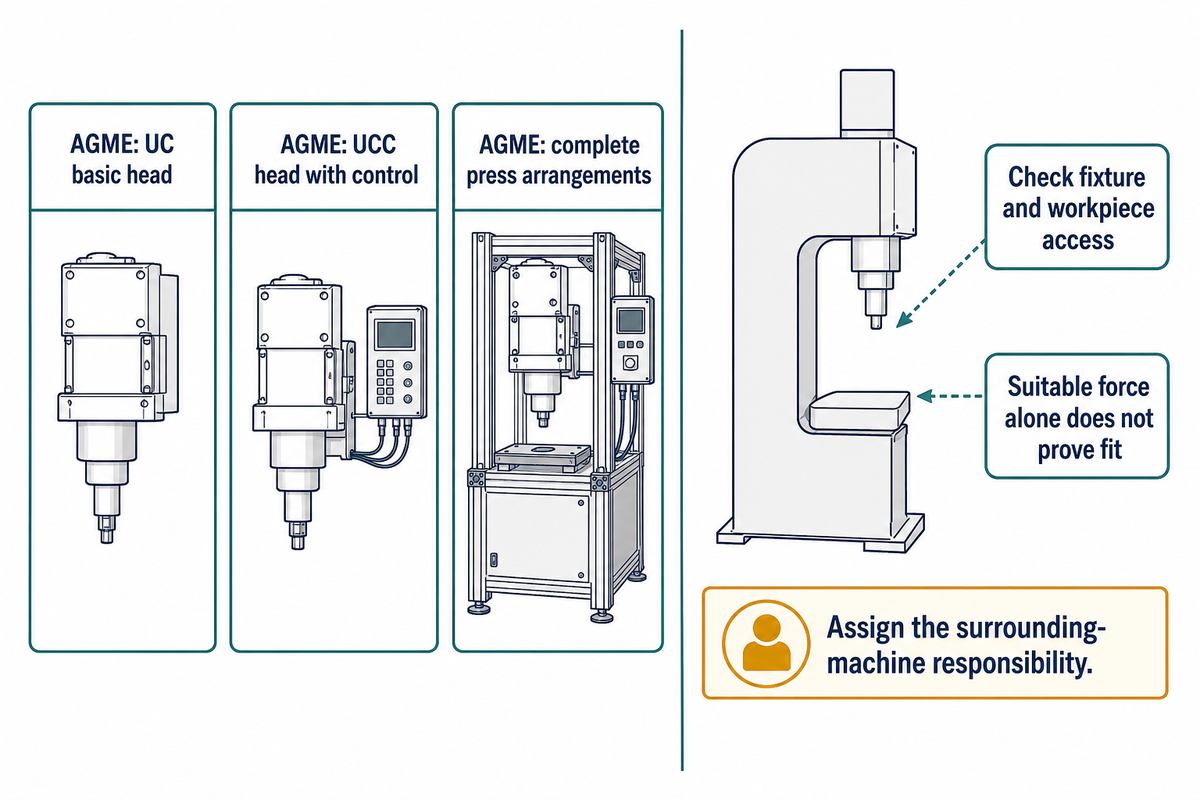
Nominal force isn’t the only factor that can rule a shortlist. Access to frames, a controller selection and the partitioning of engineering effort can work just as well. The following companies offer dedicated press equipment or identifiable controlled modules. Their published examples help separate a complete press purchase from a component that still needs a surrounding machine.
12. AGME: Best for Selecting a head, controlled head or press
Headquarters: Eibar, Spain · Founded: 1948 · Type: Joining-module and workstation manufacturer
Official website: https://www.agme.net/
Main products: PE electric servo presses
Quality system: AGME reports renewal of its ISO 9001 quality certificates.
AGME, founded in 1948 in Eibar, Spain, manufactures assembly equipment including PE electric servo presses. Its range distinguishes a basic UC head from a UCC head supplied with control, as well as complete press arrangements. This is a practical distinction for an integrator deciding how much of the machine's electrical and process-control work to buy with the pressing head.
Published capability: For PE 50, AGME publishes a 5–50 kN force range and 0.01 mm positioning repeatability. The company also lists an optional load cell with ±0.5% precision, without treating that short specification as interchangeable with another supplier's full-scale accuracy figure. The separate head formats let a project team align the offer with its existing controller and machine architecture.
Buying limitation: A UC basic head and a UCC controlled head have different included equipment. Comparing their prices without the control scope would compare different deliveries.
13. Alfamatic: Best for Electric cylinders or complete presses
Headquarters: San Giorgio su Legnano, Italy · Founded: 1979 · Type: Joining-module and workstation manufacturer
Official website: https://www.alfamatic.com/
Main products: Electric presses and electric cylinders
Quality system: Not publicly disclosed.
Alfamatic, based in San Giorgio su Legnano, Italy, dates its establishment to 1979. The company offers electric presses and electric cylinders, so the buyer can consider a complete press arrangement or the pressing element for a larger machine. Its public electric range includes both compact models and higher-force configurations.
Published capability: The EP 10 example provides 10 kN, with force measurement stated at ±0.5% of full scale. The broader electric family includes models up to 300 kN. This combination makes the range relevant where the purchasing decision includes both the mechanical supply boundary and the measurement range needed for the joint.
Buying limitation: Full-scale measurement accuracy isn’t the same percentage of the actual applied load. A low-force operation on a larger measuring range therefore needs a separate measurement-capability assessment.
14. Gechter: Best for Monitored 10–40 kN assembly stations
Headquarters: Obermichelbach, Germany · Founded: 1952 · Type: Workstation manufacturer
Official website: https://www.gechter.de/
Main products: SRV servo presses
Quality system: Not publicly disclosed.
Gechter supplies presses from Obermichelbach, Germany, with a business origin of 1952 reported by its official distribution partner. The SRV servo range combines electric pressing with force-displacement monitoring. It’s a useful starting point for buyers who want an assembly-station format within a defined moderate-force range.
Published capability: The published SRV family covers 10–40 kN and strokes up to 350 mm. Its monitoring capability gives the pressing process a recorded force-versus-travel view, while the stated travel provides a concrete basis for checking the required insertion movement. Those facts support an assembly shortlist without assuming that a monitored trace itself proves the final part's dimensions.
Buying limitation: The documented SRV range ends at 40 kN. An assembly requirement above that force falls outside the range described here, regardless of how suitable its monitoring functions appear.
15. mäder pressen: Best for Compact own-brand S-PRESS workstations
Headquarters: Neuhausen ob Eck, Germany · Founded: 1956 · Type: Workstation manufacturer
Official website: https://maederpressen.de/
Main products: Own S-PRESS servo press
Quality system: Not publicly disclosed.
mäder pressen manufactures presses in Neuhausen ob Eck, Germany. A company-issued historical release dates its origins to 1956. Its own S-PRESS product should be considered separately from the Janome presses it also distributes, preserving the distinction between the manufacturer of a machine and its sales channel.
Published capability: The documented S-Press 1000-200-100 provides 10 kN, a 200 mm stroke and a 100 mm throat. That combination makes the compact workstation relevant to parts whose insertion movement and access fit the frame. The throat dimension is particularly useful because a suitable pressing force alone says little about whether the fixture and workpiece can reach the working position.
Buying limitation: The 100 mm throat limits part access on this model. A component that needs more reach requires a different frame arrangement, even if 10 kN would satisfy its load requirement.
16. Beckwood Press: Best for Servo-electric C-frame assembly platforms
Headquarters: Fenton, Missouri, USA
Founded: 1976
Type: Workstation manufacturer
Official website: https://beckwoodpress.com/
Main products: EVOx servo-electric presses
Quality system: Not publicly disclosed.
Beckwood Press Company, established in 1976 and based in Fenton, Missouri, builds press equipment including the EVOx servo-electric range. Its documented applications include assembly, while the company's wider catalog also serves forming operations. EVOx offers a framed platform for buyers whose requirement is more complete than a bare actuator.
Published capability: The EVOx C1-5 example is listed at 2.5 US tons with a 12-inch stroke. The series states positioning repeatability of ±0.0005 inch. Keeping the US-ton unit and the named frame visible prevents a buyer from confusing that configuration with a metric-ton rating or a different machine in the broader range.
Buying limitation: Force, stroke and access depend on the frame configuration. A forming example elsewhere in the catalog doesn’t establish the fit of a particular assembly fixture or joint.
17. HyperCyl / Aries Engineering: Best for Choosing actuator-to-turnkey supply levels
Headquarters: Dundee, Michigan, USA · Founded: 1994 · Type: Joining-module and workstation manufacturer
Official website: https://www.hypercyl.com/
Main products: HyperCyl EMA electromechanical actuators
Quality system: Not publicly disclosed.
HyperCyl is an Aries Engineering brand based in Dundee, Michigan, with business origins in 1994. Its EMA electromechanical actuator offering is available at several supply levels, including an actuator, bare drive, controller package or turnkey solution. That range is relevant when a project team wants to keep some machine-building responsibilities in house while purchasing others.
Published capability: The EMA family is published at 5–230 kN, with stated repeatability of 0.0025 mm. The supply choices make it possible to discuss the same general pressing requirement at component or system level, while retaining the distinction between an actuator's rating and the performance of an assembled production cell.
Buying limitation: A bare drive, a controlled actuator and a turnkey station are different purchases. The lowest-scope offer doesn’t include the equipment and engineering present in a complete station.
18. ESTIC: Best for Servo tools paired with dedicated controllers
Headquarters: Moriguchi, Osaka, Japan · Founded: 1993 · Type: Joining-module manufacturer
Official website: https://www.estic.co.jp/
Main products: SPT servo press tools and controllers
Quality system: ESTIC's company history records ISO 9001:2015 in 2017; this is a historical company statement.
ESTIC, founded in 1993 and headquartered in Moriguchi, Osaka, supplies servo press tools with dedicated controllers. Its SPT range is a module-level choice for a machine builder designing the frame and handling arrangement. The pairing of tool and controller makes the control boundary clearer than a mechanical head offered without an identified operating package.
Published capability: The SPT005-20 model is listed with a maximum force of 5 kN, and the SPT specification gives positioning repeatability of ±0.01 mm. Those values make the tool relevant to lower-force assembly requirements, with the exact model and controller chosen as part of the machine's overall process design.
Buying limitation: The tool and controller still require the machine builder's frame and safeguards. Their catalog figures don’t describe a completed customer-specific workstation.
19. Dai-ichi Dentsu: Best for DSP3000 controlled press modules
Headquarters: Chofu, Tokyo, Japan · Founded: 1952 · Type: Joining-module manufacturer
Official website: https://www.daiichi-dentsu.co.jp/
Main products: DSP3000 servo press system
Quality system: The company's ISO 9001 certificate JQA-QMA13393 identifies headquarters and Kani factory scope.
Dai-ichi Dentsu, based in Chofu, Tokyo, dates its establishment to 1952. Its DSP3000 servo press system combines pressing modules with dedicated control. The product is relevant to integrators who want to build a monitored assembly operation around an identified module and its matching control system.
Published capability: The DPL101R3-20FB example provides 10 kN with 200 mm stroke, while DSP3000 documentation states repeatability of ±0.01 mm. A named module and control platform give the buyer a concrete basis for defining the press portion of a larger automated machine, without assuming that the entire part-handling sequence is part of the module purchase.
Buying limitation: Module repeatability doesn’t include the customer's fixture behavior or the finished part's dimensional tolerance. The DPL101R3-20FB module’s 10 kN force and 200 mm stroke also limit the application.
20. KINMARK: Best for N-series modules and automotive press-fit stations
Headquarters: Jinan, China · Founded: 1996 predecessor · Type: Joining-module and workstation manufacturer
Official website: https://www.kinmark.com/
Main products: N-series servo press-fitting systems
Quality system: KINMARK's About page lists ISO 9001; its Honors page uses ISO 9000 and ISO 14001 wording.
KINMARK supplies N-series servo press-fitting systems from Jinan, China. Its company history traces back to a predecessor established in 1996, rather than presenting that date as the incorporation year of every current entity. The range includes modules and press-fitting workstations for automotive and other assembly applications.
Published capability: The N-Series 10KN example lists 10 kN and 100–400 mm stroke options, within a family advertised at 2–350 kN. The published 0.01 mm figure is described as position accuracy, a different specification from positioning repeatability. These details support a model-based shortlist for a defined press-fit operation.
Buying limitation: A family maximum of 350 kN doesn’t describe the 10 kN model. Module and workstation configurations also include different equipment, so the selected package determines the purchase scope.
How to Choose a Servo Press Manufacturer
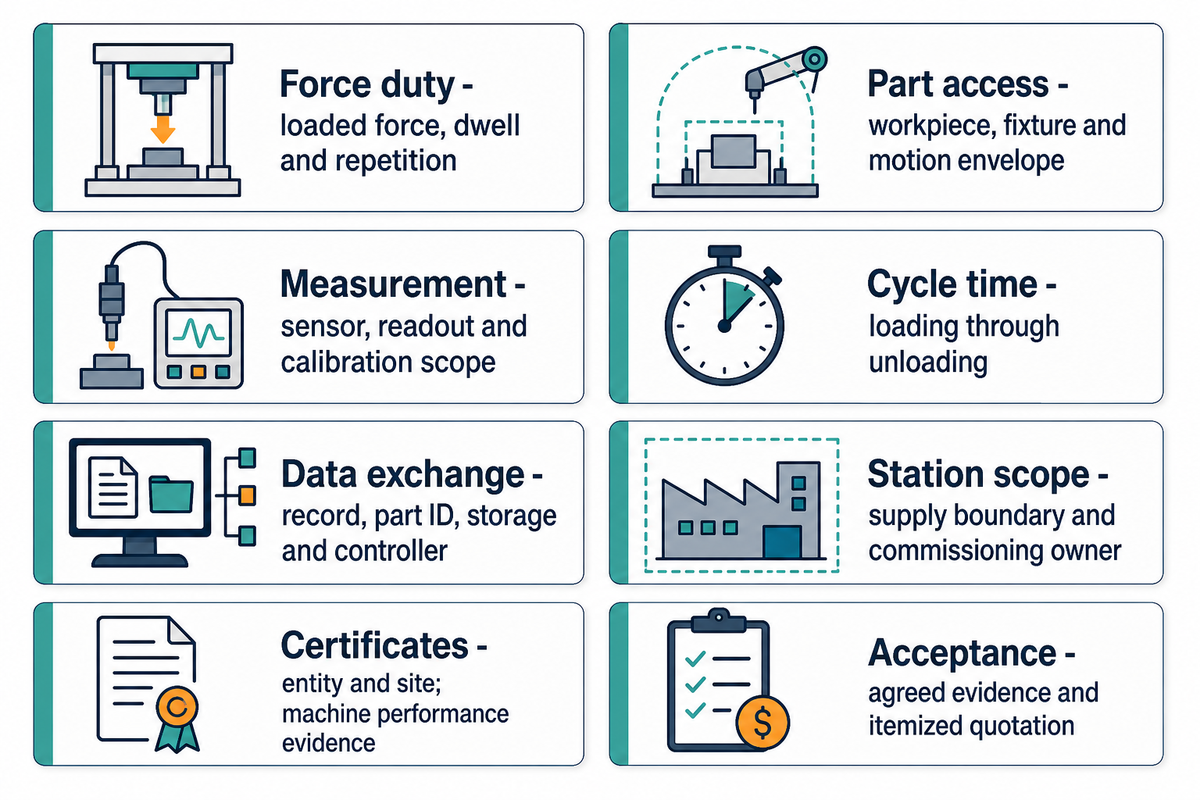
A useful comparison connects the workpiece drawing to a pressing cycle and to a defined delivery. Nominal tonnage, desirable repeatability figures and an attractive entry-level price can’t do this on their own. Use the following eight checks to compare the same job across suppliers, with the press axis, measurement package and surrounding machine considered together.
How to Evaluate a Servo Press?
Evaluate a servo press against the joint’s required force over travel, load duration, finished-part acceptance criteria and target cycle time. With regard to complex applications, consider the tooling envelope and the equipment included in each offer. Ask how the proposed operating mode provides precise control over the loaded movement. The preferred supplier response integrates the named requirements with a specific model, achievable cycle and defined measurement system, instead of depending on the largest force printed in the supplier catalog.
1. Apply the Force-Duty Fit Check
The Force-Duty Fit Check means reading the force number together with its operating definition and load duration. SCHMIDT ServoPress 605 illustrates the difference: its 1 kN intermittent rating uses S3 25%, 20-second duty, while its continuous rating is 0.5 kN. CORETEC separately defines instantaneous and normal thrust, with normal output related to mechanical life. Those are useful distinctions, not interchangeable labels or a universal conversion formula.
Ask for: the required force throughout the loaded movement, dwell time and repetition pattern. A good response identifies which rating applies to that cycle. IAI’s separate rated and maximum thrust figures provide another reason to avoid sizing an electric servo press from a peak number alone.
2. Match stroke to part access
A 200 mm stroke does not tell the buyer whether a tall fixture fits under the ram or whether a wide part can reach through a C-frame. mäder’s S-PRESS example publishes both 200 mm stroke and 100 mm throat, making the access question visible beside the force rating.
Ask for: a layout showing the workpiece, fixture, loading position and full motion envelope. A good response identifies the available daylight and throat as well as loaded travel. SIMITCH’s BP bending-type assembly presses provide a product-specific starting point for that layout discussion.
3. Compare the full measurement system
A repeatable axis returns to a consistent position; positioning repeatability doesn’t describe the finished joint’s dimensional accuracy. Force accuracy also needs its stated basis: Festo’s ±0.25% of calibrated full scale and Alfamatic’s ±0.5% full-scale figure can’t be read as the same percentages of every applied load. A larger measuring range can therefore be a poor comparison for a much smaller working force.
Ask for: sensor range, readout configuration, calibration scope, and the measurement conditions used for the proposed process. NIST’s force-transducer calibration guidance explains that calibration with a customer’s readout applies to that paired system. A good answer identifies the combination that will be delivered, rather than attaching a sensor-only claim to the whole station.
4. Separate rapid movement from loaded pressing
A high-speed approach can reduce unloaded travel time, but it doesn’t establish the speed available at the required pressing force. Promess publishes different speeds for its 20 kN and 500 kN examples; IAI distinguishes usual pressing speed from rapid motion. These details matter when evaluating a servo press for high-speed assembly.
Ask for: the complete sequence, including loading, approach, pressing, dwell, return and unloading. A good response shows where the target cycle time comes from. The automated assembly line planning guide provides wider context for locating the pressing operation within the production sequence.
What Can Be Programmed in the Press Cycle?
The programme depends on the press package and controller selected. Motion systems commonly organize an approach, a controlled pressing movement and a return, with the supplier defining the available force or position conditions. Analyze those functions in the proposed configuration. Programmable motion doesn’t assure that a machine can sustain all combinations of high force and high speeds throughout the stroke.
5. Define monitoring and data exchange
Force and position control, position monitoring and curve evaluation are related but different functions. A recorded curve is useful only when the project also defines its acceptance windows and how the result follows the part. “Absolute process transparency” is a marketing description until the offer identifies the data and interfaces that support it.
Ask for: the record format, part identifier, storage location and exchange with the line controller. If an integrated export function is needed, name it in the scope. A good answer demonstrates the requested information flow. The force-displacement curve validation guide explains why process traces and finished-part checks belong together when assessing product quality.
6. Agree who supplies and commissions the station
A pressing kit can be an efficient purchase for an experienced integrator, while a buyer without that capability may need the frame, handling equipment and control integration included. The words “system solutions”, drive technology and servo drives do not settle those responsibilities.
Module or kit
- Defined pressing axis and selected controls.
- Machine structure and handling designed around it.
- Integration ownership assigned to the machine builder.
Complete workstation
- Frame and application equipment named in the offer.
- Handling and operator access described in the layout.
- Commissioning and acceptance responsibilities assigned.
Ask for: an itemized supply boundary and the party responsible for commissioning. A good response distinguishes standard equipment, options and customer-supplied items. Projects adding robots should also define the exchange with the robotic assembly line, rather than assuming every controller interface is included.
7. Treat certificates and performance claims separately
A quality-management certificate is not a performance certificate for every press. A company’s legal entity is contained within the certificate. The site scope and the certificate’s validity period are also a part of the certificate. ISO 9001 identifies the quality-management standard; its edition history alone does not establish whether a particular company’s certificate is valid. Historical certification statements also differ from a current certificate.
Request the applicable certificate and its site scope as well as evidence of promised performance of the machine in question. A good answer would name the entity and site rather than making a general group claim for all operations. Safety functions likewise belong to the configured machine assessment; a servo-controlled axis alone does not establish the suitability of the complete workstation.
8. Compare acceptance evidence and total quoted scope
Reducing scrap, reducing energy consumption and precise force control are excellent objectives, but they require a defined baseline and acceptance method. Servo press technology does not produce the same result in every joint. For applications of servo technology in automotive manufacturing, the acceptance discussion should cover representative parts, changeover, measurement and records and the end result that’s to be shown, before the equipment is accepted.
Ask for: a quotation that separates the press, tooling, controls, handling, installation and service. A good response connects the proposed equipment to the agreed acceptance evidence. If the process mainly needs intensified pneumatic force with a different control approach, compare pneumohydraulic drive options as a separate architecture. A servo hydraulic press uses hydraulic force; conventional hydraulic presses and an electro-mechanical assembly axis shouldn’t share an unqualified efficiency claim.
Key takeaway
A suitable assembly press matches the load cycle, tooling envelope and delivered scope. The Force-Duty Fit Check keeps a peak-force headline from replacing that engineering comparison.
Frequently Asked Questions
Which is the best servo press manufacturer for precision assembly?
The best fit depends on the joint, the duty cycle and the equipment included.
SCHMIDT is a relevant starting point for explicitly separated continuous and intermittent force ratings. Promess offers monitored EMAP configurations, while Festo and Bosch Rexroth supply pressing kits for integration. A framed workstation can suit a different purchasing need from a bare module. Compare a named model against the same workpiece and cycle, then select the supplier whose delivery covers the required machine-building responsibilities.
Who is the largest servo press manufacturer in the world?
The reviewed sources do not establish a comparable global sales or shipment leader for assembly servo presses.
Company revenue, maximum press force and international office count measure different things. A large automation group can sell pressing kits without being the largest supplier of complete assembly workstations. A meaningful size comparison would need a defined product category, reporting period and consistent sales or shipment evidence across suppliers. This list uses documented application fit and product scope instead of assigning an unsupported market-share ranking.
What is the difference between a servo press manufacturer and a supplier?
A manufacturer makes an identified press product; a supplier may also be a distributor or integrator.
That distinction matters when deciding who owns the mechanical design, controller support and application engineering. A machine builder can integrate another manufacturer’s actuator into a complete workstation, adding substantial engineering without manufacturing the actuator itself. This list identifies the product and supply scope associated with each company. In a quotation, name both the maker of the pressing unit and the organization responsible for the delivered machine, so service and acceptance responsibilities are clear.
How much does a servo press cost?
Price depends on the force, frame, controls, tooling and integration work included.
The reviewed sources don’t provide a consistent public price range for equivalent complete stations. Compare itemized quotations for the same scope. A module price can’t establish the cost of a production-ready workstation.
Which is the best servo press for continuous-duty assembly?
Choose a model with an operating rating that matches the actual repeated load cycle.
SCHMIDT ServoPress 605 provides a concrete example: its published continuous force is 0.5 kN, distinct from the 1 kN intermittent rating. CORETEC uses instantaneous and normal-thrust definitions, while IAI publishes rated and maximum thrust separately. Those terms should retain the manufacturer’s meaning. The best selection depends on the required force during loaded travel, dwell and repetition, together with the chosen machine configuration. A higher peak number alone doesn’t resolve that decision.
Can a force-displacement curve replace a finished-part inspection?
A process curve and a finished-part inspection provide different evidence.
The curve records the pressing operation; the part still has its own dimensional and functional requirements. Define both in the acceptance plan. SIMITCH’s press-fit validation guidance discusses that relationship for assembly work.
Your Next Servo Press Shortlist
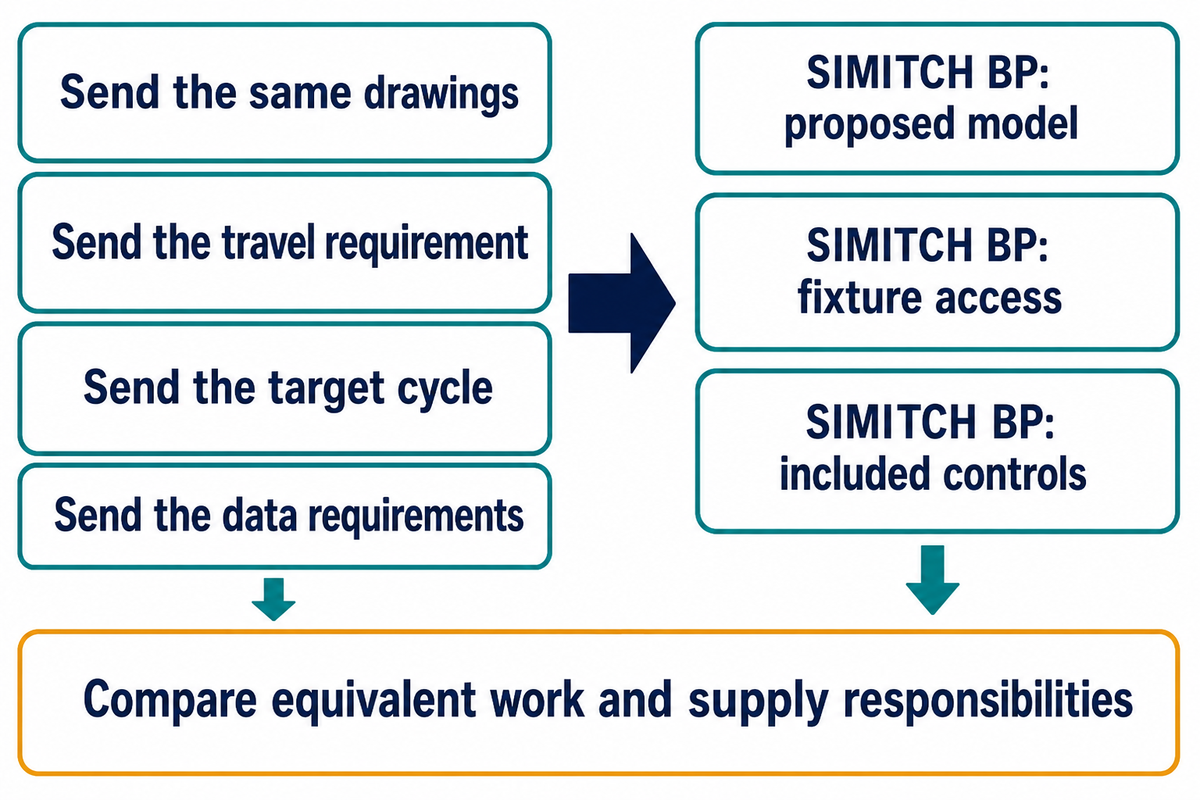
Choose a few suppliers whose documented products fit the force cycle and delivery you need. Send the same drawings, travel requirement, target cycle and data requirements to each. For a project involving SIMITCH’s BP range, discuss your assembly requirements with the team and identify the proposed model, fixture access and included controls. The best shortlist is one that compares equivalent work and equivalent supply responsibilities.
References & Sources
Company profiles draw on the manufacturers’ official product, company-history and quality-system material reviewed in October 2026. The official website is shown in each profile. Product figures retain the stated model and measurement basis; company descriptions are attributed supplier information.
- NIST: Calibration of Force Transducers, updated March 2025.
- ISO: ISO 9001 quality-management standard, current public standard page.