Get in touch with Suzhou Simitch Machinery Co., Ltd Company

Updated: October 2026
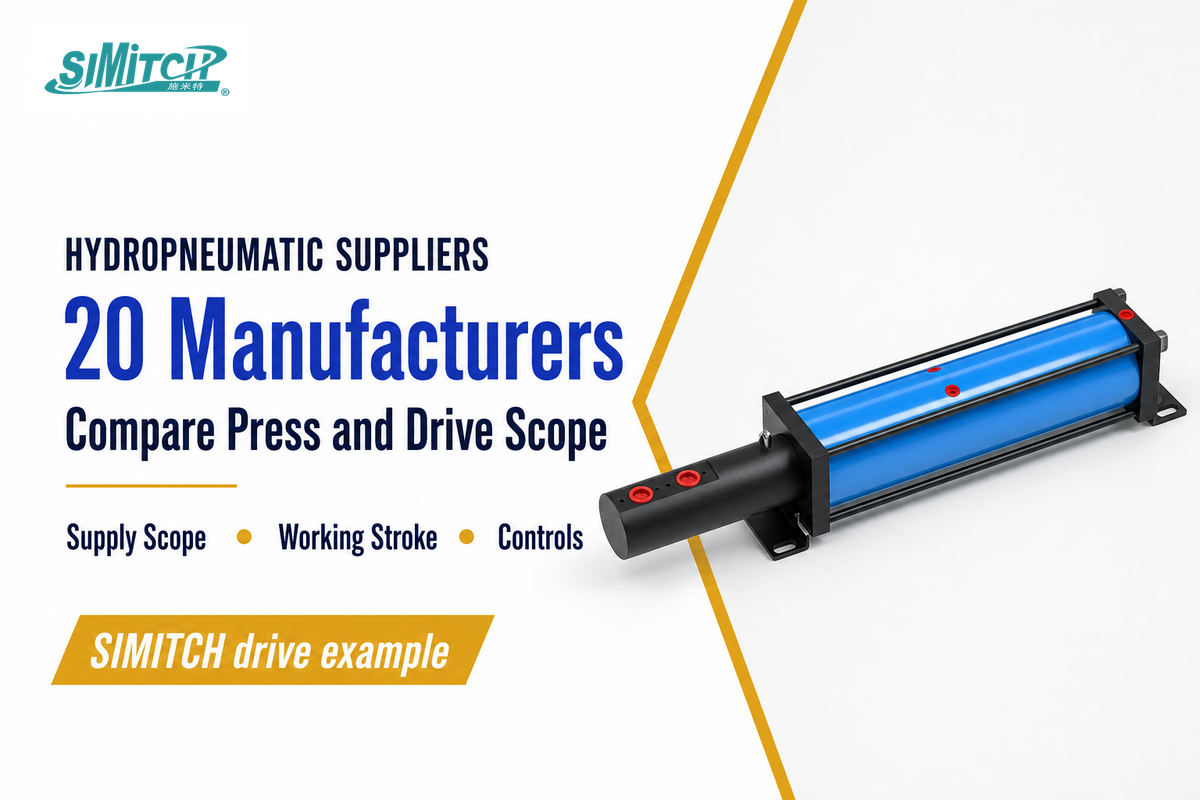
For a hydro pneumatic press manufacturer shortlist, consider SCHMIDT for monitored assembly, Alfamatic for frame and guarding choices, and Gechter for H-frame pressing. SIMITCH serves machine builders needing integrated or split drives. These 20 options cover different supply scopes, so compare the required working stroke, controls and complete-station requirements before choosing.
Quick comparison: 20 manufacturers; four drive-focused suppliers; ten standard press builders; six application-focused manufacturers. Force figures are in published units and pressure conditions. Total stroke and power stroke are separate specifications.
Quick Picks by Buying Need
- SIMITCH: integrated BS/BT or split AT/HZ drives for a customer-built machine.
- SCHMIDT Technology: a modular press and controller combination for monitored assembly.
- Alfamatic: several frame and guarding choices around the OP press family.
- Gechter: H-frame equipment with separately specified approach and power forces.
- G.P.A. Italiana: clearly separated supply levels, from frame and unit to standalone controls.
- S S Air Hydro Power: a documented brake-cable crimping machine and application-specific press options.
Disclosure: This guide is published by SIMITCH. We list ourselves first because this is our website, not because we claim to be the market leader. The other 19 manufacturers are grouped by what they’re best for, in no particular order within each group.
How We Selected These Manufacturers
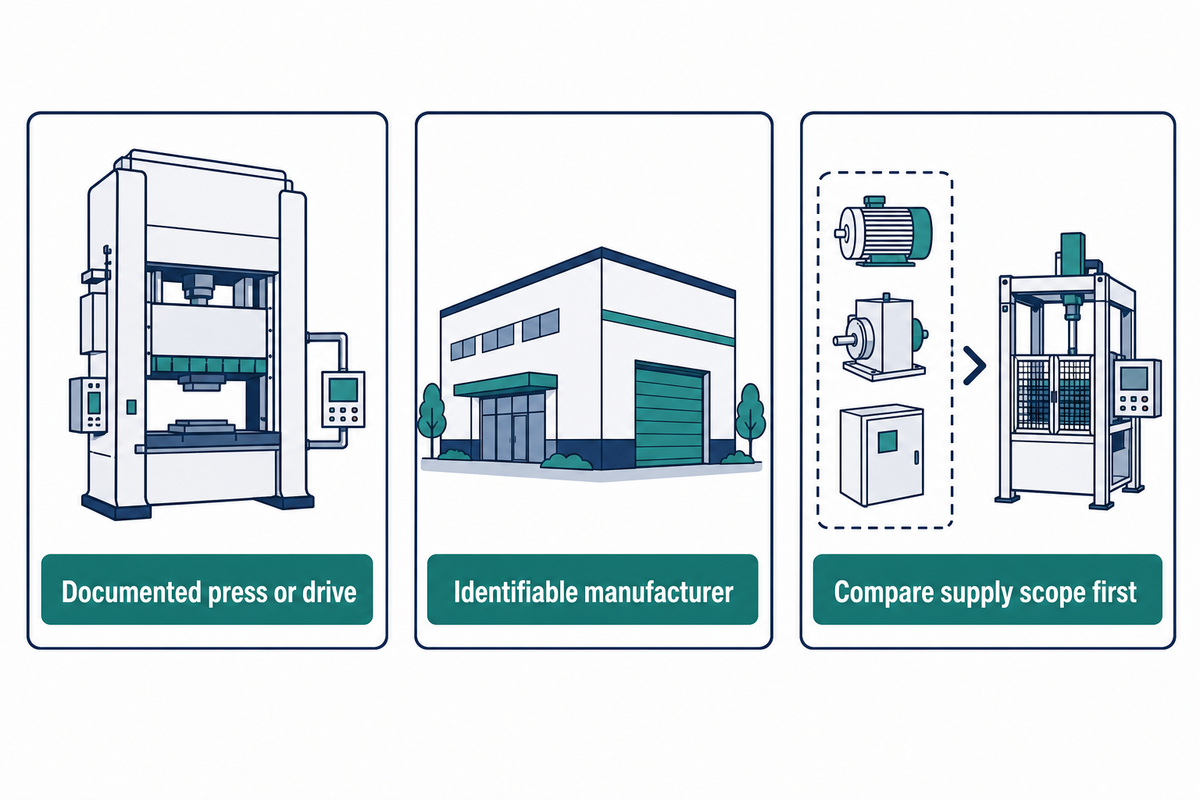
We reviewed official product specs and company histories and published quality info in Oct 2026. We reviewed each for a product with a documented hydropneumatic press or drive. An identifiable manufacturing business with a relevant product qualified for selection, which excluded directories, used-equipment dealers and duplicate distribution channels. Mixed-product businesses qualified only for their own documented equipment.
A wide variety of applications can appear in a press catalog; inclusion depends on a documented product, not a claim to serve diverse industries. The comparison is a purchasing shortlist, not a ranking of market share, or the result of tests on the machines themselves. The specifications of models given are published by the manufacturers. The best for labels are our interpretation of the products, and the absence of historical data doesn’t mean the firm doesn’t have manufacturing experience. Supply scope is the first comparison because a cylinder quotation and a guarded workstation quotation purchase different things.
Press-or-Drive Supplier Comparison
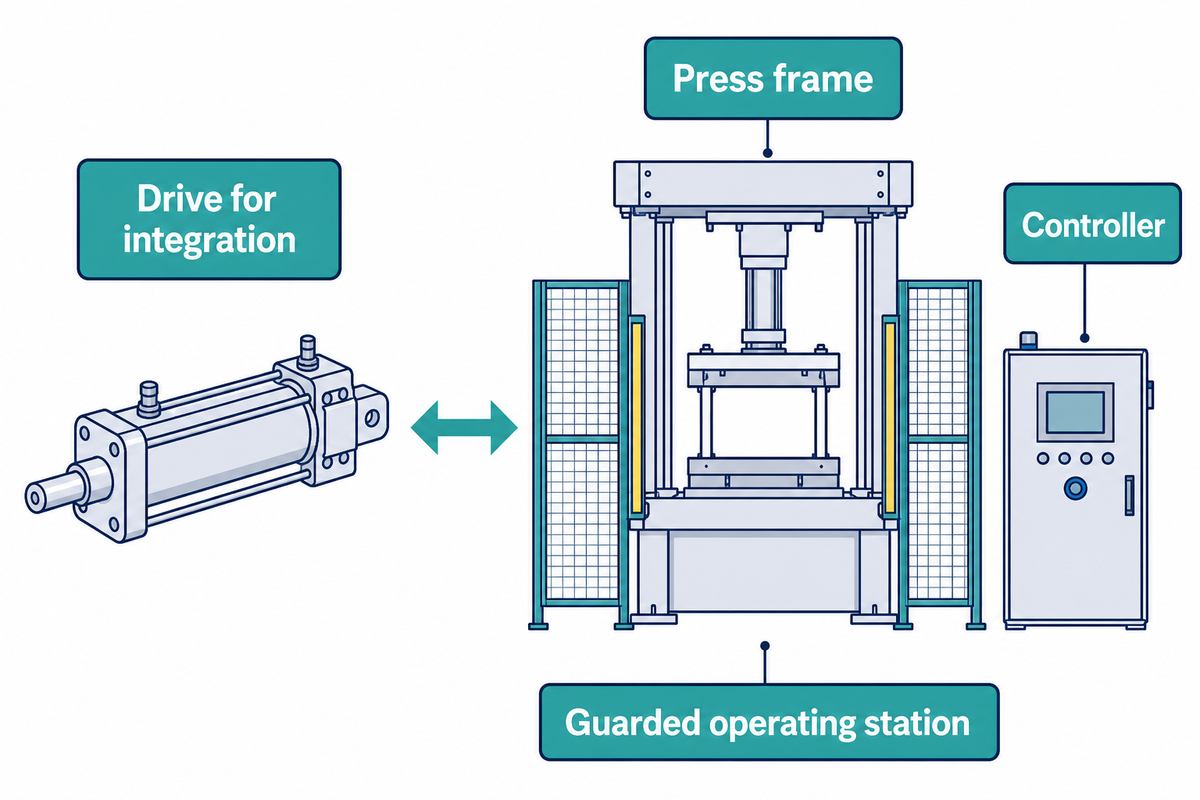
Use the table to separate supply you intend to buy before comparing maximum force. An existing machine builder and a drive manufacturer may be good partners. A complete press supplier may be better for a production team requiring a frame, a controller and a guarded operating station. Companies may have both (scopes of supply) with different limits.
| No. | Company Name | Headquarters | Founded Year | Best For | Brief Introduction | Supply Scope and Press Family | Key Advantages | Potential Disadvantages | Official Website |
|---|---|---|---|---|---|---|---|---|---|
| 1 | SIMITCH | Taicang, Suzhou, China | 2006 | Machine-builder drive | Drive-system supplier | BS/BT; AT/HZ | Two physical layouts | Frame and controls separate | https://simitch.com/ |
| 2 | Enerfluid | Ponte San Marco, Brescia, Italy | 1984 | Integrator drawing support | Drive-component manufacturer | Cylinders and boosters | Testing and CAD support | Station integration separate | https://www.enerfluidsnc.com/ |
| 3 | Suncenter | Dongguan, Guangdong, China (operating site) | — | Selectable cylinder travel | Drive-component manufacturer within Suncenter Group | SST cylinders | Separate stroke ranges | Cylinder rather than workstation | https://www.suncenterbooster.com/ |
| 4 | July Industrial | Changhua, Taiwan roots; Dongguan/Jiangxi production, China | 1996 (July Industrial history; Dongguan production from 2006) | Cylinder-layout selection | Manufacturing group with separate production and sales entities | JL cylinder families | Several arrangements | Complete machine design needed | https://julymachinery.com/ |
| 5 | TOX PRESSOTECHNIK | Weingarten, Germany | 1978 | Drive or station route | Press and drive-system manufacturer | Line-X; ecoLine | Component and system options | Ratings differ by product | https://tox.com/ |
| 6 | SCHMIDT Technology | St. Georgen, Germany | 1938 | Monitored assembly | Assembly press manufacturer | HydroPneumaticPress | PressControl choices | Monitoring range is narrower | https://www.schmidttechnology.de/ |
| 7 | Alfamatic | San Giorgio su Legnano, Italy | 1979 (company's stated operating history) | Frame and guard choice | Press and cylinder manufacturer | OP presses | Six frame arrangements | Standard power travel: 15 mm | https://www.alfamatic.com/ |
| 8 | EMG Presses | Marigny-Saint-Marcel, France | 1966 (manufacturer's stated foundation year) | Higher-force C-frame | Press manufacturer; EMG trademark of LONG | 7T–100T | Cylinder combinations | Short power stroke | https://www.emgpresses.com/ |
| 9 | mäder pressen | Neuhausen ob Eck, Germany | 1950s; focused on presses from 1968 | Deep-throat tooling access | Assembly press manufacturer | HP; XL-HP | 150/300 mm throats | Total travel: 50 mm | https://maederpressen.de/ |
| 10 | Gechter | Obermichelbach, Germany | — | H-frame pressing with a short power stroke | Press manufacturer | HPPV; HPPS | Separate force stages | Control and stroke options | https://www.gechter.de/ |
| 11 | Air-Hydraulics | Jackson, Michigan, USA | 1945 | US press customization | Press and intensifying-cylinder manufacturer | AH air-over-oil | Tooling and control options | Standard power travel: 0.500 in | https://www.airhydraulics.com/ |
| 12 | HyperCyl / Aries Engineering | Dundee, Michigan, USA | 1994 (Aries/AEC and HyperCyl history) | Sample-led selection | Hydra-pneumatic cylinder and press manufacturer | HyperPress; HPI | Application test lab | CGB limited to 30 tons | https://www.hypercyl.com/ |
| 13 | LDP Italia | Bariano, Bergamo, Italy | 1976 (company's stated design/manufacturing history) | Modular integration | Hydropneumatic press and thrust-unit manufacturer | DP; DPS; EPK | Frame-and-unit route | Integration scope varies | https://www.ldpitalia.com/ |
| 14 | G.P.A. Italiana | Lomazzo, Como, Italy (registered office) | 1962 | Defined supply levels | Automation unit, press and power-unit manufacturer | PCM; PPCM; CM | Three equipment levels | Basic supply lacks full controls | https://www.gpa-automation.com/ |
| 15 | Mercury Pneumatics | Mumbai, India | 1980 (pneumatic-product production began) | Indian frame selection | Press and cylinder manufacturer | Z systems; A/H/N | Multiple frame formats | System scope must match | https://www.mercuryindia.net/ |
| 16 | National Pneumatic Systems | Vasai, Maharashtra, India | 2006 | Custom cutting/crimping | Custom press and cylinder manufacturer | Pillar and C-frame | Several fixture arrangements | Final model values required | https://nationalpneumaticsystems.com/ |
| 17 | S S Air Hydro Power | Samaypur, Delhi, India | 2014 | Cable-crimping fixtures | Hydraulic, hydropneumatic and pneumatic equipment manufacturer | Cable and pillar presses | Named brake-cable model | 15 ton is model-specific | https://www.ssairhydro.com/ |
| 18 | Neumatica Technologies | Peenya, Bangalore, India | 1992 | Feeding plus assembly | Press and assembly-automation manufacturer | Press/automation range | Feeders and data options | Feeding and data functions need integration | https://www.neumaticaglobal.com/ |
| 19 | Synergetic Automation | Nashik, Maharashtra, India | — | Monitored custom station | Special-purpose machine and press manufacturer | Standard/custom presses | Force/stroke option | Monitoring must be selected | https://www.synergeticautomation.com/ |
| 20 | C MATIC CONTROL | Vikhroli, Mumbai, India | 2019 (LLP incorporation, Tracxn) | Mumbai C-frame projects | Press manufacturer and automation component distributor | C/H/column frames | Separate loaded-stroke data | C-frame maximum: 30 tonnes | https://www.cmaticcontrol.com/ |
Information on published founding dates details the history described in each company profile. For July, the group history and mainland production date differ; for C MATIC, the stated year is the LLP incorporation date. A dash means that no sufficiently clear date was established for this comparison. Disadvantages in the table represent specific purchase limits, not reliability ratings.
Publisher and Drive-System Specialists
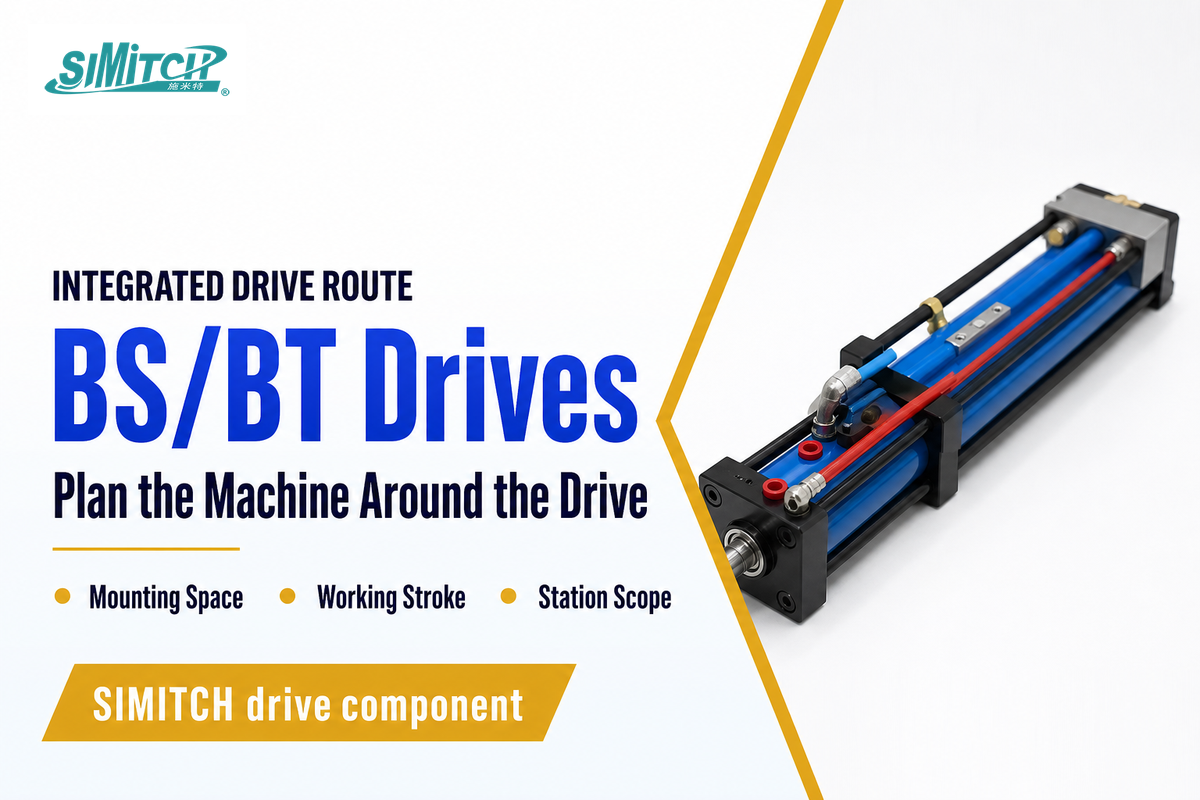
The four drive suppliers are considered when the project requires a hydropneumatic cylinder or drive package. Their published offerings assist the machine builder to evaluate an integrated or split arrangement, the force level and working stroke. A customer who wants to use a complete press should specify the frame, tooling, controls and guarding in the same project.
1. SIMITCH: Best for Integrated or split drives for a customer-built press
Headquarters: Taicang, Suzhou, China / 2006 / Drive-system supplier
Official website: https://simitch.com/
Main products: BS/BT integrated and AT/HZ split pneumohydraulic drives
Published capabilities: BS 11–970 kN at 6 bar air; AT 13–1030 kN at 400 bar oil; HZ 48–492 kN at 250 bar oil
Pressure basis: SIMITCH BS/BT integrated and AT/HZ split drive families: BS at 6 bar air pressure, AT at 400 bar oil pressure, HZ at 250 bar oil pressure.
Notable product detail: BS/BT and AT/HZ provide distinct integrated and split layouts.
SIMITCH’s BS/BT families combine the working cylinder and intensification functions in an integrated arrangement, while AT/HZ families separate them. A machine builder can choose the physical layout around the available mounting space, with the integrated and split drive product range providing the series specifications.
The BS force range is stated at 6 bar air pressure, whereas AT and HZ figures use 400 bar and 250 bar oil-pressure conditions, respectively. Comparing those values as identical air-supply tests would obscure the actual sizing question: which series supplies the required force over the loaded travel in the planned machine?
Limitation: The drive supply doesn’t by itself include the press frame, guarding, tooling or station integration.
2. Enerfluid: Best for Tested cylinders with drawing support for integrators
Headquarters: Ponte San Marco, Brescia, Italy / 1984 / Drive-component manufacturer
Official website: https://www.enerfluidsnc.com/
Main products: Pneumo-hydraulic cylinders, pressure boosters and hydraulic speed regulators
Published capabilities: Four testing stations for boosters, cylinders, locking cylinders and speed regulators
Quality information: ISO 9001:2015 quality-system claim, according to its website
Enerfluid operates four testing stations covering pressure boosters, pneumo-hydraulic cylinders, locking cylinders and hydraulic speed regulators. Its technical department supplies 2D drawings and 3D STEP models, giving integrators component geometry for machine layout and design.
The cylinder guide distinguishes pneumatic approach motion from hydraulic intensification during the loaded part of the stroke. Together, the drawings and operating information support cylinder selection for a separately engineered press.
Limitation: The documented offer is a drive component; the integrator supplies the complete press and controls.
3. Suncenter: Best for Air-driven cylinders with selectable total and power strokes
Headquarters: Dongguan, Guangdong, China (operating site) / Not established from reviewed sources / Drive-component manufacturer within Suncenter Group
Official website: https://www.suncenterbooster.com/
Main products: SST hydropneumatic cylinders and fluid-pressure equipment
Model example: SST-3T has a 20 mm piston rod in the published 6 bar nominal-pressure example.
Published capabilities: Listed cylinders 1–100 T; total stroke 50–300 mm; hydraulic stroke 5–25 mm; air supply 3–6 bar
Quality information: Website lists ISO/CE/SGS and claims CE and SGS certification; no specific ISO edition asserted
Suncenter’s SST catalogue lists 1–100 T cylinder ratings, 50–300 mm total strokes and 5–25 mm power strokes alongside a 3–6 bar air-pressure range. These family-level ranges help identify candidate sizes, but their separate maximum values don’t establish a single model combining the longest travel and highest force.
The product information distinguishes low-force contact movement from the intensified stage, which is useful when a fixture brings parts together before final pressing. For a custom assembly project, the selected cylinder’s drawing and pressure conditions provide the starting point for the machine builder’s structure and control design.
Limitation: The listed tonnage is for a cylinder, leaving the press structure and safeguarding to the system builder.
4. July Industrial: Best for Choosing among several hydropneumatic cylinder layouts
Headquarters: Changhua, Taiwan roots; Dongguan/Jiangxi production, China / 1996 (July Industrial history; Dongguan production from 2006) / Manufacturing group with separate production and sales entities
Official website: https://julymachinery.com/
Main products: JLDD, JLEA, JLTA, JLFA, JLCB and JLCA hydropneumatic cylinders
Published capabilities: JLEA/JLTA/JLFA category titles list 1–20 T; JLCB lists 25–100 T
Quality information: Historical ISO 9001:2008 and CE claims on company page, according to its website
July Industrial presents several cylinder layouts, including JLEA, JLTA and JLFA families labelled 1–20 T and JLCB models labelled 25–100 T. Those names and bands identify catalogue choices; selecting a component still requires the exact force, stroke and mounting arrangement for the tool.
July traces its roots to Changhua in 1996 and dates its Dongguan production operation to 2006. Its company history also lists ISO 9001:2008 and CE credentials.
Limitation: The public range is cylinders; component choice still requires a complete machine design.
Standard Hydropneumatic Press Builders
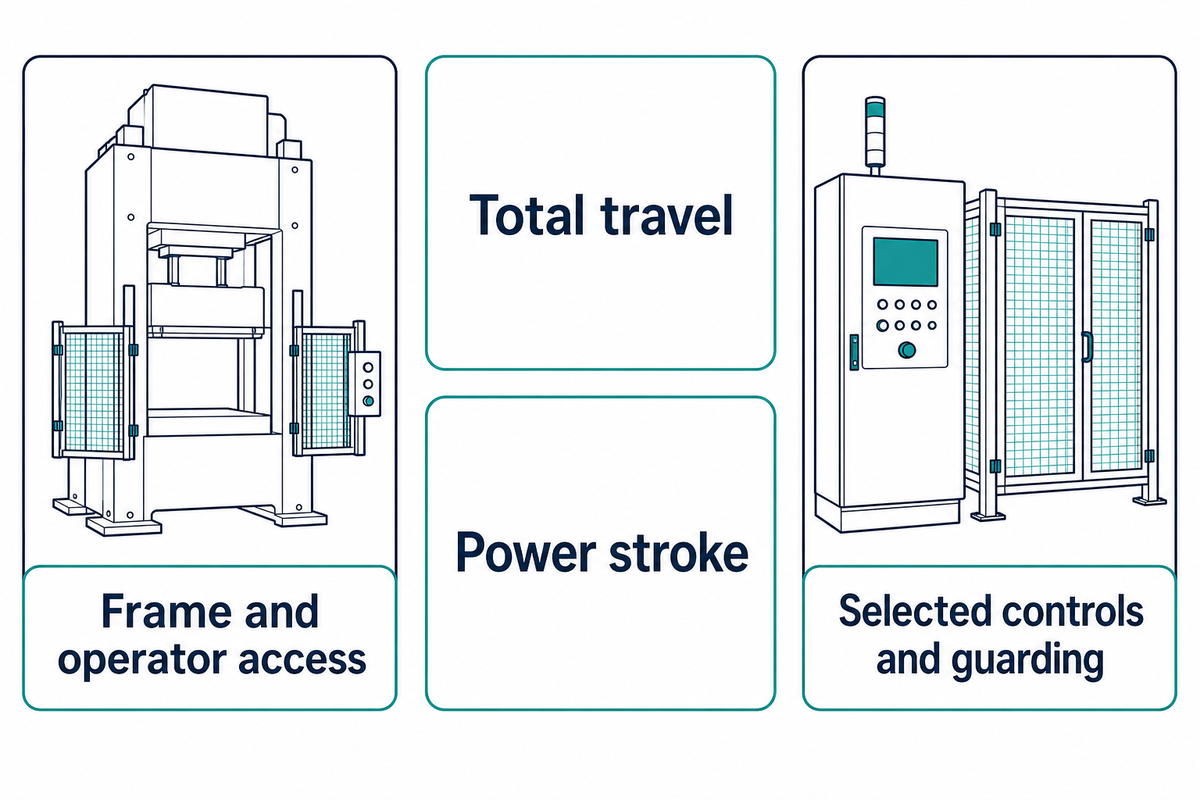
The ten press builders publish framed press equipment as well as, in several cases, separate drive components. Their catalogues make working stroke, frame format or supply level visible enough to begin a model comparison. Optional monitoring, guarding and controls still need to follow the selected configuration rather than the broadest claim across a product family.
5. TOX PRESSOTECHNIK: Best for A drive family with matching press-system options
Headquarters: Weingarten, Germany / 1978 / Press and drive-system manufacturer
Official website: https://tox.com/
Main products: TOX Powerpackage Line-X drives and ecoLine assembly stations
Published capabilities: Line-X drive family 11–1727 kN; XS power stroke 6–22 mm
Quality information: German headquarters lists ISO 9001:2015, ISO 14001:2015 and ISO 45001:2018
TOX’s component and press-system routes let a buyer investigate either a drive for integration or a supplied assembly station. The Powerpackage Line-X page’s 11–1727 kN range belongs to the drives, while ecoLine stations have their own force categories, strokes and equipment choices.
The XS specification identifies a 6–22 mm power-stroke range, a useful screening detail when checking the loaded movement. For a team deciding between a retrofit and a new station, keeping those model boundaries intact is more informative than assigning the largest catalogue force to every TOX system.
Limitation: The Line-X force range is a drive specification and isn’t the rating of every ecoLine press.
6. SCHMIDT Technology: Best for Monitored assembly with a modular press/controller range
Headquarters: St. Georgen, Germany / 1938 / Assembly press manufacturer
Official website: https://www.schmidttechnology.de/
Main products: HydroPneumaticPress systems and PressControl controllers
Published capabilities: HydroPneumaticPress 15–220 kN; C-frame and monitored variants to 100 kN
Quality information: DIN EN ISO 9001 quality certification is stated on its corporate portrait
SCHMIDT presents HydroPneumaticPress mechanics alongside PressControl options, giving monitored assembly buyers a defined press-and-controller route. Force and position information can support a specified inspection strategy when completion of the downward ram movement alone doesn’t establish correct assembly.
The published C-frame and monitored arrangements have limits narrower than the overall 220 kN maximum, including versions up to 100 kN. Compare the press model and PressControl 75 or 700 configuration together, with acceptance windows based on the part and process rather than the broadest features from separate catalogue entries.
Limitation: The 220 kN family maximum doesn’t apply to all C-frame or monitored arrangements.
7. Alfamatic: Best for Comparing several frame and guarding arrangements
Headquarters: San Giorgio su Legnano, Italy / 1979 (company's stated operating history) / Press and cylinder manufacturer
Official website: https://www.alfamatic.com/
Main products: OP hydropneumatic presses and APAX cylinders
Published capabilities: Seven OP models; table 14.5–420 kN, 115 mm total/15 mm power stroke, maximum 6 bar
Notable product detail: Six structure arrangements and three guarding arrangements; force/position monitoring is optional.
Alfamatic’s OP range is useful when frame layout and operator access are central purchasing decisions. The hydro-pneumatic press model table lists seven sizes from 14.5 to 420 kN, while the available frame and guarding arrangements provide several ways to arrange the workstation around the part.
The standard 115 mm total stroke and 15 mm power stroke distinguish loading clearance from the actual force-producing movement. Optional force and displacement monitoring can be included in the comparison, with the benefit coming from a documented combination of structure and controls rather than a claim that every OP machine fits any assembly.
Limitation: The standard 15 mm power stroke must cover the loaded portion of the operation.
8. EMG Presses: Best for Higher-force C-frame pressing with model-specific stroke options
Headquarters: Marigny-Saint-Marcel, France / 1966 (manufacturer's stated foundation year) / Press manufacturer; EMG trademark of LONG
Official website: https://www.emgpresses.com/
Main products: 7T, 13T, 30T, 50T, 75T and 100T hydropneumatic presses
Published capabilities: Metric page gives 7–100 tonne class; 100T table 100–300 mm total/8–12 mm power stroke
Quality information: Corporate page states ISO 9001 certification dating to 2000
EMG organizes its metric range as 7T, 13T, 30T, 50T, 75T and 100T models with several cylinder combinations. The 100T entry’s 100–300 mm total travel and 8–12 mm power stroke suit comparison of operations needing substantial loading clearance but a short final pressing action.
EMG describes assembly and testing at Marigny-Saint-Marcel. Its metric catalogue offers six standard C-frames and 60 cylinders, providing several model-and-stroke combinations.
Limitation: The 100T model's 8–12 mm power stroke is much shorter than its total travel.
9. mäder pressen: Best for Deep-throat access within a compact bench-press range
Headquarters: Neuhausen ob Eck, Germany / 1950s; focused on presses from 1968 / Assembly press manufacturer
Official website: https://maederpressen.de/
Main products: HP and XL-HP hydropneumatic presses
Published capabilities: 42/100 kN; 50 mm total stroke; HP throat 150 mm and XL-HP throat 300 mm
Quality information: ISO 9001:2015 quality management, according to its website
Mäder’s HP and XL-HP families are relevant where the tool needs to reach farther into a part. The reviewed selection pairs 42 kN and 100 kN classes with 150 mm or 300 mm throat dimensions, giving buyers a defined access comparison.
A deeper throat can bring a feature farther from the part’s edge under the tool, but doesn’t increase available travel or establish the force required by the operation. Compare force class, throat and tool position together; the XL designation alone doesn’t establish an unrestricted heavy-duty machine.
Limitation: The published HP/XL-HP selection has a 50 mm total stroke.
10. Gechter: Best for H-frame assembly with separate approach and power-force specifications
Headquarters: Obermichelbach, Germany / Not established from reviewed sources / Press manufacturer
Official website: https://www.gechter.de/
Main products: HPPV and HPPS H-frame hydropneumatic presses
Published capabilities: 500 kN HPPV: 500 kN power force at 6 bar, 50 mm total / 6 mm power stroke, 14 kN approach force
Quality information: Official certificates page lists ISO 9001:2015 with a 2026–2029 certificate link
Gechter’s 500 kN HPPV makes the pressing stages explicit: 14 kN approach force, 500 kN power force and 13 kN return force at the published conditions. That distinction is useful for an H-frame operation requiring a short, high-force action after the tool approaches the component.
The same model lists a 360 mm installation height, 450 mm installation width and pillar guidance. For tooling intended to bend or insert parts, those dimensions provide a starting point for fitting the workpiece, while the separate stroke and control options define which complete arrangement belongs in the final proposal.
Limitation: The 500 kN HPPV standard lists 6 mm power stroke; longer-stroke options and optional controls must be specified separately.
11. Air-Hydraulics: Best for US-built air-over-oil presses with custom tooling and controls
Headquarters: Jackson, Michigan, USA / 1945 / Press and intensifying-cylinder manufacturer
Official website: https://www.airhydraulics.com/
Main products: AH air-over-oil C-frame presses and separately supplied cylinders
Published capabilities: AH 4–50 ton nominal family; standard 0.500 in power stroke; force table at 100 psi
Quality information: ISO 9001:2015 Quality System Registration, according to its website
Air-Hydraulics describes AH equipment as air-over-oil presses, a category of air presses, connecting the family with the hydropneumatic category. Its 4–50 ton nominal models use a force table based on 100 psi air, with a standard 0.500 in power stroke inside a longer 6 in or 8 in total stroke.
Custom tooling, control and monitoring provisions include load-cell and distance-related options for projects requiring more than the base press structure. For a US equipment enquiry, the AH table supplies the model starting point, with the chosen tooling and controls defined around the loaded portion of the movement.
Limitation: The standard half-inch power stroke is the loaded travel, not the whole ram stroke.
12. HyperCyl / Aries Engineering: Best for Selecting a cylinder and press around sample-part tests
Headquarters: Dundee, Michigan, USA / 1994 (Aries/AEC and HyperCyl history) / Hydra-pneumatic cylinder and press manufacturer
Official website: https://www.hypercyl.com/
Main products: HPI/HPS/HPX cylinders; HyperPress C/H-frame and CGB presses
Published capabilities: CGB low-profile presses 2–30 ton; HPI cylinders 1–200 ton, application-dependent stroke
Notable product detail: Application Test Lab evaluates force/distance, time and finished-part requirements.
HyperCyl’s HPI cylinders and complete HyperPress machines are different product selections, so the 1–200 ton cylinder range can’t be assigned to the 2–30 ton CGB presses. The HPI limits of up to 16 in total travel and 2 in power stroke also remain dependent on force and application.
Aries Engineering’s application test lab evaluates sample parts against force, distance, time and finished-part requirements before final machine selection.
Limitation: The low-profile CGB press range stops at 30 tons; higher-force projects require a different press arrangement.
13. LDP Italia: Best for A modular press or frame-and-unit assembly for an integration project
Headquarters: Bariano, Bergamo, Italy / 1976 (company's stated design/manufacturing history) / Hydropneumatic press and thrust-unit manufacturer
Official website: https://www.ldpitalia.com/
Main products: DP-Type presses, DPS-Type frame/unit assemblies and E-Type EPK heads
Published capabilities: DP-Type uses E-Type EPK head; DPS supplied as frame plus unit for integration
Quality information: DP product page declares conformity to Machinery Directive 2006/42/EC; not a management-system certificate
LDP’s DP-Type press and DPS-Type frame-and-unit assembly serve different integration requirements. The DP uses an E-Type EPK pressing head, while the DPS gives a machine builder an assembly to incorporate into a larger system.
A moving-platen option provides an additional way to arrange tooling and part access. Magnetic sensors can be fitted directly to the E-Type unit to provide signals for integration into a production line.
Limitation: A DPS frame-plus-unit assembly leaves more integration work than a finished controlled station.
14. G.P.A. Italiana: Best for Choosing clearly defined supply levels for machine integration
Headquarters: Lomazzo, Como, Italy (registered office) / 1962 / Automation unit, press and power-unit manufacturer
Official website: https://www.gpa-automation.com/
Main products: PCM/PPCM presses and CM hydropneumatic power units
Published capabilities: 20–320 kN family; frame/unit, controlled integration unit or standalone control options
Quality information: ISO 9001 quality system qualified by TÜV since 1994, according to its website
G.P.A. makes supply scope visible through a frame and power unit, a controlled unit for integration, and a standalone arrangement. Its 20–320 kN PCM/PPCM family can therefore enter an enquiry at the equipment level appropriate to the buyer’s remaining engineering work.
The company also presents CM power units and optional quality-monitoring and Ethernet integration features. Keeping those options attached to the selected configuration helps define responsibilities when a press becomes one station in an automated process, instead of assuming that every basic assembly includes the full control package.
Limitation: The basic frame/cylinder supply doesn’t include the controls of a standalone workstation.
Application-Focused Press Manufacturers
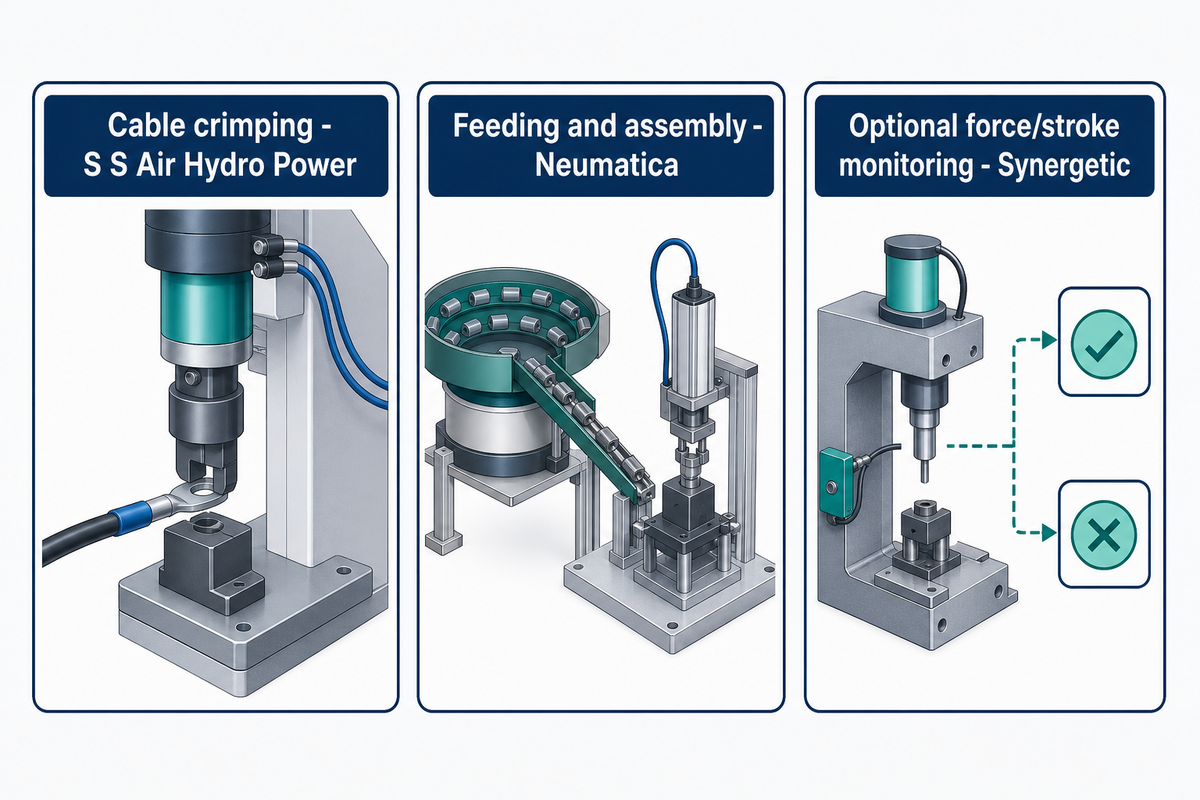
The following six companies are useful starting points for projects involving fixtures, frame choices or surrounding assembly functions. Published examples range from a named brake-cable crimping machine to feeding and process-data options. Those examples establish a relevant offering; they don’t prove that a new part or material has already been qualified on the equipment.
15. Mercury Pneumatics: Best for Indian press or cylinder projects with several frame choices
Headquarters: Mumbai, India / 1980 (pneumatic-product production began) / Press and cylinder manufacturer
Official website: https://www.mercuryindia.net/
Main products: A/H/N cylinders; Z systems; two/four-column and compact C-frame presses
Published capabilities: Published complete-system and cylinder range 1–45 tonnes; customized strokes up to 150 mm
Notable product detail: S series addresses shaft straightening rather than a generic assembly task.
Mercury’s 1–45 tonne offering includes systems and cylinders, with two-column, four-column and compact C-frame arrangements. A, H, N and Z family distinctions and customized strokes up to 150 mm give an engineer several starting points for choosing the actual mechanical layout.
Published shaft-straightening equipment provides a more specific application reference than a general industry list. Mercury is relevant when an Indian project needs to compare frame formats while retaining the possibility of purchasing only a cylinder; neither route should inherit the controls or access dimensions of another family by assumption.
Limitation: The system and cylinder options require separate frame, control and tooling specifications.
16. National Pneumatic Systems: Best for Custom presses for cutting, crimping and assembly in India
Headquarters: Vasai, Maharashtra, India / 2006 / Custom press and cylinder manufacturer
Official website: https://nationalpneumaticsystems.com/
Main products: Two/four-pillar, C-frame and compact C-frame presses; standard/split cylinders
Published capabilities: Product page specifies 6 bar air supply and configurable frame formats
Notable product detail: Published machines include anti-rotation C-frame and blister-cutting arrangements.
National offers pillar, C-frame and compact C-frame equipment alongside standard and split cylinders, with its product page specifying a 6 bar air supply. That variety helps a project that must punch or crimp parts, or assemble components address part loading and tool access alongside the force requirement.
Published examples include anti-rotation C-frame presses and blister-cutting equipment. These give buyers concrete starting points for projects involving tool orientation or packaging operations.
Limitation: The frame family is configurable; model force and loaded travel are quotation-specific.
17. S S Air Hydro Power: Best for Cable crimping and application-specific fixtures
Headquarters: Samaypur, Delhi, India / 2014 / Hydraulic, hydropneumatic and pneumatic equipment manufacturer
Official website: https://www.ssairhydro.com/
Main products: Two/four-pillar, C-frame, cable-crimping presses and cylinders
Published capabilities: A named brake-cable crimping press is rated 15 ton; PLC/HMI and load-cell versions shown
Notable product detail: C-frame variants show PLC/HMI, light curtain and load-cell arrangements.
S S Air Hydro Power’s named 15 ton brake-cable crimping press provides a specific application reference for cable assembly. Other versions show PLC/HMI, light-curtain or load-cell provisions, which belong to the arrangements in which they’re offered.
The catalogue also includes pillar and C-frame arrangements for projects needing different fixtures. For an automotive buyer, the brake-cable example establishes product relevance, while qualification of a new cable end, material or crimp geometry still requires the buyer’s actual process and strength requirements.
Limitation: The 15 ton rating belongs to the brake-cable machine, not every pictured press.
18. Neumatica Technologies: Best for Press stations combined with feeding and assembly automation
Headquarters: Peenya, Bangalore, India / 1992 / Press and assembly-automation manufacturer
Official website: https://www.neumaticaglobal.com/
Main products: Hydropneumatic, hydraulic and servo presses; general/special-purpose assembly machines
Published capabilities: Published basic-press options include PLCs, vibrating feeders, multi-tool stations and operation-data storage
Notable product detail: Cable-crimping, trimming and other basic machines are supported by automation options.
Neumatica combines press equipment with surrounding assembly functions, including published options for vibrating feeders, multi-tool stations and operation-data storage. That makes it relevant when purchasing extends beyond a ram and fixture to repetitive operations, part handling and line interfaces.
Its broader range includes hydropneumatic, hydraulic and servo technologies, without establishing one as universally optimal for automation. For an electronics assembly enquiry using hydropneumatic equipment, the selected model’s force, working stroke and control specification must accompany the proposed feeding arrangement; general-purpose features don’t define those model values.
Limitation: Feeding, multi-tool operation and production-data capture need to be specified with the press as an integrated station.
19. Synergetic Automation: Best for Custom assembly stations with force-versus-stroke feedback
Headquarters: Nashik, Maharashtra, India / Not established from reviewed sources / Special-purpose machine and press manufacturer
Official website: https://www.synergeticautomation.com/
Main products: Standard/custom hydropneumatic presses and assembly automation
Published capabilities: Optional force-versus-stroke monitoring on hydropneumatic presses
Notable product detail: The machine offer spans riveting, pressing and assembly-line integration.
Synergetic presents standard and custom hydropneumatic presses with optional force-versus-stroke monitoring. The option is relevant to assembly work where the pressing signature matters alongside confirmation that the ram reached its end position.
Sensors, evaluation criteria and the response to a rejected cycle need to be included in the proposed station. The company’s assembly-automation offering provides a route for that discussion, with standard and custom builds compared on the same defined scope rather than an unspecified promise of automation readiness.
Limitation: Force/stroke monitoring is an option that must be included in the station specification.
20. C MATIC CONTROL: Best for Mumbai-built C-frame equipment alongside component integration
Headquarters: Vikhroli, Mumbai, India / 2019 (LLP incorporation, Tracxn) / Press manufacturer and automation component distributor
Official website: https://www.cmaticcontrol.com/
Main products: Own-built C-frame, H-frame, four-column and tabletop hydropneumatic presses
Published capabilities: C-frame 0.4–30 tonnes, 5–7 bar, 50–200 mm total and 5–30 mm working stroke
Notable product detail: Product page states pressure-leak testing and material test certificates.
C MATIC’s own press page distinguishes manufactured equipment from the industrial components it also supplies. Its C-frame specification provides 0.4–30 tonnes, 5–7 bar air, 50–200 mm total stroke and 5–30 mm working stroke as a concrete starting point.
H-frame, four-column and tabletop equipment give the buyer other part-loading arrangements to consider. Keep the chosen frame, total travel and loaded stroke together: the wider advertised 100-ton range includes other arrangements and doesn’t extend every C-frame model to that force.
Limitation: The C-frame limit is 30 tonnes; the advertised 100-ton total range covers other arrangements.
How to Choose a Hydropneumatic Press Manufacturer
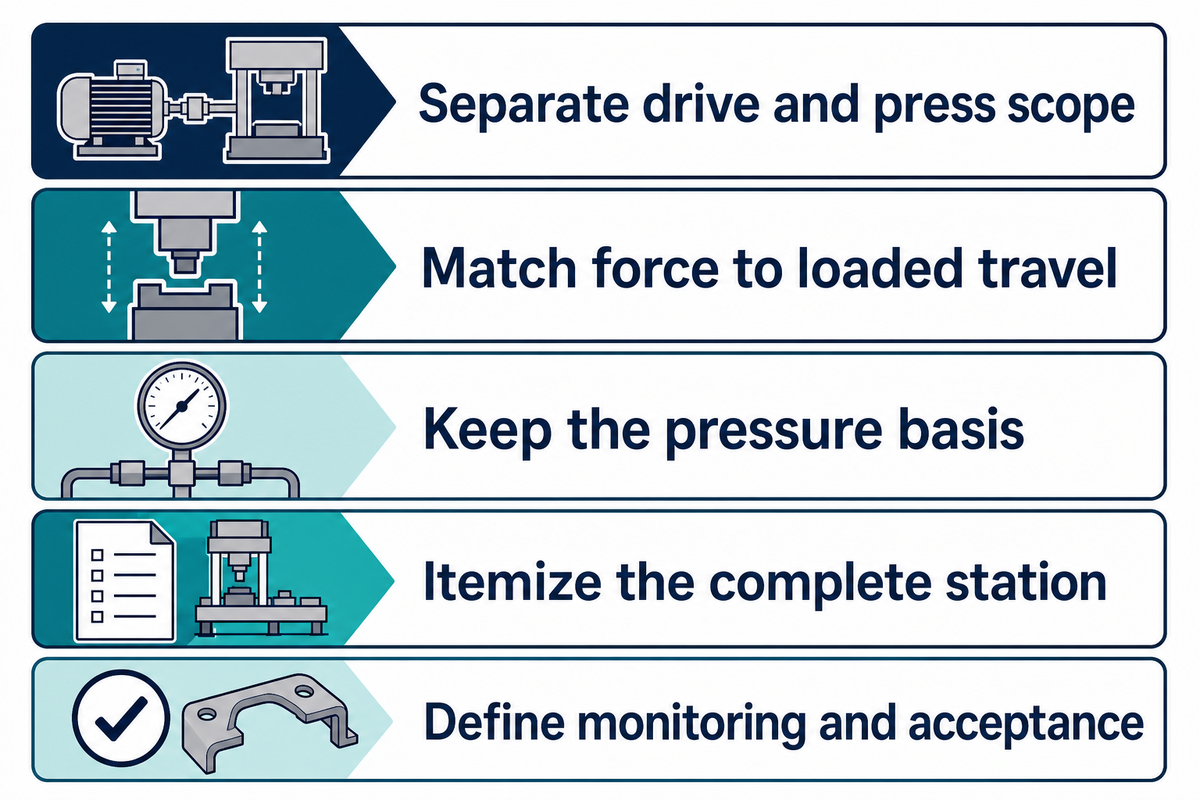
Choose a supplier based on the equipment offered that best meets the requirements of the operation, and then assess loaded travel, available air pressure and control requirements. The best shortlist for various industrial tasks may contain suppliers with different catalog maxima since the relevant comparison is the equipment proposed. A press that reaches the required force only over a short power stroke may be appropriate for one assembly and not for the other. Balancing speed and power begins with that particular movement, even on a small-scale production station.
What Belongs to the Drive and What Belongs to the Press?
A hydropneumatic drive produces motion and intensified pressing force; a complete press also needs a structure, tool mounting, controls and an appropriate safeguarding arrangement. The drive’s force rating doesn’t establish the frame’s load capacity, the assembled machine’s precision or its operating safety. SIMITCH’s drive families and G.P.A.’s different supply levels make that purchasing distinction visible.
For an existing machine builder, a cylinder can be the intended purchase. The builder may already own the frame design, choose control valves and define how the piston and rod connect to the tool. A production department buying its first station usually needs a wider supply scope. Neither approach is inherently better. The quotation needs to allocate the actual work, including installation and the final machine assessment.
Match Force to the Loaded Travel
Start with how far the tool must move while doing work. Gechter’s standard 500 kN HPPV lists 50 mm total stroke but 6 mm power stroke; Alfamatic’s OP specification lists 115 mm and 15 mm, respectively. These are different motion envelopes, not an overall ranking of machine quality. Clearance for inserting the workpiece belongs to total travel, while the loaded movement must fit the applicable force-producing stroke.
A nominally high-force machine isn’t automatically suitable for a long forming movement. Conversely, a short pressing action doesn’t justify an oversized drive without checking the tooling and frame. Obtain the model’s force-versus-travel information at the pressure available to the machine, and keep return force separate when the tool must pull away from a tight-fitting component. Gechter’s separate approach, power and return ratings illustrate why one headline number is incomplete.
Keep the Published Pressure Basis with the Force
Compressed air drives the pneumatic stage, while the intensified hydraulic chamber produces the working force. Air pressure and oil pressure are therefore different quantities within the system. SIMITCH lists some series at 6 bar air and others at specified oil pressures; Air-Hydraulics publishes AH force values at 100 psi air. Copying the force without its pressure basis removes information needed to size the machine.
The same is true of units. Preserve kN, tonnes or the supplier’s stated ton convention until the basis is clear. Don’t assume a capacity increase with an unexplained change of regional catalog descriptions. Estimates of air consumption and cycle times require a named model and operating cycle; the presence of a self-contained hydraulic stage alone doesn’t determine a measured efficiency advantage or a sustainability result.
What Should a Complete-Station Quotation Include?
A complete-station quotation should include the drive, frame, tools, controls, process monitoring, guarding and the work to install and qualify the equipment. Each of these affects the buyer’s operational scope at the time of delivery. A quotation for a bare cylinder, or a frame-and-unit assembly, can’t define the cost of a production-ready workstation, even when its advertised pressing force matches.
G.P.A. draws a distinction between base and controlled supply levels in the same way that LDP distinguishes an integration assembly from its press offering. Use these distinctions to evaluate proposals. For manual loading, tool access and protective arrangements should be defined in the machine description; if feeding is automated, the interface and cycle sequence should be described there as well. An optional light curtain, two-hand control, or force monitor should appear as a selected configuration, not based on a catalog photo.
Set the Process-Monitoring and Acceptance Requirements
For pressing solutions that assemble interference-fit parts, force and displacement monitoring can be used to distinguish an expected operation from a different force signature. Force control and process monitoring serve different functions. Observing a pressing signature doesn’t in and of itself determine what constitutes a “good” part. The acceptance criteria must connect the signal to the component, tooling, and the desired outcome; therefore, the sample-part test capability of HyperCyl and SCHMIDT’s controller choices are worth considering.
Ask for a demonstration of the proposed model and configuration on the relevant operation where feasible. A repeatable cycle on unrelated parts doesn’t establish the required tolerance or joint strength. Compare maintenance access, replacement seals, local service and technical documents to assess a claim of low maintenance for the machine in question. Evaluating cost-effectiveness requires the support scope and functions your process will use; a versatile catalogue alone doesn’t demonstrate lower ownership cost.
For safety requirements, ISO 16092-4:2019 covers pneumatic-press safety. The assessment of the relevant machine and applicable requirements must follow the actual equipment and use; citing the standard doesn’t certify any manufacturer in this list. The company’s quality-system credentials, product conformity statements and acceptance of the finished station are separate questions. Verify the latest technical documents and exactly what is ordered and who is responsible before placing the order.
If the operation is specifically a clinching assembly, SIMITCH’s press equipment for pneumatic and servo clinching and guide to choosing a clinching press configuration provide related application context. The comparison of sheet-metal joining methods addresses the prior question of which joining process fits the assembly.
Frequently Asked Questions
Which Is the Best Hydropneumatic Press Manufacturer for Monitored Assembly?
SCHMIDT and Alfamatic are relevant starting points for a framed press with monitoring options.
SCHMIDT connects its HydroPneumaticPress family to PressControl choices, while Alfamatic offers monitoring within its OP press arrangements. Compare the actual press, sensors and controller included in each proposal. A machine builder who already owns the frame may instead buy a cylinder and specify monitoring separately. The right supplier depends on that supply boundary and the part’s acceptance requirements, not a universal brand ranking.
Who Is the Largest Hydropneumatic Press Manufacturer in the World?
The reviewed sources do not establish a comparable global market-share leader for this category.
Company size, the number of offices and maximum catalogue force measure different things. A large hydraulic equipment business isn’t automatically the largest manufacturer of hydropneumatic assembly presses. This guide groups companies by documented product scope and application fit, without assigning market shares. A claim of global leadership in this sector would require a defined market, reporting period and comparable sales or shipment evidence that wasn’t available here.
What Is the Difference Between a Hydraulic Press and a Pneumatic Press?
A hydraulic press transmits force through liquid; a pneumatic press uses compressed air.
Hydropneumatic equipment combines air-driven motion with hydraulic intensification for the power stroke. In many designs, that high-force movement is shorter than the total travel. Choosing between pneumatic and hydraulic technologies requires the actual force, loaded movement and control needs. Manual presses belong in a different comparison when the task is operated entirely by hand. Neither label alone proves better precision, speed or reliability; those results depend on the machine, tooling and process as a complete system.
Is an Integrated or Split Hydropneumatic Drive Better for a Crowded Machine Frame?
A split drive allows the intensifier to be placed away from the working cylinder.
An integrated drive keeps those functions in one assembly, which can simplify the physical arrangement where sufficient space is available. A split layout gives the builder another placement option, with hydraulic connections and mounting access included in the design. SIMITCH identifies BS/BT as integrated families and AT/HZ as split families. Their force, pressure and stroke specifications remain series-specific; layout alone doesn’t establish the correct model.
How Much Does a Complete Hydropneumatic Press Cost?
Complete-station pricing depends on the drive, frame, tooling, controls and integration work included.
The reviewed public sources don’t provide consistent prices for equivalent complete stations. Compare quotations that identify the drive, frame, tooling, controls, monitoring, installation and service responsibilities. A bare-cylinder offer can’t establish the cost of a production-ready workstation. The engineering work needed to customize fixtures or automate part handling also belongs in the comparison, rather than being hidden behind an advertised starting price.
Can a Hydropneumatic Press Deliver Full Force Throughout Its Entire Stroke?
Many intensified designs separate a rapid approach from a shorter high-force power stroke.
Total travel therefore doesn’t establish the distance available at maximum pressing force. A long loaded movement needs a suitable drive and its matching force-versus-travel specification. EMG’s 100T model, for example, lists 100–300 mm total travel but only 8–12 mm power stroke. Begin with the required working stroke, then compare force and available pressure for the exact machine.
Define the Drive Scope Before Requesting a Quote
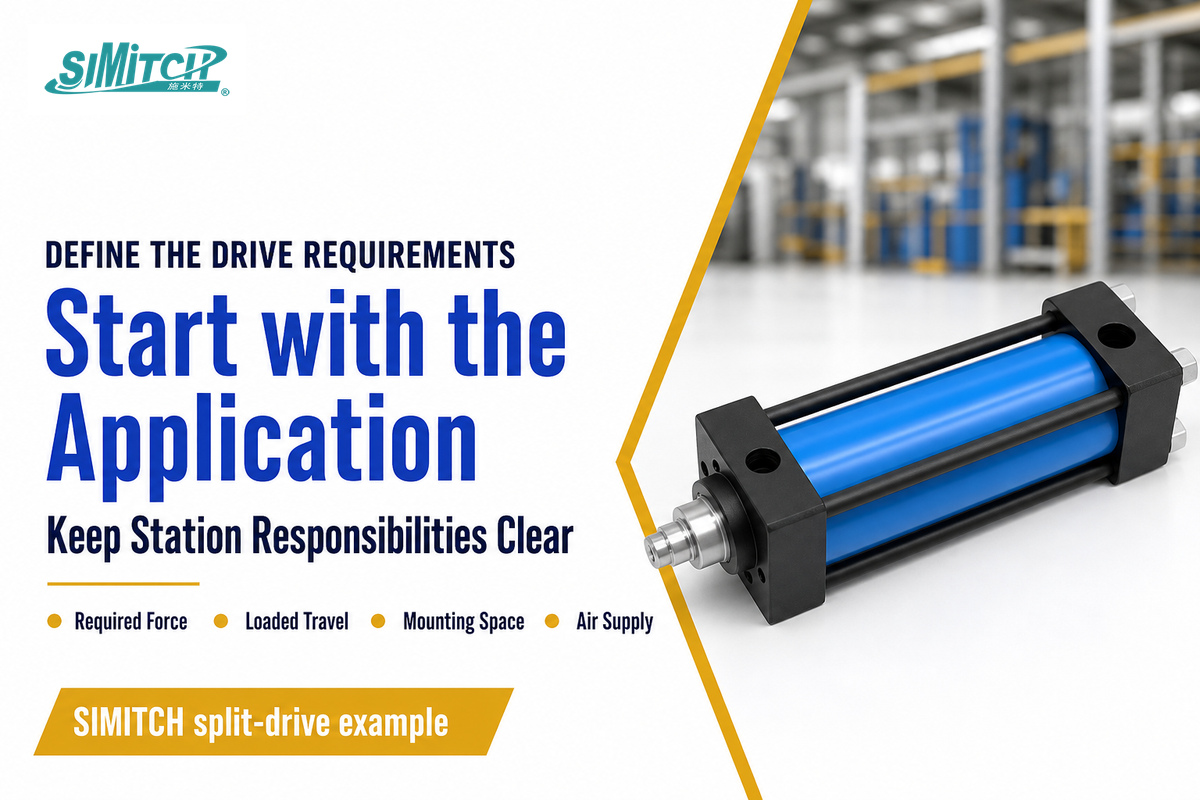
If your project needs a pneumohydraulic drive, share the required force, loaded travel, mounting space and available air supply with SIMITCH. The team can discuss the documented BS/BT and AT/HZ product routes against that scope. Read SIMITCH’s manufacturing background or send the drive requirements for a quotation, with the frame and station responsibilities identified.
References & Sources
- ISO 16092-4:2019, Machine tools safety, presses, safety requirements for pneumatic presses. Standards-scope reference; not a certificate for the companies compared.
The company profiles are based on manufacturers’ published product and corporate materials reviewed in October 2026. Website addresses are shown as plain text in the profiles. Specs and optional equipment remain tied to the stated model or family; the guide doesn’t claim independent performance testing.