Get in touch with Suzhou Simitch Machinery Co., Ltd Company

Last updated: October 2026
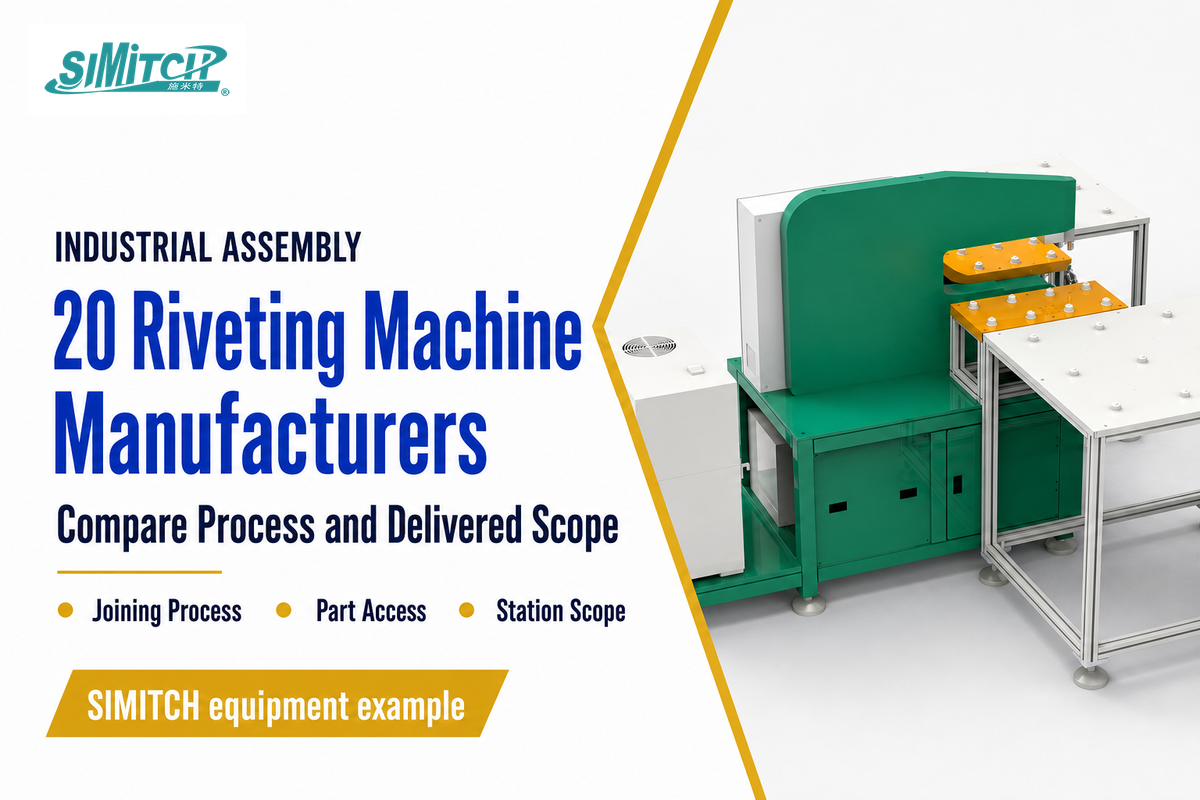
The best riveting machine manufacturer for your project depends on the joining process and delivered scope. BalTec offers radial forming workstations, National Rivet builds small-rivet setting systems, and GESIPA provides automated blind riveting. Compare the complete assembly task: a forming head, a feeding system and a finished production station are different purchases.
Quick Picks
- Best for application-engineered self-piercing riveting stations: SIMITCH.
- Best for radial riveting workstations with rotary indexing and process control: BalTec.
- Best for robotic riveting cells with part handling and vision confirmation: Stryver.
- Best for small-rivet setting with automatic part and fastener feeding: National Rivet.
- Best for automated blind riveting with WinTech setting-process monitoring: GESIPA.
- Best for SAN2 blind-rivet automation with modular feeding and charging: Titgemeyer.
Disclosure: This guide is published by SIMITCH. We list ourselves first because this is our website, not because we claim to be the market leader. The other 19 manufacturers are grouped by what they’re best for, in no particular order within each group.
How We Selected These Riveting Machine Manufacturers
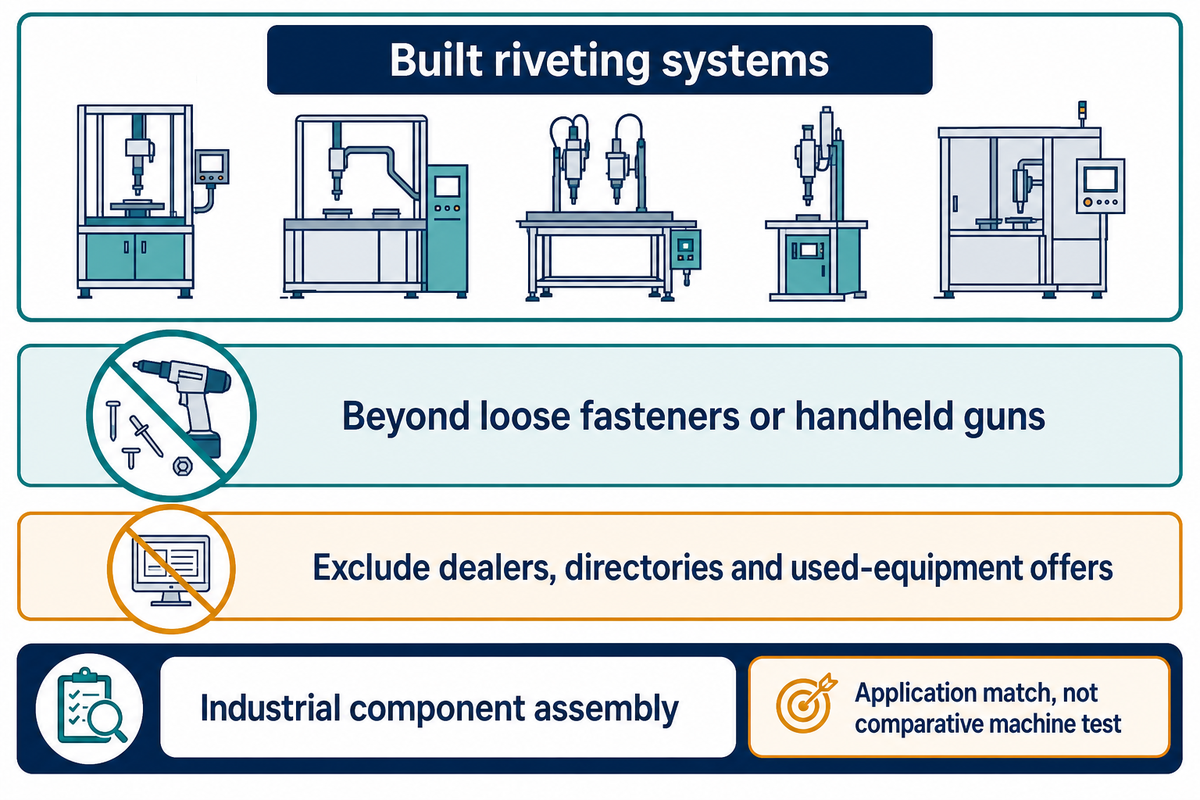
We focused on companies that design and build riveting systems or supply complete riveting systems. Included were companies that published pictures or descriptions of built riveting systems or supplied equipment beyond just a loose fastener or a handheld rivet gun. Companies that traded, distributed, sourced, listed, or mediated equipment deals, directories, media websites, websites that offered used equipment, and dealers, weren’t included. Information was verified by cross checking with publicly available resources and company websites in October 2026.
This shortlist covers activities described as industrial component assembly; dedicated airframe drilling-and-riveting cells are outside the scope of the shortlist. Best for labels are editorial application matches based on published equipment, and aren’t the results of comparative machine tests. Potential Disadvantages describes limitations of the project fit/configuration, not defects. A manufacturer of riveting heads and a custom station builder can both qualify, with different responsibilities identified below.
20 Riveting Machine Manufacturers Compared by Process and Scope
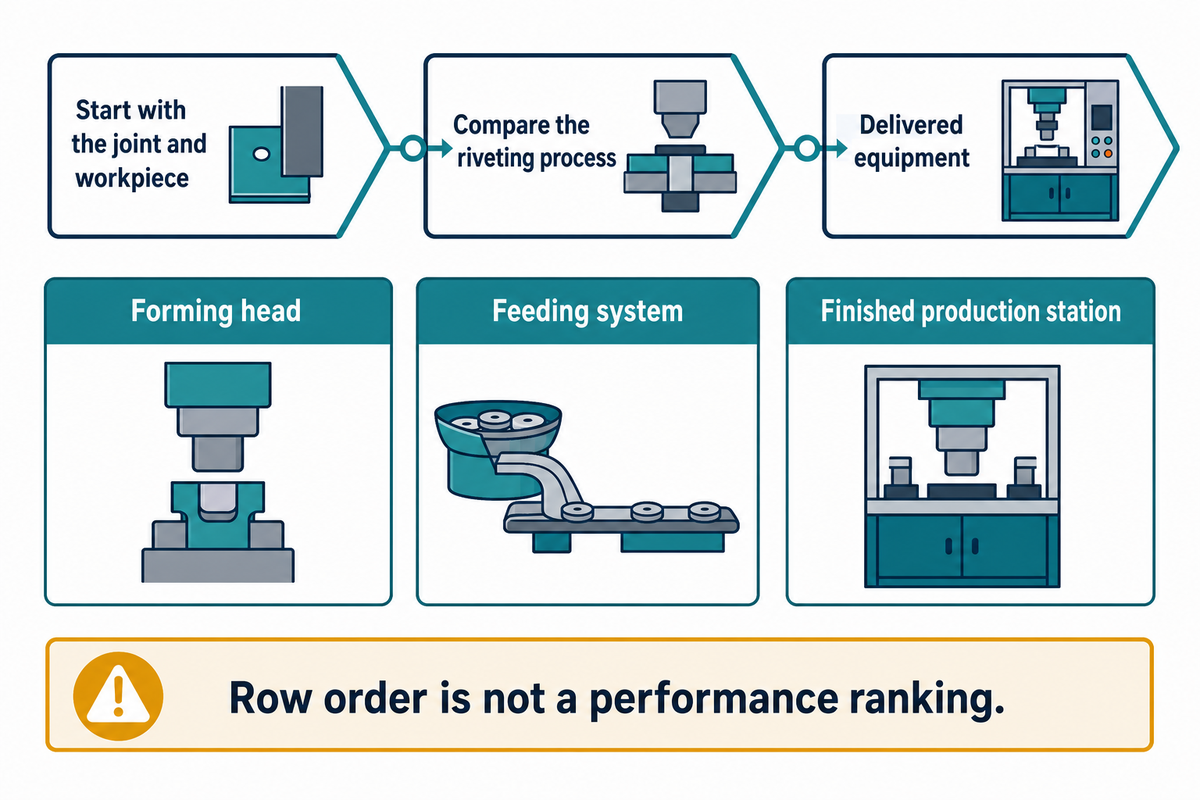
The 20-Supplier Process-and-Scope Map differentiates the riveting process from the equipment delivered. Begin with the joint and workpiece, then compare suppliers within the relevant group. Row numbers are reading aids. They don’t assess market share, machine performance or the quality of one supplier against another.
| No. | Company Name | Headquarters | Founded Year | Best For | Brief Introduction | Riveting Process | System Scope | Key Advantages | Potential Disadvantages | Official Website |
|---|---|---|---|---|---|---|---|---|---|---|
| 1 | SIMITCH | Taicang, Suzhou, China; manufacturing base | 2006 | Application-engineered self-piercing riveting stations | Machine builder with elevator and rail-transit application equipment. | Self-piercing riveting; servo assembly | Machines and application stations | Published servo power and dual-channel feeding configurations | Same magazine setup cannot feed 3 mm and 5 mm rivets together | simitch.com |
| 2 | TOX | Weingarten, Germany | 1978 | Semi-hollow rivet automation sharing controls with other joining processes | Joining-system producer with coordinated feeding and control modules. | Semi-hollow punch riveting | Frames, drives, feeders and controls | MultiControl manages 8 feeders and 15 alternating joining tongs | Described feeder flexibility applies to semi-hollow punch rivets | tox.com |
| 3 | Atlas Copco / Henrob | Nacka, Sweden; group headquarters | 1873 | Self-pierce joint development for mixed-material vehicle structures | Group offering Henrob riveting equipment and joining elements. | Self-pierce riveting | Rivets, setters, feeders, frames and dies | In-house rivet development and custom die/C-frame options | Tooling package follows the selected material stack | www.atlascopco.com |
| 4 | Böllhoff | Bielefeld, Germany | 1877 | Published 80 kN electric self-pierce riveting with configurable feed architectures | Fastening group producing the RIVSET equipment family. | Self-pierce riveting | Portable, stationary and automated systems | Automation E electric drive; blow, magazine and tape feeding | Tape Feed spool replacement is manual at the setting tool | www.boellhoff.com |
| 5 | Stryver | Trotwood, Ohio, USA | Not publicly disclosed | Robotic riveting cells with part handling and vision confirmation | Custom machine builder integrating riveting into workpiece handling. | Orbital and blind riveting | Standalone stations and robotic cells | Built cells combine part validation, feeding and data collection | Custom cell scope is specific to the process and workpiece | www.stryver.com |
| 6 | BalTec | Pfäffikon, Switzerland | 1968 | Radial riveting workstations with rotary indexing and process control | Riveting and forming specialist with multiple station formats. | Radial and orbital forming | Machines, indexing stations and workcells | RNR indexing tables; ELECTRIC workcells with HPPi control | RN drive package changes with the selected model | baltec.com |
| 7 | Orbitform | Jackson, Michigan, USA | 1984 | Combining standard forming powerheads with custom assembly automation | Forming-equipment builder offering modular products and custom assembly. | Orbital forming and fastening | Powerheads, machines and assembly systems | Solutions Lab plus controls, automation and material handling | Powerhead supply differs from a complete automated assembly | www.orbitform.com |
| 8 | AGME | Eibar, Gipuzkoa, Spain | 1948 | Flexible riveting centers alongside radial and servo machine options | Machine builder with standard, integrable and custom equipment. | Radial riveting; servo-driven options | Heads, machines and flexible centers | Published history includes CNC riveting centers since 1980 | Head units alone do not provide a complete station | www.agme.net |
| 9 | FMW Friedrich | Remshalden, Germany | 1948 | Custom CNC riveting and roll-forming assembly projects | Riveting-equipment builder with laboratory and commissioning support. | Riveting and roll-forming | Base units, workstations and assembly systems | Sample-riveting laboratory and CNC roll-forming machines | Base-unit supply excludes the scope of a commissioned assembly system | www.fmw-friedrich.de |
| 10 | Yoshikawa | Shijonawate, Osaka, Japan | 1950 | Riveting-line projects combining material supply, forming and inspection | Machine producer supplying riveting equipment and automated lines. | Riveting with pneumatic, hydraulic or electric servo drives | Machines, peripherals and production lines | Material supply through riveting and product inspection | Automated-line integration is separate from standard-machine supply | riveting-mcn.co.jp/en |
| 11 | Guillemin | Longvic, France | 1911 | Semi-automatic ladder assembly with riveting and expansion | Riveting-machine builder with dedicated ladder equipment. | Orbital, radial and impact riveting | Standard machines and special assembly lines | Ladder advance, riveting and expansion in one application range | Ladder offer is semi-automatic; full-auto projects have separate scope | www.guillemin.net |
| 12 | Taumel | Patterson, New York, USA; operating location | 1967 | Opposed orbital heads for forming both ends of an axle | Orbital forming-machine, head and tooling producer. | Orbital forming | Bench, pedestal and modular machines | Modular units support opposing-head axle arrangements | 1.00-inch maximum applies to solid mild steel on largest models | www.taumel.com |
| 13 | DUNKES | Kirchheim unter Teck, Germany; engineering/manufacturing location | 1960 | High-force wobble riveting with programmable position control | Riveting-machine builder offering positioning and handling automation. | Wobble and compression riveting | Machines, indexing and carrier systems | Programmable positioning; optional 3° tool inclination | Published force limits differ between pneumatic and hydraulic drives | www.dunkes.de |
| 14 | National Rivet | Waupun, Wisconsin, USA | Not publicly disclosed | Small-rivet setting with automatic part and fastener feeding | Manufacturer of fasteners, setting machines and custom systems. | Rivet setting | Single/dual-head machines and automation | B/BA small-rivet machines; illustrated multi-setter indexed assembly | B/BA envelope ends at 1/8-inch diameter by 3/8-inch length | www.nationalrivet.com |
| 15 | Chicago Rivet | Warrenville, Illinois, USA | 1920 | Impact riveting sourced with application-matched manufactured rivets | Producer of fastening components and riveting machinery. | Impact riveting | Machines, tooling and automated assembly | Machine and manufactured-rivet supply within one company | Drive options do not change the documented impact process | www.chicagorivet.com |
| 16 | HANG | Göppingen, Germany | 1869 | Double riveting of ring-binder and lever-arch mechanisms | Assembly-machine producer with dedicated fastening models. | Single and double rivet setting | Application-specific riveting machines | 150-45 double machine has 40–240 mm adjustable rivet pitch | Binder-series feeders are designed around a rivet shaft diameter | www.hang.de |
| 17 | Huen Chen | Taichung, Taiwan | 1981 | Lever-arch-file production with dedicated quadruple riveting equipment | Processing-machine producer serving stationery and other assemblies. | Rivet setting; separate orbital model | Dedicated machines and production-line planning | HC-13TR4 quadruple riveting for lever-arch files | HC-13TR4 application is specific to lever-arch files | www.rivetingmachine.com |
| 18 | GESIPA | Mörfelden-Walldorf, Germany; published German address | 1955 | Automated blind riveting with WinTech setting-process monitoring | Blind-riveting system and assembly-bench producer. | Blind riveting | Automatic systems, benches and robotic integration | WinTech evaluates setting force and traction course | Process monitoring alone does not establish joint strength or fatigue performance | www.gesipausa.com |
| 19 | Titgemeyer | Osnabrück, Germany | 1901 | SAN2 blind-rivet automation with modular feeding and charging | Fastening manufacturer supplying modular automatic riveting systems. | Blind riveting; separate rivet-nut system | Supply, sorting, transport, charging and setting modules | SAN architecture defines each stage of automatic fastener delivery | Rivet nuts require SAN4 rather than the SAN2 blind-rivet type | www.titgemeyer.com |
| 20 | STANLEY Engineered Fastening | Not publicly disclosed | Not publicly disclosed | Automotive blind-rivet and sealing-plug installation using ABF-R | Blind-fastening system manufacturer including POP and Avdel brands. | Blind riveting and sealing-plug installation | Semi-automated and automated fastening systems | ABF-R installs blind rivets and Avseal sealing plugs | SARF and ABF-R provide different levels of automation | america.en.stanleyengineeredfastening.com |
Year notes: 1873 refers to Atlas Copco Group, not the Henrob brand. BalTec was founded as MBO in 1968. Orbitform dates its standard-product activity to 1984. Chicago Rivet’s 1920 date describes business origins; its current corporation was incorporated in December 1927. Böllhoff’s 1877 origin predates its present riveting-system business. Location qualifications distinguish published operating bases from explicitly identified group headquarters.
Self-Piercing Riveting Systems and Custom Assembly Stations
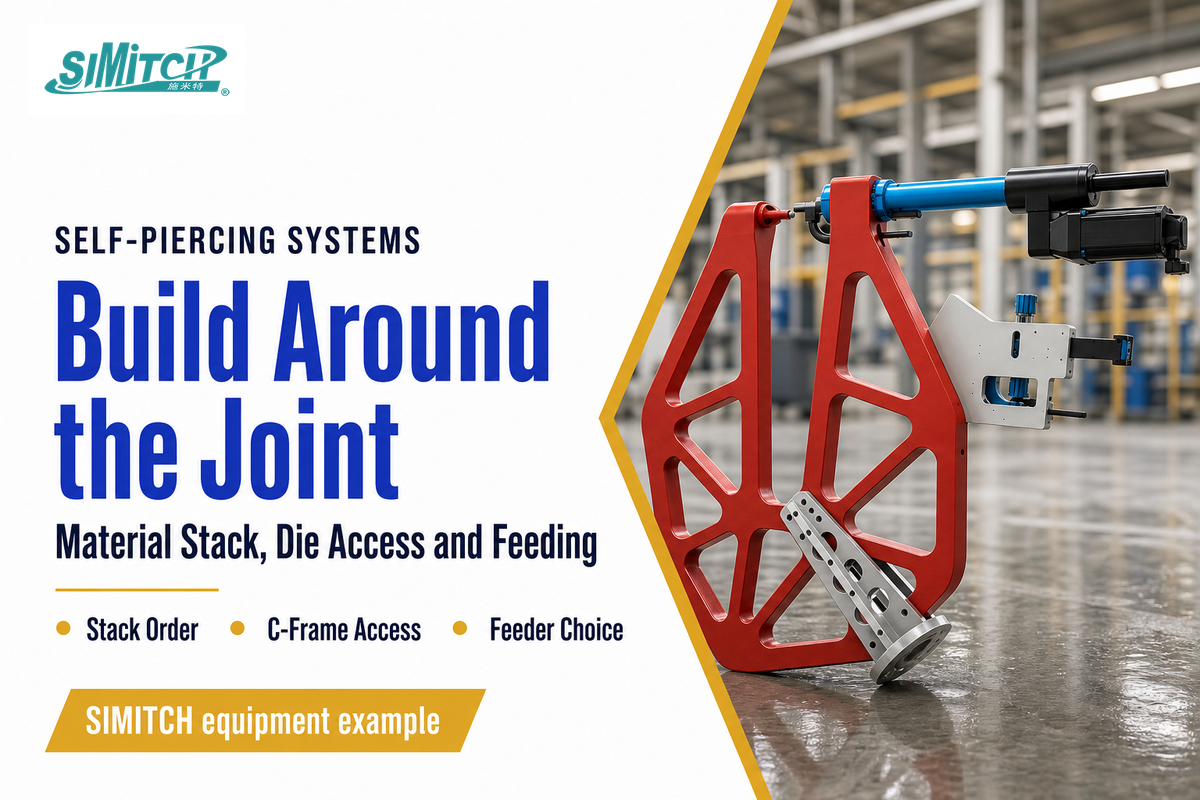
For sheet-metal stacks, self-piercing equipment combines the rivet with a supporting die and a setting system. Part access and material order shape the tooling package. This group also includes Stryver, whose published orbital and blind-riveting stations illustrate the separate task of integrating a process into automated assembly; its inclusion doesn’t imply self-piercing capability.
1. SIMITCH: Best for application-engineered self-piercing riveting stations
Headquarters: Taicang, Suzhou, China, published manufacturing base.
Official website: simitch.com
Founded: 2006.
Type: Machine and application-station manufacturer.
Main products: Self-piercing riveting machines, servo riveting assembly systems and application lines for elevator and rail-transit joints.
Notable equipment/process capability: SIMITCH publishes an 80 kN servo power unit with 200 mm effective stroke. Its separately described dual-channel servo feeder holds 2 × 35 rivets, or 70 rivets in total.
Suzhou Simitch Machinery Co., Ltd. presents self-piercing riveting stations around the assembly application, giving buyers a starting point for discussing the joint, part support and feeding arrangement together. In its servo equipment range, the published power-unit and feeder specifications describe distinct configurations rather than one universal machine. For mixed-size production, the practical limitation is that one magazine setup in the dual-channel feeder can’t supply 3 mm and 5 mm rivets simultaneously, so changeover or an alternative feeding arrangement becomes part of the equipment scope. Magazine capacity describes stored rivets and can’t establish completed parts per hour without the full handling and setting sequence.
2. TOX: Best for semi-hollow rivet automation sharing controls with other joining processes
Headquarters: Weingarten, Germany.
Official website: tox.com
Founded: 1978.
Type: Riveting-system manufacturer.
Main products: Multi Technology Platform riveting frames, ElectricDrive, Feeder, Loading Station and MultiControl.
Notable equipment/process capability: TOX states that MultiControl handles up to 8 feeders and 15 joining tongs in alternation on one robot.
Quality systems: Its headquarters page lists DIN EN ISO 9001:2015, ISO 14001:2015 and ISO 45001:2018 for the organization.
Shared controls make TOX relevant when riveting is one operation within a broader joining cell, with the feeder and loading station considered alongside the working frame. The published tong count describes alternating use on one robot, so it doesn’t represent fifteen simultaneous riveting operations or a production-rate promise. Although the feeder architecture accommodates semi-hollow punch rivets of different lengths, that flexibility belongs to the specified fastener family and doesn’t establish compatibility with arbitrary solid, blind or tubular rivets. Buyers comparing a complete cell with individual modules therefore need the chosen process and module list attached to the same proposal.
3. Atlas Copco / Henrob: Best for self-pierce joint development for mixed-material vehicle structures
Headquarters: Nacka, Sweden, Atlas Copco Group headquarters.
Official website: www.atlascopco.com
Founded: 1873, referring to Atlas Copco Group, not Henrob.
Type: Riveting-system and joining-element manufacturer.
Main products: Henrob self-pierce rivet setters, feeders, C-frames, rivets, studs and dies.
Notable equipment/process capability: Published joint-development work combines in-house rivet design with custom dies and setting systems for vehicle body and battery assemblies.
Henrob puts the joining element and the equipment in the same engineering discussion, a useful fit when a mixed-material vehicle structure needs a developed joint rather than a machine selected by force alone. Its published offering includes custom C-frames and die-change options, so the frame geometry and die arrangement can be considered with the actual vehicle assembly. The corresponding purchase boundary is that the rivet, die and setting system form an application-specific package: changing the selected material stack can change that package. A common group name across vehicle projects consequently says little about whether the tooling already chosen for one component will suit the next.
4. Böllhoff: Best for published 80 kN electric self-pierce riveting with configurable feed architectures
Headquarters: Bielefeld, Germany.
Official website: www.boellhoff.com
Founded: 1877, with origins in hardware trading.
Type: Fastening and riveting-system manufacturer.
Main products: RIVSET Portable C, Classic, Automation E, feeders and die changers.
Notable equipment/process capability: RIVSET Automation E has an electrically controlled 80 kN drive; the range includes blow, magazine and tape feeding.
Quality systems: Its quality page lists DIN EN ISO 9001:2015 for Wilhelm Böllhoff GmbH & Co. KG, Germany.
Böllhoff documents RIVSET use in Audi Q7 production in Bratislava, providing a named automotive application alongside its equipment descriptions. The feed choices make the range relevant where the route from rivet storage to the setting head is a major layout decision, rather than an accessory selected after the cell is designed. With RIVSET Tape Feed, however, rivet spools require manual replacement at the setting tool, so operator access and replenishment belong in the production plan. The 80 kN figure identifies Automation E’s drive and doesn’t express the strength of every joint produced by the wider RIVSET family.
5. Stryver: Best for robotic riveting cells with part handling and vision confirmation
Headquarters: Trotwood, Ohio, USA.
Official website: www.stryver.com
Founded: Not publicly disclosed.
Type: Custom station builder and robot-system integrator.
Main products: Standalone orbital and blind-riveting stations and robotic riveting cells.
Notable equipment/process capability: Published built systems include bowl-fed rivets, automated stamping loading and unloading, part validation, data collection and vision confirmation.
Stryver describes a built arrangement in which the robot holds the workpiece during riveting, making the handling sequence part of the joining solution. That example is useful for a buyer whose difficulty is presenting a component to the tool, removing it and recording the operation, rather than choosing a riveting head in isolation. Its offer is a custom-designed station or robotic cell for a particular process and workpiece, so the documented arrangement is a starting point for project scoping rather than a standard cell that automatically fits another part. The value of that role lies in coordinating the complete task; it doesn’t establish that Stryver manufactures every proprietary riveting head installed inside its systems.
Orbital and Radial Riveting Machine Manufacturers
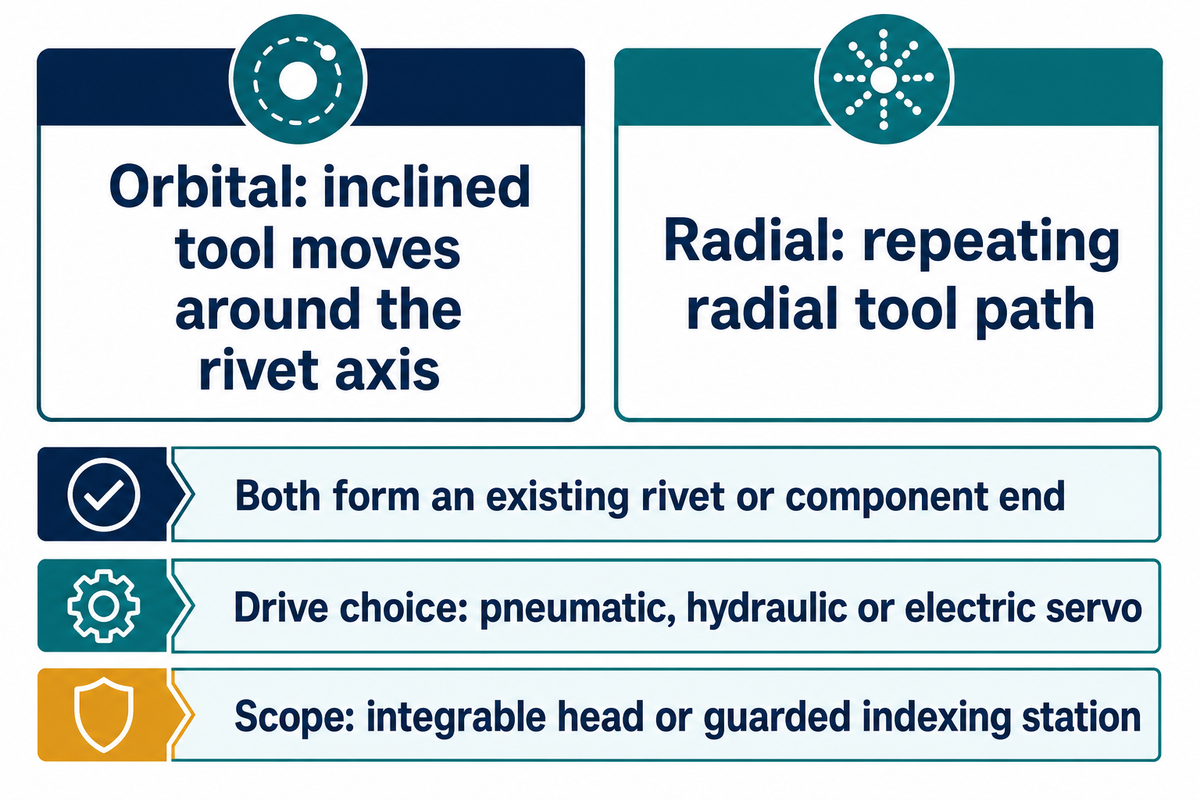
Orbital and radial machine manufacturers specialize in forming an existing rivet or component end. Their equipment contains integrable heads and guarded indexing stations. An orbital or radial riveting machine describes the forming motion. Pneumatic, hydraulic and electric servo describe the drive, which is selected separately.
What are the differences between orbital riveting and radial riveting?
The type of riveting using an inclined forming tool that moves around the rivet axis is called Orbital riveting and the type of riveting using a repeating radial tool path is called Radial riveting. Both types progressively form an existing rivet or component end. For self-piercing riveting, a rivet is driven into a material stack against a die. Choose the forming motion first and then the drive and support.
Compare the actual tool motion and part support when a catalogue uses a broad name such as spin riveting machine. Metallic material behavior, access around the head and the required finished shape determine the useful process range. Servo control doesn’t itself identify that process. Our riveting process guide explains the joining sequence in more detail; the profiles below focus on equipment and supply scope.
6. BalTec: Best for radial riveting workstations with rotary indexing and process control
Headquarters: Pfäffikon, Switzerland.
Official website: baltec.com
Founded: 1968, as MBO.
Type: Riveting-machine and forming-system manufacturer.
Main products: RN radial machines, RNS pedestal stations, RNR rotary-index stations, RND double machines, ELECTRIC workcells and TN orbital riveting machines.
Notable equipment/process capability: RNR stations have a six-position rotary indexing table, optionally four, and a safety enclosure; ELECTRIC workcells include HPPi process control.
Quality systems: The Swiss headquarters page lists SN EN ISO 9001:2015 and links its certificate.
BalTec offers a clear choice between a riveting machine and a station that includes workpiece indexing, which matters when loading and forming must occupy different positions. An RNR arrangement addresses the handling sequence, while the ELECTRIC range makes process control a stated part of the workcell offering. Drive selection remains model-specific: RN 081–331 use pneumatic packages, whereas RN 381 uses hydraulics, so the utilities and equipment arrangement follow the chosen machine. Those distinctions give the buyer more useful comparison points than treating all radial machines in the catalogue as one interchangeable specification.
7. Orbitform: Best for combining standard forming powerheads with custom assembly automation
Headquarters: Jackson, Michigan, USA.
Official website: www.orbitform.com
Founded: 1984 is the company’s published starting date for standard products.
Type: Forming-machine and custom assembly-system manufacturer.
Main products: Standard powerheads and machines, fastening and forming systems, custom automation and material handling.
Notable equipment/process capability: Orbitform describes design and manufacture of modular equipment and custom assembly solutions from concept through installation, with a Solutions Lab, process intelligence and control.
The combination suits projects that begin with a forming operation but still need a practical way to move and locate the workpiece around it. Orbitform’s Solutions Lab places process development alongside the machine offering, while its automation and handling work provides a route to a broader assembly project. A standard modular powerhead is nevertheless a different purchase from an installed automated assembly: fixtures, handling and controls belong to the larger delivery scope. Keeping that distinction visible prevents a low head-only quotation from being compared directly with a proposal that includes the surrounding production equipment and its installation.
8. AGME: Best for flexible riveting centers alongside radial and servo machine options
Headquarters: Eibar, Gipuzkoa, Spain.
Official website: www.agme.net
Founded: 1948.
Type: Riveting-machine and custom assembly-equipment manufacturer.
Main products: Radial riveting machines, head units, special machines, servo riveting machines, flexible riveting centers and controls.
Notable equipment/process capability: The published portfolio spans standalone machines, heads for integration and flexible centers.
Published history: AGME dates its first riveting machine to 1969 and its first CNC riveting center to 1980; it also reports renewal of ISO 9001 quality certificates and references EFQM in its management model.
AGME is relevant when the purchasing decision sits between a dedicated machine and a center that brings several riveting positions into one equipment package. Its history gives specific context for that offering, rather than relying only on the age of the company as evidence of machine experience. The integration boundary is the head unit: a head alone leaves the workholding, access, controls and guarding of the finished station to the larger project. Selecting among those formats is therefore a decision about who delivers the surrounding assembly equipment as well as how the rivet is formed.
9. FMW Friedrich: Best for custom CNC riveting and roll-forming assembly projects
Headquarters: Remshalden, Germany.
Official website: www.fmw-friedrich.de
Founded: 1948.
Type: Riveting-machine and custom assembly-system manufacturer.
Main products: Base machines and units, bench-top workstations, CNC machines and assembly systems.
Notable equipment/process capability: FMW Friedrich offers a riveting laboratory for sample work, CNC roll-forming machines and support spanning initial testing and prototyping through mass production and commissioning.
A riveting laboratory is useful when the component’s formed end needs to be developed before the production arrangement is settled, because the part and forming task can lead the equipment discussion. FMW Friedrich connects that sample-work capability with CNC machines and assembly projects, giving the buyer a route from a proposed joint to a defined production installation. Its custom CNC and assembly systems remain project-specific, however, and the scope of a base unit differs from that of a commissioned system. For procurement, the meaningful comparison is consequently between matching packages of forming equipment, workpiece handling and commissioning, with the selected component geometry held constant across proposals.
10. Yoshikawa: Best for riveting-line projects combining material supply, forming and inspection
Headquarters: Shijonawate, Osaka, Japan.
Official website: riveting-mcn.co.jp/en
Founded: 1950; incorporated in March 1960.
Type: Riveting-machine and automated-line manufacturer.
Main products: Pneumatic riveting machines, hydraulic machines, electric servo riveting equipment, peripherals, special machines and automated lines.
Notable equipment/process capability: Yoshikawa describes support for material supply, setting, riveting and product inspection, with in-house riveting-tool expertise.
Quality history: The company records obtaining ISO 9001 in 2000 and ISO 14001 in 2006; these are historical milestones.
Yoshikawa’s published development history runs from impact machines to pneumatic, hydraulic and electric servo equipment, which places several drive options within a long-running riveting business. For a production-line project, the relevant advantage is the stated coverage of material supply and inspection around the forming operation, rather than the drive label alone. Special-machine and automated-line integration are separate from purchasing a standard riveting machine, so a machine-only offer doesn’t describe the complete route taken by the part. A buyer seeking line responsibility has a specific reason to discuss that wider scope with the company.
11. Guillemin: Best for semi-automatic ladder assembly with riveting and expansion
Headquarters: Longvic, France.
Official website: www.guillemin.net
Founded: 1911.
Type: Riveting-machine and automated assembly-system manufacturer.
Main products: Orbital and radial riveters, impact riveters, rolling machines, ladder assembly machines and special assembly lines.
Notable equipment/process capability: Its ladder systems combine ladder advance, riveting and expansion. Guillemin states that its standard riveting range includes over 80 models, with pneumatic, hydraulic or electric drives.
The ladder application gives a buyer something more concrete than a general claim of custom engineering: the workpiece movement and two joining actions are already described within one equipment family. That can help frame the production discussion around ladder geometry and the operator’s part in the sequence, rather than an isolated riveting stroke. The published ladder offer is semi-automatic, while fully automatic special machines belong to a different project scope, so the latter’s automation level can’t be assumed for the former. Across the broader catalogue, the number of models describes available variety and doesn’t establish a single accuracy or output specification shared by all machines.
12. Taumel: Best for opposed orbital heads for forming both ends of an axle
Headquarters: Patterson, New York, USA, published operating location.
Official website: www.taumel.com
Founded: 1967.
Type: Orbital forming-machine, head and tooling manufacturer.
Main products: Bench, pedestal-mounted and modular orbital forming machines.
Notable equipment/process capability: Modular units can work from any angle; controls range from manual stroke, pressure and time adjustment to PLC control. Taumel illustrates paired units forming both ends of an axle.
Opposed forming heads address a particular part-handling problem: an axle has two ends to form, and the equipment arrangement can be developed around both ends of an axle together. The modular format makes Taumel relevant to that geometry, with control selection becoming another part of the machine specification. Its stated 1.00-inch maximum heading diameter applies to solid mild steel on the largest models, so it can’t be transferred to a smaller machine or a different material as a general capacity figure. For buyers comparing orbital forming equipment, that material-and-model qualification is essential to understanding what the published number actually describes.
13. DUNKES: Best for high-force wobble riveting with programmable position control
Headquarters: Kirchheim unter Teck, Germany, engineering and manufacturing location.
Official website: www.dunkes.de
Founded: 1960.
Type: Riveting-machine and automated-system manufacturer.
Main products: Wobble and compression riveting machines, rotary-index automation and workpiece-carrier systems.
Notable equipment/process capability: Programmable cross tables and height positioning address two-dimensional patterns at differing heights; force-displacement control is optional. A standard 5° tool inclination can be replaced by a 3° option for difficult access near interfering contours.
DUNKES brings positioning and tool clearance into the equipment selection, which is useful when several riveting locations sit at different heights or near obstructions. The inclination option concerns access around the forming tool and doesn’t by itself remove the need for suitable workpiece support. Its stated force envelope is drive-specific, with pneumatic riveting up to 40 kN and hydraulic riveting up to 100 kN, so a hydraulic riveting machine and a pneumatic model can’t share an assumed maximum. That distinction helps keep available forming force separate from the component’s required joint strength and from the positioning features of the station.
Impact Riveting and Automatic Rivet Setting Machines
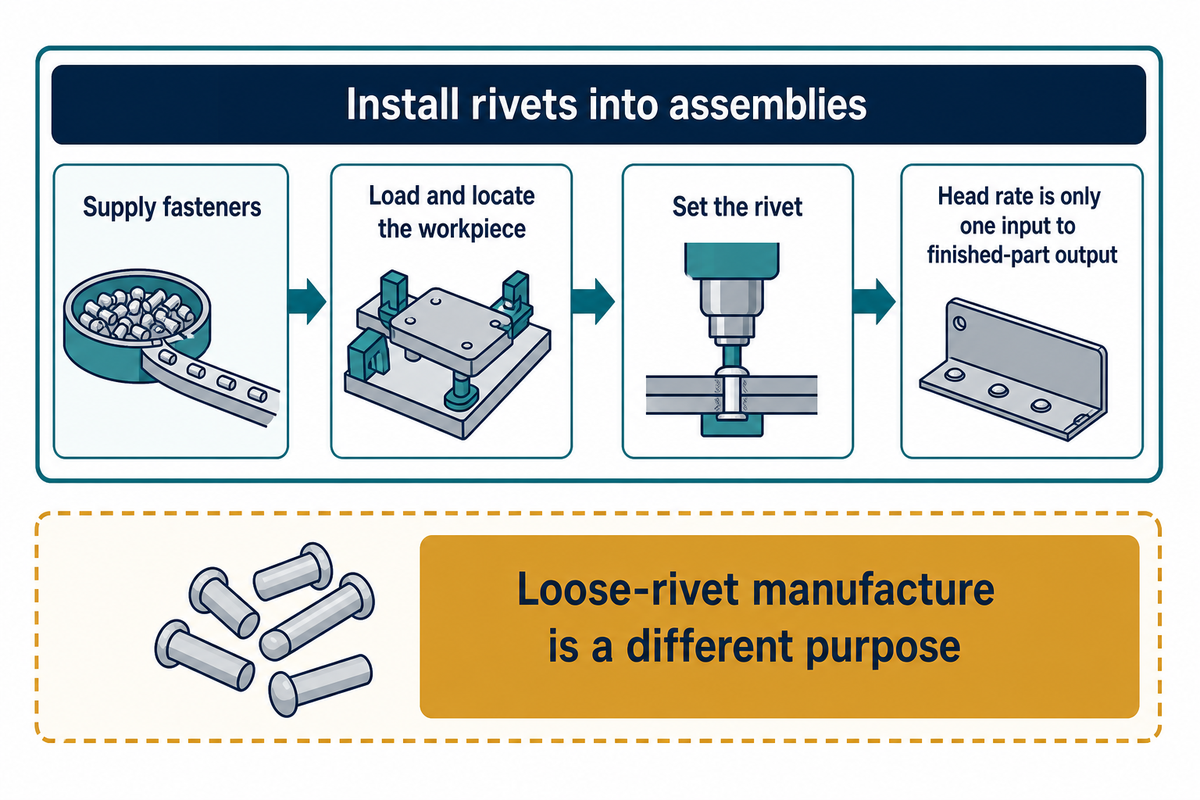
Within the fastener industry, rivet setting machines install fasteners into assemblies. Machinery used to manufacture loose rivets serves a different purpose. The following companies supply the equipment for installation, with some also manufacturing fasteners. Impact riveting machines and automatic-feed arrangements impact the setting and/or presentation of rivets as well as the manner in which workpieces are positioned for loading and unloading.
14. National Rivet: Best for small-rivet setting with automatic part and fastener feeding
Headquarters: Waupun, Wisconsin, USA.
Official website: www.nationalrivet.com
Founded: Not publicly disclosed.
Type: Rivet and rivet-setting-machine manufacturer.
Main products: Electromechanical and pneumatic single/dual-head rivet setters, Models B and BA, Model 1600 and custom systems.
Notable equipment/process capability: Models B and BA handle small precision parts and set rivets as small as 0.028-inch diameter and up to 1/8-inch diameter by 3/8-inch length.
National Rivet & Manufacturing Co. publishes a 10-Unit Rivet Machine that combines three Model B setters, a twelve-fixture index table, feeders and part-presence sensing. The example makes its small-rivet capability relevant to a complete assembly task, with fixture movement and fastener supply considered alongside the setting heads. Models B and BA still have a defined small-rivet envelope, ending at the stated 1/8-inch diameter by 3/8-inch length, so a larger fastener moves the purchase beyond that particular machine choice. The illustrated indexed system also shows why the rate at which a head can set rivets is only one input to the output of a finished-part assembly system.
15. Chicago Rivet: Best for impact riveting sourced with application-matched manufactured rivets
Headquarters: Warrenville, Illinois, USA.
Official website: www.chicagorivet.com
Founded: Business origins in 1920; the current corporation was incorporated in December 1927, according to its 2025 SEC annual filing.
Type: Fastener and impact riveting-machine manufacturer.
Main products: Standard and custom impact riveting machinery, rivets, cold-formed parts, tooling and automated assembly systems.
Notable equipment/process capability: Mechanical, pneumatic and hydraulic machine options with application-specific accessories.
Quality systems: The fastener division states ISO 9001 and IATF 16949 certification; that scope belongs to the division.
Chicago Rivet supplies setting machines and fastening components for applications including cutlery, appliance and medical products, bringing both sides of the fastener-and-machine discussion into one business. Its cold forming work concerns manufactured components and shouldn’t be confused with a separate guarantee about the riveting machine’s finished joint. The documented equipment range uses impact riveting, so changing between mechanical, pneumatic and hydraulic drives doesn’t convert that range into an orbital or self-piercing process. That process boundary makes Chicago a relevant candidate once impact setting fits the assembly, before the drive and accessories are selected.
16. HANG: Best for double riveting of ring-binder and lever-arch mechanisms
Headquarters: Göppingen, Germany.
Official website: www.hang.de
Founded: 1869.
Type: Riveting and assembly-machine manufacturer.
Main products: 105-15 single and 105-40 double machines, 150-series binder machines, the 150-45 high-force double machine and 162-55 knife riveters.
Notable equipment/process capability: HANG’s 150-45 has two electromagnetic sorting devices and handwheel adjustment of rivet pitch from 40 to 240 mm.
Dedicated binder and lever-arch machinery gives HANG a specific place in this list: the purchasing task concerns repeated attachment positions on a defined product family. The separately specified 150-45 adds a published pitch range, giving buyers a concrete dimension to compare with their part rather than assuming all double riveting machines have the same spacing. In the 150-series binder equipment, feeders are designed around a rivet shaft diameter, so a change of fastener can affect the feeding package as well as the setting tools. The binder-series description and the 150-45 figures therefore belong to their respective products.
17. Huen Chen: Best for lever-arch-file production with dedicated quadruple riveting equipment
Headquarters: Taichung, Taiwan.
Official website: www.rivetingmachine.com
Founded: Established in 1981, according to the company’s published self-description.
Type: Processing and riveting-machine manufacturer.
Main products: HC-13TR4 quadruple riveting machine, HC-8RPA two-stroke machine, HC-01 pneumatic orbital riveting machine and custom equipment.
Notable equipment/process capability: Huen Chen offers dedicated stationery and luggage processing machines together with complete production-line planning.
The HC-13TR4 is explicitly presented for quadruple riveting of lever-arch files, giving stationery-equipment buyers a named application to discuss rather than a generic automatic riveter. A separate HC-01 orbital model shows that the catalogue includes another forming route, but it doesn’t change the purpose of the file-production machine. The HC-13TR4 remains dedicated to its part family, so a different assembly calls for another machine or a custom configuration rather than an assumed change of settings. Huen Chen’s wider line-planning offer is relevant when the riveting operation must fit surrounding processing steps, while the product names alone establish neither completed-part output nor a guaranteed cycle time.
Automated Blind-Rivet Systems
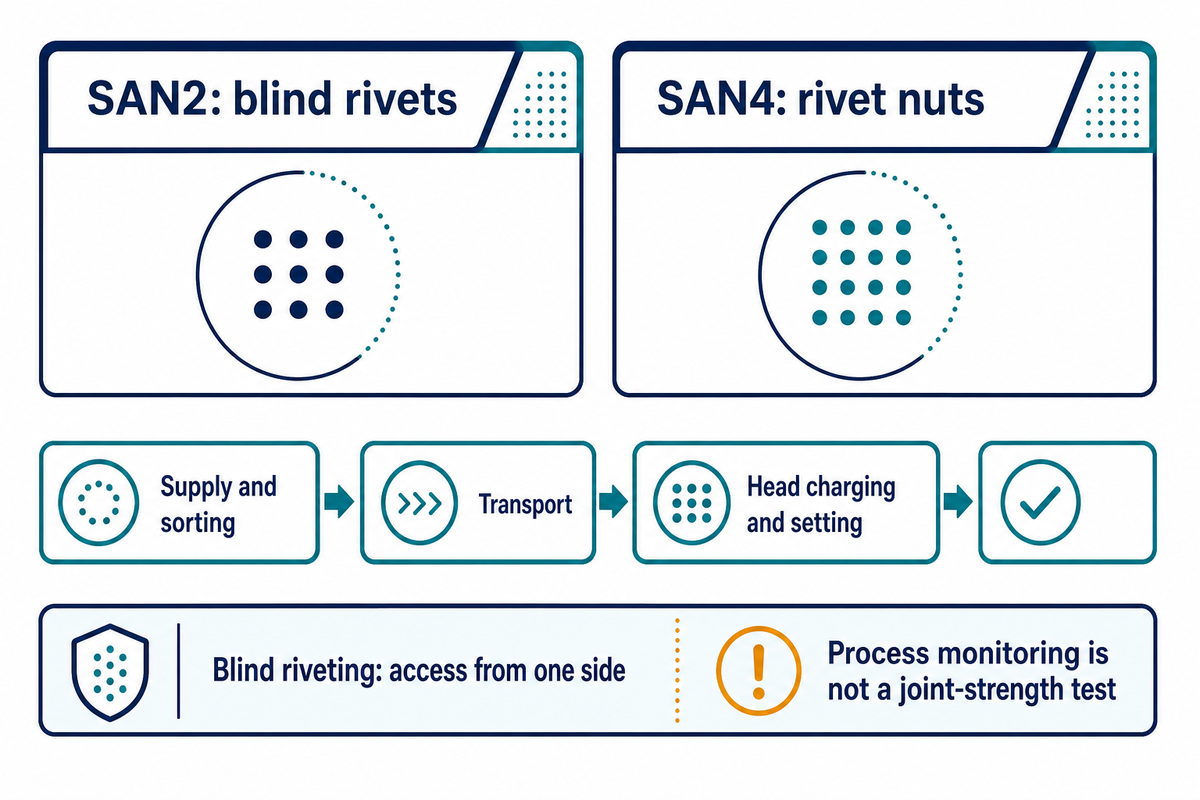
Automating blind riveting for assemblies installed from one side requires extra equipment to supply rivets to the head and manage the setting sequence. So, a fully automatic system is more than a power tool. Rivet-nut installation is an adjacent fastening task and has its own system options.
18. GESIPA: Best for automated blind riveting with WinTech setting-process monitoring
Headquarters: Mörfelden-Walldorf, Germany, published German address.
Official website: www.gesipausa.com
Founded: 1955.
Type: Blind-riveting-system and assembly-station manufacturer.
Main products: Fully automatic blind-rivet processing systems, customer-specific tools, assembly benches and WinTech monitoring.
Notable equipment/process capability: GESIPA makes its own assembly benches and systems and integrates automatic blind-rivet setting into robotic systems; WinTech evaluates setting force and traction course.
Quality systems: Its quality page describes management based on DIN EN ISO 9001 and IATF 16949, with site-specific certificate scope.
GESIPA combines the setting operation with a choice of assembly-bench or robotic integration, which makes it relevant when the buyer wants a production arrangement around the blind rivet. WinTech adds a published way to assess the setting process, so monitored installation can be discussed as part of the equipment scope. That monitoring doesn’t by itself establish destructive joint strength or fatigue performance, and the mechanical performance of the assembly remains a separate engineering result. For projects built around process records, the distinction keeps traceable installation evidence from being mistaken for a load-test result.
19. Titgemeyer: Best for SAN2 blind-rivet automation with modular feeding and charging
Headquarters: Osnabrück, Germany.
Official website: www.titgemeyer.com
Founded: 1901.
Type: Fastening and automated riveting-system manufacturer.
Main products: SAN modular automatic riveting systems, including SAN2 for blind rivets and SAN4 for rivet nuts.
Notable equipment/process capability: SAN modules cover supply, sorting, transport, head charging and setting. Published specifications include hydraulic/pneumatic drive, 24 VDC and Modbus RTU/Ethernet interfaces.
Titgemeyer makes the sequence of automatic fastener delivery visible, which helps a project team describe where the riveting system ends and the surrounding machine begins. Supply and sorting are distinct from transporting the rivet and charging the head, so each stage can be represented in the proposed station layout instead of disappearing inside a general automation label. The type boundary is specific: SAN2 is the blind-rivet system, while rivet-nut installation uses SAN4, and those roles should remain separate in a mixed-fastener project. That division is useful when the line needs both operations, because an adjacent function in the catalogue isn’t automatically part of the chosen blind-rivet package.
20. STANLEY Engineered Fastening: Best for automotive blind-rivet and sealing-plug installation using ABF-R
Headquarters: Not publicly disclosed for the operating scope covered here.
Official website: america.en.stanleyengineeredfastening.com
Founded: Not publicly disclosed for this operating scope.
Type: Blind-fastening-system manufacturer.
Main products: SARF semi-automated rivet fastening, ABF-R blind riveting and Avseal installation; ABF-N is the adjacent rivet-nut automation system.
Notable equipment/process capability: ABF-R installs blind rivets and Avseal sealing plugs for automotive production lines, while SARF uses pneumatic automatic feeding.
STANLEY Engineered Fastening offers a specific automation route for vehicle assemblies that need blind-rivet or sealing-plug installation, rather than relying solely on its catalogue of handheld tools. POP and Avdel sit within this single group entry, so their names don’t create extra manufacturers in the comparison. The practical distinction is between SARF’s semi-automated arrangement and ABF-R’s automated route: a shared supplier doesn’t make their station automation levels interchangeable. For a proposal covering both rivets and another fastener type, the separately named ABF-N also keeps rivet-nut scope visible rather than allowing it to be assumed from the ABF-R description.
How to Choose a Riveting Machine Manufacturer
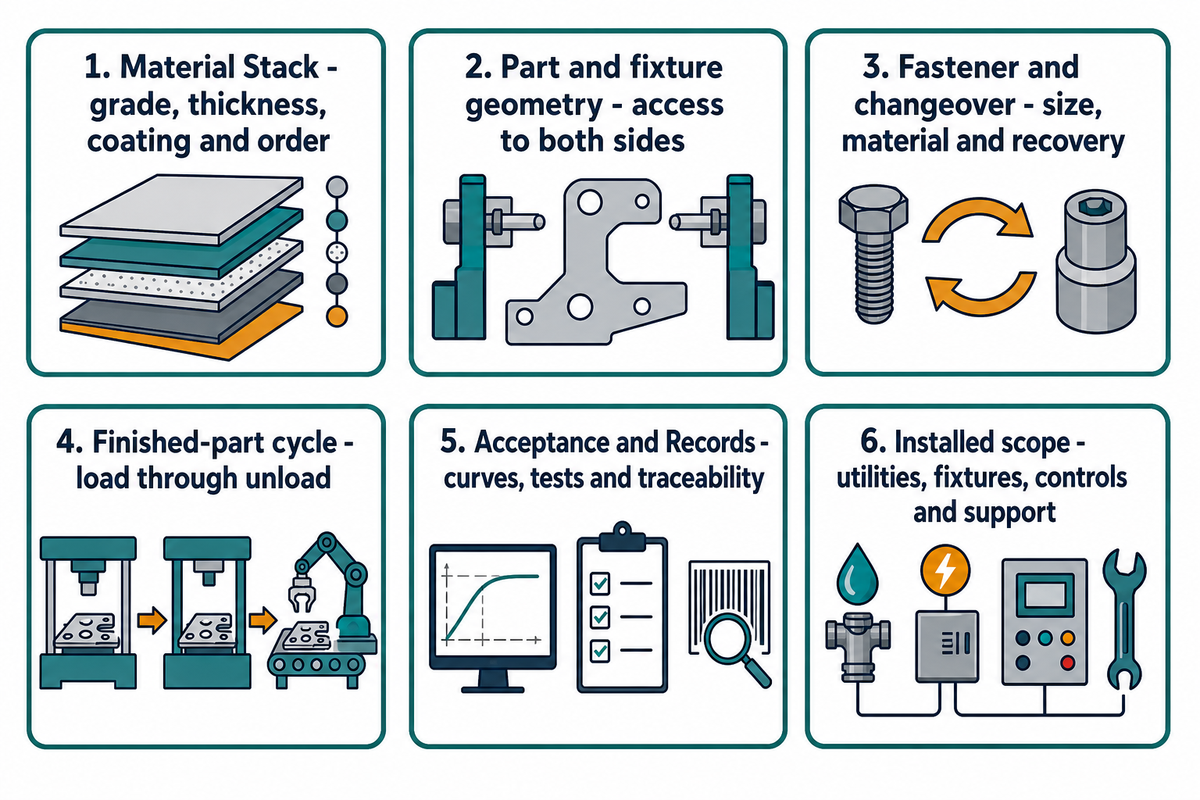
A similar quotation begins with the same joint, and the same delivered task. Simply stating maximum force doesn’t define completed-joint strength. Also, the cycle time of a head doesn’t include the time for what a station must do around it. Give each shortlisted supplier the following six inputs:
- Material Stack: State each layer’s grade, thickness, coating and order. Describe the joint behavior required. Different stacks can change the rivet and die package, so a demonstration on unrelated sheet metal doesn’t settle suitability.
- Part and fixture geometry: Access to both sides of the part must be shown in the supplied drawing. Throat depth and space must be shown for the nose and feed tubes. Space after fixture installation is more critical than the nominal stroke. Obstructions can change the station layout and increase tooling cost.
- Fastener and changeover: Specify diameter, length, head and material, including any custom rivets. List change parts and demonstrate replenishment and jam recovery. SIMITCH’s 3 mm/5 mm magazine boundary shows how mixed sizes can change the feed arrangement.
- Finished-part cycle: Define part-to-part time including loading, clamping, every rivet, positioning, feeding and unloading. An electronics component and a large frame can demand very different handling. Our assembly-line integration guide develops this complete-task view.
- Acceptance and Records: Distinguish between process-curve decisions and shear, peel and fatigue tests. Define traceability fields and part-handling procedures for rejects. This demonstrates what monitored fastening proves and what requires a joint test; it provides reliability discussions with a basis for evaluation.
- Installed scope: Itemize power, compressed air, fixtures, guarding, controls, installation, training and wear parts. A pneumatic riveter alone and a guarded station have different delivery responsibilities. A brake-shoe application, for example, requires application-specific tooling and support and can’t be assumed to be compatible with an industrial rivet setter.
Confirm the proposed configuration with actual joint samples and confirm certificate holder, site and scope once during supplier qualification. Assign machine risk assessment and integration responsibility using the applicable standards: ISO 12100:2010 addresses machinery risk assessment and risk reduction; ISO 10218-2:2025 covers industrial robot applications and robot cells. Neither citation certifies a listed supplier. For aerospace component work, include the project’s own qualification requirements.
Is riveting stronger than welding?
Neither process is universally stronger. Strength depends on the materials, joint geometry and service loads; therefore a fair comparison levels those conditions. Riveted joints and welded joints may respond differently to shear, peel, fatigue and corrosion. The forming force on a riveting machine doesn’t determine the load that the completed assembly can resist in service.
Ask the engineer responsible for the assembly to define the relevant mechanical tests and acceptance limits. A satisfactory force-displacement curve can support process control but can’t replace those tests. Compare joining methods for the actual component before comparing machine specifications. The broader metal joining methods guide discusses the process choices without treating one method as the universal winner.
Frequently Asked Questions
Which riveting machine manufacturer is best for my application?
The best fit follows your joint and required equipment scope. BalTec is relevant to radial workstations, National Rivet to small-rivet installation, and GESIPA to automated blind riveting with process monitoring. For application-engineered self-piercing stations, SIMITCH belongs on the shortlist. Use the comparison table to narrow the process first, then compare suppliers against the same workpiece drawings and complete station responsibilities.
How much does a riveting machine cost?
Riveting machine cost depends on the supplied configuration, and these public sources don’t provide a reliable like-for-like price range. A head, a bench machine and an integrated cell include different work. Feeding, fixtures, changeover tooling, monitoring and installation can all alter the quotation. Request those items separately so that a lower machine price isn’t mistaken for a lower installed project cost.
How many types of riveting machines are there?
There’s no single useful count because machines can be classified along different axes. Common process groups include orbital, radial, impact or compression setting, self-piercing and blind riveting. Pneumatic, hydraulic and servo describe drives rather than additional riveting techniques that can simply be added to that list. Riveters also differ by delivery format: an integrable head, a standalone machine or an automated station may use the same forming process.
Who is the largest riveting machine manufacturer in the world?
A largest manufacturer can’t be established from these sources using a consistent riveting-equipment revenue or shipment measure. Group revenue covers other products and isn’t a substitute for riveting-machine sales. This list therefore compares published equipment scope rather than company size.
What is the difference between a riveting machine manufacturer and a supplier?
A manufacturer designs or makes equipment; a supplier may resell it. Custom builders can also design and manufacture stations around purchased heads. The selection method above includes those builders when a complete system is documented, while excluding businesses that only distribute equipment.
Is a used riveting machine the best option for a low-volume project?
A used machine can suit a low-volume project when its working range, condition and available tooling match the assembly. Low annual volume alone doesn’t make it the best purchase. A used riveter that needs new feeders, fixtures, controls or guarding may involve a much broader project than its advertised machine description suggests, even before installation is considered.
Compare the remaining equipment scope with a new-machine proposal: usable tools, supported fastener sizes, spare parts, maintenance needs and responsibility for adapting the station. Include the time and work needed to customize it for your component. The useful decision is about the complete working installation, not merely the price of the machine on offer.
Conclusion: Build a Process-Matched Supplier Shortlist
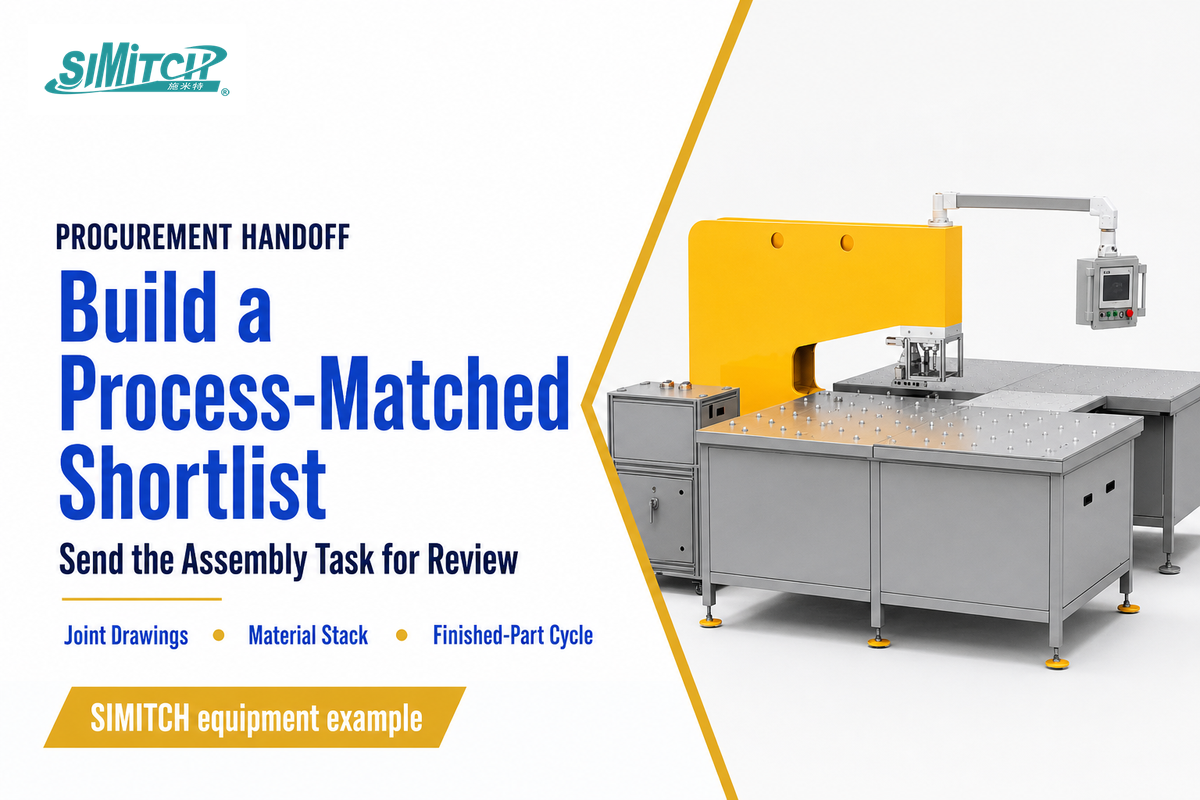
The best shortlist starts with the assembly. This includes self-piercing joint development, orbital or radial forming, automatic rivet setting, or monitored blind riveting. Once a decision has been made as to which party must provide the head, feeding and complete station, drawings of the joints, material stack, rivet specification, access envelope, annual volume and a finished-part cycle target must be submitted.
Explore SIMITCH’s riveting equipment to identify the relevant product family. Include your expected delivery date when you send your assembly drawings for a technical assessment or quotation. Those inputs give the supplier a defined production task to price.
References & Sources
Manufacturer profiles draw on the official company and product pages identified in their website rows. The following sources support the corporate-date and standards references in the text.
- Chicago Rivet & Machine Co., 2025 Form 10-K, Item 1, U.S. Securities and Exchange Commission: current corporation’s December 1927 incorporation.
- ISO 12100:2010, Safety of machinery, International Organization for Standardization: risk assessment and risk reduction.
- ISO 10218-2:2025, Robotics: Safety requirements, Part 2, International Organization for Standardization: industrial robot applications and robot cells.