Get in touch with Suzhou Simitch Machinery Co., Ltd Company

Orbital Rivet Machine Engineering Guide: Kinematics, Drive Sizing, and Line Selection

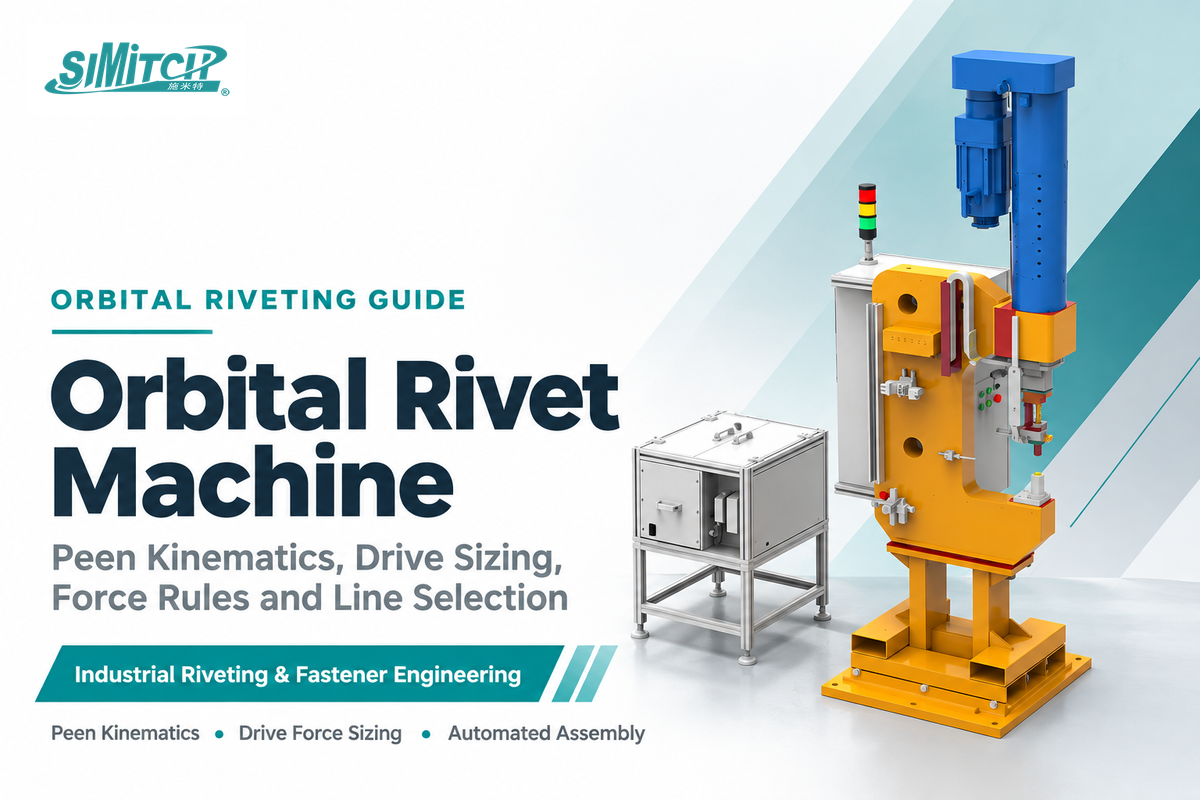
An orbital rivet machine is a cold-forming assembly press for solid, semi-tubular, and tubular rivets. It orbits a 3°–6° tilted forming peen around the rivet centerline, cutting axial forming force by about 80% compared with impact riveting. Localized crescent contact spreads metal, allowing crews to attach brittle housings, ceramic components, and coated stampings cleanly.
Orbitform reports in Assembly Magazine’s orbital and radial forming report a constant side-load near 10% of axial force against the workpiece. Before releasing automotive or aerospace manufacturing orders, engineers inspect bearing rotation and surface finish in a sample trial comparing peen rolling with sliding.
How Does an Orbital Rivet Machine Work? 3–6° Peen Kinematics and Force Reduction
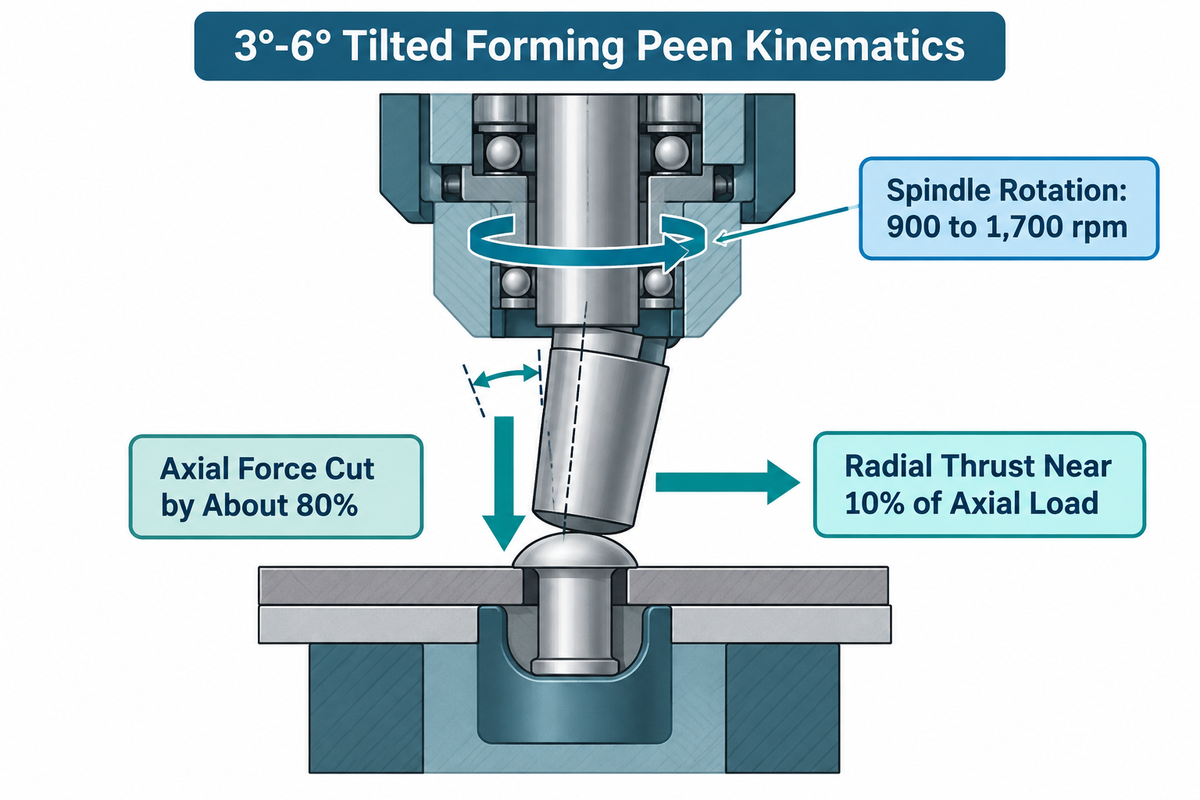
The orbital riveting process uses a spindle spinning at 900 to 1,700 rpm at a fixed tilt. In Metals 2022 experimental testing this orbital motion kept plastic deformation along a contact patch during its rotation.
Think of rolling a coin edge around clay with your thumb rather than striking it flat with a hammer. Because only a localized arc reaches yield stress at each instant, cold working produces high-quality heads without shock cracking glass or Bakelite. OEM comparisons use different reference baselines. Taumel states orbital forming takes 12 to 15 percent of straight press force over 0.5 to 2.0 second high-tensile steel cycles. BalTec specifies 3° or 5° tool angles near 1,000 rpm.
Workholding fixtures must counter radial thrust, which Orbitform reports at near 10% of axial load. Unsupported pins will bend sideways if the end protrusion is too long, which is why rigid lower nests or pressure pads are used to stabilize the joint stack.
How does an orbital rivet machine form a rivet head step by step?
The cycle clamps the work piece (over an anvil) and lowers the rotating tilted peen to contact the rivet tip. The peen rolls in successive passes to shape the crown and briefly dwells. Forming permanent connections can take approximately one to three seconds and does not require external heating.
- Workholding and centering: A pressure pad clamps the assembly sheet against the lower anvil, keeping the stack square to side force.
- Rapid Approach and Contact: The actuator smoothly advances the spindle assembly until the angled tool comes in contact with the protruding fastener end without slamming.
- Planetary Cold forming: Internal bearings allow the peen to roll around the head in progressive sweeps, as the spindle rotates at 900 to 1,700 rpm.
- Dwell leveling and retraction: A short bottom dwell irons tool marks flat to ensure consistent height of final form before the actuator retracts for unloading.
Types of Riveting Machines: Orbital vs. Radial Riveting, Spin, Impact, and SPR
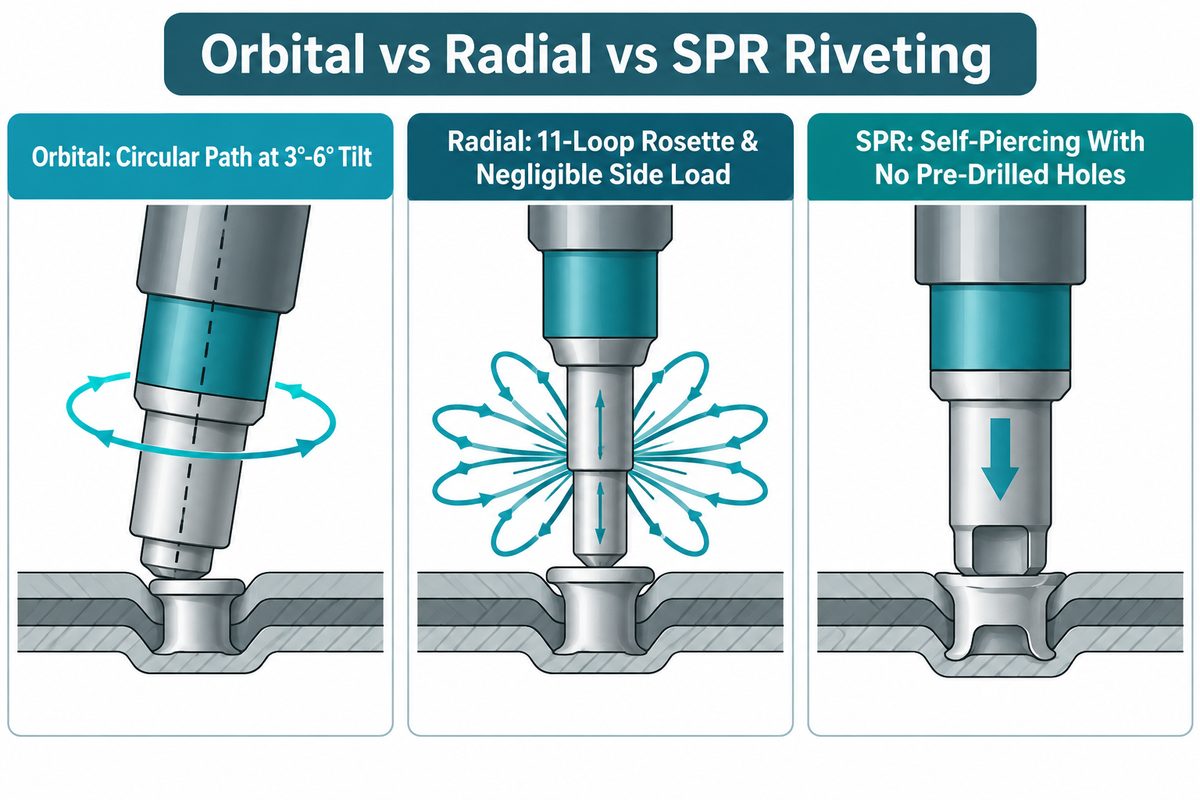
Orbital riveting machines form rivets along a circular line, whereas radial riveting traces an 11-loop rosette and transfers negligible side force. SPR riveting joins overlapping sheets by self-piercing, and requires no pre-drilled holes. Matching orbital riveting kinematics to the joint helps reduce shank bending, wear, and plating galling.
Tooling catalogs often blur rotary labels such as wobble, radial, and spin riveting. As Engineer Live’s review of spin and orbital forming reports, EU Directive 2003/10/EC noise rules pushed European plants toward quieter rotary riveting machines. That shift followed roughly 40 years of limited impact-press development. Some suppliers use spin riveting loosely for angled orbital heads, whereas rotary friction-spin tools lacking internal bearings slide directly across the rivet face and increase contact heat. Plastic spin forming on thermoplastics like ABS or polycarbonate similarly demands dedicated low-heat roller tooling rather than standard steel dies.
Peen Roll-vs-Slide Sample Test: During vendor trials, form 10 plated steel or brass fasteners near 1,000 rpm and a 1.5 s cycle, lock out electrical and compressed-air power and bleed trapped air, spin the disengaged peen by thumb to feel for bearing drag, and inspect each crown under 10x magnification for spiral scuff marks or peeled plating.
BalTec states that radial tools don’t rotate around their own axis. They cause metal to flow radially outward, inward, and tangentially along rosette angles from 2°13’ to 6°15’ on Bakelite, ceramic, and minimally clamped assemblies. In contrast, Machine Design’s engineering overview of radial and orbital riveting mentions that an orbital riveter often provides simpler gearing and quicker cycles with supported steel pins. Review our full overview of industrial riveting equipment types and joint selection when mapping plant lines.
What are the different types of riveting machines used on industrial assembly lines?
Industrial assembly lines select from rotary forming tool systems (orbital, radial, twin-spin, friction-spin, and wobble heads) as well as linear squeeze, SPR, impact, and blind-rivet processes. Engineering teams assemble stamped brackets and electrical contacts using rivet setting machines matching joint access and side-load tolerance.
| Riveting Architecture | Tool Motion Path | Radial / Off-Axis Load | Plating and Surface Risk | Pre-Drilled Hole | Best Fit Application |
|---|---|---|---|---|---|
| Orbital riveting machine | Circular path at 3°–6° fixed tilt | Moderate (~10% of axial force) | Low when bearing peen rolls freely | Required | High-speed solid, tubular, and hollow rivets with nests |
| Radial / spiralform riveter | 11-loop rosette through center (2°13’–6°15′) | Negligible side load | Minimal friction; protects delicate plating | Required | Bakelite, ceramics, optical mounts, thin flanges |
| Twin-spin roller riveter | Two spinning tapered rollers on vertical shaft | Balanced symmetric torque | Low rolling friction | Required | Fast 0.25–1.0 s cycle semi-tubular and tubular joints |
| Friction spin head (no bearing) | Tool spins directly in sliding contact | Rotational torque twist | Higher friction heat and surface scuffing risk | Required | Unplated ductile pins where sheen is secondary |
| Impact / hammer riveter | Single high-energy axial blow | Negligible lateral force; high axial shock | Can crack brittle layers and deform sheets | Required | Heavy ductile mild steel plates tolerating shock |
| Linear squeeze press | Straight vertical ram compression | Negligible lateral load; vertical axial thrust | High straight axial upset pressure at protruding end | Required | Heavy structural frame rivets up to high tonnage |
| Wobble swash-plate head | Pivoting orbital cone variant around vertex | Moderate circular side force | Low with thrust bearings | Required | Compact multi-spindle assemblies and modular cells |
| Self-piercing riveting (SPR) | Linear punch flaring rivet in bottom sheet | Negligible lateral shear; balanced C-frame clamp | Flush top head with bottom sheet button | Not required | Mixed aluminum-steel automotive sheet stacks |
| Blind (POP) pull tool | Axial mandrel pull from one accessible side | Negligible lateral load; tensile mandrel pull | Minimal front mark; leaves broken stem stub | Required | Closed tubes lacking two-sided access |
Is a riveted joint formed by orbital riveting as strong as a weld?
Not necessarily. An orbital cold-formed joint builds reliable mechanical clamp force in shear and fatigue, without welding distortion or zinc burn off. Still, it creates a mechanical interlock as opposed to a metallurgical fusion bond. Where metallurgical incompatibility blocks fusion welding aluminum to steel due to brittle intermetallic compounds, properly sized rivets avoid weld cracking.
Pneumatic, Hydraulic, and Servo-Electric Orbital Riveting Drives Compared
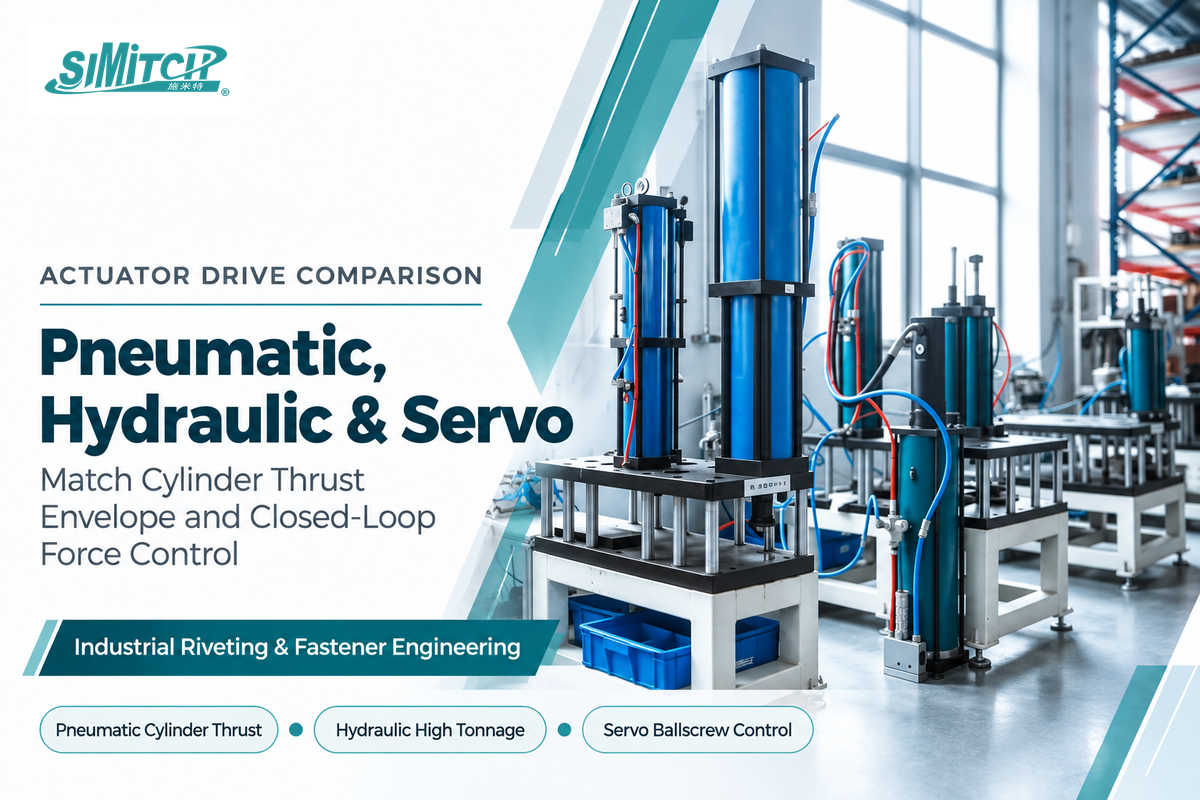
Machine Design reports pneumatic orbital units from 1,000 to 7,500 lb of thrust and hydraulic orbital presses from 6,000 to 50,000 lb. In Assembly Magazine’s analysis of servo and pneumatic heads, Orbitform notes that typical pneumatic riveters hit a ~200 lb adjustment floor while its SV-310 servo adjusts from 1 to 3,000 lb.
Minimum controllable force depends on cylinder bore, seal friction, regulator resolution, and air compressibility. Orbitform’s standard pneumatic powerhead line spans from the M-125 to the M-840. At 100 psi, the M-125 handles 0.125 in rivets with 590 lbs over a 1.5 in stroke. The M-840 reaches 0.840 in (21.4 mm) capacity with 12,700 lbs and a 2.5 in stroke. Remember that catalog diameter ratings assume mild carbon steel and require force derating before forming stainless alloys.
Passive sensors log forming data, and closed-loop automation equipment actively adjusts velocity, stroke, and dwell mid-cycle. Standard open-loop pneumatic presses fitted with LVDT stroke transducers and load cells record curves and halt bad parts without active proportional air valves. Pneumatic air-over-oil cylinders speed approach strokes before boosting thrust, yet show higher repeatability drift when shop air shifts. AGME’s SRA-12, SRA-16, and SRA-23 servo heads form 2 to 23 mm riveted head diameters in 400 N/mm² steel using 100-program controllers. Separately, Orbital Systems rates ±20 micron repeatability and ±5% load measurement to raise shift productivity and reliability. For pneumohydraulic drive cylinders and air-over-oil maintenance, see the associated guide.
| Drive Architecture | Published Force Envelope | Control Notes and Force Floor Basis | Stroke and Velocity Control | Maintenance Profile |
|---|---|---|---|---|
| Pneumatic direct cylinder | 480–7,760 lbf (Grant 80 psi); 590–12,700 lbf (Orbitform 100 psi) | Orbitform reports ~200 lb practical lower floor on standard pneumatic heads; varies by cylinder bore | Air regulator pressure plus hard stop; optional passive LVDT logging | Annual O-ring seals, clean air filters, lower purchase cost |
| Hydropneumatic air-over-oil | Mid-tonnage shop-air boosted stroke | Minimum output depends on air bore and regulator; transition pressure controls booster switch | Fast air approach followed by oil-boosted power stroke | Air seals plus hydraulic oil level and bleed inspection |
| Hydraulic cylinder press | 6,000–50,000 lbf (Machine Design orbital review) | No single lower limit spans all models; low-force control hinges on proportional valve hysteresis and seal drag | Proportional hydraulic valve flow; oil temperature shifts response | HPU pump, oil cooling, ISO 4413 circuit checks, hose life |
| Servo-electric ballscrew | 1–3,000 lb (SV-310); 2,200–7,510 lb (SV315–715); 15 kN (ER15) | SV-310 reaches 1 lb minimum; programming resolution differs from load measurement accuracy (±5% on Orbital Systems) | Programmable velocity and stroke; closed-loop force/button-height feedback varies by OEM package | Ballscrew lubrication, low utility air draw, quiet motor operation |
Machine Configurations, Peen Tooling Profiles, and Lateral-Load Fixturing
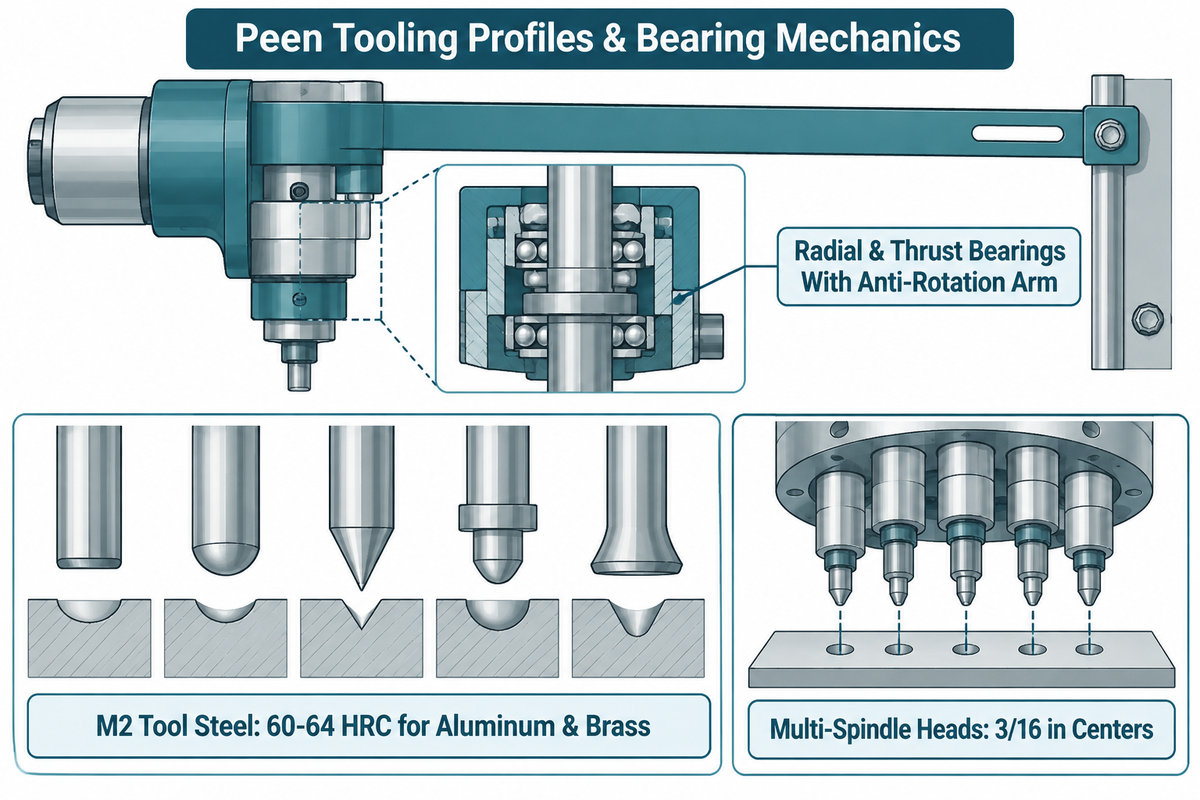
Mechanical framing scales throughput to part access across benchtop and rotary indexing stations. Grant bench powerheads deliver 480 to 7,760 lb at 80 psi with 2 million to 6 million cycles between scheduled overhauls. For tight multi-pin assemblies, Taumel multi-spindle heads hold 3/16 in centers.
Two U.S. patents show how orbital powerheads cut rotational sliding drag between the spindle and forming tool. U.S. Patent US3800579A (Langendorf Watch Co., 1974) uses a spherical cradle rocker and an eccentric shaft to pivot a wobble member through a series of conical angles. U.S. Patent US4391121A (assigned to Orbitform Inc.) adds interposed radial and thrust bearings with an anti-rotation arm to prevent the peen from spinning at full motor speed.
M2 tool steel peens hardened to 60–64 HRC handle aluminum, brass, and low-carbon steel reliably. On high-volume stainless production running 3 to 5 rivets per minute, a practitioner on Practical Machinist’s orbital and radial riveting thread found O1/HSS drill-rod peens galling in hundreds of cycles. Durable, high-performance ground carbide extended tool life, though lubrication, surface polish, and cycle dwell also govern wear. Peens used to cold-form a stake pin or head use flat, crowned, conical, captured, or flared profiles. For multi-station turntable acceptance rules, read our guide on automated assembly line integration and station acceptance.
Rivet Materials, Brittle Substrates, and Machine Force Sizing Calculations
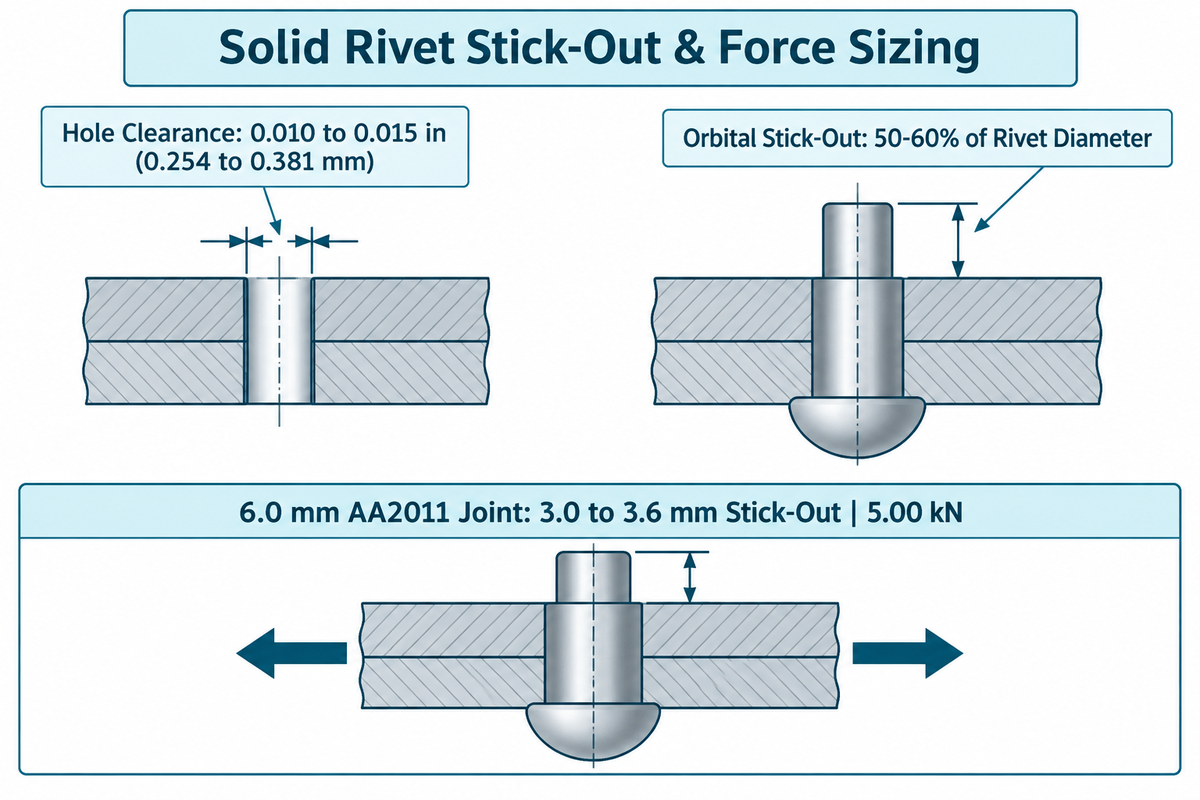
Orbitform’s solid rivet sizing specifies hole clearance of 0.010 to 0.015 in (0.254 to 0.381 mm) over rivet diameter. Recommended orbital shank stick-out is 50–60% of rivet diameter, or roughly 0.062 in on a 1/8 in pin compared with 100% stick-out for impact riveting.
Shortening the length of protrusion reduces unsupported slenderness. Full upset of the rivet alloy, however, still depends on matching rivet volume, radial confinement, and press capacity.
- Aluminum cold forming benchmarks. In JMMP 2021 aluminum orbital testing conducted across 30 AA2011 joints on AA6082-T6 sheet (157 rad/s, 4 mm/s), forces reached 5.00, 8.00 and 9.00 kN (6, 8 and 9 mm). To minimize galvanic corrosion in aluminum multi-material assemblies, Frontiers in Materials 2025 highlights AA5052-O and AA6061-T6 rivets.
- High-force steel bearing joints: On wheel-hub bearing rings with a 0.036 mm interference fit, Materials 2019 hub-bearing research recorded a 119.7 kN peak experimental load in a 300 kN press.
- Stainless work hardening and hardness limits: Compression testing in NIH PMC SUS304 data shows flow stress nearly doubling from yield to 0.4 strain at 100 °C. It drops ~225 MPa (33%) at 400 °C. Orbitform’s Solutions Lab formed 0.065 in stainless tubing walls smoothly yet saw hex distortion on thicker 0.109 in walls until switching to stepped servo tool paths. Assembly Magazine’s forming capacity guide sets a conservative 35 HRC cold metal ceiling and warm forming above 1.25 in steel. By contrast, Machine Design cites a 54 HRC alloy case.
- Composite service-load boundary: On AA5083 aluminum to 2.5–4.0 mm fiberglass joints in Metals 2022, low-force orbital forming made clean rivet heads without crushing fibers. Yet tensile loads from 2,932.6 to 3,772.9 N fractured the composite plate via net-tension or cleavage. Crack-free rivet forming alone does not establish laminate service strength.
Worked Sizing Example (AA2011 Aluminum Joint): Assumed inputs: join two pre-drilled 3.0 mm aluminum plates (6.0 mm stack) with a 6.0 mm AA2011 solid rivet. Use Orbitform’s 50–60% stick-out guideline and JMMP 2021’s measured 5.00 kN load (157 rad/s, 4 mm/s). Adding 50–60% of 6.0 mm gives 3.0 to 3.6 mm stick-out, requiring a 9.0 to 9.6 mm total rivet shank. Orbitform rates the M-125 at 590 lb and the M-240 at 1,460 lb (100 psi), while SV315 handles 2,200 lb. This AA2011 comparison provides an initial press-capacity check; final machine sizing requires forming trials on exact alloy temper, head style, and shop air pressure. Review solid and semi-tubular rivet structural families and mechanical fastener families for industrial assembly for rivet specs.
Process Monitoring, Joint Inspection, and OSHA and ISO Machine Guarding
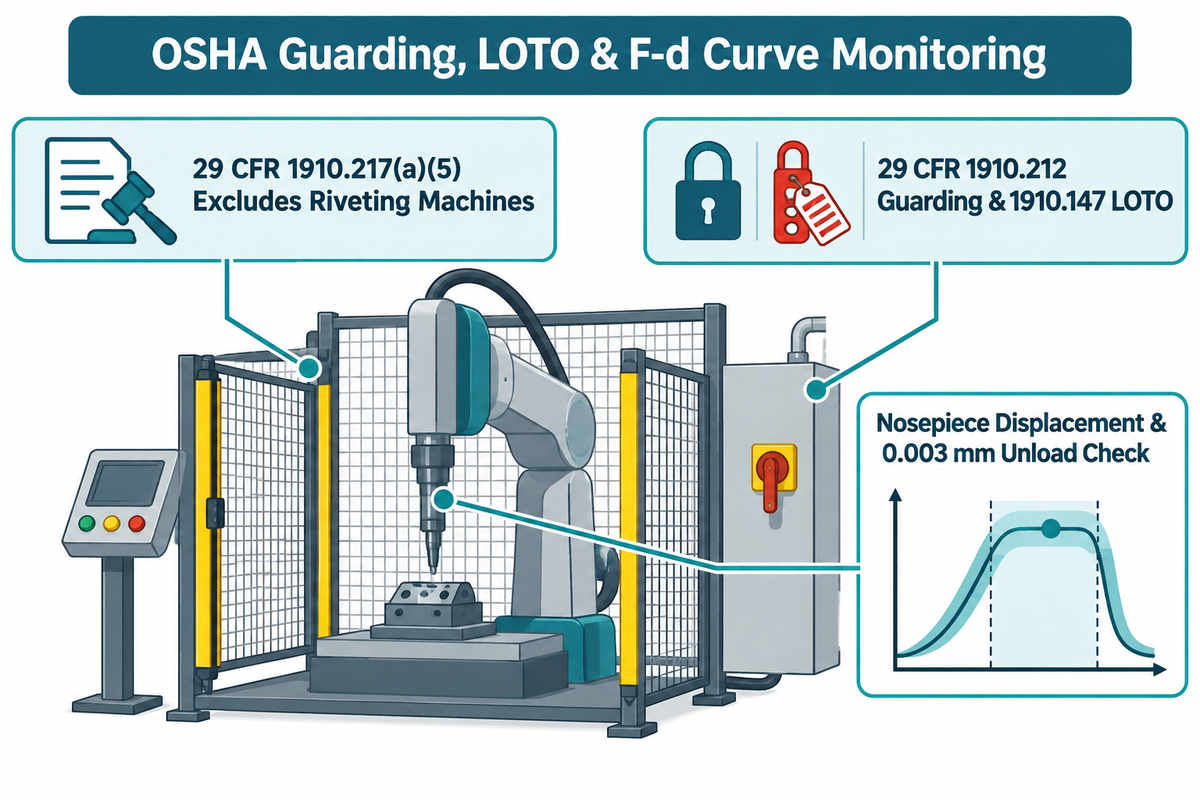
Federal U.S. standard 29 CFR 1910.217(a)(5) excludes riveting machines from mechanical power-press rules, assigning production point-of-operation guarding to 29 CFR 1910.212 while servicing requires 29 CFR 1910.147 energy isolation. Both production guarding and maintenance lockout are required on U.S. floors.
“Press brakes, hydraulic and pneumatic power presses, bulldozers, hot bending and hot metal presses, forging presses and hammers, riveting machines and similar types of fastener applicators, are excluded from the requirements of this section.”
OSHA’s July 2021 Federal Register notice (86 FR 40651) reiterates that normal operator protection relies on 1910.212 barriers, light curtains, or compliant two-hand controls meeting concurrent actuation and safety-distance requirements. Under 29 CFR 1910.147(b), push buttons and E-stops are not energy isolating devices. Technicians clearing jams or swapping peens must lock out electrical, air, hydraulic, gravity, and other stored mechanical energy and bleed pressure per 1910.147(d)(5). Internationally, ISO 12100:2010 guides machinery designers on risk assessment alongside ISO 4413:2010 hydraulic safety rules and ISO 10218-2:2025 robot cell safety (which absorbs ISO/TS 15066 collaborative force limits). Consult SIMITCH’s industrial machine guarding guide before commissioning stations.
Can an orbital riveting machine save pressing parameters and force-stroke curves?
Yes, instrumented controllers log pressing parameters, force-stroke windows, and pass/fail timestamps to microSD, PLC memory, Ethernet, or OPC UA networks. BalTec’s HPP-25 has over 40 modes across 6 control quantities, while AGME’s SRA-UCC saves 100 recipes locally or via PLC registers.
U.S. Patent US9027220B2 (Newfrey LLC) discloses a linear displacement sensor mounted directly at the nosepiece to measure punch upset independent of motor current. Even when electronic F-d curves are within tight tolerances, Orbitform cautions that captured peen tools can conceal subsurface cracks beneath visually clean crowns. Materials 2019 also reports a 0.003 mm elastic unloading error affecting hub-bearing clearance after retraction, making post-unload dimensional gages and section checks necessary.
Troubleshooting Orbital Riveting Defects and Preventive Maintenance
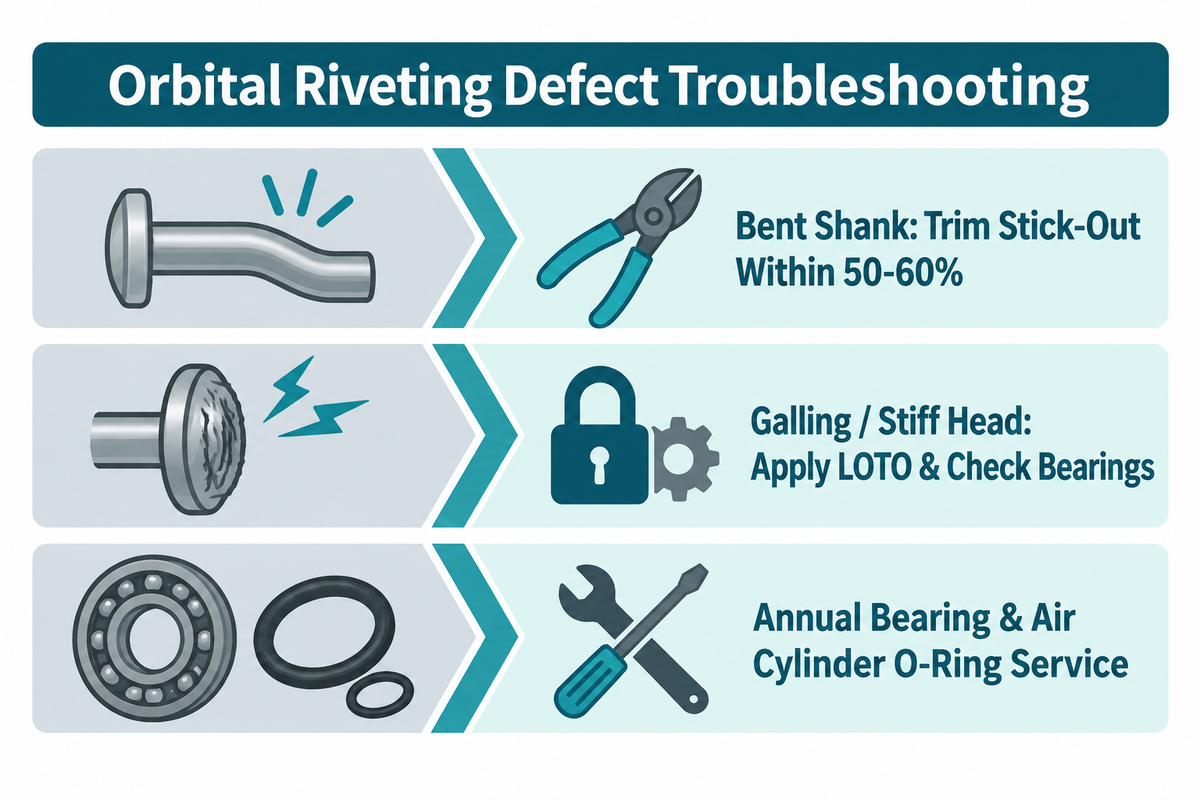
The table below maps six orbital riveting defects to documented causes, covering stick-out errors, bearing wear, Atlas Copco’s die clearances, and incoming fastener hardness drift.
Always isolate electrical, pneumatic, hydraulic, gravity, and stored mechanical energy sources and release residual pressure under 29 CFR 1910.147(d)(5) before turning a disengaged peen by hand. Orbitform suggests replacing spindle bearings and the O-rings on the air cylinder seals annually, unless the annual machine volume is very low, to prevent blow-by. Winco Stamping also states that worn peens must be replaced rather than hand reground to protect stamped surfaces.
| Observed Defect Symptom | Documented Mechanical Cause | Verified Station Fix |
|---|---|---|
| Rivet shank bent or tilted | Excessive protrusion above Orbitform’s 50–60% orbital stick-out guideline or hole clearance above 0.015 in over rivet diameter | Trim stick-out within 50–60% of shank diameter and verify 0.010–0.015 in hole clearance |
| Galling, smearing, or stiff head | Worn spindle bearings, excess grease packing, or peen galling on stainless pins | Apply full LOTO, clean/rebuild bearings, check grease volume, and test polished carbide or coated tooling |
| Concentric rings on head or sheet | Anvil die hole too tight (rings on head) or oversized (rings on substrate) | Remachine lower anvil pilot cavity to match Atlas Copco nominal die tolerances |
| Radial head cracking | Overly long cycle dwell or improper incoming rivet heat-treatment temper | Audit incoming rivet temper and ductility, then adjust dwell and peen contact profile |
| Inconsistent formed head height | Air-cylinder O-ring blow-by, line droop, or unmonitored rivet batch drift | Replace O-rings annually, hold regulated supply pressure specified by OEM, segregate lots |
| Off-center mushroom head | Non-perpendicular nest support under constant orbital side-load force | Square anvil to spindle centerline and add rigid pressure-pad clamping |
Orbital Rivet Machine Price Drivers and Comparable 8-Input RFQ Checklist
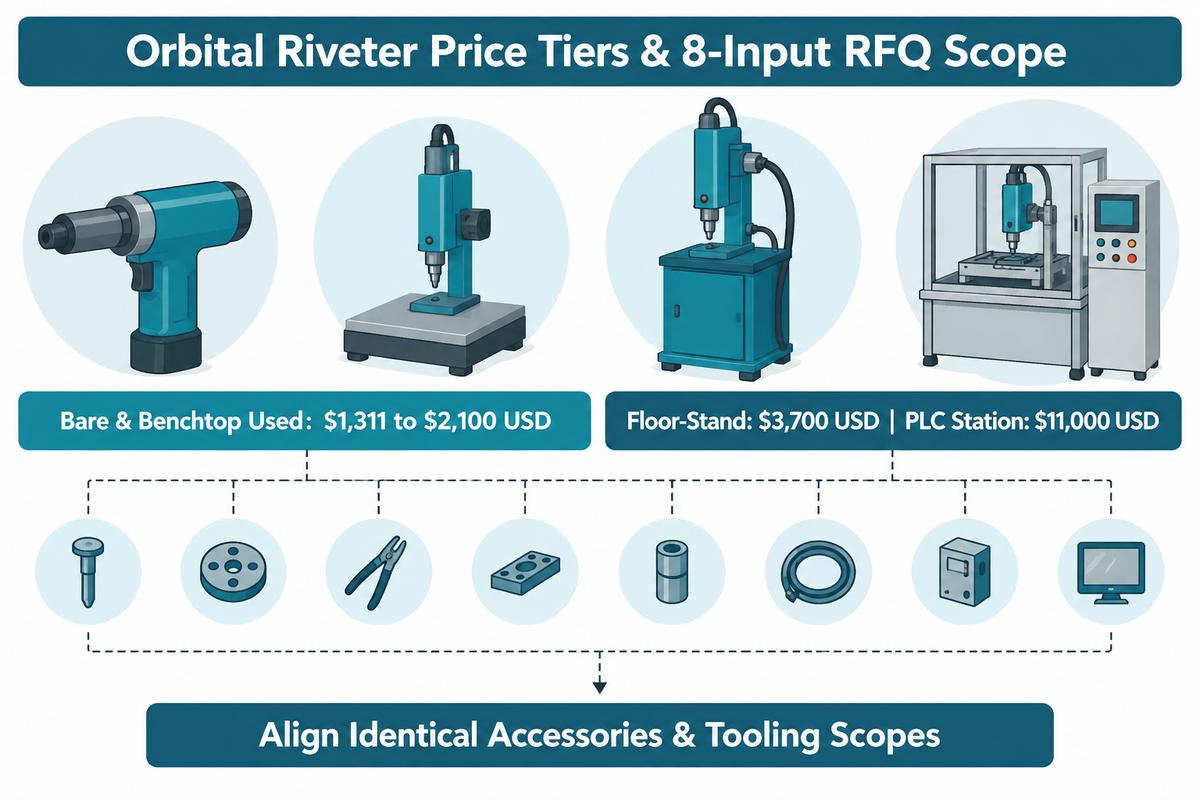
Secondary US listings on Machinio’s orbital riveting listings in November 2026 start at $1,311 USD (Bracker RN002) and $1,800 USD (bare Orbitform M-105A head). Complete machines list at $2,100 USD (benchtop Taumel BK-120NM with foot pedal), $3,700 USD (floor-stand BK-1500), and $11,000 USD (PLC-equipped Orbitform B-845-0000 station).
Bare powerhead listings omit pedestals, control cabinets, light curtains, custom peens, rotary dial tables, automatic feeders, and Factory Acceptance Testing (FAT). Unlike contract riveting services quoting per-part runs, equipment teams across various industries apply FAR 15.404-1(b)(2) proposal analysis rules to align identical accessories before comparing supplier quotes. Review SIMITCH industrial riveting equipment scope to align automated cell requirements.
What should you inspect before buying used orbital riveting equipment?
There are six things to consider when purchasing used orbital hardware. Confirm rated force, stroke, and throat ratings first. Isolate electrical, air, hydraulic, gravity, and stored mechanical energy before spinning the peen for rough bearings. Last, safely test pressure cylinder seals, audit PLC parts, and check guarding, OEM serial numbers, and live sample parts.
Listing photos of older components may give a false sense of security about controller parameter edits. 1980s BalTec RN281 digital controllers are reported by machinists on Practical Machinist to be locked against cycle time edits. The factory manual is required to switch startup parameter 0 to 1, making live adjustment tests advisable before payment.
8-Input Comparable RFQ Specification Checklist
| RFQ Input # | Parameter to Specify | Engineering Baseline / Starting Target |
|---|---|---|
| 1 | Rivet print, alloy grade, and hardness | Solid/semi-tubular shank diameter, 50–60% of rivet diameter orbital stick-out (Orbitform); steel cold capacity depends on alloy/diameter (Assembly Magazine notes ≤35 HRC baseline) |
| 2 | Sheet stack thickness and bottom substrate | Layer gages, surface coatings, and brittle Bakelite or composite sheet limits |
| 3 | Hole clearance and pocket throat access | 0.010–0.015 in (0.254–0.381 mm) over rivet diameter; minimum flange wall clearance |
| 4 | Drive architecture and OEM capacity class | e.g., Orbitform pneumatic M-125 (590 lb) to M-840 (12,700 lb @ 100 psi), SV-310 servo (1–3,000 lb), or hydraulic presses (6,000–50,000 lb range per Machine Design; verify OEM model curves) |
| 5 | Target cycle speed and part feeding | 0.5–2.0 s solid-steel orbital cycle (Taumel); manual load vs. rotary dial or automatic blow-tube feed |
| 6 | Process control, sensing, and data export | Specify passive F-d window logging (e.g., HPP-25), active closed-loop servo regulation, and PLC/OPC UA curve archiving separately |
| 7 | Safety guarding and LOTO standard | OSHA 1910.212 safeguarding + 1910.147 multi-energy LOTO; ISO 10218-2:2025 for robot cells |
| 8 | FAT/SAT acceptance and annual spares scope | Head height, destructive cross-section, pull/backlash spec, and annual seal/bearing kit |
Orbital Rivet Machine Manufacturers and Sheet-Metal Joining Alternatives
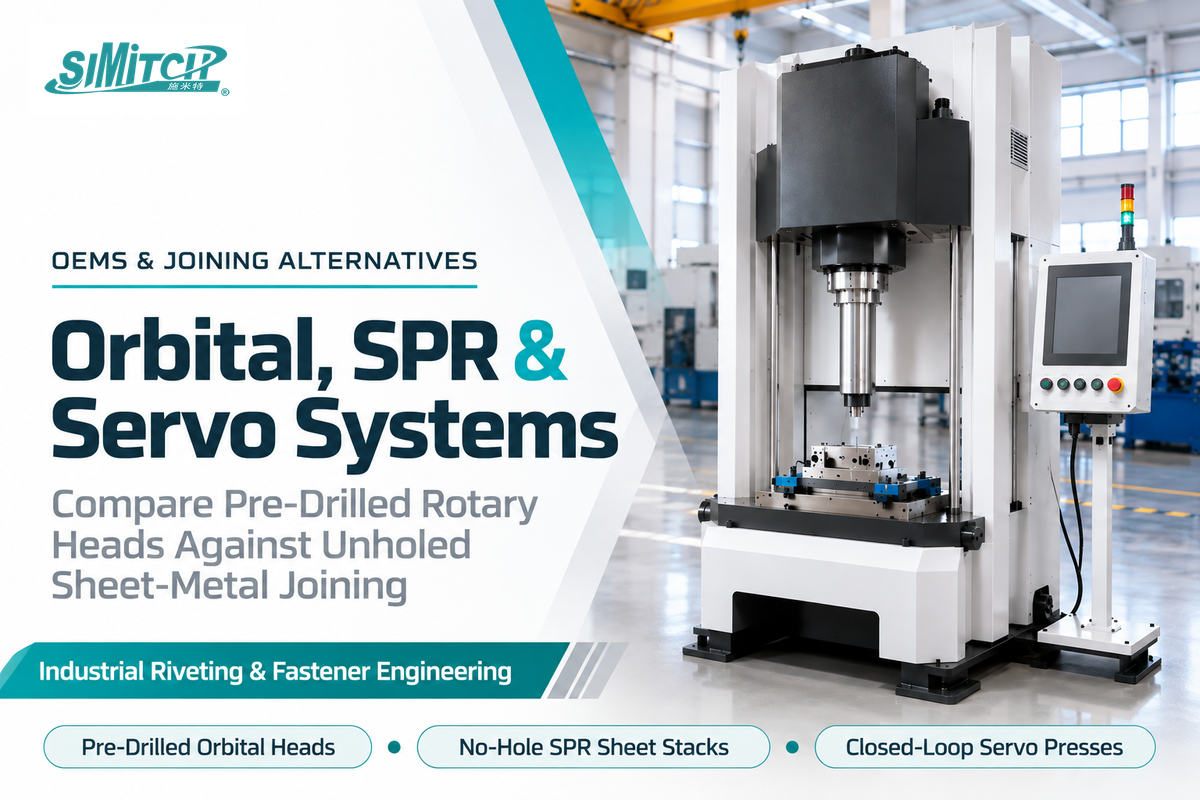
BalTec, Orbitform, AGME, Taumel, Grant Riveters, and Orbital Systems are some of the rotary OEMs building standalone orbital riveters and radial heads for pre-drilled fasteners. By contrast, high-speed production lines joining unholed aluminum-steel stacks can use C-frame self-piercing riveting (SPR) or servo presses with clinching tooling.
Selecting a linear servo press alone won’t complete an unholed joint: engineers pair the controllable servo actuator with dedicated SPR dies, clinching punches, or pin insertion tooling. As Assembly Magazine’s self-piercing riveting analysis and Design World’s SPR guide reveal, SPR joins 1.6 to 8 mm stacks without pre-drilled holes. The top sheet requires at least 0.5 mm and the ductile bottom sheet at least 1.0 mm, so that the semi-tubular rivet can flare cleanly inside the lower sheet. On thick or high-strength automotive stacks, insertion loads reach 60 to 85+ kN. On the other hand, brittle press-hardened steel on the die side limits ductile flare and risks cracking.
Founded in 2006 in Taicang, Suzhou, SIMITCH engineers and manufactures automated cold-joining machinery rather than standalone orbital powerheads. Our production lines cover 50 or 75 kN hydro-pneumatic SPR presses and 5T or 8T CNC servo SPR systems with 100 or 200 mm strokes. SIMITCH also supplies 80 kN servo riveting assembly systems (200 mm stroke, 0–333 mm/s, ±2% force accuracy, 0.01 mm repeat positioning, 2×35 feeders) alongside BP assembly presses and clinching lines. Compare vendors across our industrial riveting machine manufacturers comparison, practical self-piercing riveting joint validation guide, and self-piercing riveting SPR machines for sheet-metal stacks.
| Assembly Condition | Pre-Hole | Access Side | Force and Stack Boundary | Recommended Machine Process | Representative OEM Role |
|---|---|---|---|---|---|
| Pre-drilled solid mild steel pin | Yes | Two-sided | ~80% less axial force vs. impact; 480–50,000 lbf across pneumatic/hydraulic | Pneumatic or hydraulic orbital | BalTec, Orbitform, Taumel, Grant |
| Fragile ceramic or Bakelite base | Yes | Two-sided | Negligible lateral force; minimal tool slip | Radial 11-loop rosette riveter | BalTec, Orbitform radial modules |
| Ultra-small 0.02 in brass contact | Yes | Two-sided | Down to 1–10 lb programmable thrust (SV-310) | Electromechanical servo orbital | Orbitform SV-310, BalTec ER15 |
| High-mix 2–23 mm steel rivet heads | Yes | Two-sided | 400 N/mm² steel rated, 100 saved recipes | Closed-loop electric servo orbital | AGME SRA-12/16/23 |
| Tight multi-pin bracket (≤0.25 in spacing) | Yes | Two-sided | Center distances down to 3/16 in | Multi-spindle orbital head | Taumel multi-point orbital systems |
| Coated dissimilar sheet stack (Al-steel) | No | Two-sided C-frame | 1.6–8 mm stack; 50–85+ kN (50/75 kN SIMITCH; 60–85+ kN auto) | Self-piercing riveting (SPR) | SIMITCH SPR (50/75 kN; 5T/8T), Henrob |
| Automated linear pin / bushing press | Yes | Two-sided | Up to 80 kN, ±2% force, 0.01 mm repeat | Closed-loop servo assembly system | SIMITCH 80 kN servo systems, Promess |
| Zero-consumable ductile sheet joint | No | Two-sided C-frame | Cold sheet interlock without added rivet | Mechanical clinching press | SIMITCH clinching systems, ECKOLD |
| Enclosed hollow box section | Yes | One-sided blind | Mandrel break load from accessible side | Blind break-mandrel or locked tool | Atlas Copco, Stanley Engineered Fastening |
Industry Outlook: Closed-Loop Servo Control and Automated Fastening Integration
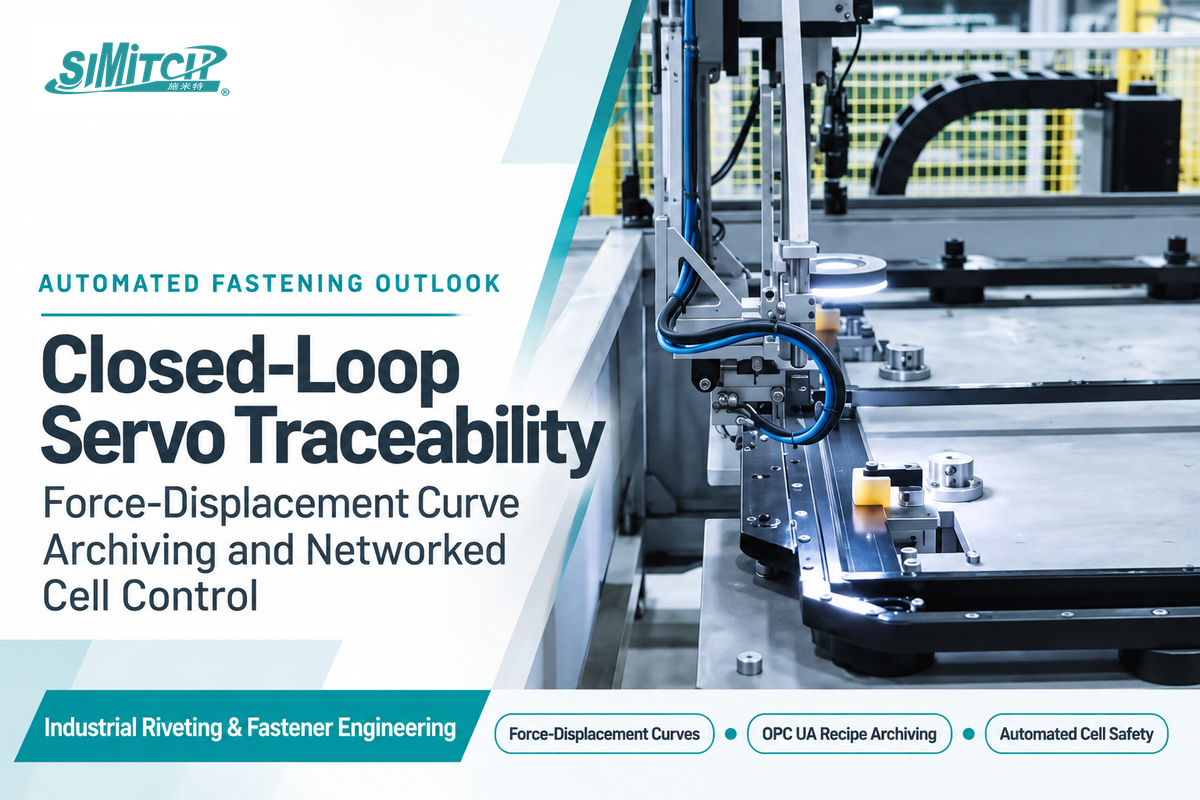
When sizing machines for 2026–2027 capital budgets, buyers increasingly choose networked servo monitoring over basic air presses for product-liability records and EU control compliance. As reported in Assembly Magazine’s December 2024 Stadler Rail report, rolling-stock plants already run Curve Anomaly AI software to flag irregular force-distance and torque-angle curves in production.
Control standards tighten that hardware choice. Under the EU Machinery Regulation taking effect in January 2027, as detailed in SICK’s ISO 10218:2025 safety summary, control architectures must defend safety functions against accidental or malicious interference. Networked controllers such as BalTec HPPi add OPC UA communication, though plant integrators still verify full cell cybersecurity compliance separately.
For broad market scope covering robotic riveters, SPR presses, and rotary heads combined, GlobeNewswire’s November 2026 forecast tracks total automated riveting systems. That GlobeNewswire report estimates global spending growing from $3 billion in 2025 to $3.27 billion in 2026 and $4.65 billion by 2030 (9.2% CAGR). If your line joins unholed sheet stacks, or you need a traceable force-displacement curve, share your stack drawing and takt time with the SIMITCH team. We can help evaluate closed-loop servo riveting assembly systems and SPR lines.
Frequently Asked Questions About Orbital Rivet Machines
How much does an industrial orbital rivet machine cost?
Used orbital machines listed on Machinio in November 2026 span $1,311 to $2,100 USD for bare heads and benchtop units. Floor-stand models run $3,700 USD, and PLC-equipped stations reach $11,000 USD.
Custom carbide peens, pedestals, safety light curtains, vibratory feeders, PLC curve archiving, and Factory Acceptance Testing significantly increase the cost of a new turnkey cell once they are engineered around a specific workpiece. Buyers compare contract riveting services or turnkey machine builds against bare heads by adjusting new and used vendor quotes for differing terms, accessories, and tooling scopes.
What is the difference between orbital riveting and radial riveting?
Orbital heads sweep a tilted bearing-mounted peen around a continuous circular track suited to higher cycle rates. Radial heads trace an 11-loop rosette through the rivet center without rotating the tool.
In precision tooling comparisons in Assembly Magazine, radial riveting produces negligible lateral force and a gentler surface flow on fragile ceramic, Bakelite, or plated pins. Conversely, orbital riveting accommodates simpler spindle drive mechanisms and close multi-point centerlines where supported assemblies handle the outward fixture force, while fragile assemblies favor radial heads.
Can an orbital rivet machine form stainless steel and plated rivets without galling?
Yes, when press force respects alloy work-hardening limits, bearing rotation stays smooth, and ground carbide peens undergo trial verification on the target fastener lot.
NIH PMC testing shows SUS304 flow stress nearly doubles by 0.4 compressive strain, and Orbitform’s Solutions Lab saw hex distortion on 0.109 in stainless walls. Brittle O1/HSS peens can gall rapidly at production speeds, whereas polished carbide tools, stepped servo tool paths, and sample trials help protect plated and stainless crowns.
What peen tilt angle do most industrial orbital riveting machines use?
Industrial orbital riveting heads operate at fixed spindle inclinations between 3° and 6°, with BalTec standard orbital tooling standardized at 3° or 5° inclinations.
Fixed inclination dictates tool length and free working height while keeping axial deformation constrained to the contact line.
Why does a long or slender rivet shank bend during orbital riveting, and how do you stop it?
Slender shanks bend sideways when forming loads exceed the protruding shank’s critical buckling limit or when lower nest alignment allows the stack to shift.
Verify required formed-head upset volume using Orbitform’s 50–60% stick-out starting point and maintain close pilot-hole clearance. Brace with a rigid anti-rotation fixture or a pressure pad and switch to radial forming if the parts are too narrow to allow clamping.
Does OSHA 29 CFR 1910.217 mechanical power press regulation apply to orbital riveting machines?
No, 29 CFR 1910.217(a)(5) excludes riveting machines, assigning production guarding to 29 CFR 1910.212 and servicing lockout to 1910.147.
Normal production uses barrier guards, light curtains, or OSHA-compliant two-hand controls with concurrent actuation and safe-distance spacing. Tool changes require locking out electrical, air, hydraulic, gravity, and stored mechanical energy.
When should a sheet-metal assembly line choose self-piercing riveting (SPR) instead of orbital riveting?
Choose C-frame self-piercing riveting for overlapping 1.6 to 8 mm aluminum or steel stacks lacking pre-drilled holes. Both sides must permit tooling access and the press must deliver 50 to 85+ kN insertion force.
SPR flares the rivet inside the ductile lower sheet against a forming die, matching SIMITCH’s 50/75 kN or 5T/8T machines and high-strength automotive stacks. Retain orbital or radial forming assemblies where pre-drilled solid pins, stepped hinge pivots, and brittle substrates are relied upon.
References & Sources
- U.S. Occupational Safety and Health Administration (OSHA): 1910.217 – Mechanical power presses
- U.S. Occupational Safety and Health Administration (OSHA): 1910.147 – The control of hazardous energy (lockout/tagout)
- U.S. General Services Administration (FAR): 15.404-1 Proposal analysis techniques
- ISO: ISO 12100:2010 – Safety of machinery: Risk assessment and risk reduction
- ISO: ISO 10218-2:2025 – Robotics safety requirements: Industrial robot applications and robot cells
- ISO: ISO 4413:2010 – Hydraulic fluid power safety rules
- Di Bella et al. (Metals, 2022) “The Effect of Thickness on Strength of Single Lap Orbital Riveted Aluminum/Composite Joints Used in Marine Environments”
- Materials (2019, 12(22), 3785), Study on the Forming Process and Deformation Behavior of Inner Ring in the Wheel Hub Bearing Based on Riveting Assembly
- Di Bella et al. (JMMP, 2021): Effect of Sheets’ Thickness and Rivet Geometry on Mechanical Properties of Orbital Riveted Aluminium Joints: Experimental and Numerical Analysis
- NIH PMC (Materials, 2020, PMC7700464): Automatic Multi-Stage Cold Forging of an SUS304 Ball-Stud with a Hexagonal Hole at One End
- Du et al. (Frontiers in Materials, 2025): Mechanical Joining in Lightweight Multi-Material Structures
- USPTO / Google Patents: US3800579A – Wobble riveting machine
- USPTO / Google Patents: US4391121A – Orbital tool assembly for forming rivet heads
- USPTO / Google Patents: US9027220B2 – Rivet setting machine
- Machine Design: Radial and Orbital Riveting Add Finesse to Fastening and Joining
- Assembly Magazine (John Sprovieri): Orbital and Radial Forming for Delicate Assemblies
- Assembly Magazine (Jim Camillo): What’s New With Orbital and Radial Forming
- Assembly Magazine (Adam Cort): Orbital and Radial Forming
- Assembly Magazine: Advances in Self-Piercing Riveting
- Assembly Magazine (Dec 2024): Railcar Manufacturer Masters High-Mix Production
- Design World (Dr. Jeff Muelaner): What is Self-Piercing Riveting?
- Engineer Live: Consider spin and orbital riveting
- SICK AG Safety Briefing: What Is New in ISO 10218:2025?
- Machinio (Nov 2026): New & Used Pneumatic Orbital Riveting Machine Listings
- GlobeNewswire (Nov 17, 2026): Global Automated Riveting Systems Market Report 2026–2030
Related Posts

WHY WE WRITE THIS
About SIMITCH
SIMITCH develops sheet-metal joining equipment for clinching, riveting, servo pressing, pneumohydraulic drive and hot-melt connection applications. Our engineering team starts with the material stack, access envelope, cycle target and acceptance method before recommending a machine route.
Founded in 2006 in Taicang, Jiangsu, SIMITCH combines research and development, in-house production and global sales. These guides turn field experience into practical decision support for process engineers, plant teams and industrial buyers.
OUR EXPERIENCE
Since 2006
Equipment engineering, machining, assembly and joint validation under one manufacturing system.
OUR EXPERTISE
Five joining routes
Clinching, riveting, SPR, precision press-fit and hot-melt connection for production lines.