Get in touch with Suzhou Simitch Machinery Co., Ltd Company

Types of Fasteners: Bolts, Screws, Nuts, Rivets, Inserts and Clinch Hardware

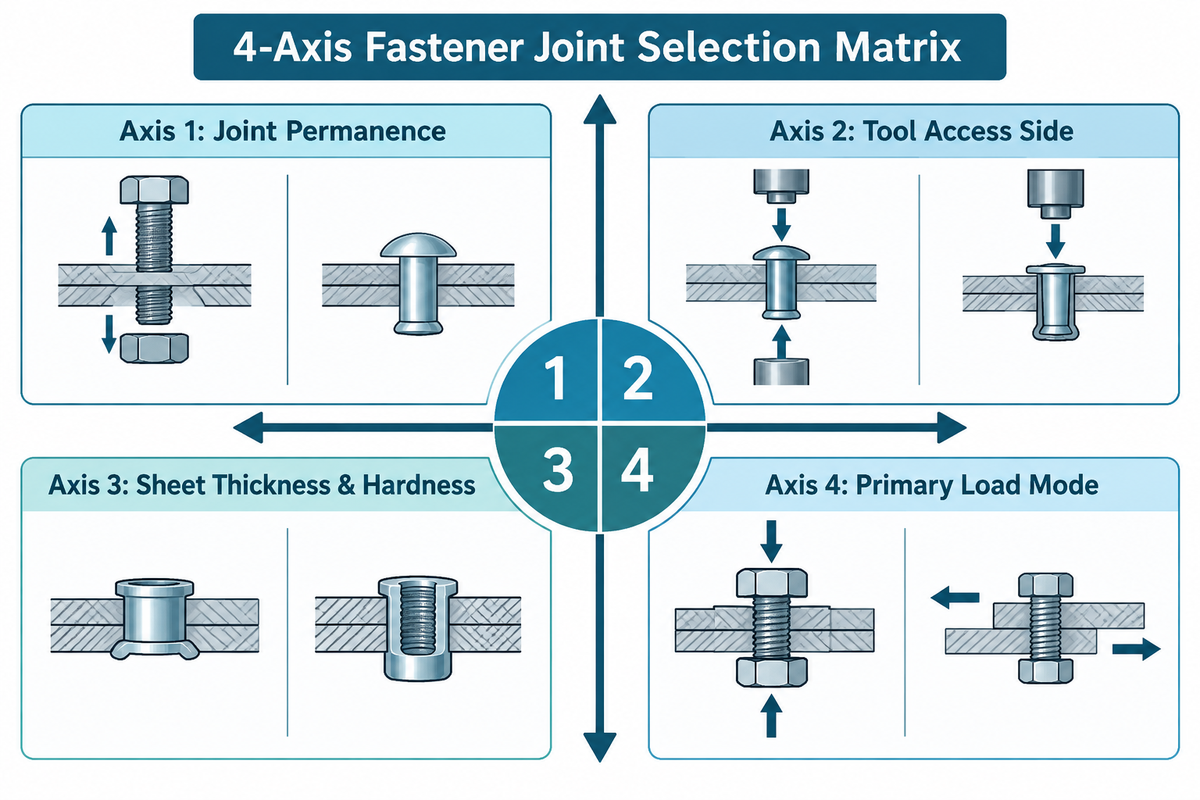
Four joint checks, permanence, tool access, sheet thickness, and load direction, determine the selection of the types of fasteners. Permanent fasteners such as solid rivets, blind rivets, and self-piercing rivets deform plastically to lock structural joints against vibration.
Many different types of fasteners exist, from wood screws at a local hardware store to specialized types in aerospace assembly. Knowledge of each common fastener, common fastener types, and variety of types helps select the fasteners you need. This manual compares common types of screws, different types of bolts, versatile types of inserts and rules of automated assembly.
How Are Different Types of Fasteners Classified by Permanence, Access, and Joint Load?
Engineers classify different types of fasteners first by whether the joint is removable or permanent, and second by tool access. Every common type of fastener either unthreads cleanly for maintenance or deforms permanently during installation. These joints can’t be fully disassembled.
According to the NASA Fastener Design Manual (NASA-RP-1228), to select the correct types of fasteners, the hardware geometry has to match the joint load path. Tensile joints, for instance, use axial bolt preload to clamp the surfaces of the joints together. Shear joints, on the other hand, rely on an unthreaded shank, dowel pin, or rivet body that’s built on industrial riveting equipment to prevent sliding.
The 4-Axis Fastener Joint Selection Matrix
We screen industrial fasteners in our 4-Axis Fastener Joint Selection Matrix under four engineering constraints before you evaluate catalog dimensions. Use these four axes sequentially when selecting a fastener for a new assembly:
- Axis 1 (Joint Permanence): Use clevis pins or retainers if the cover must be opened for service. Choose solid rivets, blind rivets, or self-piercing rivets when the structure stays closed for its entire service life.
- Axis 2 (Tool Access Side): Standard nuts and bolts, solid rivets, and self-clinching nuts require access to both sides of the workpiece. Blind rivets, blind rivet nuts, and self-drilling screws install from one side when a box section blocks rear access.
- Axis 3 (Sheet Thickness and Hardness): Thin sheet metal can’t support enough cut threads to withstand stripping under load. Use self-clinching inserts in ductile sheet metal which is softer than the insert, or blind rivet nuts in harder tubes.
- Axis 4 (Primary Load Mode): Axial clamping preload across flanges is produced by high-strength hex bolts and head cap screws. Shoulder bolts, dowel pins and structural rivets, in the transverse shear position, provide load across smooth cylindrical shanks.
How Many Types of Fasteners Are There Across Workshop and Industrial Charts?
Mechanical engineering textbooks group the most common types into five basic families: bolts, screws, nuts, washers, and rivets. Workshop reference charts split those into seven or nine families by including pins, retaining rings, threaded inserts and masonry anchors. Each added fastener type solves a substrate or alignment challenge that standard nuts and bolts cannot handle alone. Each.
According to the MIT D-Lab Fasteners engineering guide, threaded fasteners and semi-permanent rivets have specific uses in metal and wood fabrication. See the selection matrix below and compare the ten primary fastener families.
| Row | Fastener Family | Joint Permanence | Tool Access Required | Primary Load Mode and Substrate | Typical Industrial Examples |
|---|---|---|---|---|---|
| 1 | Externally threaded bolts | Removable | Two-sided (wrench on nut and head) | High axial tensile clamp preload and shank shear in clearance holes | Hex bolts, carriage bolts, flange bolts, structural heavy hex bolts |
| 2 | Externally threaded screws | Removable | One-sided into tapped or self-formed hole | Light-to-high clamping in metal, wood, or plastic | Machine screws, socket head cap screws, sheet metal screws, wood screws |
| 3 | Studs and threaded rod | Removable nut on fixed or through stud | One-sided (tapped/welded stud) or two-sided | High-cycle tension in manifolds, flanges, and hanging pipelines | Double-end studs, weld studs, fully threaded rod, tap-end studs |
| 4 | Nuts and lock nuts | Removable (prevailing torque decays with reuse) | Rear access required to seat nut on bolt or stud | Internal thread engagement and vibration resistance | Hex nuts, nylon lock nuts, all-metal prevailing-torque nuts, castle nuts |
| 5 | Washers | Removable companion hardware | Installed under bolt head or nut face | Bearing stress distribution, hole spanning, or preload retention | Flat washer, conical Belleville washer, wedge-locking washer, split lock washer |
| 6 | Solid and semi-tubular rivets | Permanent | Two-sided (bucking bar or riveting die anvil) | High shear and fatigue resistance in aircraft and hinges | Universal-head solid rivets, countersunk rivets, oval semi-tubular rivets |
| 7 | Blind rivets and lockbolts | Permanent | One-sided (blind rivets) or two-sided (swaged lockbolts) | Sheet metal shear (open-end blind) or heavy structural clamp (lockbolts) | Open-end pop rivets, closed-end blind rivets, structural retained-mandrel rivets |
| 8 | Self-piercing rivets (SPR) | Permanent | Two-sided C-frame punch and die access | High-strength shear and peel in unpunched aluminum and multi-material sheets | Semi-tubular steel or boron-steel self-piercing rivets for automotive enclosures |
| 9 | Self-clinching hardware and inserts | Permanent body with removable mating screw | Two-sided press anvil (clinch) or one-sided (rivet nut) | Reusable load-bearing internal or external threads in thin sheet metal | PEM self-clinching nuts, flush standoffs, clinch studs, blind rivet nuts, wire inserts |
| 10 | Pins, retaining rings, and anchors | Removable (pins/clips) or permanent (concrete wedge anchors) | Press/groove access (pins/rings) or drilled substrate (anchors) | Precision shear alignment (dowel pins), axial shoulder retention, or masonry fixing | Dowel pins, spring pins, cotter pins, circlips, wedge anchors, toggle bolts |
Externally Threaded Types of Screws, Bolts, Studs, and Threaded Rod
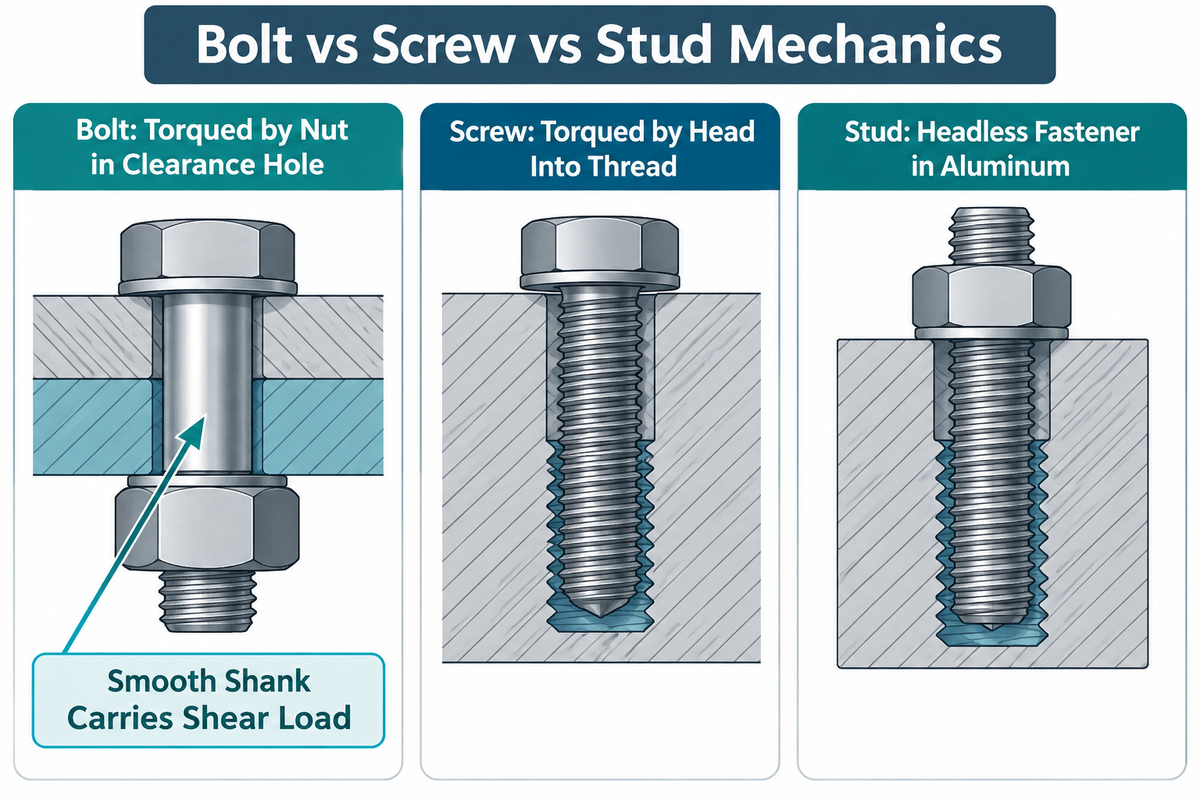
Externally threaded fasteners include bolts, screws, studs, and threaded rod that generate clamping force through helical thread pitch. In shops, small and large fasteners are often referred to as screws and bolts, respectively; however, in engineering practice, they’re distinguished by how the tightening torque is applied. Using the wrong externally threaded fastener can place fragile thread roots across a shear plane.
Across global manufacturing, these externally threaded fasteners are used in machinery, enclosures, and structural frames. Because they’re widely used in industries such as electronics, appliances and heavy equipment, engineers must carefully separate bolts from screws.
How Does ASME B18.2.1 Separate a Bolt From a Screw When Both Use External Threads?
Under ASME B18.2.1 and the NASA Fastener Design Manual, a bolt is an externally threaded fastener inserted through clearance holes and tightened by torquing a nut. A screw is an externally threaded fastener inserted into holes and tightened by torquing its head into a preformed or self-formed internal thread.
This mechanical rule explains why Fractory’s engineering fastener classification treats hex cap screws and machine screws as screws even when they’ve flat ends. Compare the major types of bolts and types of screws below:
- Hex Bolts and Structural Bolts: Standard hex bolts have a six-sided head and an unthreaded shank grip length. Position the smooth shank across the joint interface so the full cylinder diameter carries transverse shear loads.
- Carriage Bolts: Carriage bolts feature a smooth domed head and a square neck directly beneath the head. The square neck of the bolt stops it from turning.
- SOCKET HEAD CAP SCREWS: Used in machine tooling, dies, and compact automotive housings, high strength alloy steel screws have an internal hex drive, recessed in a cylindrical head.
- Machine Screws: Machine screws are smaller externally threaded fasteners driven by Phillips, slotted, or Torx drivers.
- Sheet Metal Screws and Self-Tapping Screws: Sheet metal screws have sharp threads that cut or deform mating threads in thin metal or plastic. Self-tapping screws require a pilot hole, whereas self-drilling screws integrate a fluted point that drills and taps in one pass.
- Wood Screws and Deck Screws: Wood screws have a coarse thread pitch, a tapered point, and an unthreaded upper shank. Outdoor deck screws have bugle heads and a corrosion resistant finish.
- Studs and Threaded Rod: A stud is a headless externally threaded fastener that prevents wear in tapped aluminum housings. A continuous threaded rod is cut to length for structural tie-downs and a anchor bolts to hanging pipelines.
According to the NASA Fastener Design Manual (NASA-RP-1228), full thread engagement requires the bolt end to extend past the nut face. This allows the nut to engage the full thread crests instead of the chamfered tip.
Nuts and Bolts Pairing: Lock Nuts, Flat Washer, and Lock Washer Types
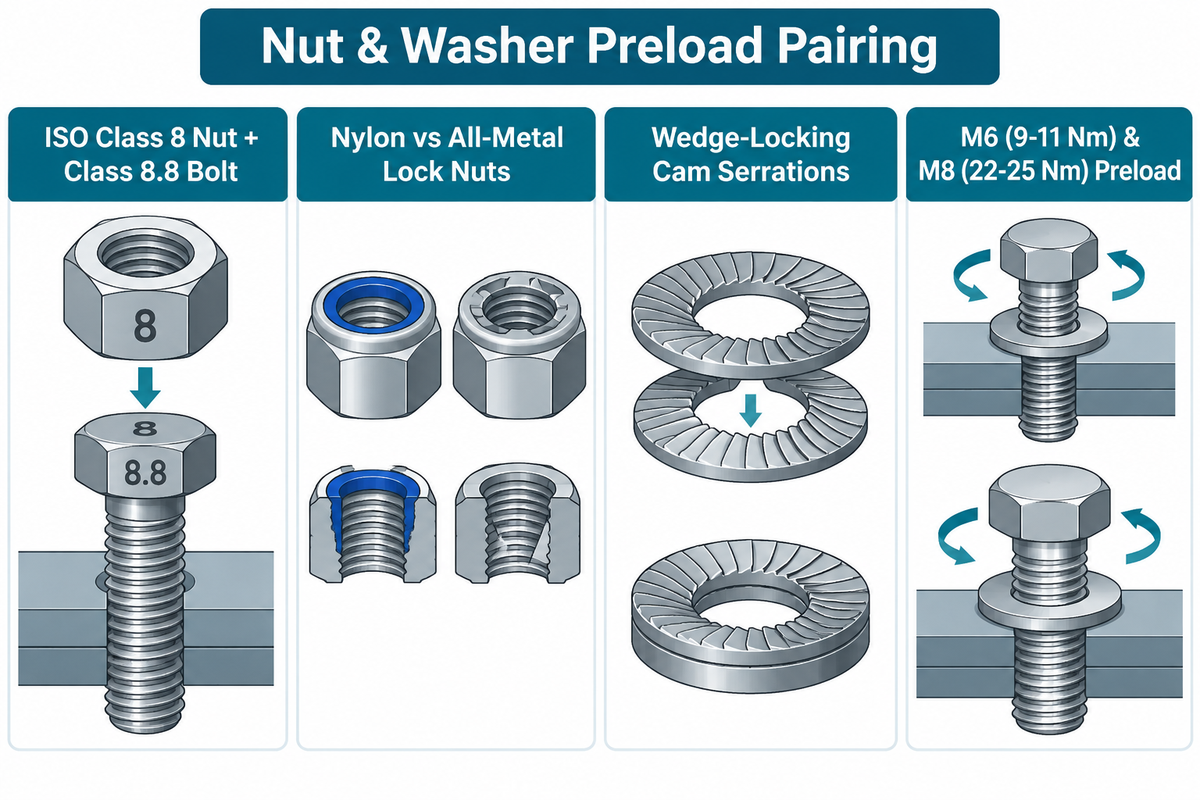
Nuts and bolts work as a matched clamping system where the nut provides internal threads and the washer controls bearing stress. In industrial assemblies, nuts are used to convert applied wrench torque into axial bolt tension. Using the wrong nut or washer grade causes thread stripping, surface crushing, or self-loosening.
Always match the nut strength class to the mating bolt, such as pairing an ISO Class 8 nut with a Class 8.8 bolt. Review the primary types of nuts and types of washers before finalizing a bolted joint:
- Hex Nuts and Cap Nuts function as internal threads in general machinery. Heavy hex nuts are used with structural steel. Domed cap nuts cover threads.
- Nylon Lock Nuts and All-Metal Lock Nuts: A nylon collar in a nylon lock nut engages the thread of a bolt to resist vibration loosening. In high temperature exhaust and oven zones, all-metal lock nuts should be specified. Also note, the prevailing torque of a lock nut drops with each time it’s removed and reinstalled.
- Slotted Nuts and Castle Nuts: Castle nuts have radial slots on the turret top. Technicians slide a cotter pin or safety wire through the drilled bolt to lock the wheel spindle.
- Flat Washer Types: A flat washer is a stamped or machined disc placed between a bolt and a nut to spread clamping stress over a larger area to prevent crushing soft materials.
- Belleville Conical Washers and Wedge-Locking Washers: Belleville conical spring washers are used to provide stiffness to axial springs to compensate for thermal expansion and gasket creep. Two-piece wedge-locking washers, on the other hand, use radial serrations and inner cams to lock the joint under transverse vibration.
What about traditional helical split lock washers? According to Assembly Magazine’s analysis of bolted joint integrity and YT Fasteners’ spring washer engineering guide, helical split lock washers aren’t always effective under severe transverse vibration. In YT Fasteners’ torque reference, an M6 joint tightened to 9–11 Nm (~5.5 kN target preload) or an M8 joint at 22–25 Nm (~10.5 kN preload) compresses a split lock washer flat. When properly loaded, a split lock washer functions like a plain washer, so proper axial preload, wedge washers, or anaerobic threadlockers must provide locking function.
Permanent Fastener Types: Solid Rivets, Blind Rivets, Lockbolts, and Self-Piercing Rivets (SPR)
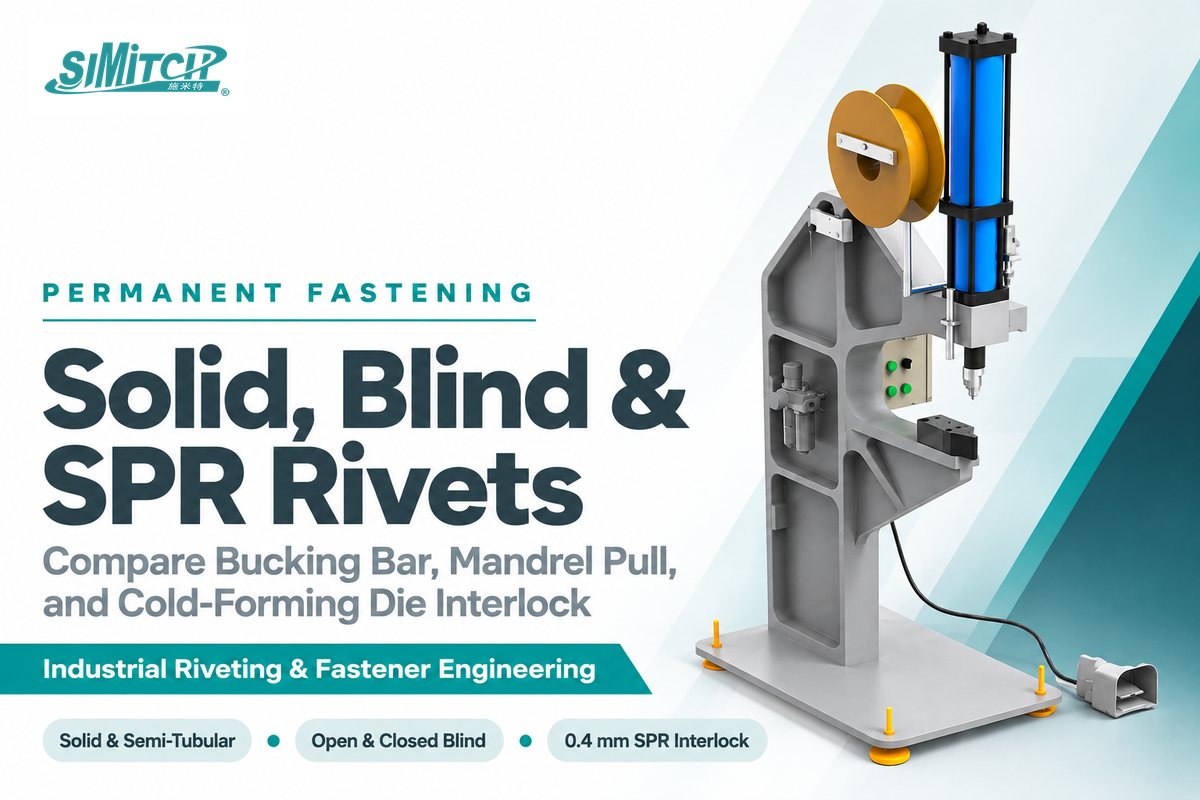
Rivets are permanent fasteners join two or more plates by plastically deforming a cylindrical metal tail or collar. Lack of threads to unwind means properly set rivets provide superior vibration resistance and lower weight compared to nuts and bolts. Knowledge on how the industrial riveting process forms permanent joints helps engineers correlate rivets to the type of joint used.
In numerous assemblies including airframes, appliances and body-in-white, rivets are used wherever permanent shear integrity is essential. Compare the four main types of rivets below:
- Solid Rivets and Semi-Tubular Rivets: Solid rivets consist of a single shaft with a preformed head driven against a bucking bar or riveting die. Semi-tubular rivets are similar to solid rivets, except they have a shallow axial hole at the tip, which upon driving the rivet, rolls the tail out to the side.
- Open-End and Closed-End Blind Rivets: Blind rivets are installed where tool access is from only one side of the assembly. Closed-end blind rivets seal the tail completely to block water and gas leakage.
- Structural Blind Rivets and Lockbolts: Standard open-end pop rivets carry lower shear and tensile clamp loads than bolts. Structural blind rivets mechanically lock the broken mandrel pin in the shear plane. Two-piece swaged lockbolts cold-form a metal collar into annular locking grooves for heavy truck and rail frames.
- Self-Piercing Rivets (SPR): In one single cold-forming stroke without previous drilled holes, a punch drives a semi-tubular rivet through the top sheet, and a die flares the skirt into the bottom sheet. As Atlas Copco’s engineering guide on self-piercing rivet joints mentions, a designed interlock of 0.4 mm may still work at 0.35 mm when proved by testing.
Because self-piercing riveting is reliant on controlled skirt flare and bottom-sheet thickness, production teams monitor head flushness and cross-section interlock closely. Consult our technical guide on diagnosing self-piercing riveting joint defects for rules on cross-section acceptance.
Sheet Metal Fastener Insert Types: Self-Clinching Nuts, Standoffs, Studs, and Rivet Nuts
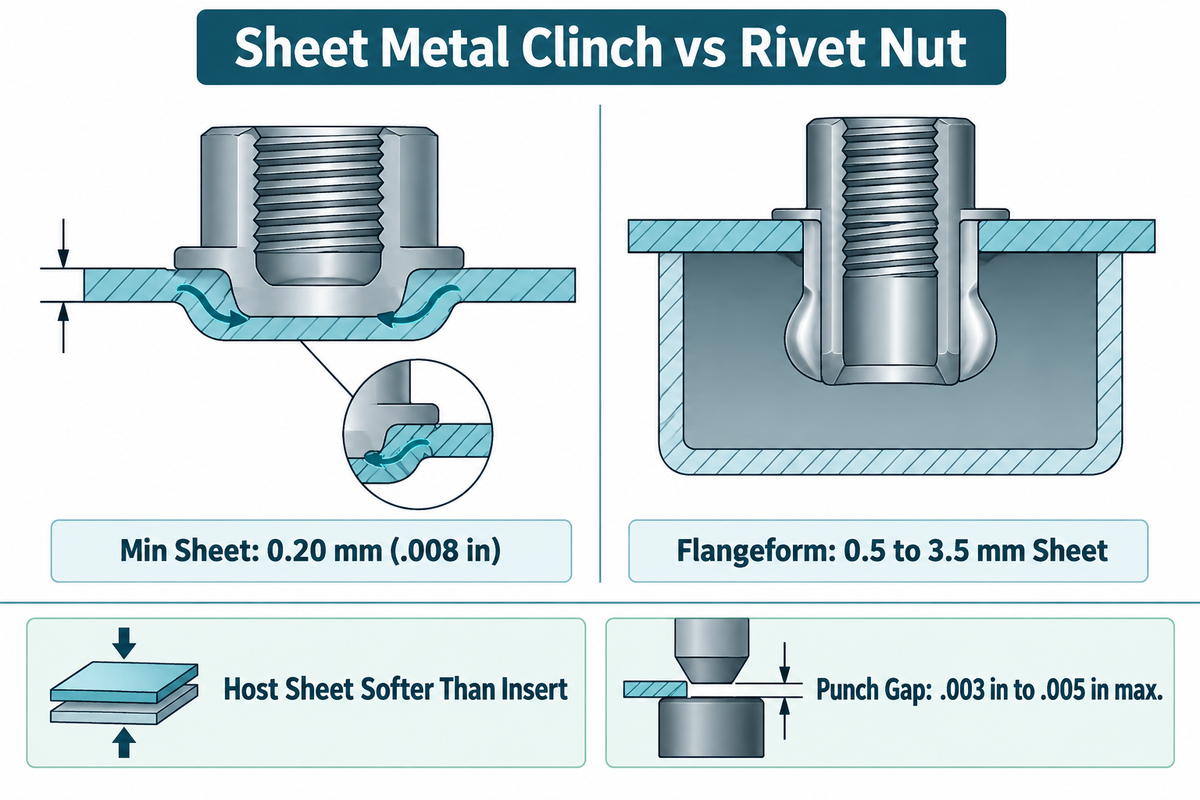
Thin sheet metal enclosures lack the wall thickness needed to tap durable internal threads directly. Sheet metal fasteners permanently anchor a hardened threaded insert into the sheet. This allows screws to be removed repeatedly. According to PEM’s fastener overview, self-clinching hardware provides strong threads in metal as thin as 0.20 mm (.008 in).
When Should Sheet Metal Assemblies Use Self-Clinching Inserts Instead of Blind Rivets or Self-Piercing Rivets?
For thin sheet metal enclosures and brackets, self-clinching nuts, blind rivet nuts, open-end or structural blind rivets, self-piercing rivets (SPR), and self-drilling screws prevent thread stripping under load. Use blind rivets or self-piercing rivets when the sheet metal joint is permanent, and won’t require unbolting for maintenance.
Per PEM’s technical installation FAQ and Assembly Magazine’s guide to press-in fasteners, PennEngineering makes studs for sheets as thin as 0.02 inch, while Flangeform studs fit sheets from 0.5 to 3.5 millimeters thick. In the same Assembly Magazine press-in fastener report, one-piece Spred-Lok inserts cover internal threads of #4 (M3) to 5/16 (M6). Self-clinching hardware must be installed with a steady parallel squeezing force rather than a hammer blow so ductile host metal cold-flows into the annular undercut. The host sheet must always be softer than the fastener to prevent thread crushing. On automated stud-feeding presses, PEM also specifies keeping the gap between the vacuum punch and stud jaws between .003 in and .005 in (.08 mm to .13 mm) maximum.
On Practical Machinist, when a closed tubular frame blocks two-sided press anvil access, three insert solutions are compared.
- Flush, blind, and concealed-head standoffs stack printed circuit boards at exact heights without exposed backside holes.
- Blind Rivet Nuts (Nutserts): They’re similar to rivets and are used for boxed extrusions. These are installed from one side like a rivet and used for a field retrofit.
- Helical Wire Inserts and Tapped Aluminum Holes: There’s an interesting discussion at Practical Machinist’s aluminum threading forum where machinists discuss the differences in coarse and fine threads when fastening aluminum plate. When soft threads start to wear from repeated assembly and disassembly, machinists use stainless wire inserts (which are surprisingly strong for their size).
For a more complete look at clinching, press-in hardware and welding for thin enclosures, see our article on sheet metal fastening methods for thin enclosures.
Non-Threaded Alignment and Retention Fasteners: Pins, Retaining Rings, and Circlips
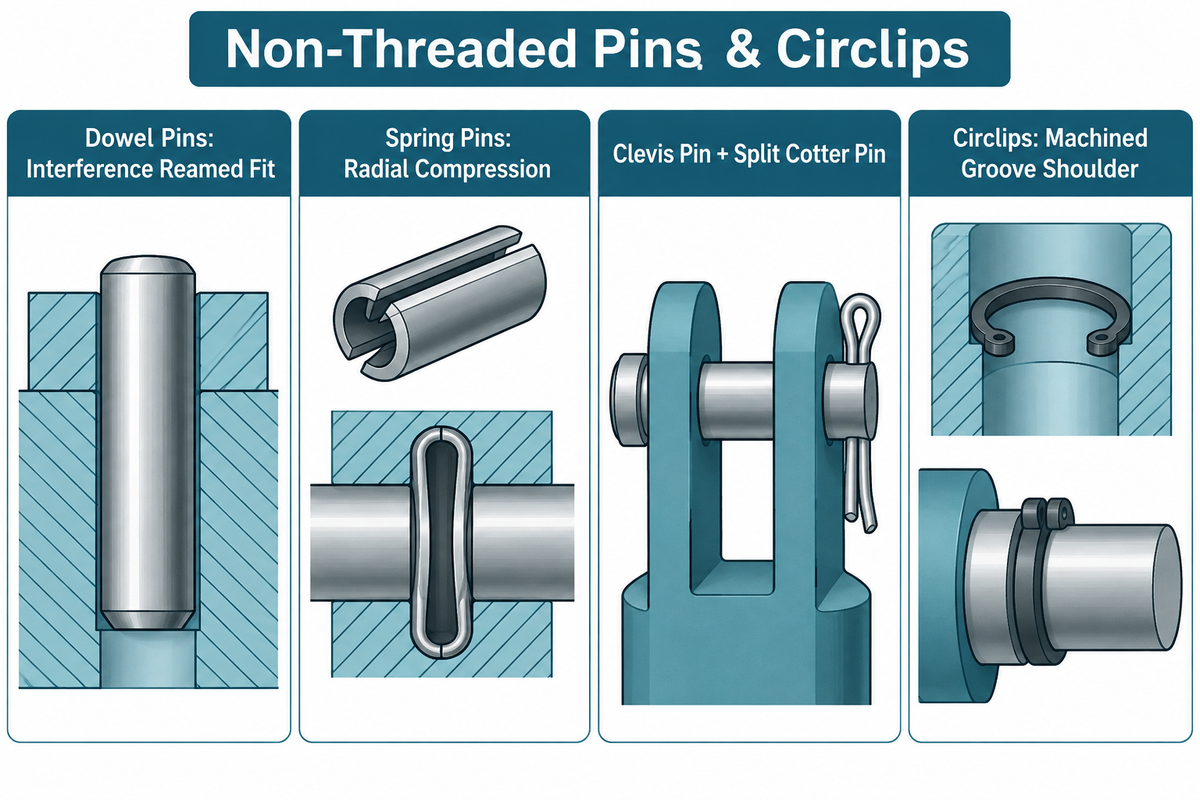
Non-threaded mechanical fasteners (particularly cylindrical pins and axial retaining rings) uncouple precise part alignment and shaft retention from clamping force. Depending on standard clearance holes to locate precision dies or rotating shafts allows the joint to shift within hole clearance. Pure shear or axial loads in compact areas are best carried by dedicated pins and retaining rings. Per the NASA Fastener Design Manual (NASA-RP-1228), clevis pins, dowel pins, and retaining rings must be sized to the shear plane and groove shoulder dimensions of the joint.
Other pin and retaining ring types are:
- Solid Dowel Pins and Taper Pins: Precision ground and hardened steel dowel pins press into reamed holes with tight interference fits. They’re used to accurately align machine housings, gear boxes, and injection molds.
- Spring Pins (Roll Pins and Coiled Pins): Slotted or spiral spring pins compress radially when driven through drilled holes. These kinds of pins absorb variations in hole size and ease shock loads in levers and shafts.
- Clevis and Hitch Pins: A clevis pin is a shear pin that has a cross-drilled hole near the tip. Sliding a cotter pin through the hole locks linkages and allows the pin to be quickly removed.
- Retaining Rings (Circlips and E-Clips): Stamped from spring steel, internal and external rings snap into machined grooves in a bore or around a shaft, respectively. They create a load-bearing shoulder to retain bearings and gears without threads.
Construction and Substrate Fasteners: Types of Anchors and Types of Nails
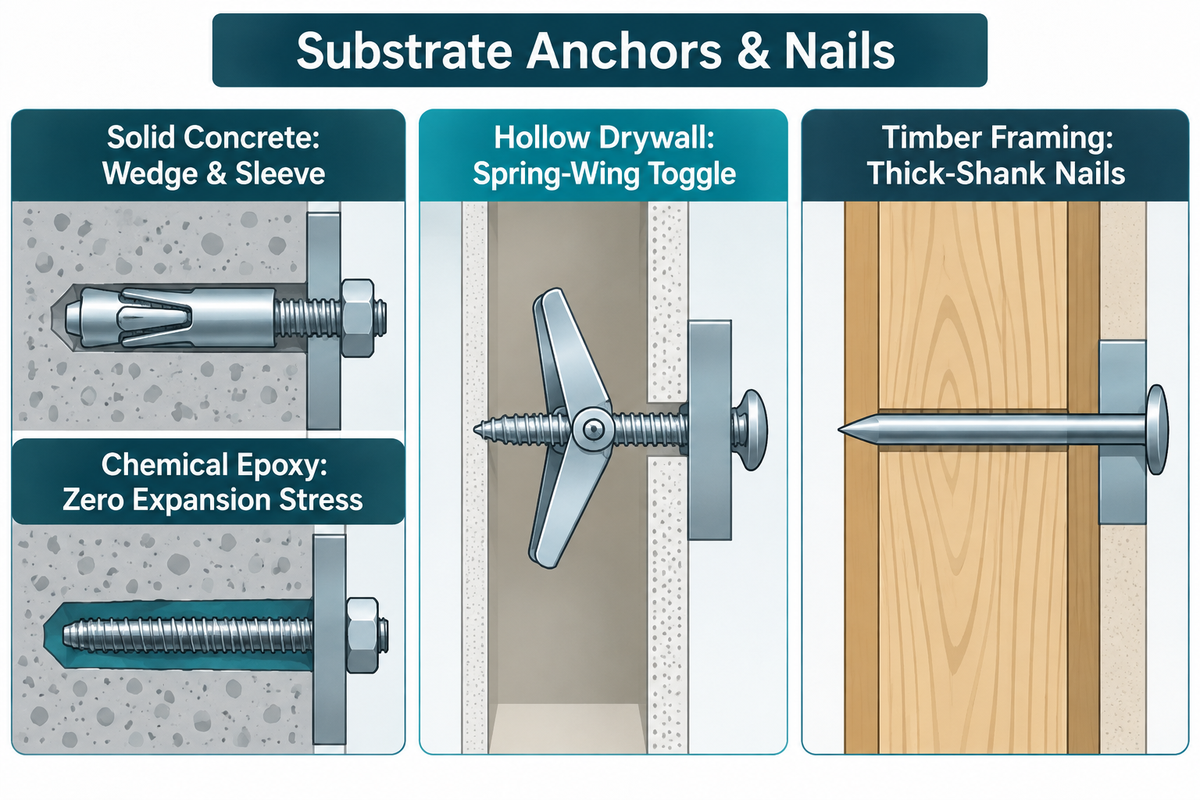
While machine screws, bolts, and rivets join manufactured metal or polymer components together, anchors and nails fasten equipment or framing into masonry, wallboard, or timber.
As Fastener Mart’s technical guide to masonry anchors and Fastener SuperStore’s fastener overview explain, anchors are used to create grip inside porous or brittle base materials:
- Masonry Expansion Wedge Anchors and Sleeve Anchors: Heavy steel wedge anchors are driven into drilled holes in solid poured concrete. Torquing a nut pulls a cone that expands into an expansion clip that wedges against the wall of the concrete. Sleeve anchors expand the full length of the sleeve to grip block and brick.
- Masonry Expansion Wedge Anchors and Sleeve Anchors: Heavy steel wedge anchors are driven into drilled holes in solid poured concrete. Two part chemical epoxy anchors bond threaded rod into concrete near slab edges without expansion stress.
- Hollow-Wall Toggle Bolts and Drywall Anchors: In hollow gypsum wallboard where no wood stud is present, a spring-wing toggle bolt spreads load across the rear face of the board. Lighter wall brackets are held in place by self-drilling nylon or zinc drywall anchors.
- Types of Nails (Common Nails and Roofing Nails): Used in structural carpentry common nails have thick shanks. Wide-head Galvanized roofing nails are used to secure roofing felt and shingles in construction.
Fastener Strength Grades and Shear vs Tensile Load Table: ISO 898-1 and SAE J429
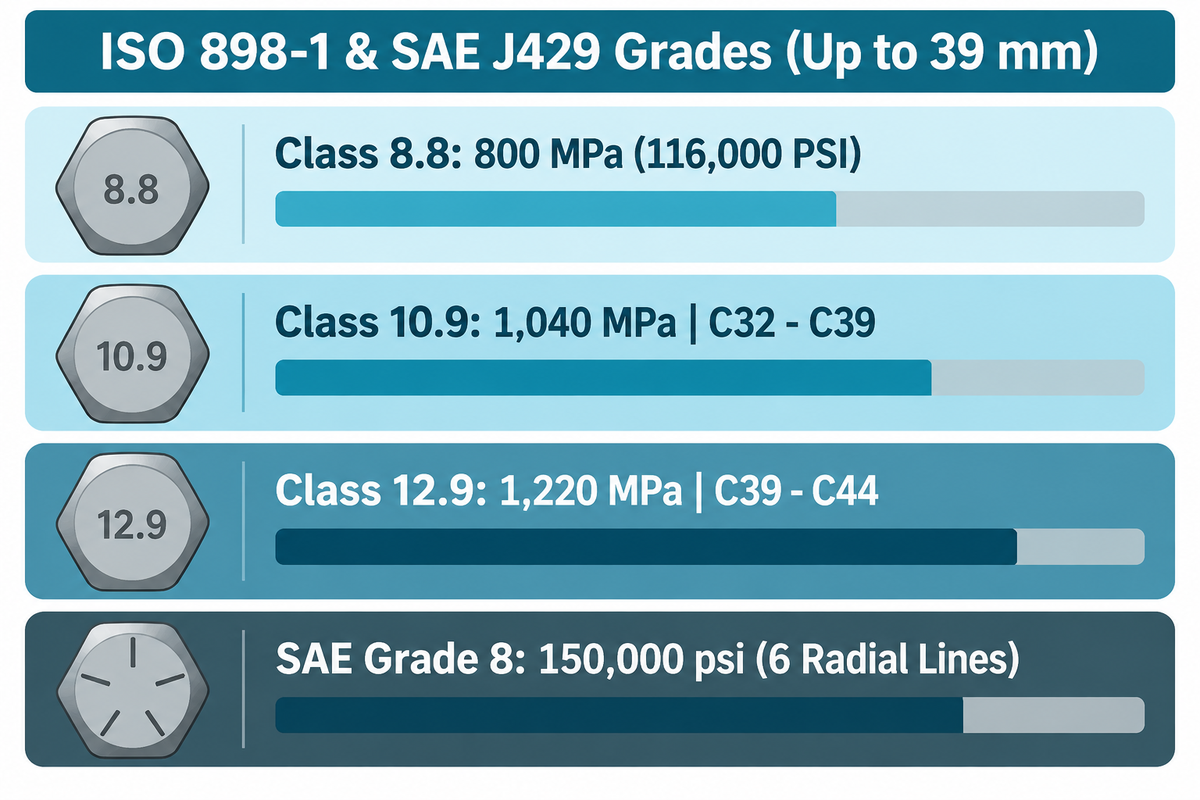
Specifying fastener geometry without a strength grade risks bolt fracture or thread stripping under load. Carbon and alloy steel externally threaded fasteners follow two grading systems: metric property classes under ISO 898-1 (for nominal diameters up to 39 mm) and inch grades under SAE J429. Never mix metric and inch hardware because their thread pitches are incompatible.
Compare the verified mechanical property values from Fastenal’s ISO 898-1 mechanical properties chart and Bolt Depot’s SAE J429 and metric grade chart in the nine-row table below.
| Standard and Class / Grade | Material and Heat Treatment | Nominal Size Range | Proof Load | Min Yield Strength | Min Tensile Strength | Rockwell Hardness | Head Marking and Application Note |
|---|---|---|---|---|---|---|---|
| ISO 898-1 Class 4.6 | Low or medium carbon steel | M5 – M39 | 225 MPa | 240 MPa | 400 MPa (58,000 PSI) | B67 – B99.5 | Stamped “4.6”; light brackets, threaded rod, non-structural guards |
| ISO 898-1 Class 5.8 | Low or medium carbon steel | M5 – M24 | 380 MPa | 420 MPa | 520 MPa (75,000 PSI) | B82 – B99.5 | Stamped “5.8”; general industrial enclosures and static covers |
| ISO 898-1 Class 8.8 (up to M16) | Medium carbon steel, quenched and tempered | M5 – M16 (below 16 mm) | 580 MPa | 640 MPa | 800 MPa (116,000 PSI) | C22 – C32 | Stamped “8.8”; standard structural machinery and automotive bolts |
| ISO 898-1 Class 8.8 (over M16) | Medium carbon steel, quenched and tempered | M18 – M39 (16 mm – 72 mm) | 600 MPa | 660 MPa | 830 MPa (120,000 PSI) | C23 – C34 | Stamped “8.8”; larger diameter equipment frames and flanges |
| ISO 898-1 Class 10.9 | Alloy steel, quenched and tempered | 5 mm – 100 mm (M5 – M39) | 830 MPa | 940 MPa | 1,040 MPa | C32 – C39 | Stamped “10.9”; high-preload chassis, powertrain, and press tooling |
| ISO 898-1 Class 12.9 | Alloy steel, quenched and tempered | 1.6 mm – 100 mm (M1.6 – M39) | 970 MPa | 1,100 MPa | 1,220 MPa | C39 – C44 | Stamped “12.9”; socket head cap screws; hydrogen embrittlement risk if electroplated |
| SAE J429 Grade 2 | Low or medium carbon steel | 1/4″ thru 3/4″ | 55,000 psi | 57,000 psi | 74,000 psi | B80 – B100 | No radial head lines; general hardware, wood framing, and light fixtures |
| SAE J429 Grade 5 | Medium carbon steel, quenched and tempered | 1/4″ thru 1″ | 85,000 psi | 92,000 psi | 120,000 psi | C25 – C34 | 3 radial head lines; inch counterpart to Class 8.8 for automotive machinery |
| SAE J429 Grade 8 | Medium carbon alloy steel, quenched and tempered | 1/4″ thru 1-1/2″ | 120,000 psi | 130,000 psi | 150,000 psi | C33 – C39 | 6 radial head lines; inch counterpart to Class 10.9 for heavy duty equipment |
What accounts for ISO Class 12.9 not being a universal upgrade over Class 8.8 or 10.9? As indicated in Fastenal’s Blue Print engineering guide on hydrogen embrittlement, higher hardness alloy steel fasteners (Class 12.9, C39-C44 hardness) are also susceptible to delayed brittle fracture under prolonged tensile stress. Fastenal considers two hydrogen sources: internal hydrogen generated by manufacturing (e.g. acid pickling, electroplating, etc.) and external hydrogen generated in service (e.g. corrosion, etc.). For high strength joints which are exposed to moisture, Class 10.9 with non-electrolytic zinc flakes plating is preferred over Class 12.9 electroplated coatings.
Fastener Materials, Coatings, Galvanic Corrosion in Aluminum, and Total Installed Cost
Choosing between steel fasteners, stainless steel fasteners, aluminum, brass, or titanium depends on both service corrosion exposure and the total installed cost of the joint. Rapid external corrosion of uncoated carbon steels results in rust, and mismatching of different metals in a wet electrolyte results in galvanic corrosion, which pits the more anodic metal.
Galvanic compatibility is of utmost importance when using aluminum alloy sheet and extrusions in the EV battery trays, solar racking, HVAC cabinets, and other such applications. Bare carbon steels rust and disfigure aluminum, and brass or copper fasteners act aggressively towards aluminum. Specify 300-series austenitic stainless steel fasteners with insulating washers, aluminum rivets, or steel fasteners coated with zinc-nickel or zinc-flake dispersion.
Other than just the strength and durability of the material, Procurement teams need to take into account the unit price of the hardware versus the total cost of the joint when mass producing a product.
- Cost Iceberg in Fastening: In Bossard’s Total Cost of Ownership (TCO) in Fastening framework, the cost of a fastener is just a small fraction of the total cost. Design, purchasing, logistics, hole preparation, kitting, and assembly labor represent the vast majority of total fastening expense.
- Cost Drivers of Manual Bolting: The cost of a hexagonal bolt, flat washer, lock washer, and hex nut is very cheap per piece. But, manual bolting consists of four different SKUs and requires two-handed access and manual torque verification.
- Automated Fastening Economics: Moving to single-piece self-piercing rivets or automated press-in fasteners eliminates nut-and-washer handling and removes hole tapping. In high volume production, the cost of an automated machine cell is amortized and the total cost of an accepted joint goes down.
High-Volume Automated Fastening Selection: Orbital/Radial Riveting, SPR Systems, and Servo Presses
In high volume automotive, appliance, elevator and battery pack manufacturing, it’s economical to use automated machinery to form and feed fasteners rather than using hand tools. The right machine architecture matched to a fastener family prevents crushed clinch studs and distorted thin panels.
Compare the three primary architectures of automated fastening equipment and their process monitoring controls.
- Orbital and Radial Servo Riveting Machines: Instead of hammering a solid rivet straight down with impact force, servo riveting assembly systems guide the peening tool along an orbital or radial path. This smooth forming motion maintains the metal grain structure on the pivot pin and controls the height of the rivet.
- Automated Self-Piercing Riveting (SPR) Systems: High-speed, automated self-piercing riveting (SPR) machines, as disclosed in US Patent US9776239B2 (Henrob Ltd), use a single setting head that’s fed by a multi-feed delivery tube to punch different sized rivets based on the varying sheet stack-ups. SPR machines can be affixed to either robotic arms or C-frames to rivet aluminum and steel sheets.
- Closed-Loop Servo Presses: Industries require stable, even squeezing force to affix PEM self-clinching nuts, standoffs, studs and dowel pins. Many closed-loop servo press systems, including industrial closed-loop servo press systems, track real-time force-displacement curves and reject any panel with a missing or incorrectly seated fastener. Should your team want to engineer an automatic fastening station, contact SIMITCH engineering to review your joint drawings.
FAQ
What are the five basic types of fasteners?
Mechanical engineering textbooks group the most common types into five basic families: bolts, screws, nuts, washers, and rivets.
Bolts and screws use external helical threads to clamp parts together. Nuts provide mating internal threads for bolts and studs, while washers distribute bearing loads and protect joint surfaces. Rivets are permanent unthreaded fasteners that join metal or composite sheets by plastically deforming a solid shank, hollow sleeve, or semi-tubular skirt during installation.
What are 7 types of fasteners?
Seven-category workshop charts list bolts, screws, nuts, washers, rivets, pins and retaining rings, and anchors or threaded inserts.
Adding pins and retaining rings covers non-threaded shear alignment and axial shaft retention via dowel pins, cotter pins, and circlips. Adding anchors and inserts covers masonry wedge anchors, hollow-wall toggle bolts, and sheet metal self-clinching nuts that establish durable load-bearing threads in thin panels or brittle substrates where standard machine threads cannot be tapped directly.
What are different types of fasteners for metal?
Fasteners for metal depend on thickness: thick steel or aluminum uses bolts and machine screws, while thin sheet metal uses clinch inserts or rivets.
For structural steel plate and machined housings, engineers specify ISO 898-1 Class 8.8 or 10.9 hex bolts, socket head cap screws, studs, and hardened dowel pins. For thin sheet metal enclosures and brackets, self-clinching nuts, blind rivet nuts, open-end or structural blind rivets, self-piercing rivets (SPR), and self-drilling screws prevent thread stripping under load.
Which type of fastener is used with a cotter pin?
A cotter pin is used with a slotted nut (castle nut) on a drilled-shank bolt or with a cross-drilled clevis pin.
Sliding the split cotter pin through the aligned slot and hole and bending its prongs outward creates a positive mechanical lock that prevents nut rotation or pin withdrawal.
What type of fasteners should you use with aluminum to prevent corrosion?
Use 300-series stainless steel fasteners, aluminum rivets, or zinc-nickel and zinc-flake coated steel fasteners when joining aluminum.
Aluminum is anodic to most structural metals and when exposed to humidity and sea water, pairing fasteners of bare carbon steel or brass with Aluminum results in galvanic corrosion. In removable joints, pair Passivated 300-series Stainless Steel screws with lock nuts, and use washer and anti-seize lubricant to prevent thread galling. In automotive or closed joints, use aluminum blind rivets.
Which type of fastener is suitable for use in wallboard?
Hollow gypsum wallboard requires spring-wing toggle bolts, strap toggles, metal Molly bolts, or threaded self-drilling drywall anchors.
Toggle bolts and Molly bolts expand behind the drywall sheet to spread shear and pull-out loads across a wide rear area when no wood or steel stud is available.
What are the main types of fasteners used in aircraft and automotive structures?
Aircraft structures rely on solid aluminum rivets, titanium lockbolts, and structural blind rivets, while automotive structures use flange bolts, self-piercing rivets, and clinch hardware.
Aluminum alloy airframes use swaged lock bolts and high strength screws to maximize fatigue life at low weight. Automotive body-in-white structures and EV battery enclosures use ISO class 8.8 and 10.9 hex flange bolts, weld and self-clinching nuts, and flow-drill screws with semi-tubular self-piercing rivets (SPR). These fasteners rapidly join aluminum castings and high-strength steel, without thermal weld distortion.
References & Sources
- NASA –
NASA Reference Publication 1228: Fastener Design Manual (Richard T. Barrett, Lewis Research Center) - MIT D-Lab –
MIT D-Lab Fasteners Engineering Guide: Screws, Bolts, Nuts, Washers and Pop Rivets - International Organization for Standardization (ISO) ISO 898-1: Mechanical Properties of Fasteners Made of Carbon Steel and Alloy Steel, Part 1: Bolts, Screws and Studs
- PennEngineering (PEM) PEM Fastening Products Technical FAQ: Self-Clinching Host Sheet Hardness and Installation Rules
- PennEngineering (PEM) Different Types of Fasteners
- Fastenal Engineering & Design Support Mechanical Properties per ISO 898-1 of Externally Threaded Metric Fasteners
- Bolt Depot US SAE J429 and Metric ISO 898-1 Bolt Grade Markings and Strength Chart
- Fastenal Blue Print Hydrogen Embrittlement in High-Strength Steel Fasteners: Internal vs. Environmental Mechanisms
- Practical Machinist Forum PEM Self-Clinching Nuts, Spiralock, and Helicoil Thread Inserts in Sheet Metal
- Practical Machinist Forum – What are the Best 1/4-Inch Threading and Fastening Methods for Securing Into 3/16-Inch Aluminum?
- Bossard Group – Total Cost of Ownership (TCO) in Fastening: Cost Structure and Assembly Efficiency
- Atlas Copco Industrial Technique – Creating a Strong and Reliable Joint with Self-Piercing Rivets (SPR)
- Fastener Mart – Masonry Expansion, Sleeve, Drop-In and Hollow-Wall Anchors
- Assembly Magazine – Fastening: Assembly With Press-In Self-Clinching Fasteners
- Assembly Magazine – Maintaining Joint Integrity: Preload, Vibration Loosening and Locking Fasteners
- YT Fasteners A Complete Guide to Spring Washers: Split Lock vs. Belleville Conical Washer Selection
- USPTO/Google Patents – US9776239B2 (Henrob Ltd): Method for Delivering and Setting Self-Piercing Rivets
Related Posts

WHY WE WRITE THIS
About SIMITCH
SIMITCH develops sheet-metal joining equipment for clinching, riveting, servo pressing, pneumohydraulic drive and hot-melt connection applications. Our engineering team starts with the material stack, access envelope, cycle target and acceptance method before recommending a machine route.
Founded in 2006 in Taicang, Jiangsu, SIMITCH combines research and development, in-house production and global sales. These guides turn field experience into practical decision support for process engineers, plant teams and industrial buyers.
OUR EXPERIENCE
Since 2006
Equipment engineering, machining, assembly and joint validation under one manufacturing system.
OUR EXPERTISE
Five joining routes
Clinching, riveting, SPR, precision press-fit and hot-melt connection for production lines.