Get in touch with Suzhou Simitch Machinery Co., Ltd Company

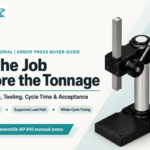
Arbor Press: How It Works, What It Does and How to Choose

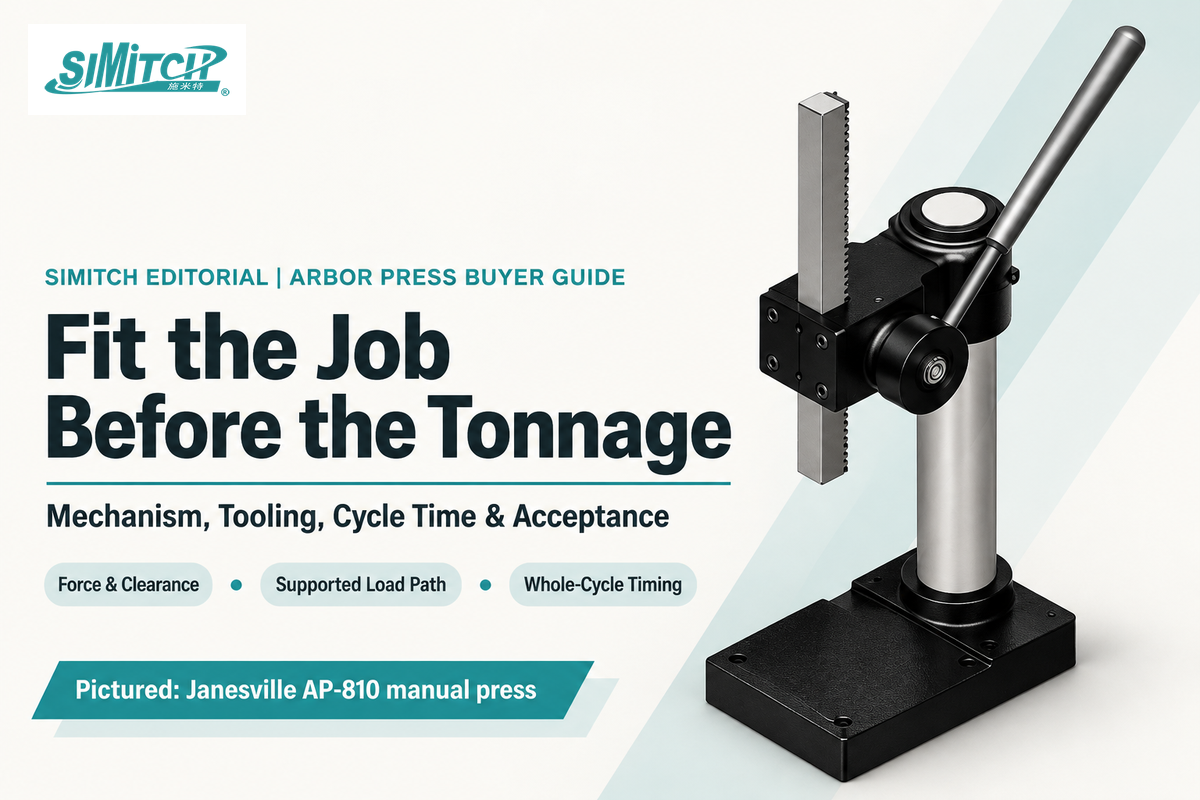
An arbor press is a compact press that uses a lever and a rack-and-pinion mechanism to push a ram into a supported workpiece. It can be used to install a bearing, insert a pin, stake a rivet or drive a suitable broach. When deciding on this machine, the load path and available space are considered first, then the force rating.
A cheap bench machine can do useful assembly work. Difficulty arises when the tool doesn’t reach the correct surface, the part tilts under load, or an operator has to repeat a difficult pull throughout the shift. This paper connects the machine specifications to those real world problems. It also includes a sizing example and a complete cycle time example.
Arbor Press Uses and How the Mechanism Works
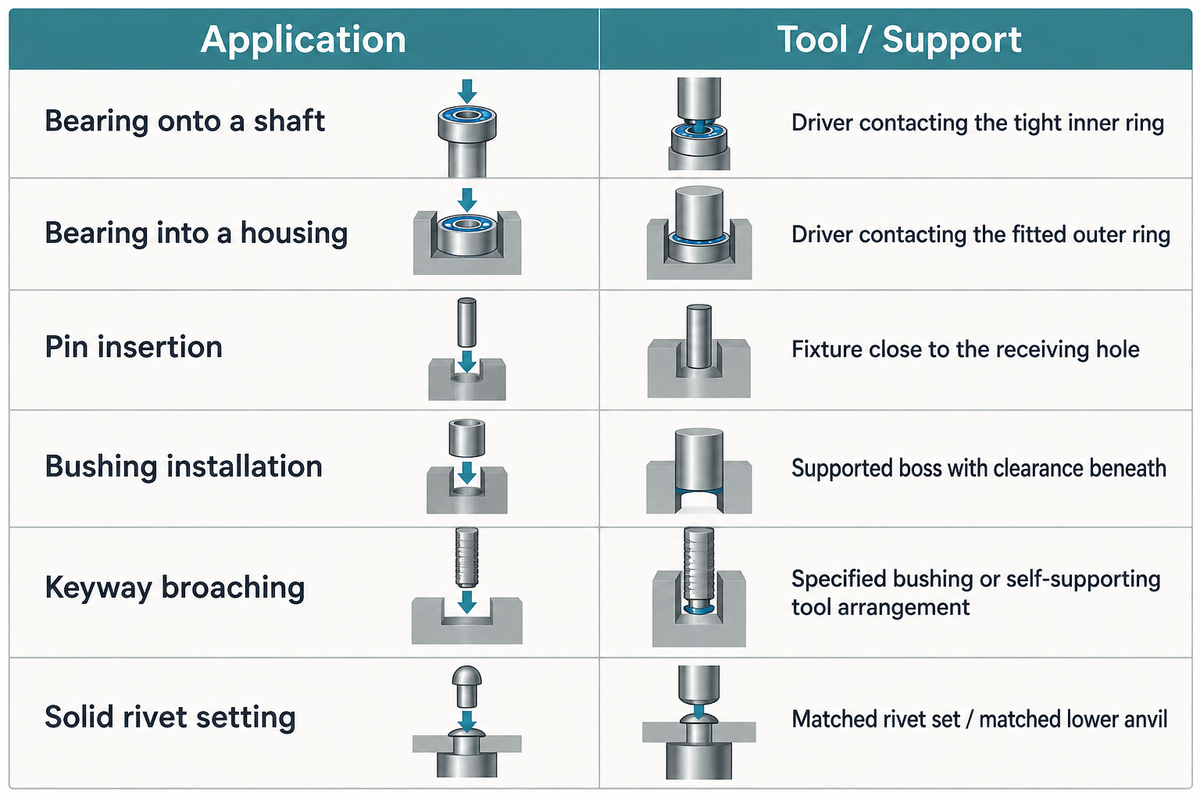
A traditional arbor press turns hand effort into a straight ram movement through a pinion engaging a rack. Picture a handle turning a small gear against a straight gear. The frame takes the reaction load and the tool and anvil determine where that load enters and leaves the part.
Ratcheting models have a ratchet so the operator can reposition the handle for the next stroke. An arbor press with handwheel can be used to move the ram quickly toward or away from the job; the wheel cannot be used as a replacement for the pressing lever. Designs with multiple levers provide a mechanical advantage. Dake lists several compound manual models from 6 to 15 tons, so a general statement that manual machines stop at 5 tons would exclude real equipment.
The application alters the tooling even when the frame stays on the same bench. Press-fit insertion moves one part into another. Staking and riveting deform material. Broaching cuts material and requires a path for the tool and chips. A ram moving vertically doesn’t, by itself, keep any of these operations aligned.
| Application | Upper tool | Support and exit path | Main selection risk |
|---|---|---|---|
| Bearing onto a shaft | Driver contacting the tight inner ring | Support the shaft load path | Force crossing the rolling elements |
| Bearing into a housing | Driver contacting the fitted outer ring | Support the housing around the bore | Thin housing wall distortion |
| Pin insertion | Flat or shaped pin driver | Fixture close to the receiving hole | Pin starting at an angle |
| Bushing installation | Piloted driver suited to the bushing | Supported boss with clearance beneath | Collapsing the bushing edge |
| Keyway broaching | Contact suited to the broach | Specified bushing or self-supporting tool arrangement | Insufficient daylight or lateral loading |
| Solid rivet setting | Matched rivet set | Matched lower anvil | Wrong head shape or unsupported joint |
| Staking | Shaped stake or punch | Nest supporting the local feature | Deforming adjacent surfaces |
| Small metal forming | Matched forming die | Supported lower die | Force rising sharply near closure |
| Light stamping | Guided punch or marking tool | Die opening or firm backing | Uneven impression or trapped offcut |
Small shop work can include jewelry fixtures and dies for leather hardware, but a manual desktop arbor press machine still requires a proper tool interface. Job variety makes tooling changeover important for shops that handle both metalworking and craft work. DIY fixtures require the same consideration for support and alignment as purchased tools.
Arbor Press Capacity: Force, Throat, and Working Height
One US ton-force equals approximately 8.90 kN; one metric tonne-force equals approximately 9.81 kN. A kilogram-force (kgf) equals 9.806 65 newtons (N). The unit matters but the rating answers only the force question. A useful machine must also be able to accommodate the part, upper tool, lower support, loading clearance and required ram travel without colliding with the frame.
A 1/2 US ton rating is approximately 4.45 kN and a 3 US ton rating is approximately 26.69 kN. Consider the rated operating conditions of the machine and the process load to determine if capacity is adequate.
Throat depth is the horizontal distance available behind the ram axis. Working height is the vertical space for the job and its tools. Stroke is the usable pressing movement. Overall machine height is a different dimension. Examples from Janesville’s offerings illustrate this point. Both Janesville’s ILP-500 and the AP-810 are listed at half a ton. For example, Janesville’s ILP-500 and AP-810 are both listed at half a ton, yet their listed throats are 1.75 and 2.76 inches and their maximum strokes are 6 and 9.5 inches respectively.
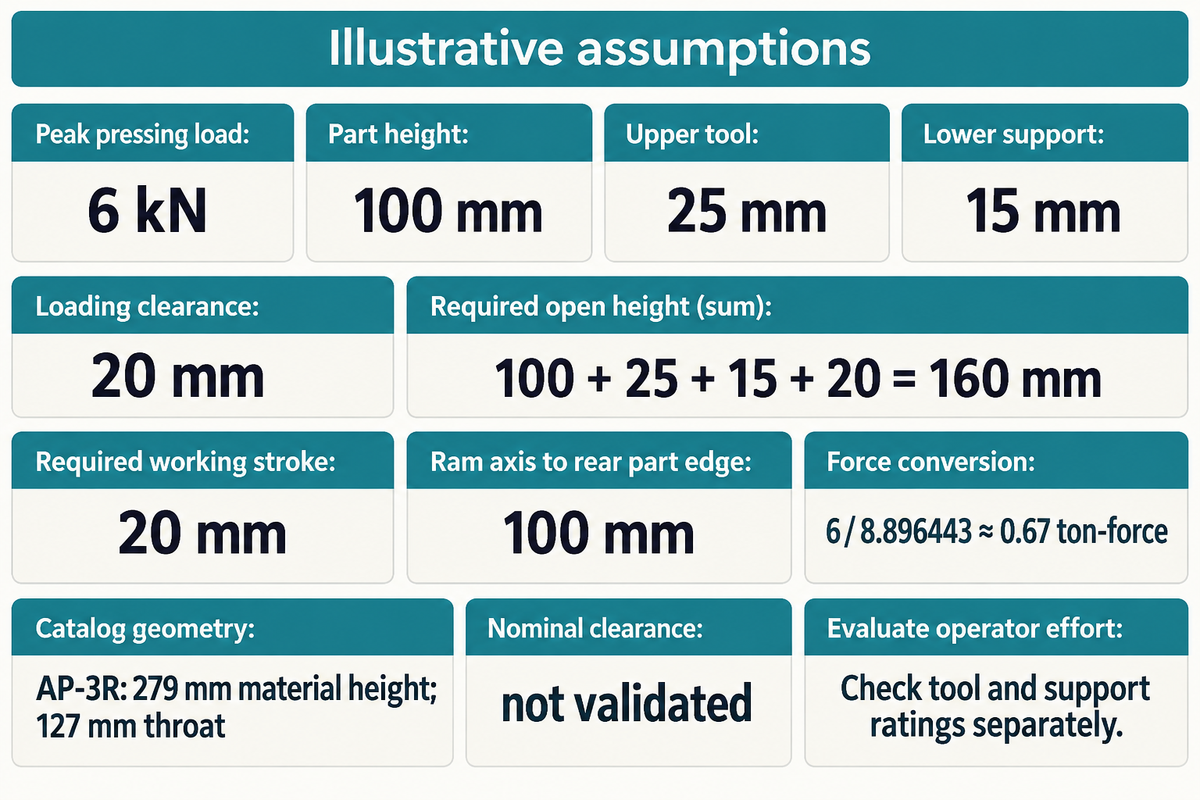
Use the Pressing Station Fit Card below before comparing prices. For this worked example, assume a measured peak process force of 6 kN, a 100 mm part height, a 25 mm upper tool, a 15 mm base support and 20 mm loading clearance. These are assumed job inputs, not a bearing-force recommendation. A fixture for the bench press has to fit the usable support area on the table.
| Check | Example or source input | What it decides |
|---|---|---|
| Peak pressing load | 6 kN, assumed measured peak | Start force screening here |
| Part height | 100 mm, assumed | Vertical stack contribution |
| Upper tool projection | 25 mm, assumed | Space occupied below the ram |
| Lower support height | 15 mm, assumed | Space occupied above the table |
| Loading clearance | 20 mm, assumed | Room to place and remove the job |
| Required open height | 100 + 25 + 15 + 20 = 160 mm | Screen the assembled tool envelope |
| Required working stroke | 20 mm, assumed | Check movement after contact separately |
| Ram axis to rear part edge | 100 mm, assumed | Compare with throat and fixture envelope |
| Force in US ton-force | 6 / 8.896443 ≈ 0.67 ton-force | A half-US-ton model fails this load screen |
| Named geometry comparison | Baileigh AP-3R: 279 mm maximum material height; 127 mm throat | Candidate geometry for a drawing check |
| Operator effort | Evaluate the intended handle position and repeated task | Force capacity does not settle shift workload |
| Tool and support strength | Check their separate ratings and load paths | The frame rating does not rate every fixture |
The AP-3R’s listed maximum material height exceeds the example stack by 119 mm, and its throat exceeds the example rear-edge distance by 27 mm. The tool drawing must clear the ram, table and frame throughout its travel. Its manual specifies 6 inches of ram travel per revolution; that’s NOT a specification of a 6 inch total stroke. Selecting a 1 ton arbor press simply because its label exceeds 0.67 ton-force would leave operating effort, process variation and tool strength unresolved.
Using an Arbor Press for Bearings, Pins, and Broaches
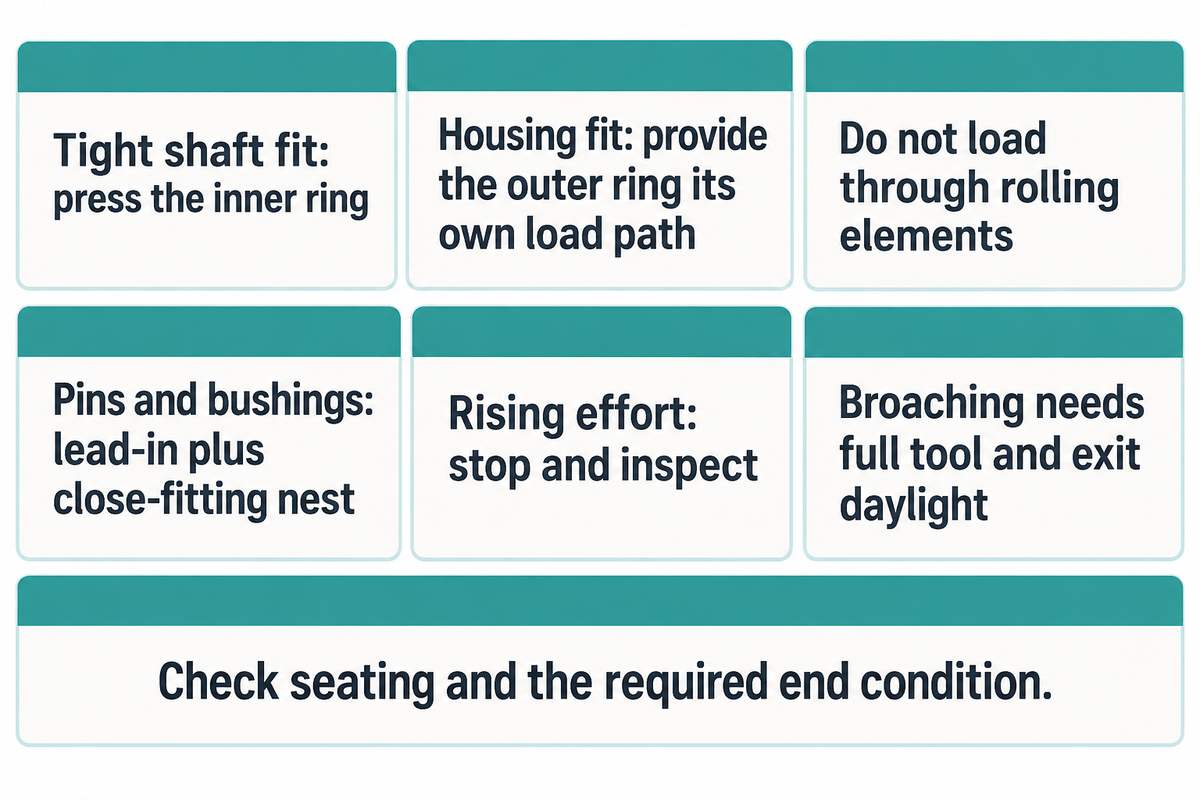
Apply pressing force through the fitted component and support the receiving part close to that load path. Press the inner ring when mounting it with a tight fit on a shaft. A correctly sized press can still damage a bearing when the tool loads it through the rolling elements.
NSK’s mounting instructions differentiate cases where both rings are tight from cases where only the inner ring is tight. NSK’s mounting instructions say not to heat bearings above 120˚C. When both rings have tight fits, the mounting tool contacts both rings. In a housing fit, the outer ring needs a load path of its own. The fixture must not turn the bearing itself into a bridge between the ram and the base.
Can you use an arbor press for wheel bearings?
Yes, when the bearing assembly, specified mounting method, required force and tooling fit the press. Support the hub or knuckle and load the ring with the interference fit. Sealed hub units, retaining features and large assemblies can require different equipment or service procedures, so a wheel-bearing label alone doesn’t determine the press size.
Use the service part instructions and assembly drawing, and remove the specified retaining parts before applying a load. Provide clearance for the displaced shaft, bearing or installation tool; pressing against a hidden shoulder can produce a force rise that looks like a tight fit. Check seating and the required end condition after installation rather than treating a high peak load as success. Don’t consider a high peak load as success. Our interference-fit guide describes the dimensional relationship behind the joint.
For steel pins and bushings, a lead-in helps the part start square and a close-fitting nest resists movement. A sudden increase in effort calls for a stop and inspection of misalignment, obstruction or part condition. Don’t compensate for a tilted start by exerting a greater effort. Interference fit, surface finish or lubricant changes can affect the force curve. Keep process variables in the record.
A separate setup is needed for broaching. Pilot Precision’s duMONT keyway sets use specified shims and bushings, while its production push broaches use a self-supporting arrangement; leave enough daylight for the complete tool and its exit. Reports of tilted keyways suggest checking the alignment of the ram, support and guide. They aren’t instructions to manually straighten the loaded broach.
A suitable bearing tooling and support arrangement can resolve support and alignment problems that may remain even with a larger frame. Specify an allowed press-fit lubricant with the joint design and check that trial and production parts conform to the same conditions.
Arbor Press vs Hydraulic, Pneumatic, and Servo Presses
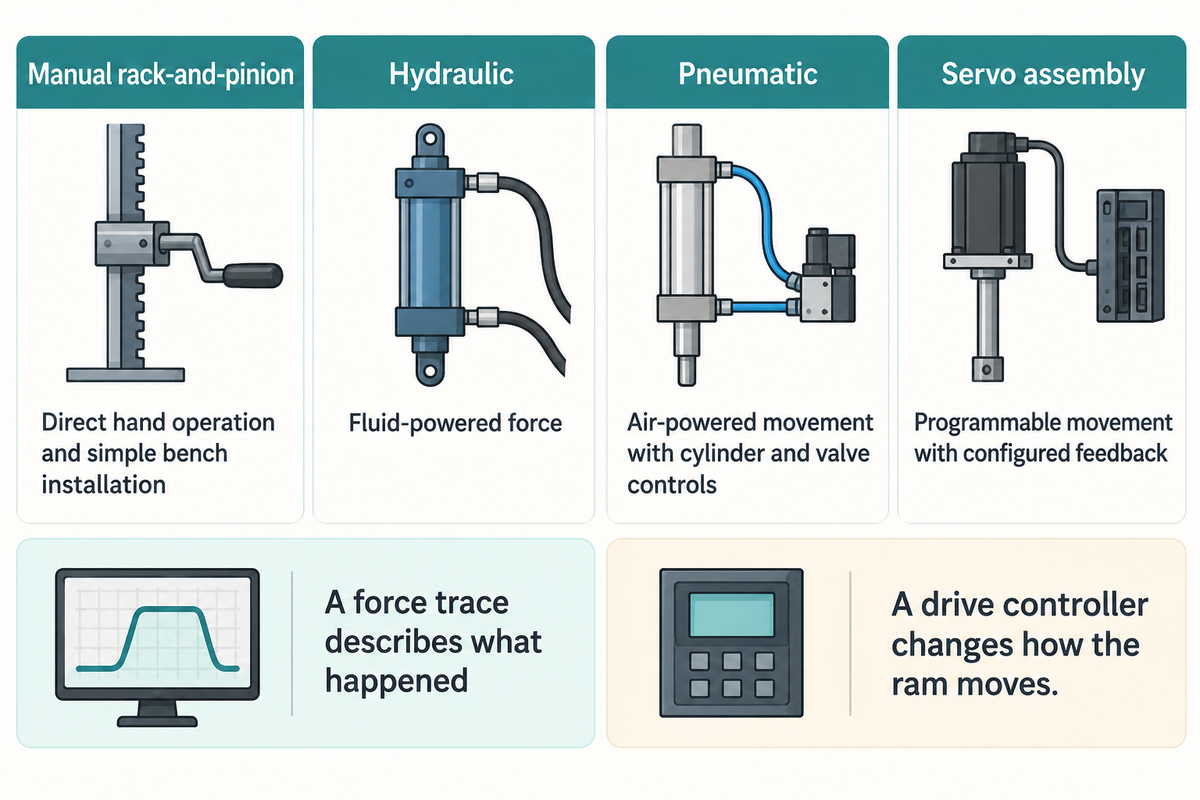
Add force and displacement monitoring when the job requires recorded results and acceptance decisions; compare powered equipment when it also requires controlled movement or reduced repetitive effort. Certain manual presses can monitor force and displacement; therefore, we need not replace the hand-operated drive to add such a function.
Is an arbor press hydraulic?
A conventional arbor press is mechanically driven through a rack and pinion, usually by hand. In a press design, a hydraulic press develops ram force using a pressurized fluid, acting on a piston. Sellers sometimes group several small press designs together, so the mechanism and specification give a clearer answer than the catalogue category alone.
Hand-operated machines don’t become hydraulically operated by the use of a handwheel or ratchet. A manually operated hydraulic pump still generates hydraulic pressure. Compare the complete operating method. Our hydraulic press explanation addresses hydraulic mechanisms in greater detail.
| Press arrangement | What it offers | Question before purchase |
|---|---|---|
| Manual rack-and-pinion | Direct hand operation and simple bench installation | Can operators complete the task comfortably over the intended shift? |
| Hydraulic | Fluid-powered force; available designs cover varied capacities | What approach, working and return speeds does this model provide? |
| Pneumatic | Air-powered movement with cylinder and valve controls | How do supply pressure, tooling and stopping behavior affect this job? |
| Servo assembly | Programmable movement with configured feedback | Which position, speed, force and data functions are included? |
A force trace describes what happened; a drive controller changes how the ram moves. Keep those functions separate in the specification. If the only missing capability is a recorded result, inspect a monitoring option first. If the task also needs a controlled approach, programmed dwell or reduced repetitive effort, compare powered equipment using the same parts and acceptance criteria.
When Manual Pressing Becomes a Production Bottleneck
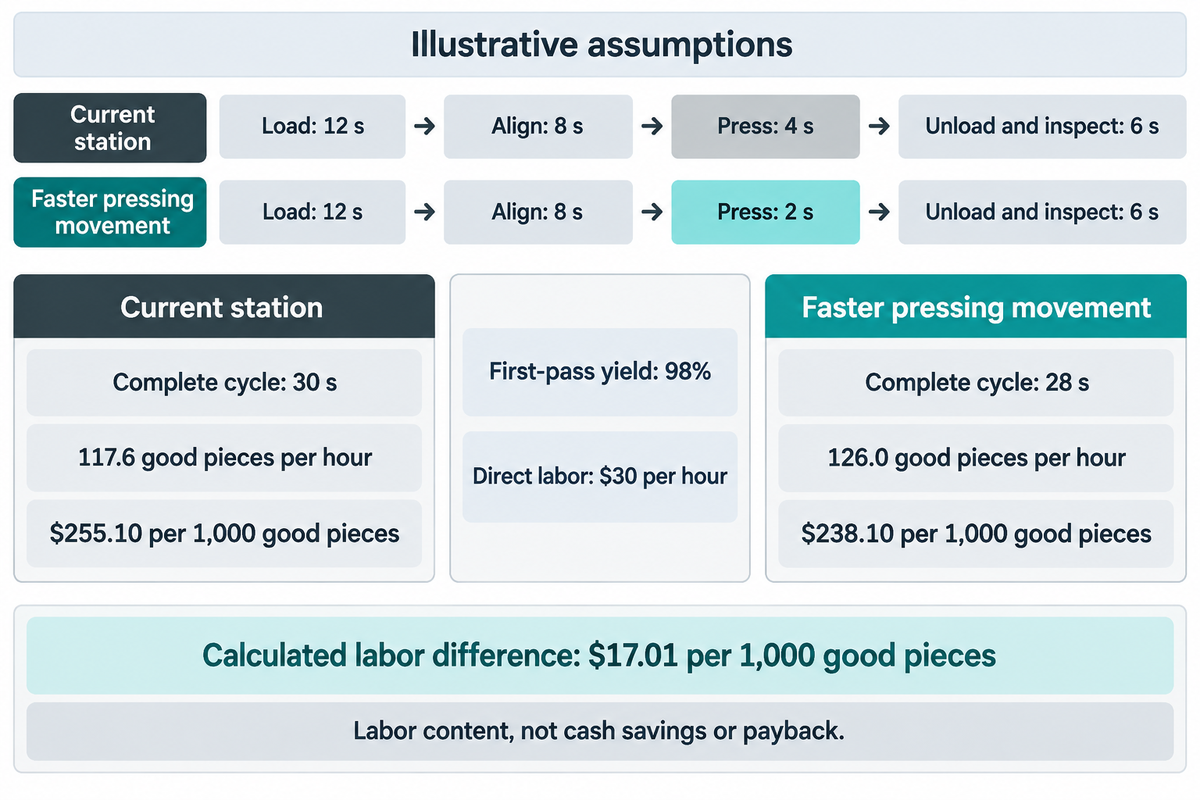
A faster ram helps only the portion of the complete cycle spent pressing. Loading, aligning, unloading and inspection can consume the majority of an operator’s time. Separate those activities and calculate cycle time. Evaluate changeover times, downtime, adjacent stations and repetitive effort before concluding that a powered press would increase useful production.
The EPA’s cellular-manufacturing method separates manual work, machine work and operator movement time. Use the Handle-to-Good-Part Bottleneck Ledger so a plant manager can pinpoint lost time, quality staff can safeguard the inspection task, and finance can see whether labor is reduced or work is transferred.
Assume one operator handles one part at a time, with no overlapping tasks: loading takes 12 seconds, alignment 8 seconds, pressing 4 seconds and unloading plus inspection 6 seconds. Assume a 98% first-pass yield and direct labor at $30 per hour in both cases. The proposed change reduces only the pressing movement time to 2 seconds.
| Ledger entry | Current station | Faster pressing movement |
|---|---|---|
| Load | 12 s | 12 s |
| Align | 8 s | 8 s |
| Press | 4 s | 2 s |
| Unload and inspect | 6 s | 6 s |
| Complete cycle | 30 s | 28 s |
| First-pass yield | 98% | 98% |
| Good pieces per operating hour | 117.6 | 126.0 |
| Direct labor per 1,000 good pieces | $255.10 | $238.10 |
| Calculated labor difference | $17.01 per 1,000 good pieces | |
The calculations are: Good pieces per hour = 3,600 / cycle seconds × first-pass yield; direct labor per 1,000 good pieces = hourly labor × cycle seconds × 1,000 / (3,600 × yield). This model doesn’t account for capital, energy, materials, rework, or downtime and changeover. It measures labor content during operation, not cash savings or payback.
Quality may resist shortening inspection while production wants more output. Settle that disagreement by timing the inspection, and specify which defects it catches before removing it. Finance should factor in a second operator or more product handling if the new layout requires it. Assess operator exposure for the planned shift and take into account NIOSH’s identification of risk factors associated with force, repetition and posture. Also consider pulling and product handling during the assessment of posture and repetition.
Safe Setup, Maintenance, and Troubleshooting
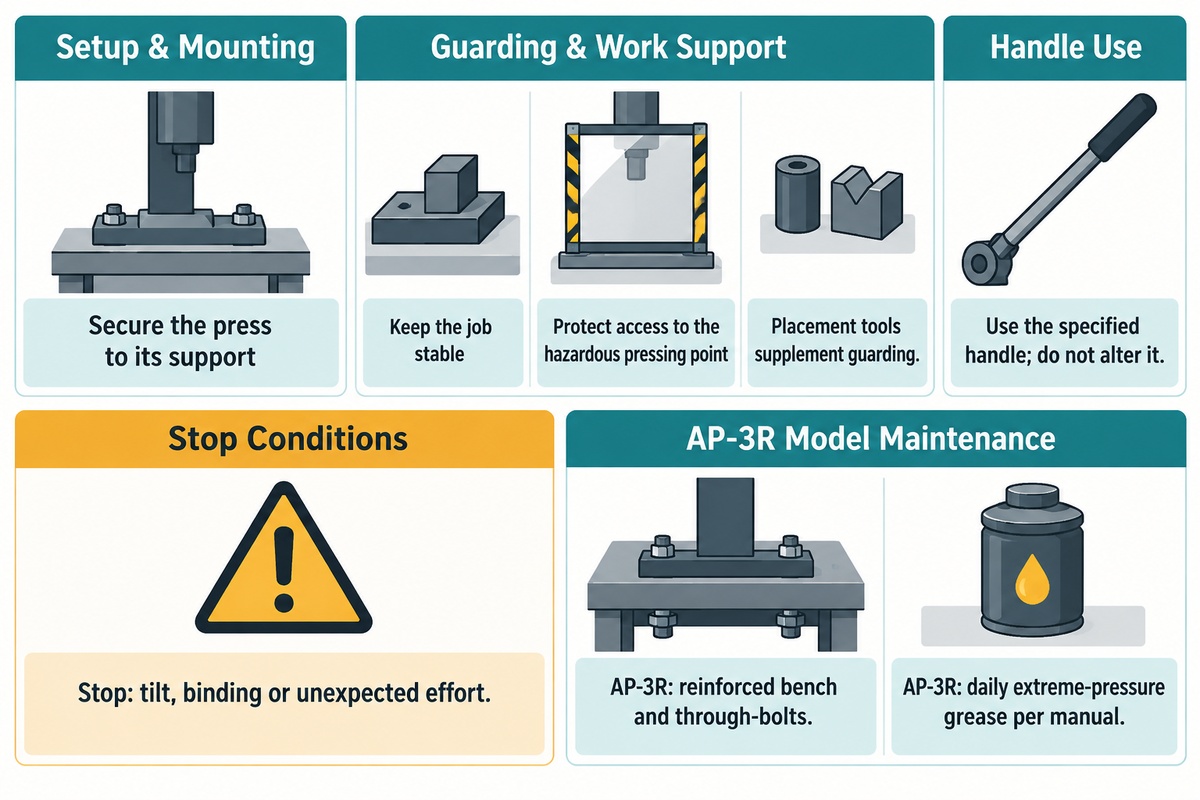
Secure the press to its support. Keep the job stable. Protect access to the hazardous pressing point. Stop when the part tilts, the tool binds or effort increases unexpectedly. Maintenance follows the actual model manual, including lubrication, adjustments, and inspection of the rack, pinion, ram guides and fasteners.
The Baileigh AP-3R manual says to use a reinforced workbench and attach the press with through-bolts, washers and nuts. The instruction says to lubricate the press with good-quality extreme-pressure grease, daily. Another manufacturer’s design can require different maintenance, so a cast iron frame alone doesn’t establish a service schedule.
Use the specified handle. Don’t alter the handle. Using a pipe for a longer lever changes the applied machine load and operator control. Loose blocks and improvised die stacks, as well as using the hands to steady a loaded part, increase the hazards. Set the handle and work height so the task doesn’t require repeated awkward wrist postures or reaching.
For US workplaces, OSHA 1910.212 addresses guarding of hazardous points of operation and anchoring fixed machinery. Tools used to place or remove stock supplement guarding; they do not replace it. They don’t replace guarding. OSHA 1910.217 covers mechanical power presses and explicitly excludes hydraulic and pneumatic power presses from its stated scope. The hand-operated-lever provisions in that regulation do not create a general exemption for hand-powered equipment.
Likewise, ANSI B11.2 differentiates manually fed hydraulic or pneumatic powered presses from manually powered presses. The machine, task, and workplace dictate the applicable safeguards. For day-to-day operation, the Naval Postgraduate School’s arbor-press procedure also requires an authorized operator, impact-resistant goggles and confirmation that the handle and slide move smoothly.
Buying an Arbor Press or a Monitored Assembly Station
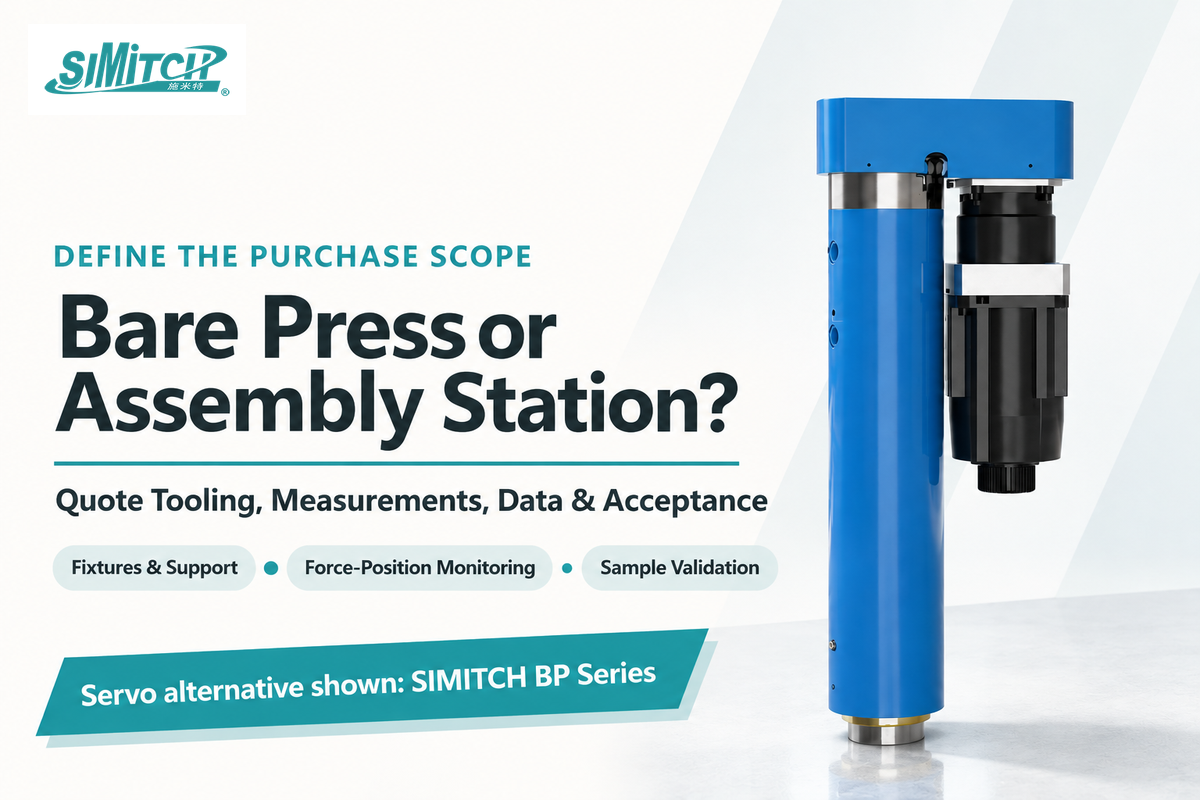
Purchase a bare press for a defined tool-and-part task; purchase a complete station for a requirement that includes fixtures, measurements, safeguarding, data, and acceptance support. A catalogue price helps to analyze the first purchase. A production quote requires the complete scope, including who supplies each tool and who validates the completed assembly.
For a price reference dated November 10, 2026, KAKA Industrial listed its AP-1 1-ton machine at $99, AP-1S at $375 and AP-2S 2-ton machine at $436. Janesville priced its ILP-500 half-ton model at $491 and its AP-810 half-ton model at $855. These named catalogue examples aren’t market averages or delivered station prices. Tooling, freight, tax, and support affect the comparison.
When purchasing, compare the quoted opening, throat, adjustable features and ram interface, and price. A heavy duty arbor press label is less helpful than a drawing and application supported by an arbor press review that demonstrates the part and tool. Procurement also requires a source of replacement parts for wear items, while production needs an installation plan that keeps the bench and handling path usable.
“any significant deviations from the original scope can result in price and/or schedule changes.”
Quote fixtures, part sensing, measurement channels, documentation, training and installation support as separate lines. Request a firm proposal when the job is defined and a budgetary proposal while the job definition is still in progress. A press machine quote should indicate whether the supplier is selling the equipment only or assuming responsibility for the demonstrated assembly result.
SIMITCH’s BP series for controlled precision assembly is a servo assembly option with published force classes of 10, 30, 60, 100, 150 and 200 kN and configured force-position monitoring. This is a different product family from the conventional manual arbor machines discussed above. SIMITCH determines pricing and lead times through an application review that includes tooling and sample validation.
Bench, Tooling, and Acceptance Requirements
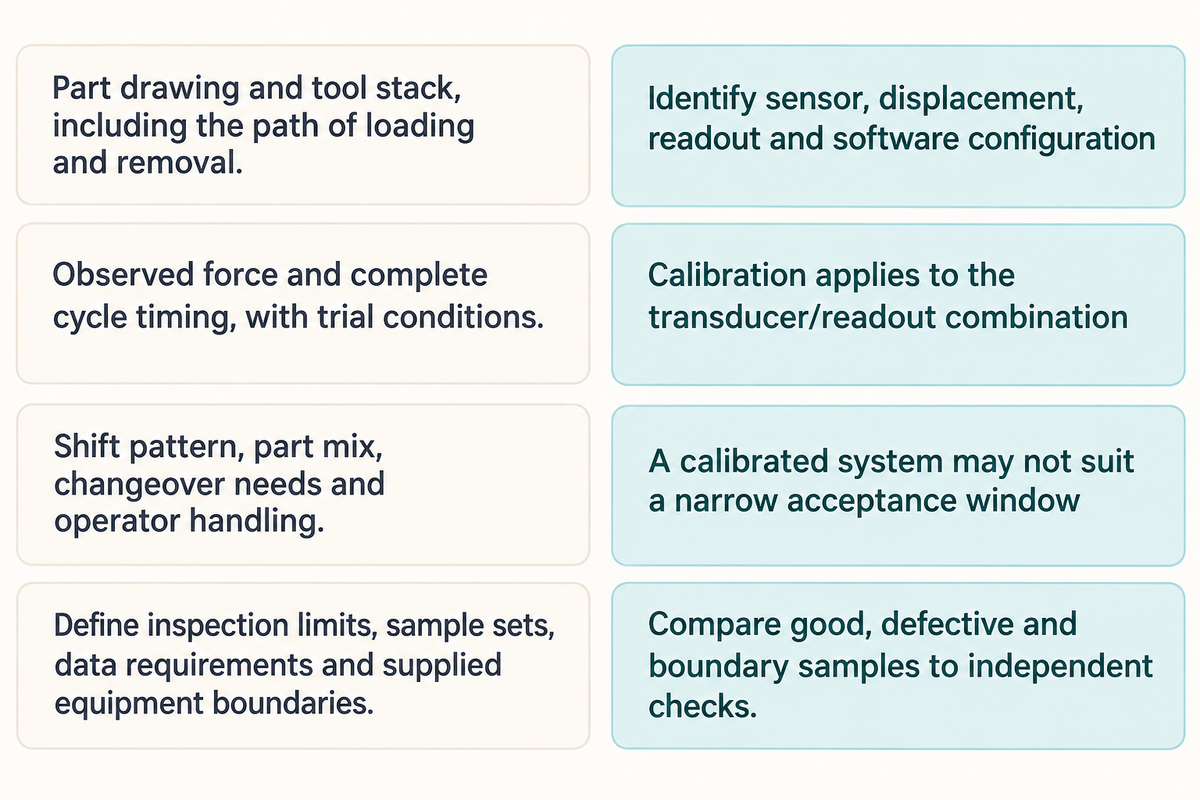
Specify the entire supported assembly and tool interfaces, and the criteria for accepted parts, prior to delivery. Define the bench, part-loading route, force path, measurement configuration and sample plan. The equipment supplier and buyer need to understand and agree on the definition of a good piece, especially if a force curve will release or reject production parts.
Provide a sectioned drawing showing fitted surfaces and tool support and contact points. Specify the material, fit tolerance, surface condition, lubricant and required final position. If the specification includes keyways or a cutting operation, provide the actual details of the broaching tool and the required exit clearance rather than describing the operation in generic terms of pressing.
For monitored work, find the force sensor, displacement measurement, readout, and software configuration. According to NIST, calibration performed with a customer-supplied readout applies to that transducer/readout combination. Its traceability policy distinguishes traceability from fitness for purpose and states that the measurement uncertainty must suit the measurement need. A calibrated system may not be suitable for a narrow acceptance window.
Staff should define good, defective and boundary samples and compare their results to independent part checks. Staff should include intended variation in interference, lubrication and tool wear. Staff should agree on the results storage, access, export and format. The response to a failed cycle should be agreed upon. Our guide to Measuring pressing force discusses the measurement side in more detail.
What Is Changing in Manual Press Monitoring?
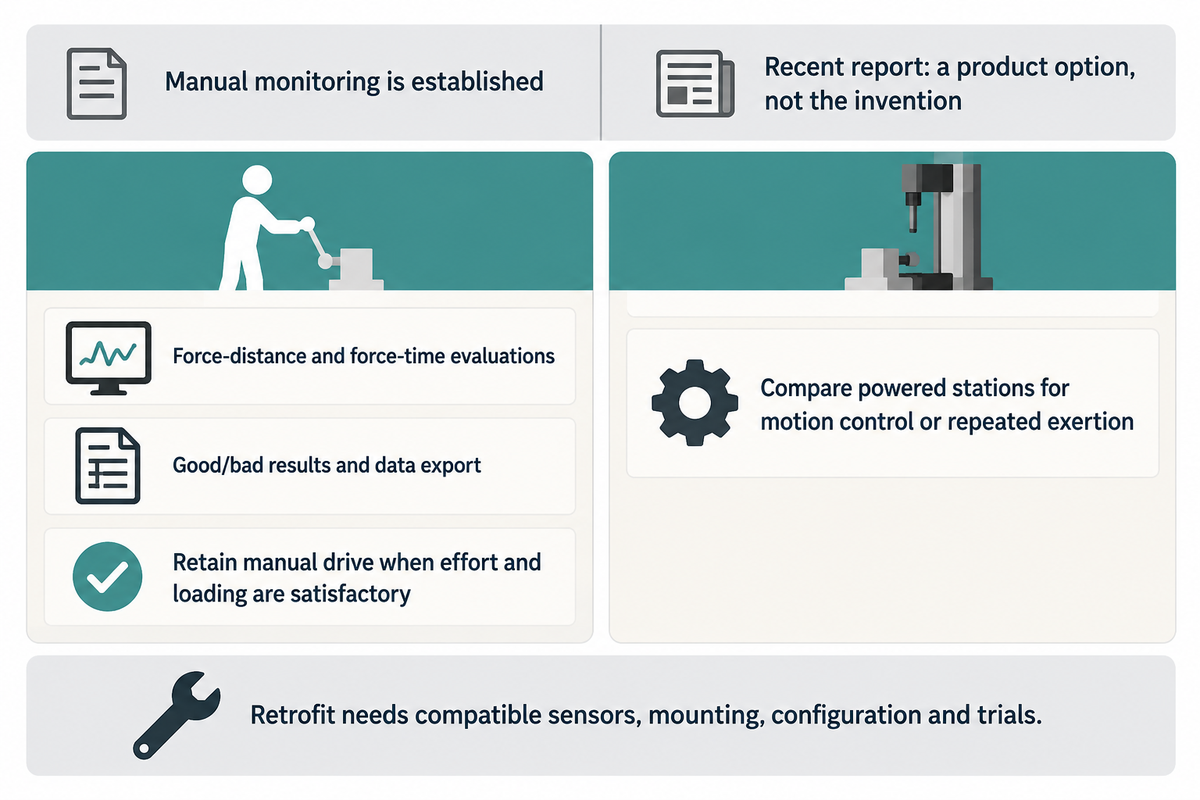
A September 2026 ASSEMBLY product report discusses EMG Control force and displacement monitoring for manual rack-and-pinion, toggle and benchtop pneumatic presses. The report states that the system can be adapted for use with presses from manufacturers other than EMG. Clients with an adequate manual station can thereby have monitoring options alongside purchasing a powered press.
An ASSEMBLY report by John Sprovieri describes force-distance, force-time evaluations, good/bad results and data export. Manual monitoring itself is older: a 2013 ASSEMBLY article already described electronic monitoring options for hand-operated presses. The recent development is a reported product option rather than the invention of monitored manual assembly.
Retrofitting still needs compatible sensors, mounting, configuration and acceptance trials. If hand effort and loading are satisfactory, retaining the manual drive may suit the case. If motion control or repeated exertion is the constraint, add these to the powered station comparison. Send SIMITCH your drawing, your current cycle and acceptance limits through the assembly application inquiry so that the discussion is about the joint and station rather than tonnage alone.
Frequently Asked Questions
How is an arbor press actuated?
A conventional arbor press is actuated by pulling a handle that turns a pinion against the ram’s rack.
The ram then presses the upper fitted tool against the supported portion. Single-lever machines use a direct handle stroke; ratcheting machines allow repositioning of the handle. Some machines are fitted with a hand wheel that enables quick ram approach and return. A compound mechanism changes the mechanical advantage. The model manual defines the handle’s operating method and the rated capacity.
What is arbor press swing?
For a centered round workpiece, twice the throat depth indicates a nominal diameter that can clear the frame.
Catalogue terminology varies, so use the dimensioned drawing to locate the ram axis and the nearest frame obstruction. A projecting clamp or fixture, or an irregular part, can consume clearance even if the nominal workpiece diameter fits. Check the total assembly for clearance throughout travel and loading; swing doesn’t describe vertical working height or available force.
Where is an arbor press installed?
An arbor press is installed on a stable, adequately rated bench or stand using the manufacturer’s mounting arrangement.
The support must carry the machine and work while resisting movement during handle operation. Provide space for the handle arc, part handling and tool exit, as well as clear access around the pressing point. For example, Baileigh’s AP-3R manual specifies a reinforced workbench and through bolts with washers and nuts.
Can you stamp metal with an arbor press?
Yes, small stamping and marking jobs are possible with matched tooling, adequate force and enough clearance. A guided tool, supported die and adjustable stops help to maintain a consistent impression. The thickness of the material and the geometry of the tool determine the job load; the press rating alone doesn’t qualify the setup.
Can I test a press before I commit to a purchase?
Some suppliers do application testing; Janesville offers testing of press applications for free. Send a sample of the part being fitted, the fitted dimensions, the final position, and the requirements for inspection; this will help the test answer a specific question. For a custom monitored assembly station, specify sample quantities, tooling ownership, report contents and test acceptance criteria in the quotation. Ask if the test configuration is that of production; a demonstration using different tools or measurement hardware may leave critical purchase questions unanswered.
How fast do arbor presses ship?
Janesville states that manual presses normally ship within 24 hours and pneumatic presses within one to two days. Use the supplier’s latest order acknowledgement for the correct configuration and the destination.
How do you use an arbor press for jewelry?
Use a fixture and tool designed for the jewelry task, such as setting a small rivet or making a controlled impression. Support the work close to the contact point and use the stop to protect thin or delicate features. A general-purpose bench press may require a different tool holder or finer adjustment. Try the specified tool with the matched scrap material first, inspect the result, and keep your fingers away from the closing tool and die.
References & Sources
- NIST Guide to the SI: conversion factors, force table.
- Naval Postgraduate School: Arbor Press safe operating procedure.
- OSHA 1910.212: General requirements for all machines.
- OSHA 1910.217: Mechanical power presses.
- B11 Standards: ANSI B11.2 public scope.
- NIOSH: Identify ergonomic risk factors.
- EPA: Cellular manufacturing methods.
- NIST: Calibration of Force Transducers.
- NIST: Metrological Traceability and policy.
- Edwin H. Zimmerman, Your Builder IS Your Partner, ASSEMBLY, 2008.
- Jim Camillo, Assembly Presses for Low-Force Applications, ASSEMBLY, 2021.
- John Sprovieri, Control Monitors Force and Displacement During Press-Fit Assembly, ASSEMBLY, 2026.
- Jim Camillo, Manual Assembly Presses are Simple and Flexible, ASSEMBLY, 2013.

WHY WE WRITE THIS
About SIMITCH
SIMITCH develops sheet-metal joining equipment for clinching, riveting, servo pressing, pneumohydraulic drive and hot-melt connection applications. Our engineering team starts with the material stack, access envelope, cycle target and acceptance method before recommending a machine route.
Founded in 2006 in Taicang, Jiangsu, SIMITCH combines research and development, in-house production and global sales. These guides turn field experience into practical decision support for process engineers, plant teams and industrial buyers.
OUR EXPERIENCE
Since 2006
Equipment engineering, machining, assembly and joint validation under one manufacturing system.
OUR EXPERTISE
Five joining routes
Clinching, riveting, SPR, precision press-fit and hot-melt connection for production lines.