Get in touch with Suzhou Simitch Machinery Co., Ltd Company

Updated October 2026
A press fit lubricant reduces sliding friction as one component is pressed into another. For rubber bushings that need to grip after installation, start with a compatible temporary assembly fluid. For metal-to-metal joints, use the specified assembly oil or paste. In both cases, control the film thickness and assess damage from insertion and the strength of the joint separately.
It can be useful to lubricate the press fit to improve the press stroke. However, it tells very little about how the joint behaves as the fluid dries, rubber relaxes or the assembly enters service. Choosing the assembly fluid and choosing the release test should occur in the same process plan.
Quick Specs
| Interface | Exact metal, rubber or plastic grades and surface condition |
|---|---|
| Application | Dose in mL per joint, coverage and application-to-press delay |
| Finished-joint check | Push-out force in N or retained torque in N·m, at specified time and temperature |
How press fit lubricant changes insertion force and retention
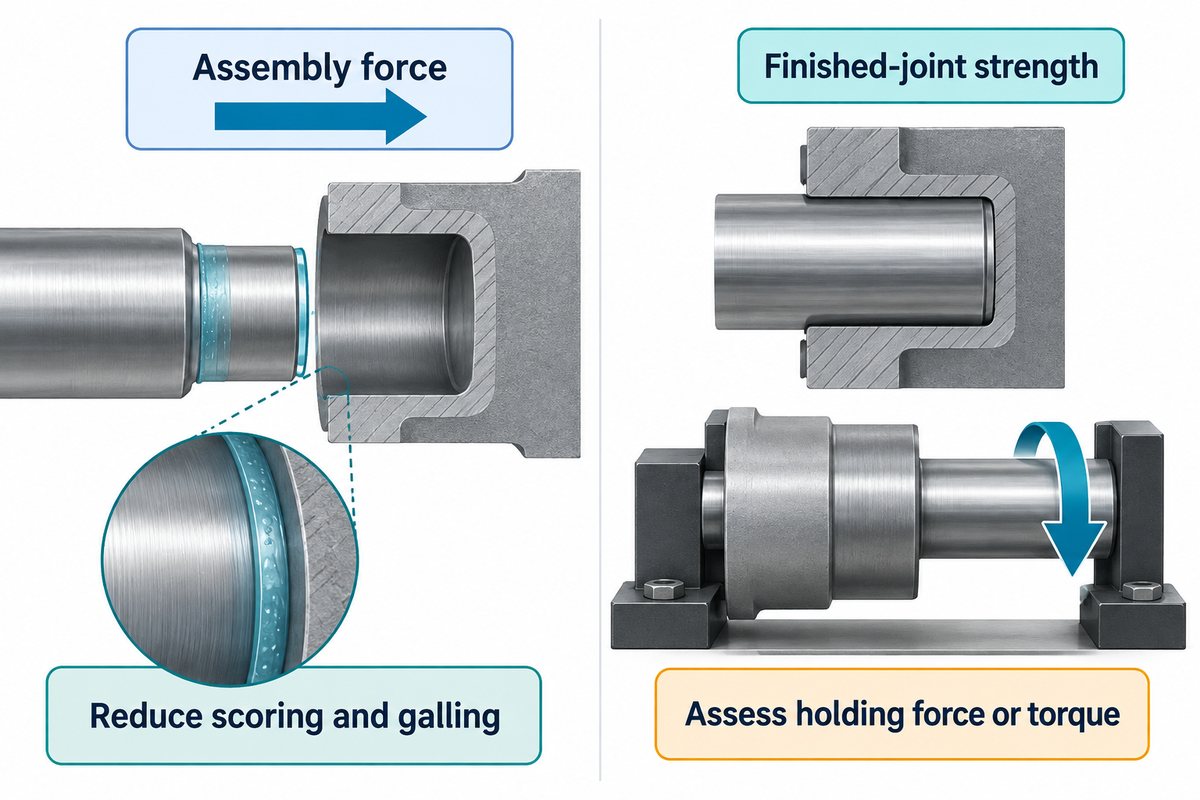
Lubrication can help reduce scoring and galling during assembly, while the finished joint depends on contact pressure. The required holding force or torque for the assembly should be assessed for the joint conditions and service.
In the 2023 numerical study Influence of the Friction Coefficient on the Stress Distributions and Contact Pressure in Press-Fits, changes in friction during assembly are shown to change the resulting stress in the joint. Friction also changes the condition of the contact surface, and thus the strength of the joined parts. Assembly force and finished-joint strength are separate outcomes.
Do press fit lubricants work?
Press fit lubricants work by changing friction between the mating surfaces during assembly. An assembly fluid can be used to limit adhesive damage or stick slip during assembly. The goal shouldn’t be to display the lowest press force, but to achieve an undamaged, fully seated assembly that meets its retention requirements.
Keep mechanical inputs constant when evaluating products. Changes to shaft diameter, bore finish and lead-in can impact a curve as much as a change in fluid. Resolve dimensional inputs using the press-fit tolerance guide before assuming a difference in force is due to lubrication.
Choose a lubricant by joint material and final duty
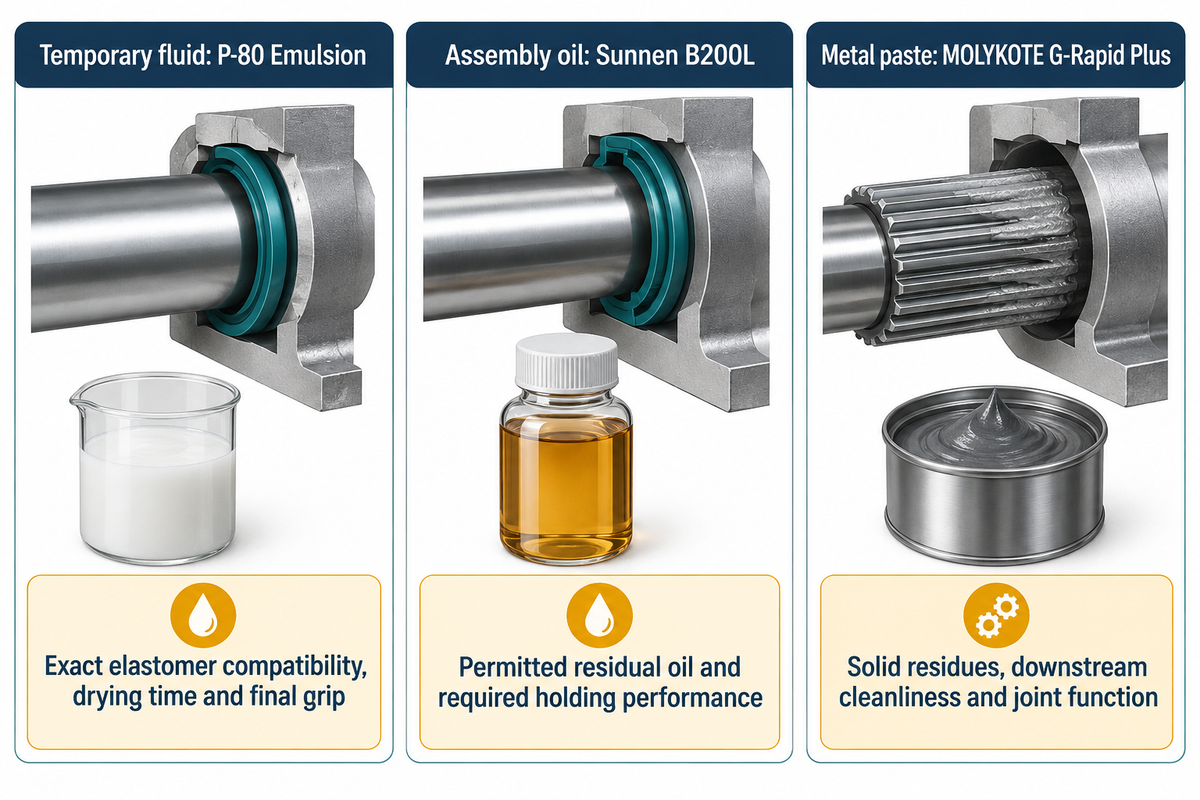
The lubricant family must be chosen from the mating materials and the film allowed after assembly. Temporary rubber fluids can be used in assemblies where lubricity fades after assembly. Oils and solid lubricant pastes can be used for specific metal assemblies. A grease chosen for a moving bearing has a different function from that of the fluid used to install its ring.
Press-Fit Lubricant Selection Table
The Press-Fit Lubricant Selection Table lists three families of assembly fluids and the conditions that govern release, and also specifies which families are intended for which interfaces.
| Family and example | Suitable starting point | Decisive condition |
|---|---|---|
| Temporary fluid: P-80 Emulsion | Rubber-part installation where temporary slipperiness helps | Exact elastomer compatibility, drying time and final grip |
| Assembly oil: Sunnen B200L | Specified press-fit installation with a light oil film | Permitted residual oil and required holding performance |
| Metal paste: MOLYKOTE G-Rapid Plus | Metal press-fitting or slight-motion connections specified for paste | Solid residues, downstream cleanliness and joint function |
These examples aren’t a ranking. For their assembly products, Sunnen and DuPont list animal and mineral oils, respectively. Solid lubricants include graphite and molybdenum disulfide. None of the descriptions state that the product is a temporary rubber fluid.
Follow the application instructions for the general purpose grease. Compatibility relies on the complete formulation and mating materials, especially if the base is synthetic. For elastomers, see ASTM D4289. For heavy duty service, determine the load and environment that the finished connection must withstand. High-performance lubricants also need to satisfy the same material and residual film requirements. A waterproof grease or a product promoted for resistance to extreme pressure may still leave an unwanted film in a static joint. For information on the mechanical process, refer to ASSEMBLY’s “Best Practices for Press-Fit Assembly” for information on lubrication and assembly alignment and tooling.
Temporary lubricant versus grease for rubber bushings
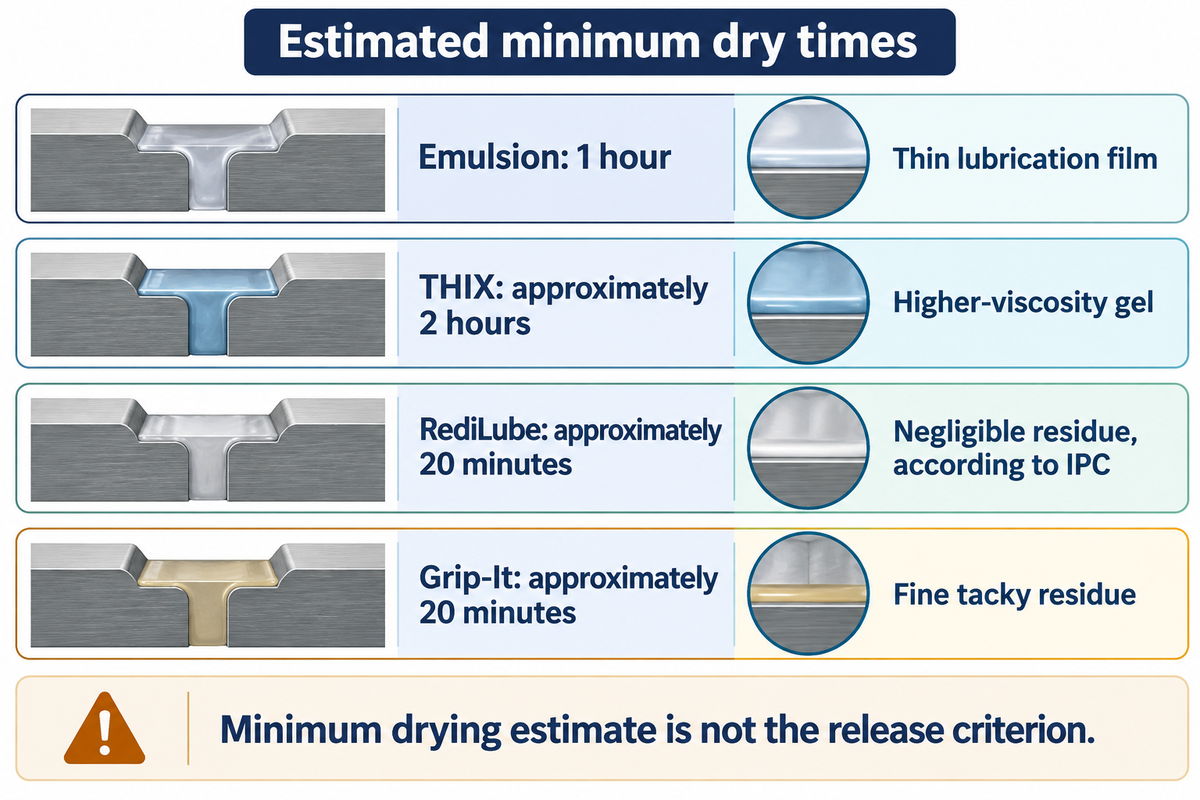
For a rubber bushing that needs easier insertion followed by recovered grip, use a compatible temporary assembly fluid. However, if a design calls for continuing lubrication, use persistent grease. The product’s drying behavior, residual film and interaction with elastomers matter more than whether the assembly feels slippery.
| Grade | Estimated minimum | Residue or handling distinction |
|---|---|---|
| Emulsion | 1 hour | Thin lubrication film |
| THIX | Approximately 2 hours | Higher-viscosity gel |
| RediLube | Approximately 20 minutes | Negligible residue, according to IPC |
| Grip-It | Approximately 20 minutes | Deliberately leaves a fine tacky residue |
According to IPC’s product table and drying paper, the assembly drying time depends on the grade and application conditions. Its paper also states that some applications can take up to two days to completely dry. Excess liquid and less porous materials can make the process take even longer. Thus, a greater dose can also affect how long one has to wait for the assembly to dry.
A dry lubricant isn’t always temporary. A dry film lubricant is selected for the lubricating layer to remain. For a bush that needs to grip, decide if the residue needs to reduce friction or allow for grip to recover.
Drying and rubber behavior continue on different clocks. ASTM D6147-97(2026), the compression stress-relaxation method, explains that rubber’s counterforce falls over time at fixed strain. For an automotive bushing, include the relevant conditioning period in the retention test; do not use a manufacturer’s minimum drying estimate as the release criterion.
Temporary fluid: advantages
- Provides installation slip that can fade after drying.
- Offers different viscosities for application control.
- Allows selection around the required final grip.
Temporary fluid: limitations
- Needs a defined conditioning and release interval.
- Can leave grade-specific residue.
- Still requires compatibility with the exact rubber compound.
Material compatibility and silicone contamination
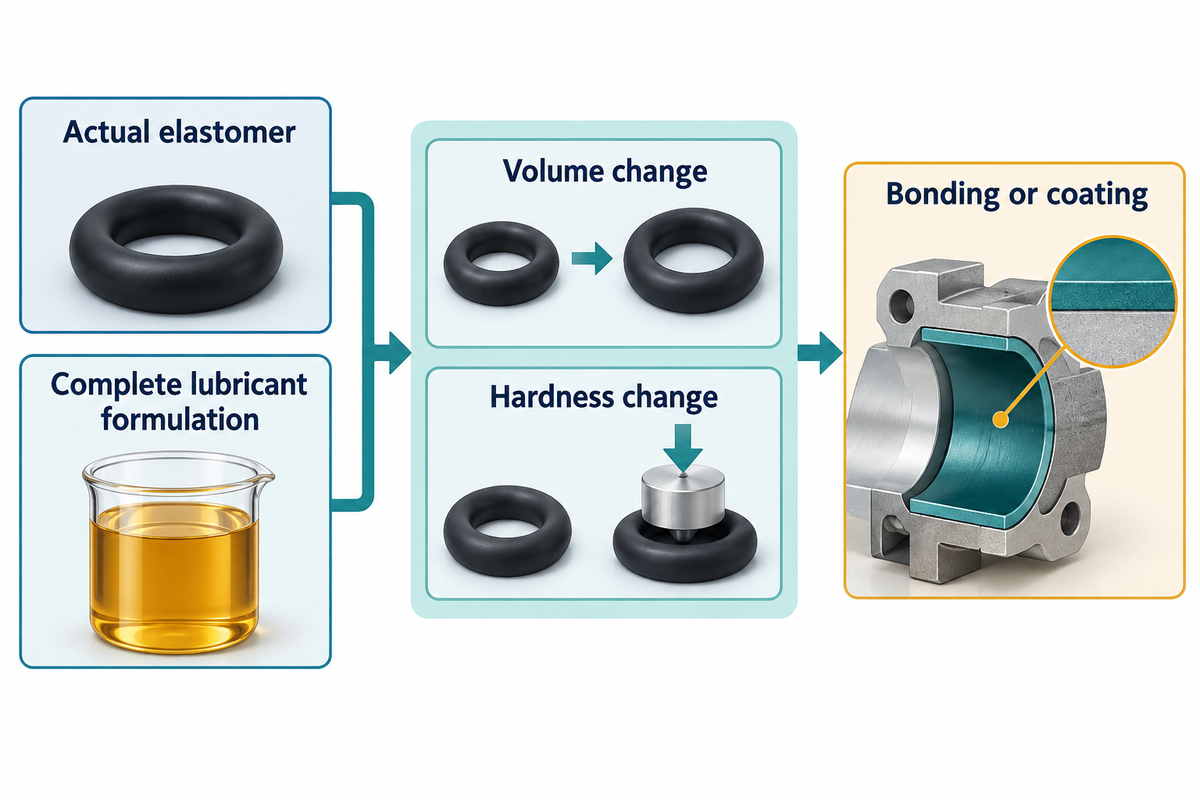
Evaluate compatibility between the actual elastomer and the complete lubricant formulation. Volume change and hardness change are preliminary tests; other tests may include changes in tensile and elongation properties. Keep lubricant away from surfaces that will later require bonding or coating, unless the downstream process allows it. For an O-ring or other rubbery seal, use the actual compound for the evaluation.
The public scope of ASTM D471-16a(2021) covers the comparative effects of various liquids on rubber. It does not include cellular rubber, porous formulations and compressed sheet packing, except as described in the standard’s stated exception. This material test does not guarantee the integrity of the joined connection.
“It yields comparative data on which to base judgment as to expected service quality.”
ASTM D471, public Significance and Use section
Engineering Note
ASTM D4289-24a describes elastomer immersion for 70 hours at 100 °C or 150 °C, or conditions specified by the lubricant specification. Those are test conditions, not operating limits. The public guidance requires application-specific correlation and identifies additional properties for severe flexing or temperature exposure.
Where should you not use silicone lubricant?
Don’t use Omega’s SG GREASE TUBE on a mating surface that will later have to be painted or adhesive finished. Before a product can be used with silicone rubber, that particular product’s material compatibility needs to be tested and its instructions checked. Compatibility is dependent on the formulation and elastomer, and a silicone label alone isn’t a material approval.
For example, Omega’s silicone/PTFE grease listing cautions against certain paint and silicone rubber uses. Other products state differing compatibility claims. Keep cleaning solvent, mold release and assembly fluid on the same process review: changing any one of them can change the condition presented to the next operation.
Metal assembly lube, anti-seize and bearing fits
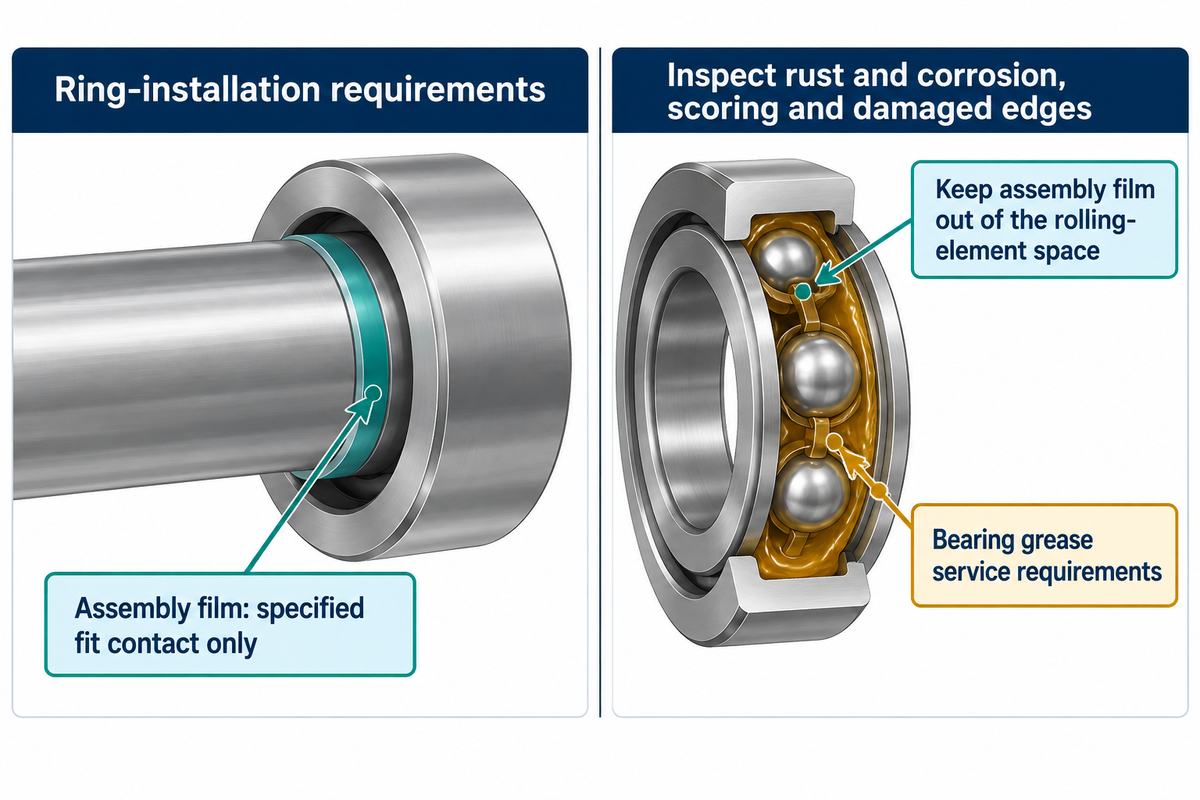
For metal assemblies, a lubricant paste may be used when it meets the specified contact and residual-film requirements. A general anti-seize paste isn’t automatically a substitute for the specified assembly paste. For a bearing ring, follow the mounting spec of the bearing as well as the joint fit requirements.
In the case of DuPont’s G-Rapid Plus, a thin film of the product should be used on a clean surface for press fitting, and it shouldn’t be mixed with greases or oils. Its mineral base oil contains moly and graphite solids. Treating every persistent paste as an installation error would exclude an intended application.
In The Influence of a Lubricant Medium on the Development of Fretting Wear in an Interference Fit Connection, Barta and colleagues found fretting wear traces in all of the tested shafts that were subjected to rotating bending. The lubricants changed the wear without eliminating the failure mechanism.
Likewise, in a bearing race, shaft-to-ring retention isn’t measured by a paste’s performance. Results from the 2023 study Investigating the Fretting Failure of Axial Thrust Steel Bearings showed that, during fretting wear tests, paste formulations influenced the type and extent of fretting corrosion. One of the co-authors of this study was affiliated with a lubricant company. These results therefore pertain to the test configuration of the study.
- Keep assembly film on the specified contact rather than spreading it into the rolling-element space.
- Distinguish bearing grease service requirements from ring-installation requirements.
- Inspect rust and corrosion, scoring and damaged edges before adding more lube.
If the requirement includes exposure to water washout or high temperature, qualify to these conditions as well. To resist wear and corrosion, the selected grade must satisfy these separate conditions as well as the installation condition.
For rolling bearings, the retained grip is one condition to consider; service life is the other. Hoop stress from an interference fit can affect bearing fatigue life even with clearance compensation. NASA’s study Interference-Fit Life Factors for Roller Bearings discusses bearing-fatigue effects of hoop stress. It doesn’t compare different lubricants. For bearings, keep bearing life, fit and the mounting load path together when specifying press-fit tooling.
Compare lubricant cost per accepted assembly
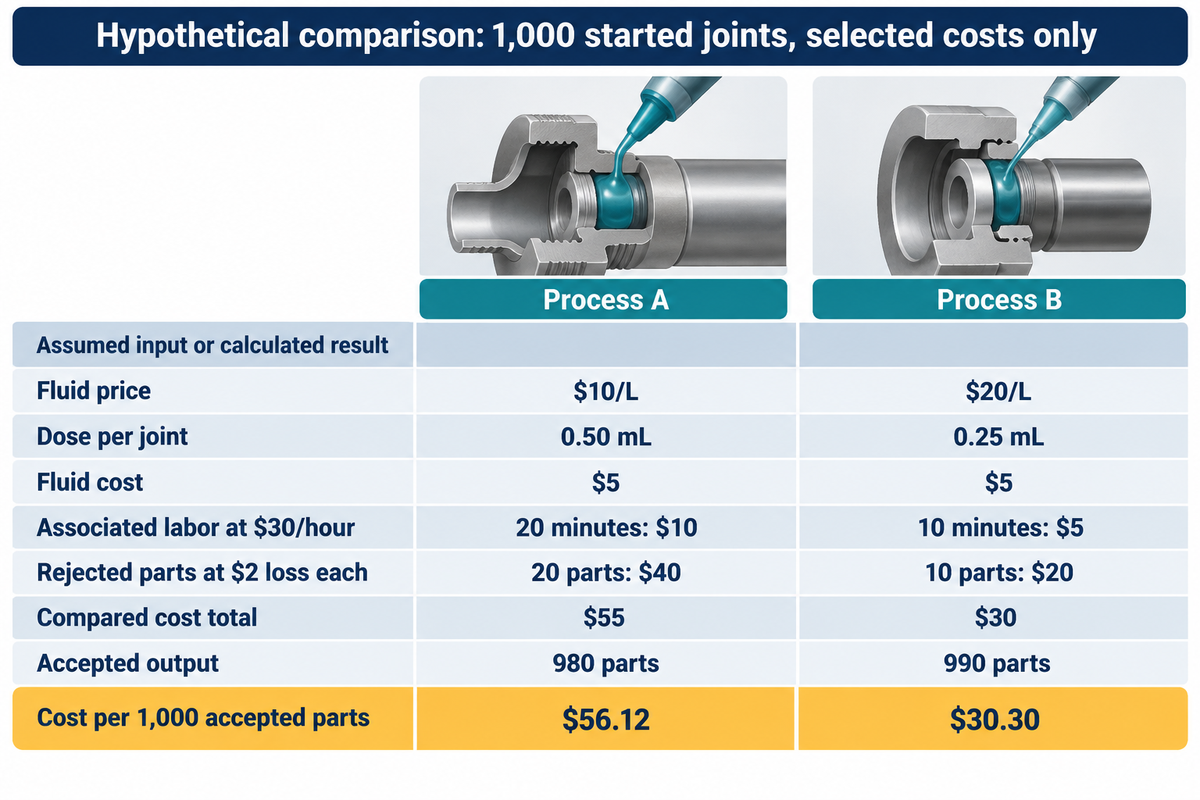
Compare fluid consumption and the associated processing costs to the accepted output. A higher price per liter can be partially offset by a smaller dosage, but the labor and reject costs need to come from the process. Count drying space and/or delayed release costs separately if they vary from the process being evaluated. Don’t assign all process improvements to the lubricant.
Cost per 1,000 Accepted Assemblies
Compare process costs to the accepted output and adjust for 1,000 assemblies.
| Assumed input or calculated result | Process A | Process B |
|---|---|---|
| Fluid price | $10/L | $20/L |
| Dose per joint | 0.50 mL | 0.25 mL |
| Fluid cost | $5 | $5 |
| Associated labor at $30/hour | 20 minutes: $10 | 10 minutes: $5 |
| Rejected parts at $2 loss each | 20 parts: $40 | 10 parts: $20 |
| Compared cost total | $55 | $30 |
| Accepted output | 980 parts | 990 parts |
| Cost per 1,000 accepted parts | $56.12 | $30.30 |
For A, fluid costs 1,000 × 0.50 mL ÷ 1,000 mL/L × $10/L = $5. Add $10 labor and $40 reject loss, then calculate $55 ÷ 980 × 1,000 = $56.12. Common costs are excluded. The assumed reject loss excludes costs already counted, preventing double counting.
The plant engineer records dose and handling time. Quality confirms the accepted quantity, and finance checks the cost boundary. If a drying queue consumes fixtures or floor space, the measured cost should be included. The comparison of measured and simulated assembly curves in Prediction of Pressing Quality for Press-Fit Assembly shows the need to evaluate a defined part and process, rather than assume a lower force proves an improvement.
Control lubricant delivery and press-fit process signals
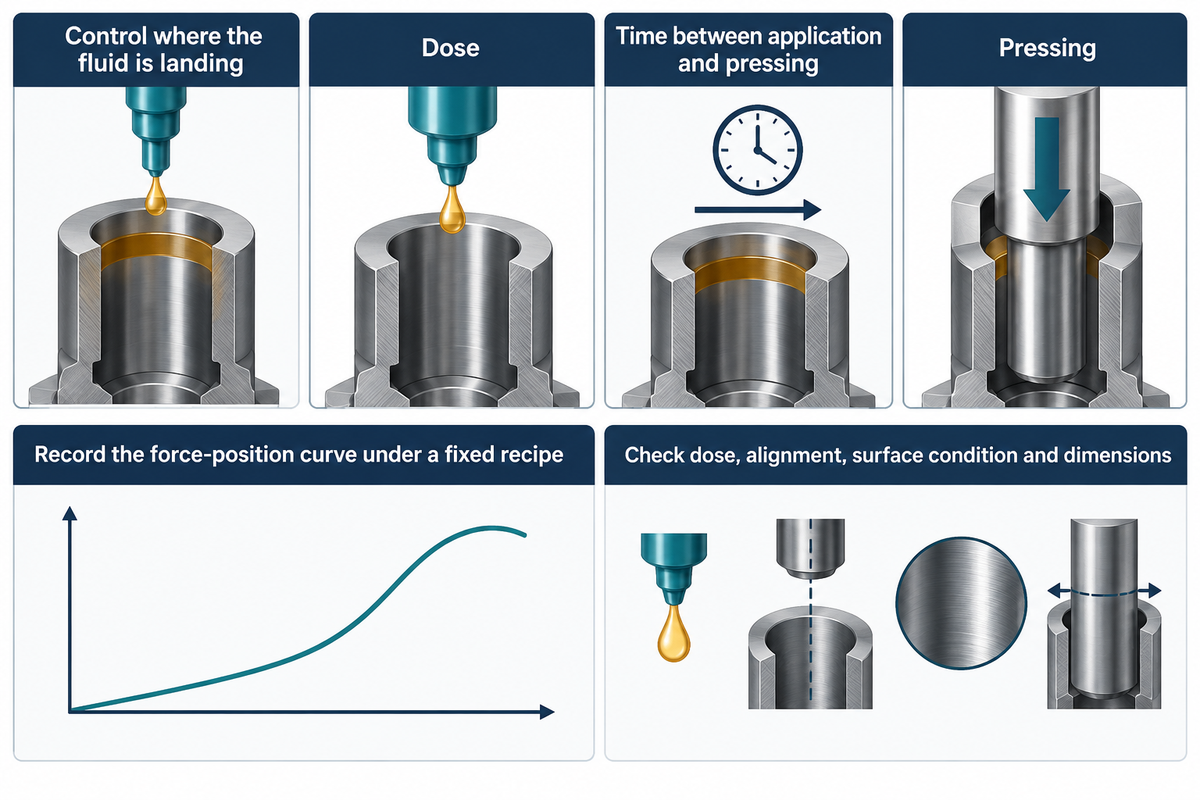
Control where the fluid is landing, the dose and how long it waits between application and pressing. Record the force-position curve under a fixed recipe. A change in the peak or gradient of the curve should prompt checks of dose, alignment, surface condition and dimensions before adjusting the lubricant alone.
Coverage should be the same regardless of the method used (brush, pad, metered applicator). Check delivery from a dispensing valve after an idle period and check for drips after shutoff. High viscosity can affect transfer of a paste from a brush and low viscosity can allow a fluid to run away from the contact before it’s inserted.
In the 2015 press-fit curve study, You and colleagues evaluated 18 micropart specimens and included comparative experimental and simulation data. Discussion highlights the influence of maximum force and the shape of the curve. The acceptance limits apply to the parts tested in the study, and not to every press-fit application.
Why can a press-fit feel rough even when the final depth is correct?
It’s important to align surfaces accurately and to have a consistent film during insertion. Irregularities during the assembly of a component may lead to an uneven insertion. Final depth of insertion indicates endpoint, and not the path taken to attain that depth. The curve and the mating surfaces, including the areas obscured by a shoulder after assembly, should be inspected.
Verify the support and lead-in before increasing fluid or force. A fixture that tilts under load can keep producing damaged parts with different lubricants. The BP press model comparison frames equipment selection; it doesn’t set the acceptance window for the part.
SIMITCH lists external force and displacement sensing, sampling up to 10 kHz and up to four evaluation windows for its assembly servo press systems. These are published equipment capabilities. Define the actual production limits from the joint and validated process.
Validate retention after assembly and conditioning
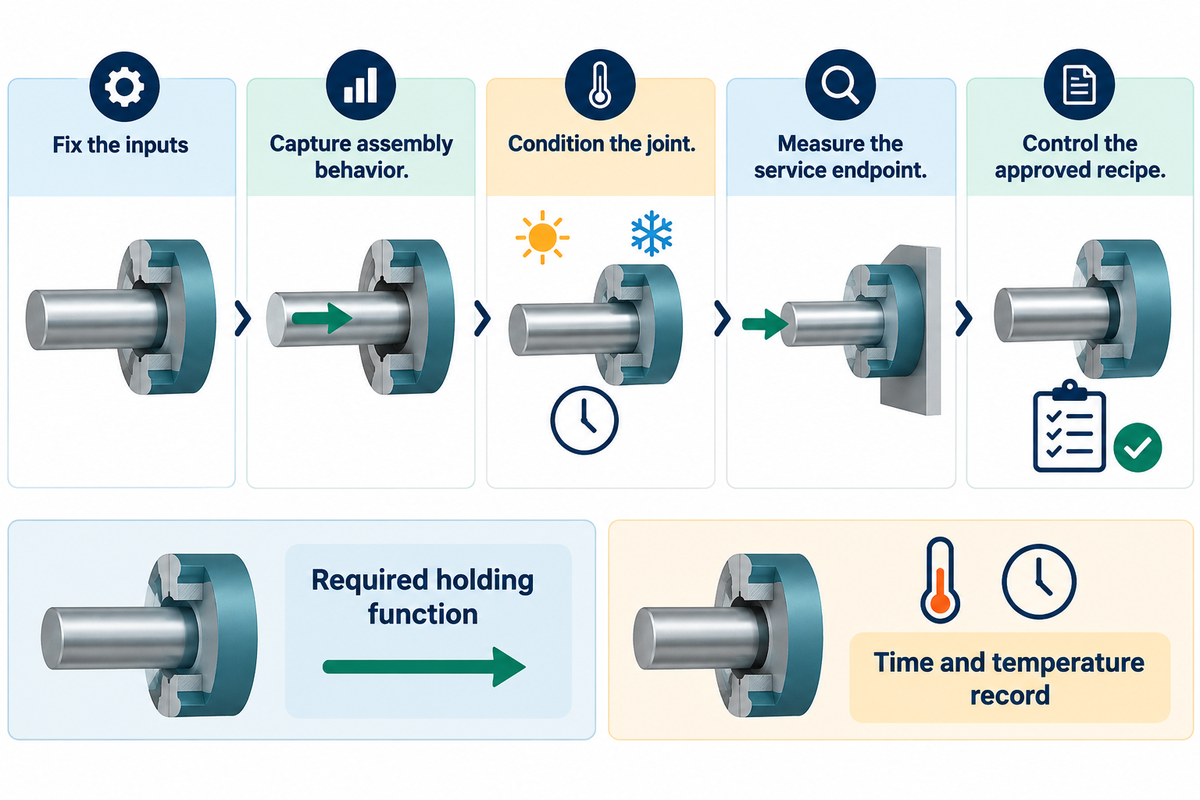
Validate the lubricated joint against the load it must retain after the conditioning period. Use push-out, torque, or some other defined test. Record the temperature, time, and condition of the material being tested. The joint must withstand its service exposure, so consider relevant aging or repeated loading in the validation plan.
- Fix the inputs. Record component grades, dimensions, finish, lubricant grade, dose and application method.
- Capture assembly behavior. Save the force-position trace and inspect seating and surface damage.
- Condition the joint. Hold it for the specified time and environment before the required release test.
- Measure the service endpoint. Record retention and any other required response against the drawing or product specification.
- Control the approved recipe. Treat a lubricant, dose, material or cleaning change as a process change.
The distinction between assembly checks and service tests matters in both rubber and metal assemblies. According to ASTM D6147, the relaxation method describes decay of force over time. Fretting Wear explains how oscillating surfaces can expel a lubricant film without replenishing it, leading to wear. An assembly test checks insertion, and a service wear test takes place over time.
Provide the joint inputs to the supplier to support discussion of press capacity, tooling and data collection without having to speculate about the joint. Use the servo-press request checklist to organize your documents.
| Parameter | Recommended range | Why it matters | How to verify |
|---|---|---|---|
| Fit dimensions | Drawing limits, mm | Contact condition | Part measurements |
| Lubricant dose | Approved recipe, mL/joint | Film consistency | Dispense check |
| Insertion recipe | Specified speed, mm/s | Repeatable comparison | Recorded press settings |
| Conditioning | Specified hours and °C | Comparable release state | Time and temperature record |
| Retention | Drawing requirement, N or N·m | Required holding function | Defined joint test |
| Material pair | Exact component grades | Formulation compatibility | Material records and specified tests |
| Downstream operation | Permitted residue and cleaning process | Bonding or coating condition | Approved process instruction |
| Surface condition | Drawing finish and cleanliness | Insertion behavior | Surface and dimensional inspection |
| Production demand | Required accepted parts/hour | Press and waiting capacity | Timed production trial |
Frequently asked questions
For the joint, decide on a grade rather than treating lubricants as substitutable. Keep checks for product safety and unopened shelf life separate from checks on retained-joint performance. The answers below address common questions purchasers ask, including differences between a grease fitting, an installation fluid and an adhesive retaining compound.
Which press fit lubricant is best?
The best starting choice matches the materials and the film allowed after assembly.
For a rubber bushing that must grip after insertion, compare compatible temporary fluids. For a specified metal connection, compare assembly oils or pastes intended for that duty. Check the exact grade against the component drawing and downstream operation. A lubricant made for easy installation can still be unsuitable when its remaining film interferes with bonding or the required retained torque.
Are press fit lubricants safe?
They can be handled safely when the selected product and application follow its safety data sheet.
Read the current safety data sheet for ventilation, protective equipment, storage and disposal instructions. Aerosol packaging adds handling considerations that a brush-applied paste may not share. Keep spills away from walking and gripping surfaces. Material compatibility is a separate question: a product described as non-corrosive still needs to suit the actual metal, rubber or plastic and any later coating operation. Do not use a food-contact or environmental claim unless the exact grade carries that documented qualification.
Do press fit lubricants expire?
Assembly lubricants have grade-specific shelf-life and storage instructions; packaging can change the period.
DuPont’s G-Rapid Plus sheet gives unopened paste a usable life of 60 months from production at 0–40 °C. Its aerosol packaging is listed for 24 months at 5–35 °C. These periods do not apply to every assembly lubricant or to an opened, contaminated container. Record the batch and opening date, and follow the selected supplier’s instructions for stock rotation and storage.
Is a press fit grease fitting a lubricant?
A press fit grease fitting is hardware, not a lubricant.
It provides a connection for servicing with a grease gun. Selecting that fitting is a different task from selecting the fluid used to press a component into its housing.
Can lubricant be combined with a retaining compound?
Combine them only when the retaining-compound instructions permit the actual surface condition and the process has been qualified.
An anaerobic retaining compound develops an adhesive contribution within a metal joint. Assembly oil changes sliding behavior; these are different functions. Henkel authors explain the adhesive mechanism in ASSEMBLY’s Increasing Strength and Reliability of Interference Fits. Some grades tolerate limited oil contamination, but that does not authorize mixing an arbitrary paste into the adhesive or coating both surfaces with a separate oil. Follow the specified cleaning, application and cure sequence. Include the real assembly delay and surface finish in the trial, then evaluate the intended retention endpoint. Do not substitute a thread sealant simply because it also cures between metal surfaces. Where the chosen process uses the retaining compound during insertion, confirm its application method directly in that product’s instructions rather than adding a second fluid to make the stroke feel easier.
Key takeaway
Specify the lubricant, applied film and release test together. That connects an easier press stroke to an assembly the production team can accept.
Plan the press around the joint
SIMITCH supplies assembly press systems. Send the part drawing, material pair, lubricant recipe and acceptance requirement to discuss the press, fixtures and process records.
Related Articles and Selection Resources
References & Sources
- Influence of the Friction Coefficient on the Stress Distributions and Contact Pressure in Press-Fits Izard et al., Lubricants, 2023.
- Best Practices for Press-Fit Assembly Jim Camillo, ASSEMBLY, 2017.
- ASTM D6147-97(2026) ASTM International, public scope and significance.
- ASTM D471-16a(2021) ASTM International, public scope and significance.
- ASTM D4289-24a ASTM International, public scope and significance.
- The Influence of a Lubricant Medium on the Development of Fretting Wear in an Interference Fit Connection Barta et al., Lubricants, 2024.
- Investigating the Fretting Failure of Axial Thrust Steel Bearings Bhaumik et al., Metals, 2023.
- Interference-Fit Life Factors for Roller Bearings Oswald, Zaretsky and Poplawski, NASA, 2009.
- Prediction of Pressing Quality for Press-Fit Assembly Based on Press-Fit Curve and Maximum Press-Mounting Force You et al., International Journal of Aerospace Engineering, 2015.
- Fretting Wear E.C. Fitch, Machinery Lubrication, 2005, adapted from a 1992 book.
- Increasing Strength and Reliability of Interference Fits Henkel authors Doug Lescarbeau and Rob Dunkel, ASSEMBLY, 2013.