Get in touch with Suzhou Simitch Machinery Co., Ltd Company

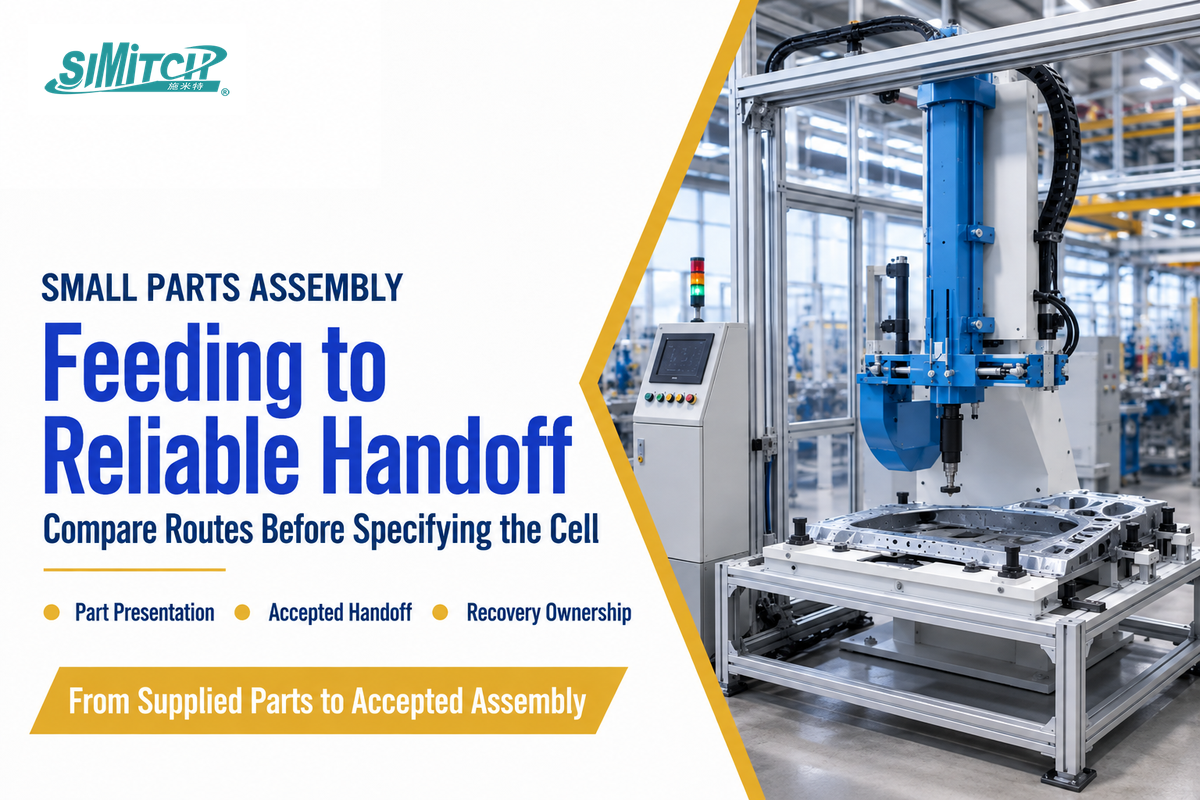
Small Parts Assembly (SPA) automation requires the systematic feeding, handling, joining and inspection of small components. It begins with the status of supplied components and the accepted assembly. Reliable presentation of components often determines whether the rest of the cell is able to work.
Quick Specs
| Planning input | Specify for your application |
|---|---|
| Incoming condition | Part revision, packaging and representative lots |
| Receiving condition | Orientation, seating and product-quality criteria |
| Output measure | Accepted assemblies over the production period |
| Supply boundary | Component handling, joining station and inspection owners |
Small parts assembly automation should be selected by accepted output at the receiving station. Compare bowl, flexible and tray presentation using the same parts, then include replenishment, changeover and fault recovery in the trial.
TL;DR
- A successful pick can still produce an incomplete assembly.
- Vision selects a pose; separation must first make the part accessible.
- Tray loading and exchange belong in the capacity and labor comparison.
- Automatic recovery needs a defined destination for uncertain parts.
Updated October 2026
Small parts assembly automation: define the handoff
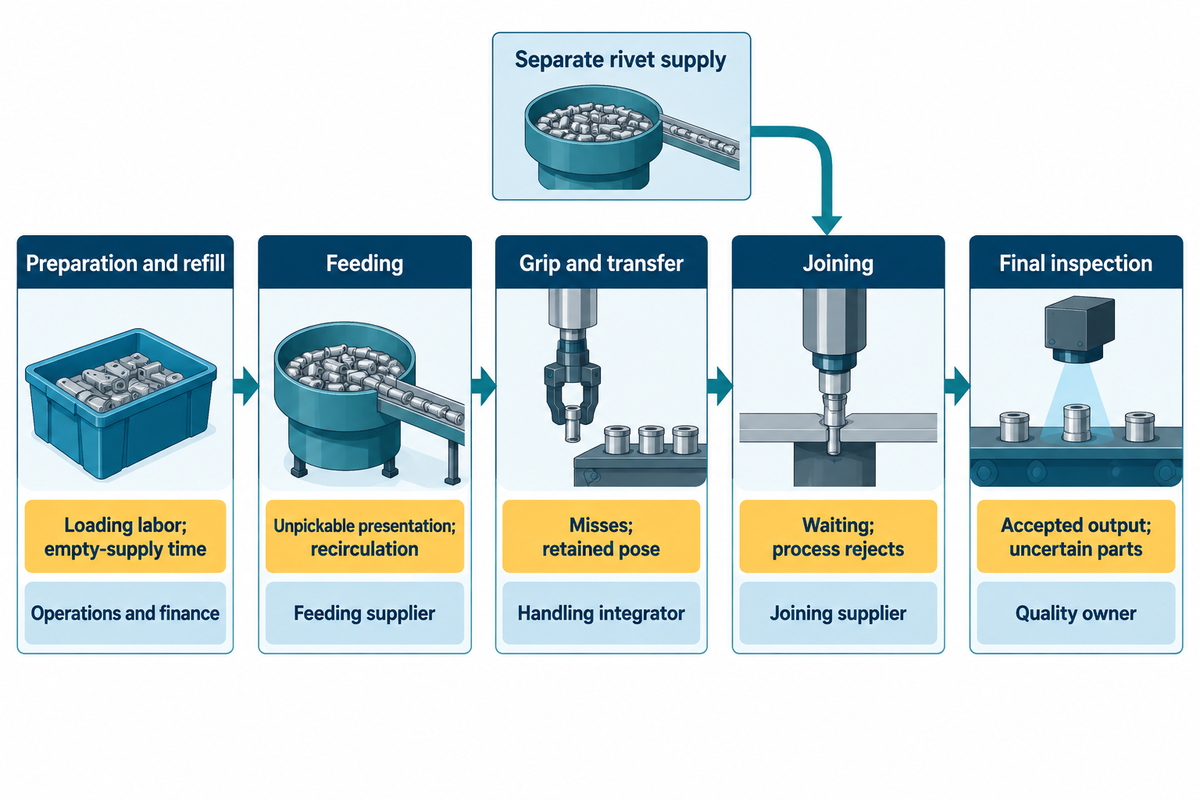
Define the assembly system from incoming packaging to accepted product, with an owner for each transfer. A feeder presents components; a handler moves them; process tooling joins them; an inspector accepts the result. Rivet supply is a separate stream from component supply, even if they meet at one station.
The National Institute of Standards and Technology’s grasping research considers both manipulation and assembly as measurable activities. Use the task focus in your quotation. For robotics in parts manufacturing, the boundary should determine which manual corrections the machine takes over. First compare metal joining methods, and then define what must reach the selected tool.
Can you automate an existing manual assembly process?
It’s possible to automate one handling task at a time while retaining the supplied component geometry in an existing manual assembly process. Select a repeatable transfer, and define its incoming and outgoing conditions. Retain manual replenishment if it’s useful. Give the downstream station an accepted part signal before extending the automated line.
Observe the manual corrections an operator is making before buying an assembly robot. Separating stuck pieces, turning a hidden face up and feeling whether a part is seated are different tasks. A robotic assembly system needs a physical or sensing method for each correction. Reducing manual labor at pickup can leave more tray preparation elsewhere, so count both workloads.
Where nominal pick rate loses output
To understand nominal pick rate losses, track work and interruptions between incoming packaging and final acceptance.
| Stage | Observe | Owner to name |
|---|---|---|
| Preparation and refill | Loading labor; empty-supply time | Operations and finance |
| Feeding | Unpickable presentation; recirculation | Feeding supplier |
| Grip and transfer | Misses; retained pose | Handling integrator |
| Joining | Waiting; process rejects | Joining supplier |
| Final inspection | Accepted output; uncertain parts | Quality owner |
Separate sticky and tangled parts before orientation
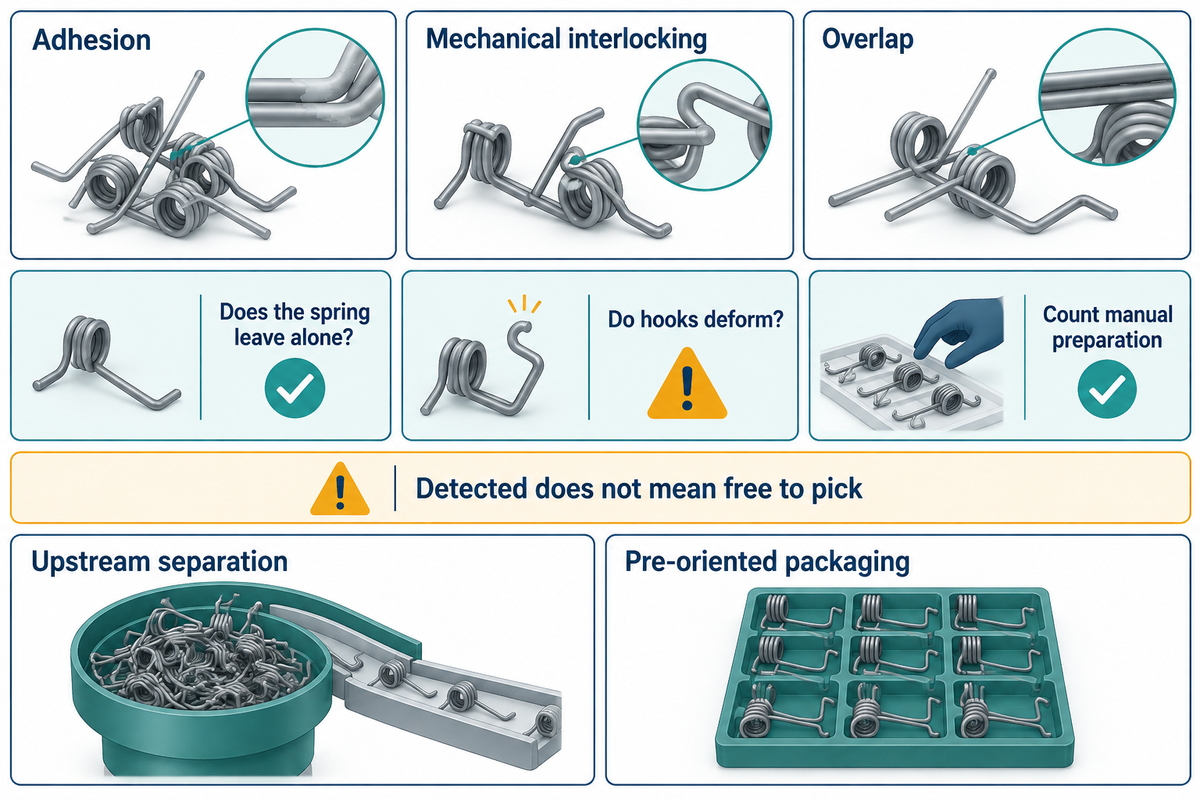
Distinguish between adhesion, mechanical interlocking and overlap before deciding on feeding systems. That receiving requirement starts with the condition of incoming parts. An oily contact surface needs an investigation different from hooked springs locked together. A camera can identify an exposed part, but the selected part has to be free to come off the surrounding material without pulling a different part with it.
ASSEMBLY’s reporting on positioning problems discusses overlap and interlocking of hooked springs, and soft parts lacking a rigid gripping surface. The distinction between the cases is between finding the part and making it available for pickup.
Example: Hooked springs are delivered loose in bags to the buyer. The suggested vision system detects an exposed spring, but the hook remains engaged to a spring lying underneath. The buyer shortlists upstream separation followed by controlled replenishment alongside pre-oriented packaging, and the trial starts with unopened production bags rather than a hand-arranged surface. It records whether a selected spring leaves alone, whether hooks deform and how much manual preparation each route requires. If separation damages the spring, the bulk route is rejected for that incoming condition. If pre-oriented packaging works in the trial, keep its loading and transport burden in the comparison. Component drawings are unchanged.
For sticking without interlock, look at the surface condition of the part before changing agitation. Oil, moisture and electrostatic charges are some of the hypotheses. Repeated circulation can also change the part surface, so inspection should happen after the whole work sequence.
Bowl feeders, flexible feeders and trays compared
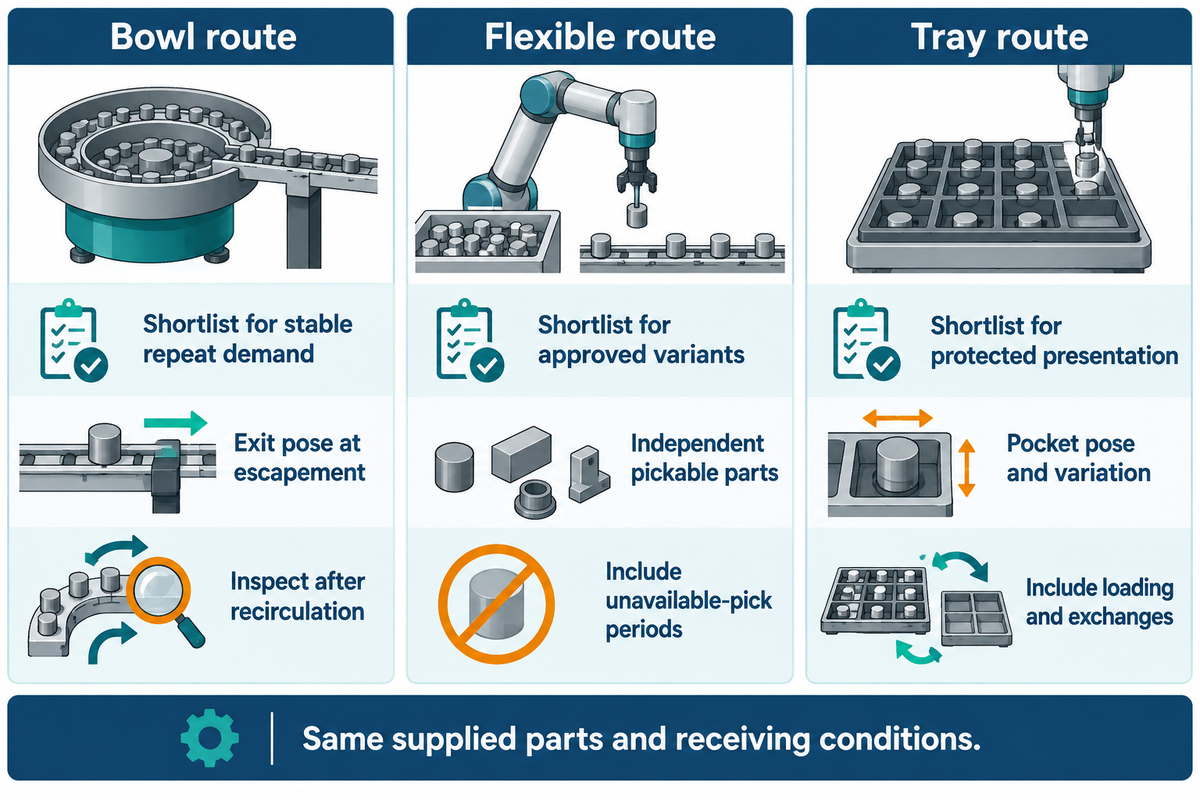
Shortlist a bowl route for stable repeat demand, flexible parts feeding for different approved variants, and trays when controlled presentation protects components. Evaluate each route at the receiving station. Production volume alone misses repeat demand, preparation labor and the periods when no usable part is available.
The routes can overlap: Haugaard and colleagues’ vision-trap research combines vision with a vibratory feeder. Evaluate a hybrid by its separation and handoff sequence, rather than assigning capabilities from its label.
3-Route Part Presentation Trial
The 3-Route Part Presentation Trial evaluates three presentation routes utilizing the same supplied parts and required receiving conditions.
| Comparison input | Bowl route | Flexible route | Tray route |
|---|---|---|---|
| Incoming packaging | Bulk loading from supplied package | Controlled release onto surface | Supplied tray or separate loading |
| Singulation | Separation at track entry | Independent pickable parts | One intended part per pocket |
| Required orientation | Exit pose at escapement | Allowed poses recognized | Pocket pose and variation |
| Contact and damage | Condition after recirculation | Condition after redistribution | Condition after transport/extraction |
| Refill interruption | Delivery through hopper refill | Presentation through replenishment | Exchange and empty-pocket response |
| Variant changeover | Track, tooling and purge | Recipe, surface, grip and fixture | Tray, locator and programme |
| Accepted output | Delivery into receiving station | Include unavailable-pick periods | Include loading and exchanges |
| Fault recovery | Blocked track and accepted restart | Missed pick and accepted restart | Displaced part and accepted restart |
| Quotation ownership | Tooling, tuning, wear and integration | Feeder, vision, robot and integration | Trays, loading, exchange and integration |
Example: One example is the case of the plant that inspects repeat pins, interlocking springs and fragile housings. Stable demand for repeat pins places them on the shortlist for consideration for the bowl. Unacceptable marking after recirculation eliminates that candidate. Interlocking springs undergo a separation trial and, later on, are presented flexibly only when individually accessible. Continued interlocking focuses attention on constrained presentation. Housings protected by pockets start on the shortlist for consideration for the tray. Pocket inconsistency or extraction damage necessitates a revised handling proposal. The buyer retains the same receiving-pose requirement for every candidate. Tray loading remains paid work, even when it occurs outside the cell. None of these decisions is explained by batch quantity alone. A successful route for a pin doesn’t qualify the spring.
Before accepting a purchase, agreements on success criteria are made, as well as independent product inspection, sample size and lot coverage, performance thresholds and tolerance levels for decision risks. NIST Technical Note 2045 links binary acceptance decisions to sampling and risk; a short screening run serves a different purpose.
Keep orientation through vision, robot and fixture transfer
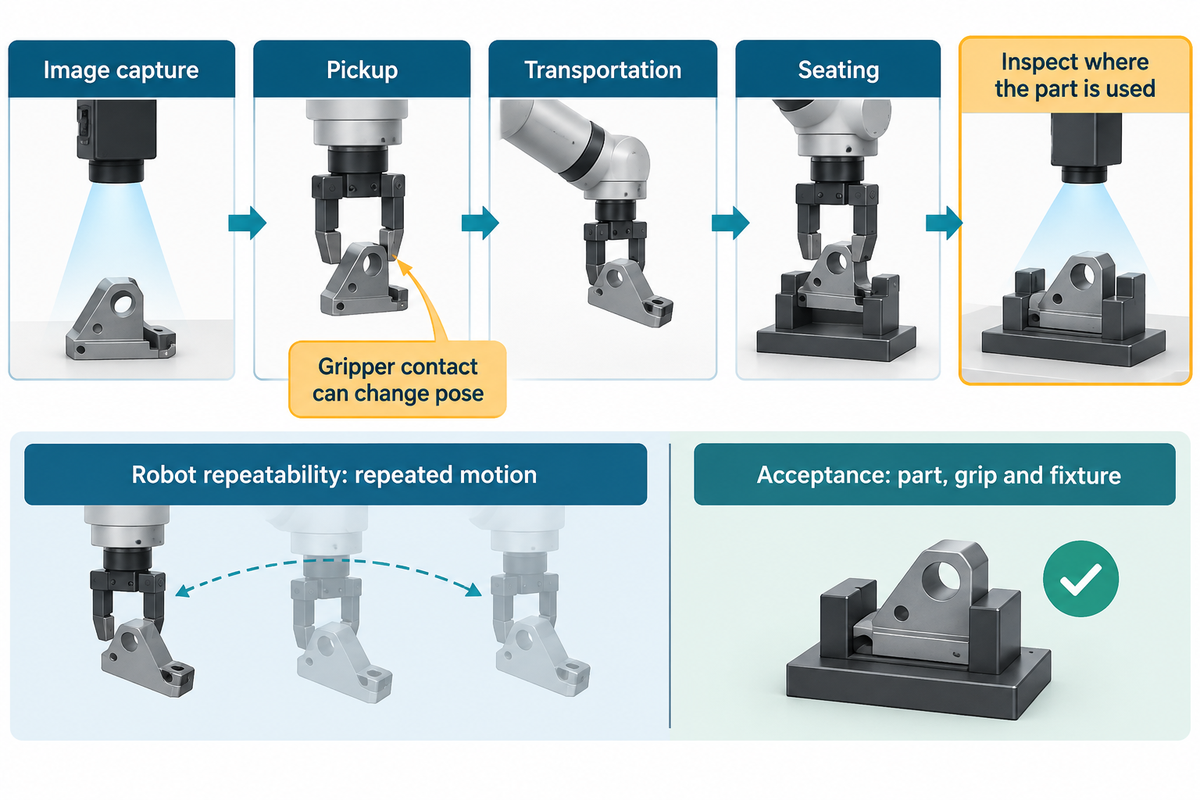
Preserve the allowed pose during image capture, pickup, transportation and seating. Machine vision describes a candidate pose and gripper contact can change it. A robot arm’s repeatability describes repeated motion, while assembly acceptance includes part variation, grip location and the receiving fixture. Final inspection should be placed where the part is used.
NIST’s bin-picking research addresses uncertainty in the part’s posture inside the gripper and correction at placement. Therefore, mechanical centering can be part of the handoff with sensing. Evaluate precision and repeatability at the receiver during the pick and place trial.
In a 2026 university laboratory study, Davide Galli and colleagues evaluated a pre-assembly cell at the Free University of Bozen-Bolzano. Separate gripper tests used 30 trials per component at known, controlled poses and reported no failed grasps or drops. The complete-cell experiment instead ran 30 assembly cycles across three lighting conditions. Reported outcomes were 70% autonomous compliant assemblies, 23% compliant assemblies after assistance and 7% undetected noncompliant assemblies. Missing washers or screws and a spacer stuck during insertion exposed weaknesses in the checks. The authors describe these as preliminary observations, not long-term reliability estimates. It is advised that the buyer verifies assembly completion independent of the completed motion sequence.
“the current grasp verification strategy relies on a relatively simple check of the gripper state”
Handle static, delicate surfaces and flexible components
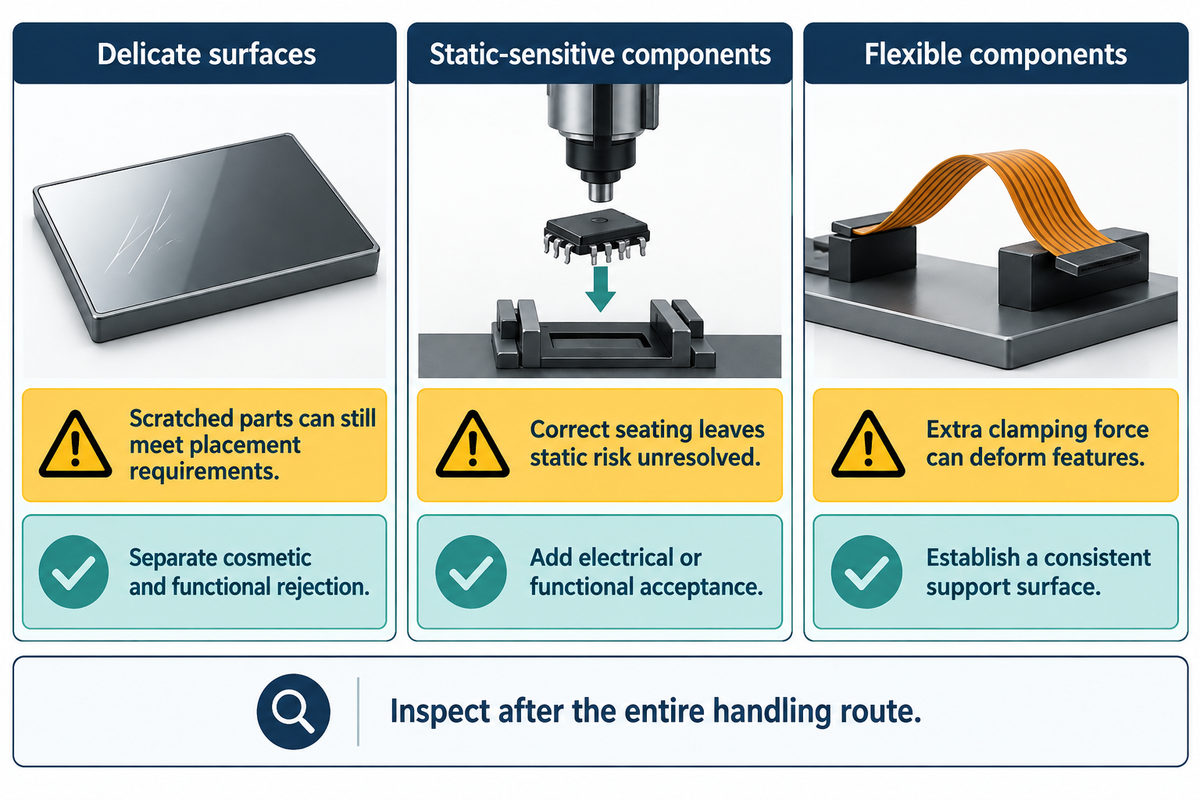
Control contact, bulk exposure and grip pressure to protect delicate parts before increasing production speed. Features on a part can be distorted or scratched and still be used to meet a placement specification. Define cosmetic and functional rejection criteria separately from the pickup check. Inspect after the entire route through the handling systems.
Electrostatic-sensitive electronic components require addition of either electrical or functional acceptance to mechanical placement checks. The EOS/ESD Association explains how devices can charge in a feeder and discharge on contact with an insertion head. Correct seating leaves that risk unresolved.
Ordinary plastic insulators do not lose charge through grounding within a reasonable time because the conductive path is inadequate. The Association’s static-control guidance discusses ionization for such materials. The quality owner should select the controls for the devices and materials involved, as passing one functional check doesn’t rule out latent damage.
Before gripping, establish a consistent support surface on flexible components. Additional clamping force can deform the feature that the next assembly operation needs.
Modular changeover without losing the assembly programme
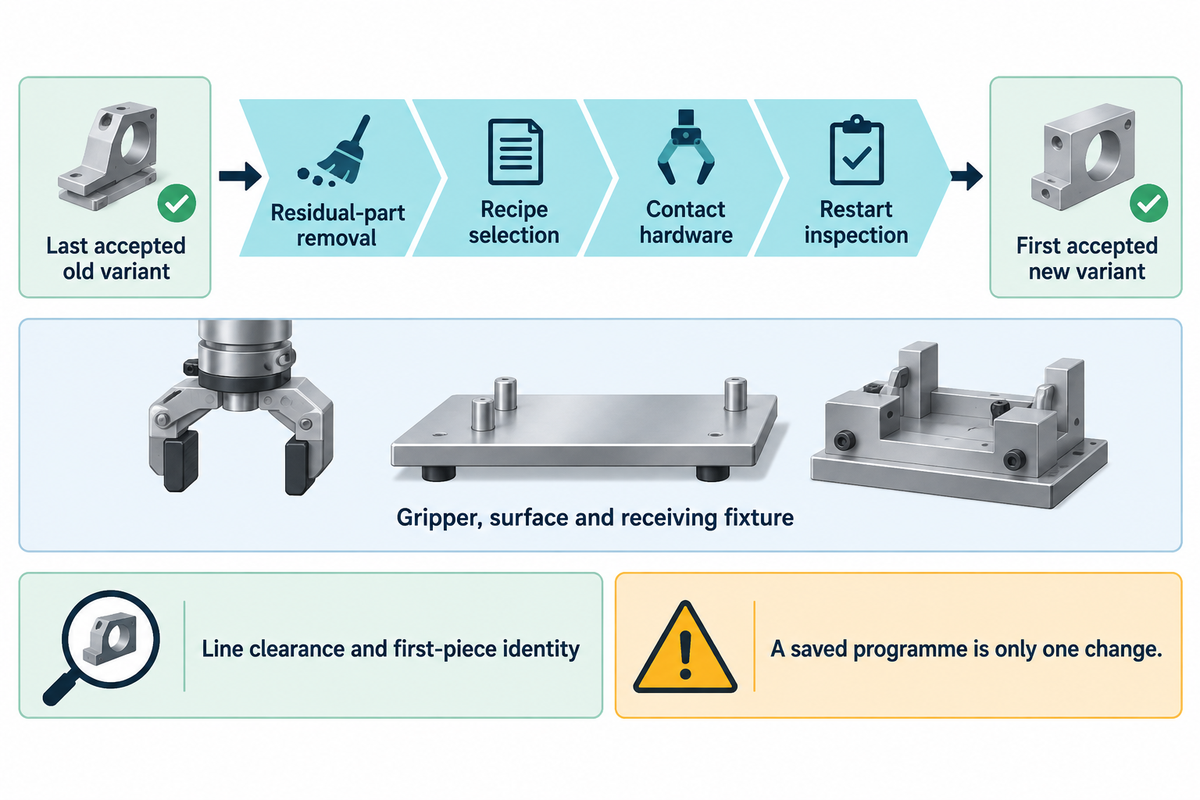
Measure the time taken for modular changeover from the last accepted old variant to the first accepted new variant. Residual-part removal, recipe selection, contact hardware, and restart inspection should be included. While changeover is being performed, the software can be set to alter the recognition pattern, and the assembly process may still be waiting for a different gripper, presentation surface or receiving fixture.
In Automation World’s 2021 Armo-Tool report, changes in brake-line fittings instigated a flexible-feed project with changeovers reported below 10 minutes. That named application’s timing is a useful comparison, rather than a default allowance for another production process.
List recipe versions for each approved part number against fingers, surfaces, fixtures and purge methods. Where similar variants remain together, line clearance and first-piece identity checks address the risk of human error. A fully automated cycle may require manual changeover. A saved programme is but one change on the list.
Feeder faults: recovery and acceptance at the assembly station
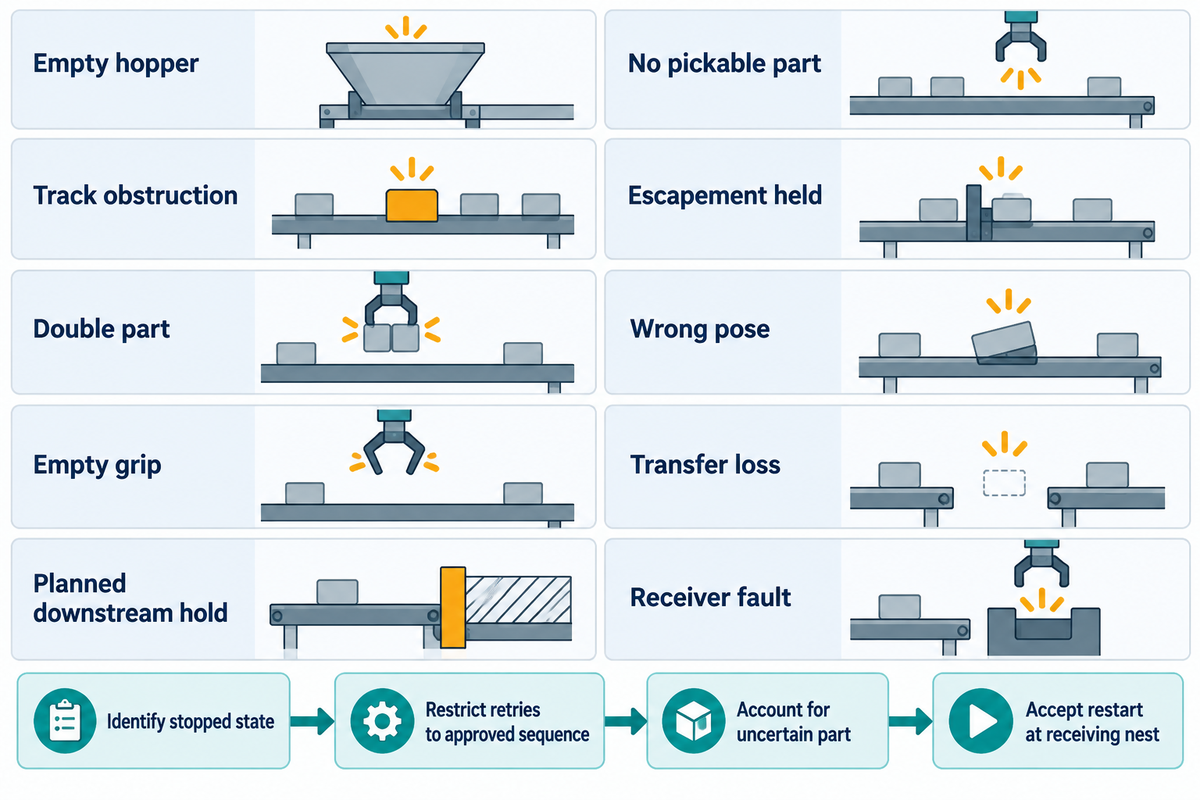
Recover a feeding fault by identifying the stopped state, controlling the uncertain part, and restoring an accepted handoff. Restrict automatic retries to the approved sequence. A reset signal alone can’t establish where a part went or whether the receiving station can safely continue its assembly operation.
5-Event Feed Recovery Trial
The 5-Event Feed Recovery Trial links ten fault cases to detection, authorized recovery and the first accepted restart part.
Use observations or integrator-approved safe simulations. The limits named below define settings to determine prior to the trial. These aren’t preset timers or retry counts. Record elapsed times for all interruptions and rejected parts for every event.
| Family / case | Detection distinction | Permitted response / boundary | Escalation owner | Part destination / first accepted restart |
|---|---|---|---|---|
| Empty supply: empty hopper | Level low; no obstruction | Hold demand; refill-time limit | Operator | Retain known parts; inspect first delivery |
| Empty supply: no pickable part | Material present; pose unavailable | Approved redistribution; retry limit | Feeding integrator | Segregate unresolved cluster; accept single part |
| Blocked track: obstruction | Transfer absent; downstream ready | Stop feed; intervention boundary | Authorized maintenance | Segregate affected parts; inspect transfer |
| Blocked track: escapement held | Supply present; release absent | Hold cycle; release-time limit | Feeding integrator | Check held part; accept released part |
| Double or misoriented: double | Two parts versus single | Approved rejection; retry limit | Handling integrator | Segregate pair; accept next single |
| Double or misoriented: wrong pose | Present but pose rejected | Approved reorientation; retry limit | Handling integrator | Segregate unresolved part; accept pose |
| Missed pick: empty grip | No acquisition versus sensor fault | Bounded retry; confirmation timeout | Controls integrator | Reconcile attempted part; inspect acquisition |
| Missed pick: transfer loss | Acquired then lost versus unseated | Hold motion; intervention boundary | Handling integrator | Account for lost part; inspect nest |
| Downstream not ready: planned hold | Demand withheld; no fault | Approved retained-part state; hold limit | Line operator | Retain identified part; accept resumed handoff |
| Downstream not ready: receiver fault | Fault interrupts transfer | Hold sequence; restart boundary | Cell integrator | Resolve part ownership; inspect resumed assembly |
Example: An empty-grip event records the attempted pocket, missing confirmation and permission to retry. If the retry remains unresolved, the sequence holds and the controls integrator takes ownership. The record is closed only after the uncertain part is accounted for and the receiving nest accepts the restart part.
For US servicing work, OSHA 1910.147 addresses hazardous energy. Normal production is handled separately; covered servicing during production includes the removal or bypass of guards, or entering the point of operation or associated danger zones. The minor servicing exception requires routine, repetitive work that’s production-integral and uses effective alternative protection. The responsible safety owner must classify the task before intervention.
Quality control should count autonomous accepted output, assisted output, and undetected defects separately. NIST’s confidence-interval guidance gives reason for caution for small samples and low failures, and requires special statistical treatment. Agreed sample plans and thresholds should be documented on the recovery record. For riveting, prepare an SPR joint-validation brief as a separate acceptance input.
Match the feeder to the joining tool
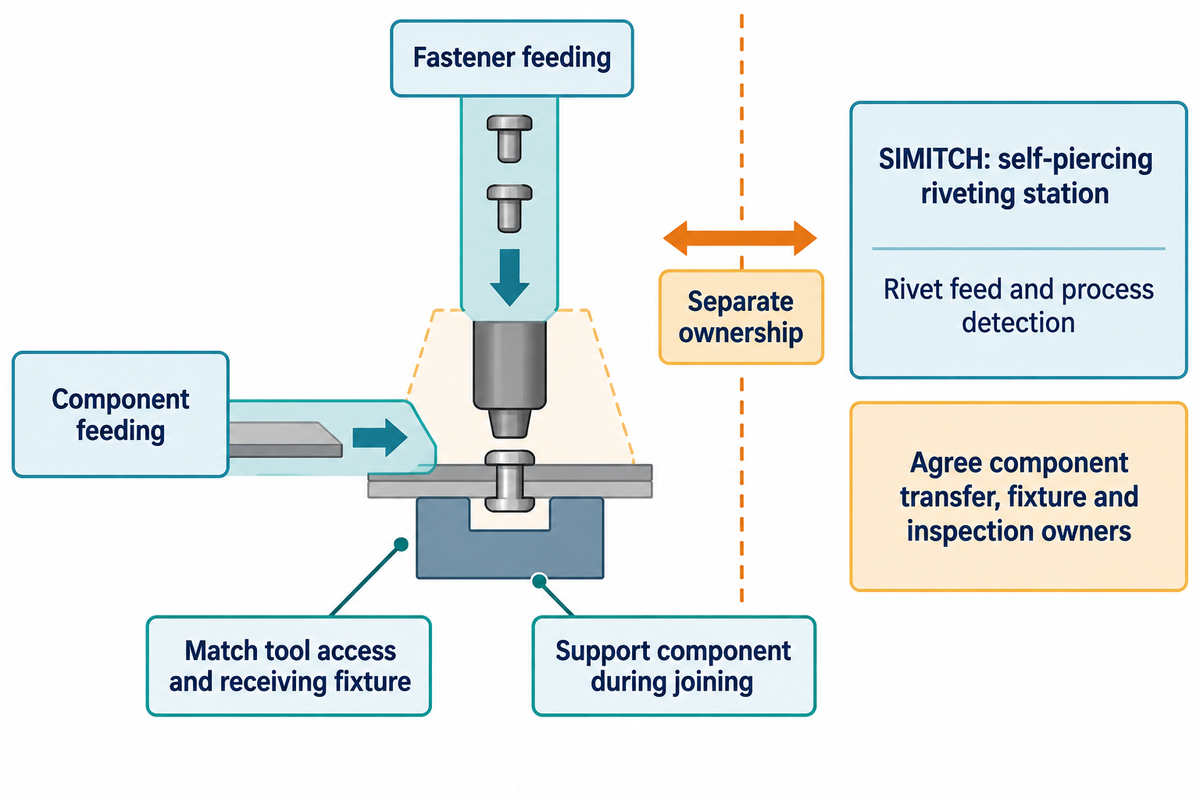
Component presentation should be matched to the joining tool’s access and receiving fixture before the final choice of feed route is made. Recovery must return the component to that receiving condition. Component feeding and fastener feeding need separate ownership, even when both report to the same cell controller. The component must stay supported while the process acts on it.
SIMITCH servo riveting assembly systems offer self-piercing riveting for both industrial and automotive assembly with features like automatic rivet feeding, rivet-presence and process detection, centering and anti-flipping functions. These address the rivet stream. The rest, i.e. component transfer, fixture control and inspection, line signals, should be addressed in the project interface agreement.
In the case of a press-fit, screw or weld process, its own receiving-tool review is in order. For insertion work, press-fit tooling contact and support change what the handler delivers. Where an operation needs to dispense adhesive, include access and contamination controls as part of that process review.
Choose an assembly integrator and define quotation scope
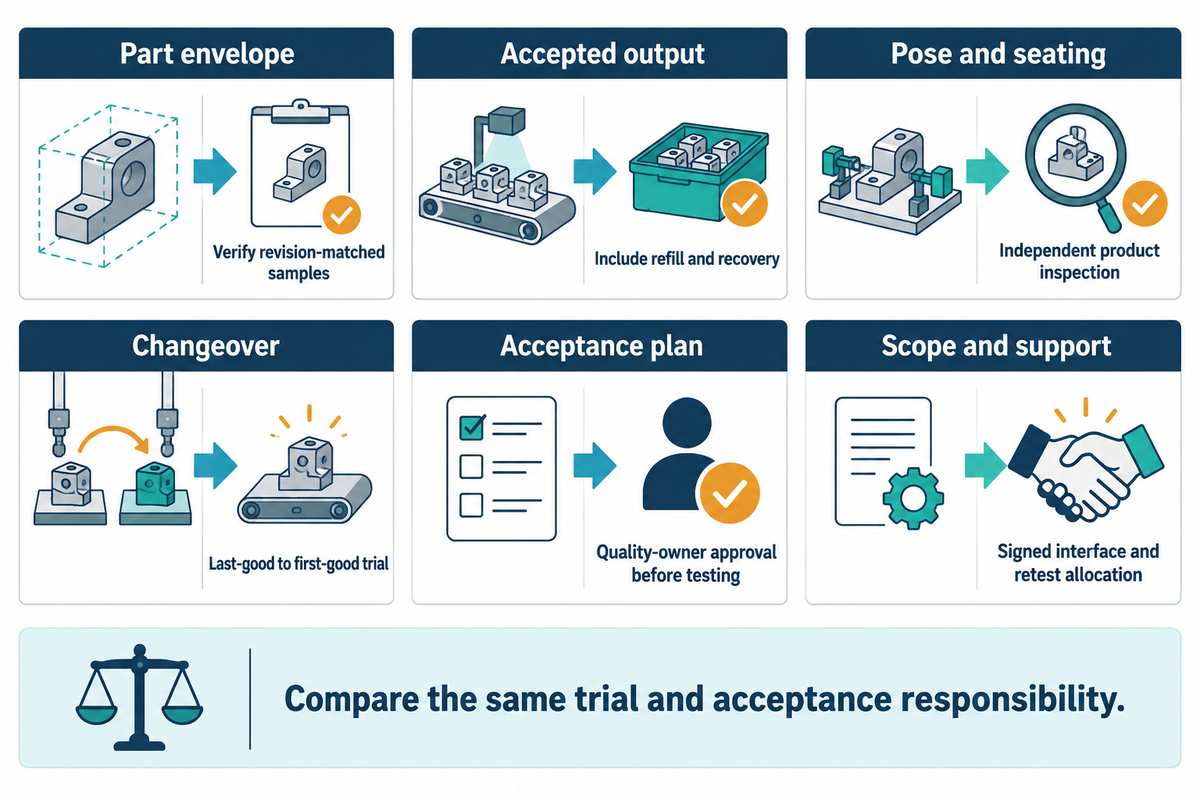
Choose an integrator against the completed assembly deliverable, then compare quotes with the same trial and acceptance responsibility. Robotic assembly solutions can cover various portions of the work. A custom assembly station, a feeding package and an entire production line require different engineering and support efforts.
| Supplier | Scope described on its own page |
|---|---|
| JR Automation | Small-parts and micro-precision assembly integration |
| SDC | Micro-precision assembly, joining, testing and inspection |
| Sure Controls | Flexible-feed and robotic integration |
| SIMITCH | Self-piercing riveting station, rivet feed and interfaces |
What Information Should You Send to a Robotic Assembly Supplier?
Current part drawings, representative samples, incoming packaging, required receiving pose and accepted-output demand, variants, acceptance criteria, utilities and interface responsibilities should be provided. Based on these inputs, the supplier can define the entire handling task and identify what remains outside its quotation before equipment selection commits the automation project.
For a SCARA robot or delta robots, the quotation should state payload and reach and tool assumptions. Compare robotic arms to the required transfer, rather than to a high-speed demonstration. An assembly project also requires ownership of training, spares and retest. For the riveting subsystem, review riveting service requirements in that context.
Insert these fields in a request for quotation. Specify or measure values for these fields, keeping the same unit in all quotes.
RFQ checklist
| Parameter | Recommended range | Why it matters | How to verify |
|---|---|---|---|
| Part envelope | Drawing limits, mm and g | Access and grip selection | Revision-matched samples |
| Accepted output | Required assemblies/hour | Cell capacity | Include refill and recovery |
| Pose and seating | Drawing limits, mm and degrees | Receiving fit | Independent product inspection |
| Changeover | Allowed minutes per variant | Production availability | Last-good to first-good trial |
| Acceptance plan | Agreed samples/lots and thresholds | Decision risk | Quality-owner approval before testing |
| Scope and support | Named delivery responsibilities | Comparable quotations | Signed interface and retest allocation |
Industry Outlook: integration after the 2025 robot-safety update
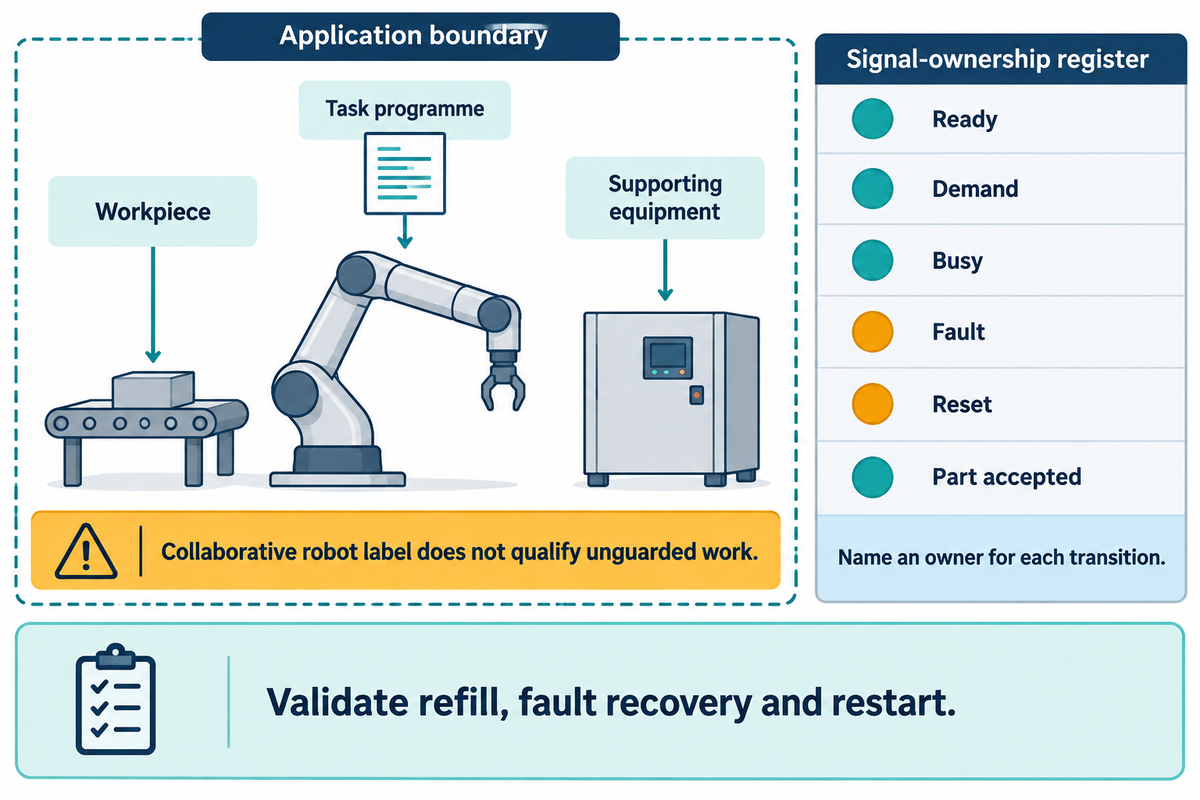
Use the 2025 robot-safety update to specify the whole application in new purchase orders. Carry the same quotation scope into the application review. ISO 10218-2:2025, dated February 2025, addresses integration of industrial robot applications and cells. The purchase review should therefore include the workpiece, task programme and supporting equipment alongside the robot itself.
The March 2025 explanation from the Association for Advancing Automation indicates focus on application, clarified functional safety and safety related cybersecurity requirements. Assign responsibility for the cell risk assessment and validation including refill, fault recovery and restart. A collaborative robot label doesn’t qualify the application for unguarded work.
On the factory floor, the interface brief should identify ready, demand, busy, fault, reset and part-accepted signals, with an owner for each transition. Identify motor and controller electrical loads, pneumatic requirements, conveyor transfers and maintenance access. Manufacturing environments also require defined lighting conditions for vision. For an SPR station, screen C-frame access against the installed fixture.
Release orders against sustained throughput over replenishment and recovery rather than nominal pick-and-place speed. The automated assembly line must produce accepted products within its agreed production pattern. If the joining step is self-piercing riveting, send the part stack and interface brief to SIMITCH for an SPR station review.
What are the 5 basic components of an automated system?
A useful five-part grouping is feeding, handling, process tooling, sensing and controls.
Feeding presents the part, handling transfers it, and tooling performs the manufacturing processes required for the joint. Sensing checks the agreed conditions while controls coordinate the sequence. This grouping helps divide a process automation project into tasks; it is not a universal classification. Safeguarding, maintenance access and final acceptance still cover the complete cell.
What are the production volume and cycle time requirements?
Specify accepted assemblies per production period, the part mix and the available operating time.
Include batch patterns and expected refill, inspection and changeover interruptions. The receiving station sets the useful output requirement for automated production. A high-volume pin job and recurring short batches can demand different replenishment arrangements even when their annual totals match. Record retries, rejects and operator assistance during the trial so the quoted cycle time and the delivered good output remain distinguishable.
What drives the cost of an assembly automation system?
Part presentation, tooling, sensing, inspection and integration scope drive the quotation.
Assembly machines also need commissioning, training and support. Compare the same deliverables before comparing prices: tray preparation may remain manual labor, while a bulk-feed package adds separation equipment and tuning. The commercial agreement should allocate sample supply, consumables, wear parts and retesting when acceptance conditions are missed. Consistent quality needs an inspection budget as well as motion hardware.
Does every small-parts assembly cell need a robot?
No. Fixed transfer mechanisms or operator-assisted stations can perform suitable handling tasks.
Choose industrial robots or simpler automation technology around access, transfer and acceptance requirements.
How should a recovered part be handled after a missed pick?
Reinspect or segregate a recovered part whenever its identity, location or orientation is uncertain.
The approved sequence determines whether a part can be retried, retained or removed. Pick-and-place systems need a defined receiving condition before the next assembly step starts. Record the attempted location, detection signal, authorized action and unresolved-part destination. When a component is lost during transfer, also account for the receiving nest and any affected work in progress. The first accepted restart part closes the record; a cleared alarm does not. Retain elapsed interruption and assistance details so repetitive tasks with frequent recovery are visible in the production record.
Perspective on feeding and joining
For a self-piercing riveting project, settle the component handoff before choosing the gun and feed route. A clear receiving pose lets the joining supplier review support, access and rivet delivery together. SIMITCH supplies the SPR station and its agreed interfaces; the quotation should name who owns component presentation and final product inspection. That allocation makes a stopped or rejected assembly easier to resolve.
References & Sources
- Grasping, Manipulation, and Contact Safety Performance of Robotic Systems, National Institute of Standards and Technology.
- Parts Feeding: Productive Positioning, ASSEMBLY.
- Vision-trap research for automated part feeding, Haugaard and colleagues, arXiv.
- Confirming a Performance Threshold with a Binary Experimental Response, National Institute of Standards and Technology.
- Addressing Perception Uncertainty Induced Failure Modes in Robotic Bin-Picking, National Institute of Standards and Technology.
- Conceptualisation and Implementation of a ROS-Based Robotic Cell for a Flexible Pre-Assembly Task, Galli and colleagues, Machines.
- Part 1: An Introduction to ESD and Part 2: Principles of ESD Control, EOS/ESD Association.
- Omron Automation's Flexible Feeding System, Automation World.
- 1910.147: The control of hazardous energy, Occupational Safety and Health Administration.
- 7.2.4.1. Confidence intervals, National Institute of Standards and Technology.
- ISO 10218-2:2025, International Organization for Standardization.
- Updated ISO 10218 FAQ, Association for Advancing Automation.