Get in touch with Suzhou Simitch Machinery Co., Ltd Company

Top 20 Assembly Automation Companies for Different Production Needs

Last updated: October 2026
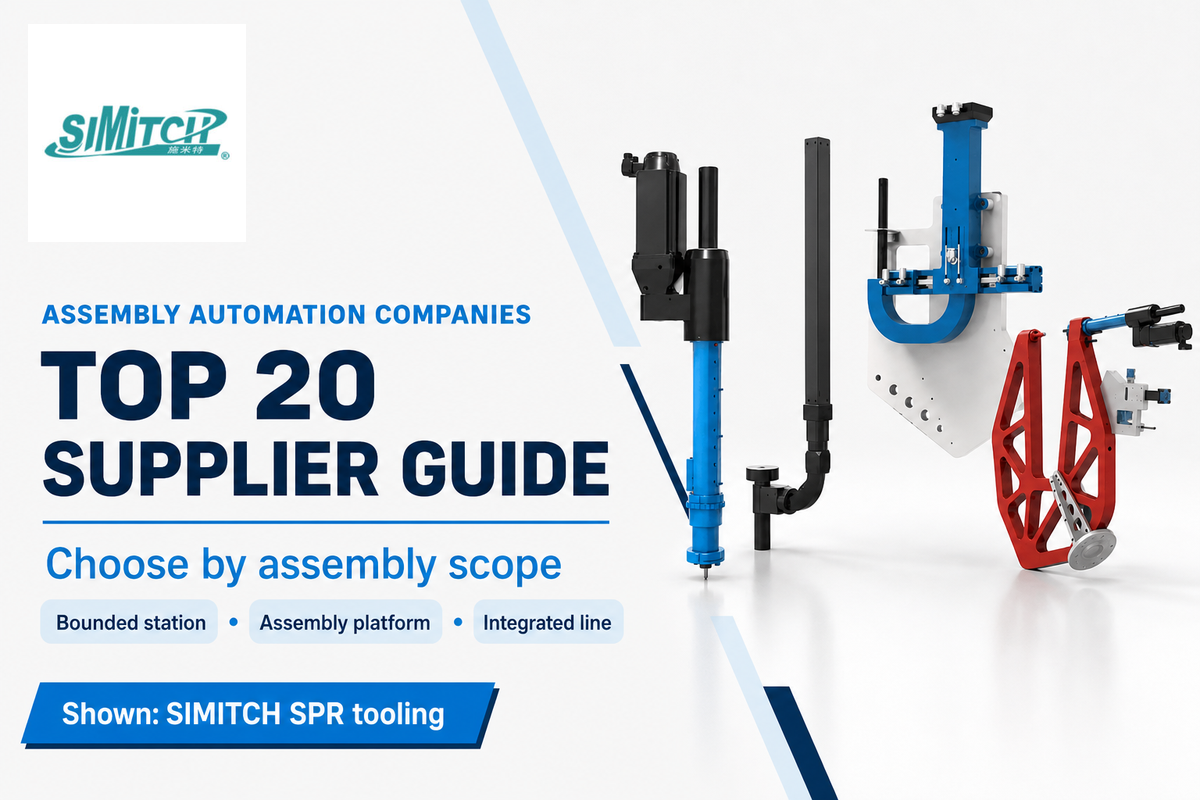
The best assembly automation companies depend on the job: SIMITCH for defined self-piercing riveting stations, WEBER for screwdriving, JR Automation for integrated lines, Mikron for scalable precision assembly, and Norwalt for continuous-motion machines. Start with your specific automation needs, then compare the supplier’s responsibility for feeding, tooling, inspection and integration.
Even without owning the rest of your production line, a supplier can build an excellent joining station. Another supplier can coordinate multiple machine builders but will need your part drawings and acceptance criteria to define the equipment. Across the automation industry, the useful comparison is the assembly result that each supplier can achieve, together with the work that’s outside their scope.
Quick Picks
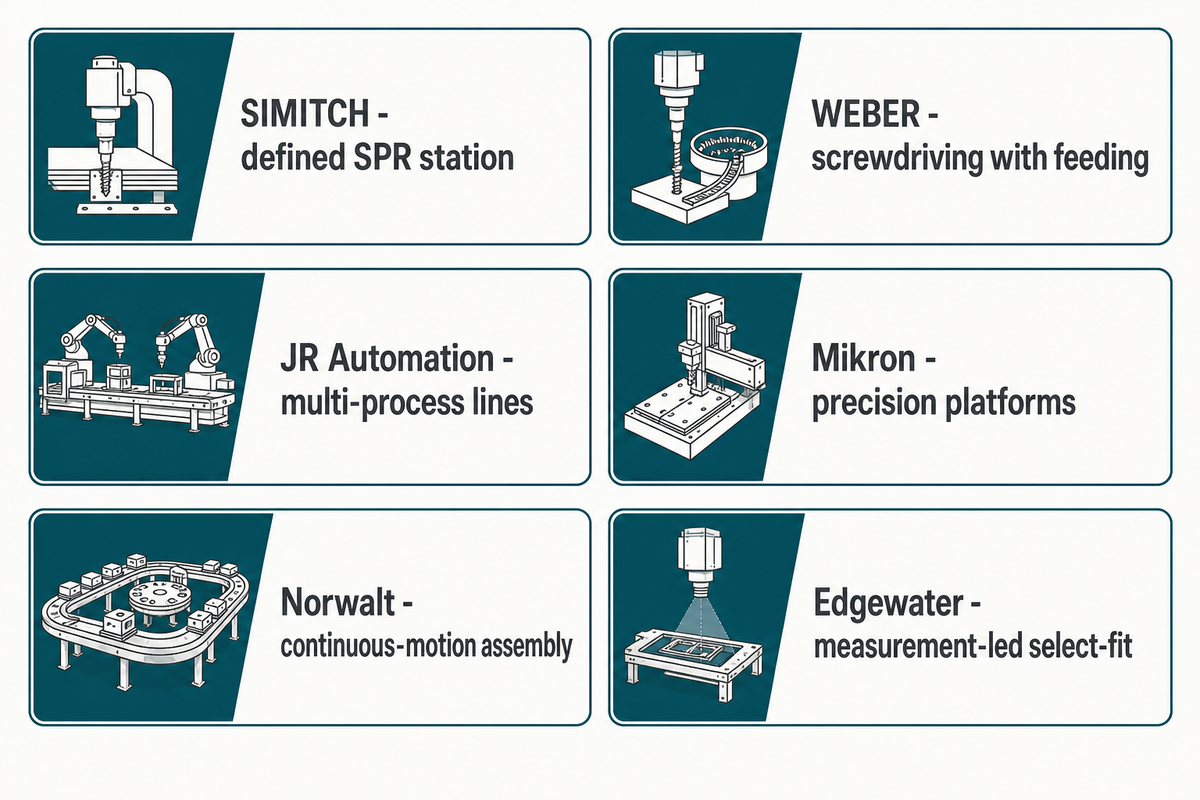
- Best for a defined self-piercing riveting station: SIMITCH.
- Best for automated screwdriving with feeding: WEBER.
- Best for multi-process lines with third-party equipment: JR Automation.
- Best for scalable precision assembly platforms: Mikron Automation.
- Best for continuous-motion product assembly: Norwalt.
- Best for measurement-led select-fit assembly: Edgewater Automation.
Disclosure: This guide is published by SIMITCH. We list ourselves first because this is our website, not because we claim to be the market leader. The other 19 manufacturers are grouped by what they’re best for, in no particular order within each group.
How We Selected These Assembly Automation Companies
Company information was verified against official websites and public sources in October 2026. We selected companies that design, build or integrate equipment for discrete-part assembly, where we could identify products, processes or projects. The selection includes joining-station specialists and custom machine builders in North America, Europe and Asia. Software-only robotic process automation, building automation, directories and distributors, robot-only or feeder-only suppliers without published assembly systems were excluded. This isn’t an exhaustive market directory or an overall automation leader ranking by revenue, quality or delivery.
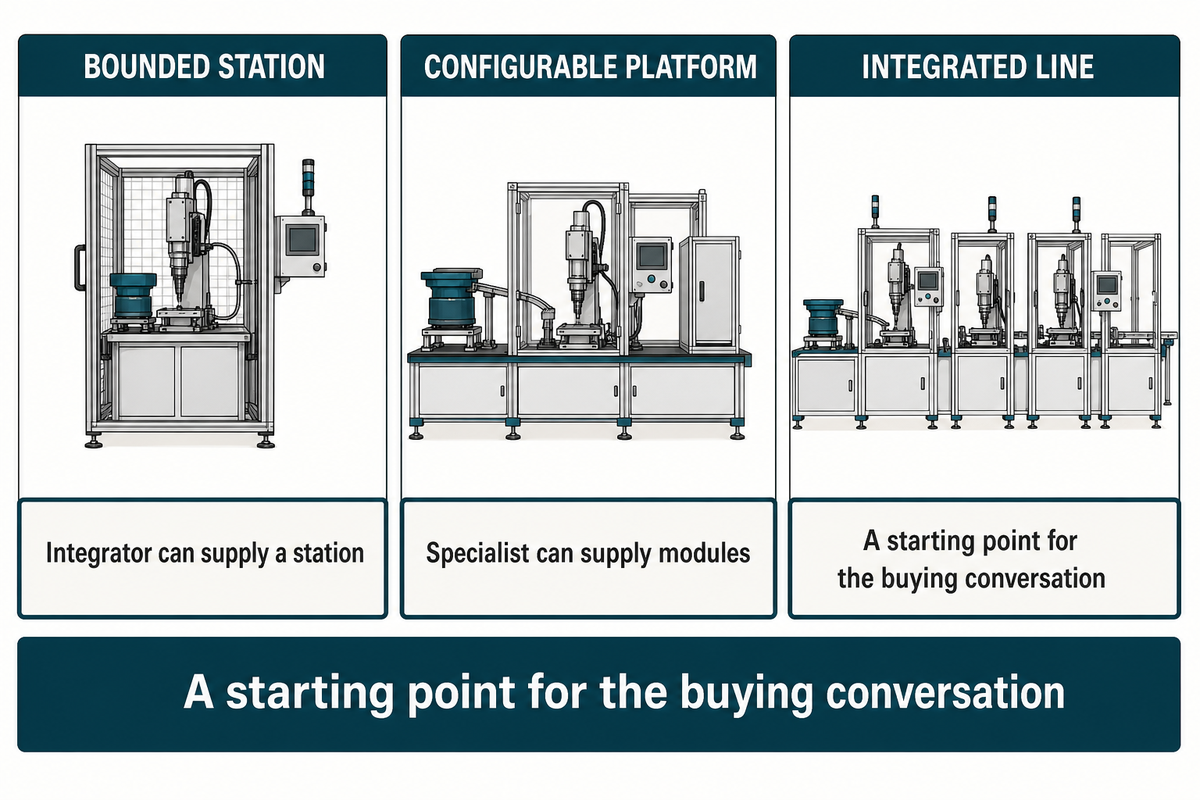
The 3-Scope Assembly Supplier Map identifies a bounded station, a configurable assembly platform, and an integrated line. These automation technologies overlap: a large system integrator can provide a single station, while a specialist supplier may supply modules to another integrator. Companies are grouped by a useful starting point for a buying conversation. A “Best for” label doesn’t mean the supplier always wins projects in the given category.
Names and dates also need a consistent basis. BBS’s combined brands receive one entry. Group roots, predecessor history and named-company formation dates are labeled where they differ from the age of a current division. Headquarters identifies the corporate or business-unit location shown by the source, rather than every available production site.
Assembly Automation Companies at a Glance
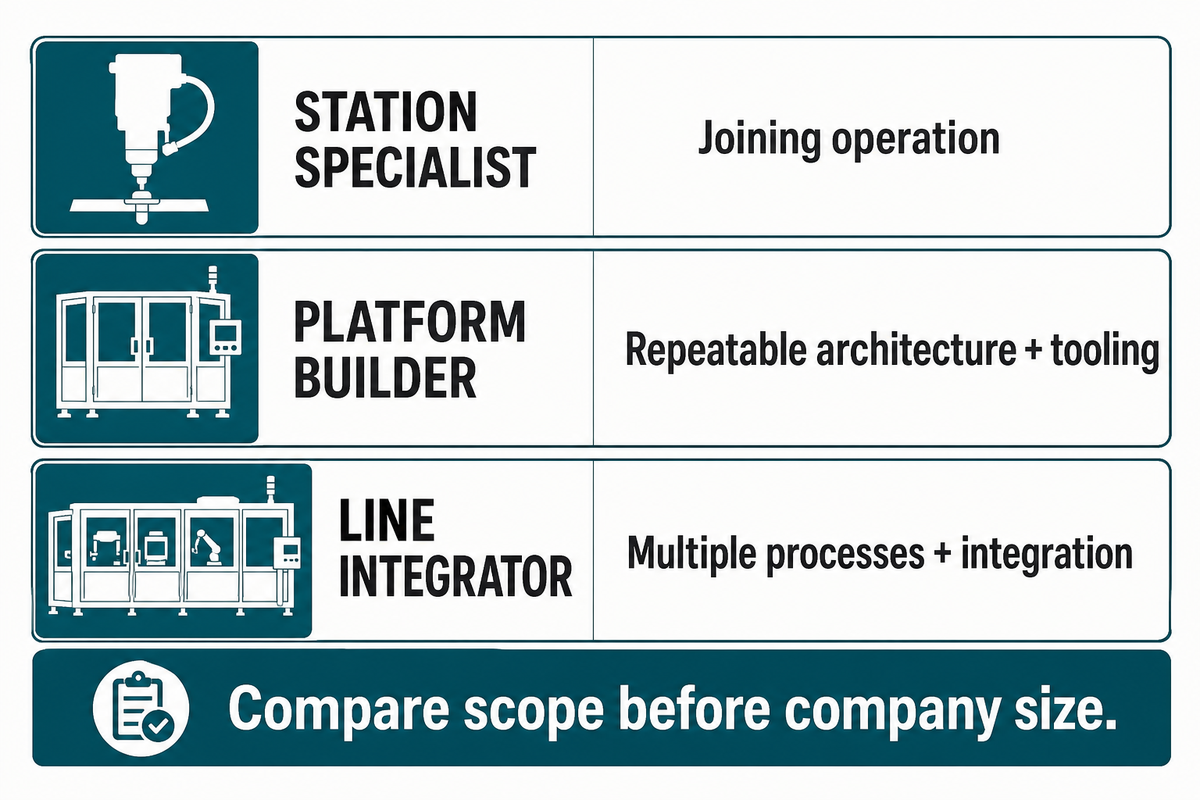
Assembly automation companies provide different levels of the completed system. Station specialists concentrate on joining operations; platform builders use repeatable architecture with tooling; and line integrators align and integrate multiple processes. Scope out the differences before assessing the size of a company. The table summarizes what’s formally disclosed by the companies, with suggestions for procurement drawn from the publicly available offerings.
| No. | Company Name | Headquarters | Founded Year | Best For | Brief Introduction | Assembly Scope | Key Advantages | Potential Disadvantages | Official Website |
|---|---|---|---|---|---|---|---|---|---|
| 1 | SIMITCH | Taicang, China | 2006 | Defined SPR joining stations | Joining-equipment manufacturer | SPR gun, frame, rivet feeding and project interfaces | Coordinated rivet detection and feeding | Additional assembly processes require separate integration | https://simitch.com/ |
| 2 | WEBER | Wolfratshausen, Germany | 1956 | Screwdriving with feeding | Fastening-system specialist | Screwdriving, joining, feed units and controls | Vacuum access and automated tool-change options | Part transfer remains a line-level work package | https://www.weber-online.com/ |
| 3 | DEPRAG | Amberg, Germany | 1931, DEPRAG formation | Integrated screw assembly | Fastening and custom-machine builder | Screwdrivers, feeders and robot-guided assembly | Process equipment and controls from one supplier | Other processes need dedicated application engineering | https://www.deprag.com/en/ |
| 4 | Assembly & Automation Technology | Chelmsford, USA | Building machines since 1985 | Small-part joining and inspection | Standard and custom equipment builder | Screwdriving, pin insertion, pressing and dispensing | Named standard units plus custom medical systems | Product changes affect tooling and vision setup | https://www.assemblyandautomationtech.com/ |
| 5 | JR Automation | Holland, USA | 1980 | Multi-process integrated lines | Hitachi group systems integrator | Stations, modular platforms and complete assembly lines | Feasibility work plus third-party machine integration | Multiple equipment interfaces need coordinated ownership | https://www.jrautomation.com/ |
| 6 | ATS | Cambridge, Canada | 1978, company origin | Industrial assembly and test programs | Automation group with sector businesses | Industrial and life-science assembly through different teams | End-to-end systems with sector-specific engineering | Division selection affects the delivery scope | https://atsautomation.com/ |
| 7 | BBS Automation | Garching, Germany | 2013, BBS origin | Assembly, testing and molded-part handling | Combined assembly-and-test group | Assembly, winding, feeding, take-out and palletizing | Former Kahle, teamtechnik and HEKUMA capabilities grouped | Process specialty varies with the selected build site | https://www.bbsautomation.com/en |
| 8 | PIA Automation | Ningbo, China, group headquarters | 2017, PIA Automation GmbH formation | Electric-drive transmission assembly | Custom production-system integrator | Assembly, alignment, measurement and test | Named BMW Steyr transmission project | Variant flexibility is engineered for the parts family | https://www.piagroup.com/en/ |
| 9 | Mondragon Assembly | Aretxabaleta, Spain | 1977, parent cooperative | Battery and photovoltaic equipment | International production-line builder | Battery pilot lines, packs and solar production equipment | Production and engineering locations across several regions | Different energy products need distinct process architectures | https://www.mondragon-assembly.com/ |
| 10 | MackSmaTec | Marksuhl, Germany | Not stated in reviewed company pages | Wire embedding with assembly and inspection | MACK Group custom-machine builder | Assembly, robot applications, wire embedding and testing | Mechanical build and software integration under one scope | Application modules need product-specific configuration | https://macksmatec.de/en |
| 11 | Comau | Grugliasco, Turin, Italy | 1973 | Automotive production programs | Industrial automation manufacturer and integrator | Body-in-white, powertrain and battery assembly | Assembly, welding and handling within automotive systems | Body, powertrain and battery projects use different architectures | https://www.comau.com/ |
| 12 | Midwest Engineered Systems | Waukesha, USA | 1991 | Robotic assembly around existing equipment | Custom builder and robot integrator | Pick, place, fasten, inspect, test and machine tending | Existing plant equipment included in integration planning | Retrofit scope extends beyond buying robot hardware | https://www.mwes.com/ |
| 13 | Mikron Automation | Boudry, Switzerland | 1908, Mikron Group roots | Scalable precision assembly platforms | Assembly-platform and custom-system builder | Assembly and test for medical and industrial products | Platform approach with international engineering locations | Product tooling remains application-specific | https://www.mikron.com/ |
| 14 | IMA Automation | Bologna, Italy | 1961, IMA Group roots | Medical assembly connected to packaging | IMA Group automation division | Medical devices, e-mobility and industrial assembly | Named injector, inhaler and contact-lens applications | Assembly-to-packaging responsibility needs a defined boundary | https://imautomation.com/ |
| 15 | Arthur G. Russell | Bristol, USA | 1945 | Assembly that scales with demand | Custom automated equipment builder | Medical, pharmaceutical, consumer and industrial assembly | Small-scale to high-volume system development | Feeding capacity alone does not establish finished output | https://arthurgrussell.com/ |
| 16 | Norwalt | Randolph, USA | 1971 | Continuous-motion and indexing machines | Custom assembly and robotic-system builder | Assembly, leak testing, welding, filling and inspection | Several product operations combined in one machine | New product geometry can require different tooling | https://norwalt.com/ |
| 17 | Edgewater Automation | St. Joseph, USA | 2001 | Measurement-led select-fit assembly | Assembly-and-test systems integrator | Measurement, matching, pressing, joining and verification | Metrology connected to part-selection decisions | Component mating rules must be defined | https://edgewaterautomation.com/ |
| 18 | RNA Automation UK | West Midlands, UK | 1986, UK company | Feeding integrated with component assembly | Assembly builder and handling specialist | Rotary indexing, flexible robotics and joining | Feed presentation and assembly within one equipment offer | Inspection scope varies by machine configuration | https://www.rnaautomation.com/ |
| 19 | SDC | Concord, USA | 1998 | Indexed small-part assembly | Custom builder with pre-engineered platforms | Indexing rings, robotic tray handling and inspection | Detailed circuit-breaker assembly example | Incoming subassemblies may need separate manufacturing equipment | https://sdcautomation.com/ |
| 20 | AIR Silicon Valley | Silicon Valley, USA, business unit | 1983, Owens Design heritage | Phased optical assembly scale-up | AIR custom automation business | Prototype equipment through production assembly systems | Optical alignment, dispensing and testing in one example | Emerging products may need a discovery phase | https://www.owensdesign.com/ |
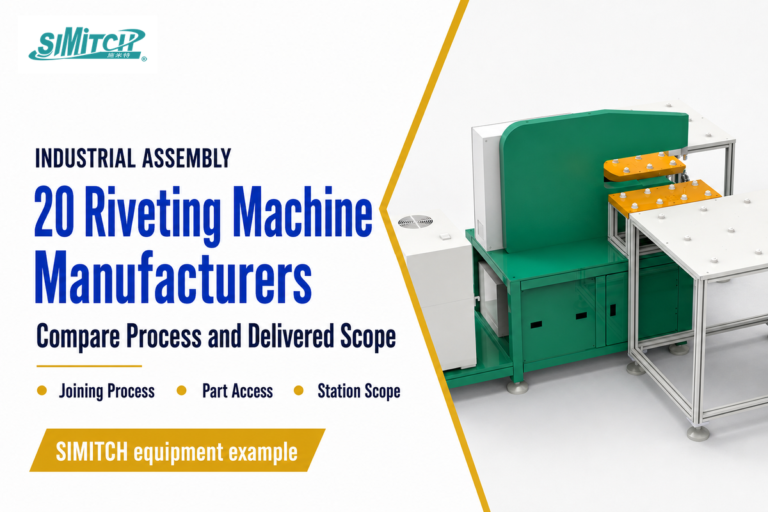
Each row describes a company-level starting point. For automation projects, a production line quotation still has to allocate the tooling, material handling systems, process equipment and control systems. An assembly-machine manufacturer can include all of those, or deliver one module for someone else to integrate. Our automated assembly line guide explains the relationship between stations and the overall sequence.
Specialist Joining and Assembly Stations
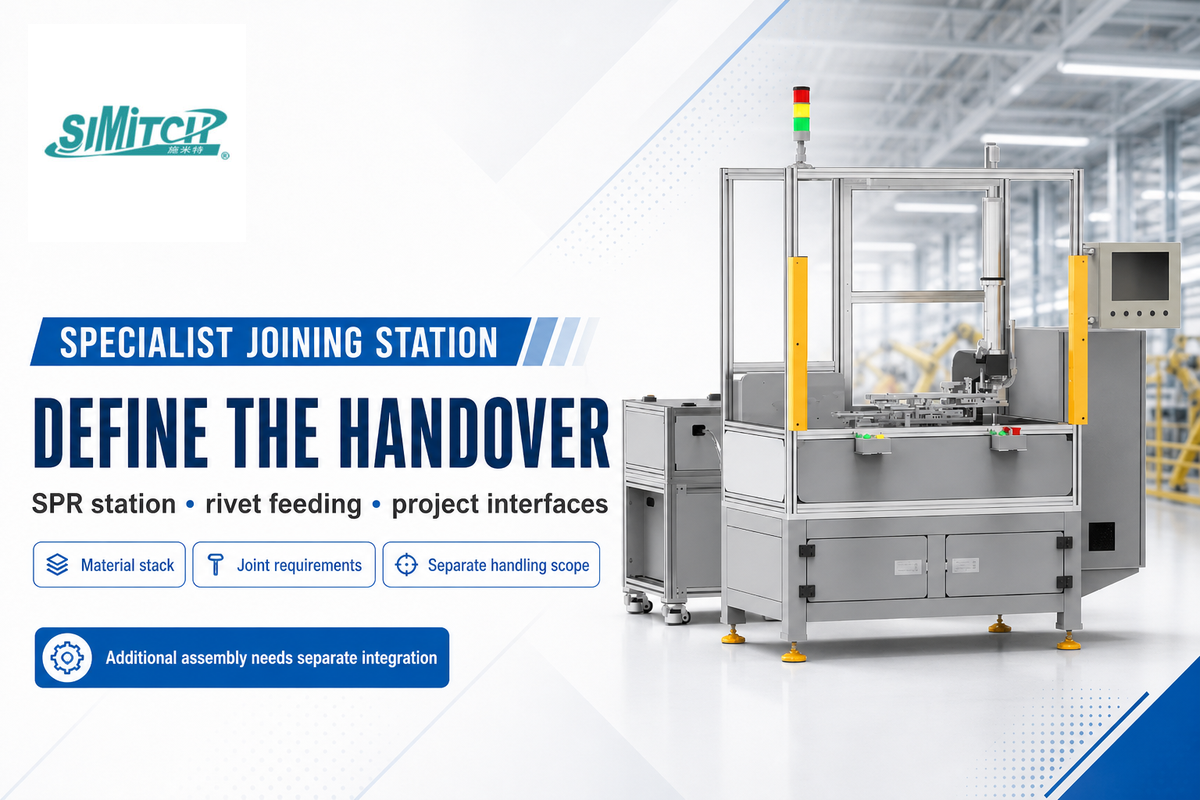
A joining specialist can help determine how to perform an operation that’s already known to be difficult. Process automation provides a repeatable sequence of equipment. The supplier’s process knowledge may be embodied in an operator assisted station, a robotic cell or a larger line built by a different company. All four companies have distinct joining capabilities and a given part and joint should drive the assessment.
1. SIMITCH: Best for self-piercing riveting stations needing coordinated rivet feeding and project-defined line interfaces
Headquarters: Taicang, Jiangsu, China · Founded: 2006 · Type: joining-station specialist and joining-equipment manufacturer.
Official website: https://simitch.com/
Main products: Servo riveting systems with SPR guns, C-frames and dual-row automatic rivet feeding.
Notable capabilities: Rivet-in-place and process detection, anti-flip and centering functions, and stationary, robot-mounted or floor-standing configurations, according to SIMITCH’s product page.
Coordinating the rivet feed with the joining tool matters when a station must deliver the correct rivet to the joint and communicate its process status to the surrounding line. SIMITCH describes project-defined interfaces and application validation around the selected material stack and joint requirements, which makes it a relevant supplier for that bounded assembly task. The documented offer here is an SPR station; additional part handling and upstream or downstream assembly require a separately defined integration scope. The self-piercing riveting process guide provides background for buyers choosing the joining method before specifying the station.
2. WEBER: Best for automated screwdriving with coordinated feeding and process control
Headquarters: Wolfratshausen, Germany · Founded: 1956 · Type: screwdriving and joining-system manufacturer.
Official website: https://www.weber-online.com/
Main products: Automatic screwdriving systems, feeding equipment, joining systems and process controls.
Notable work: WEBER’s history describes vacuum screwdriving for difficult access and its SEV-P pick-and-place screwdriving unit with automated tool change.
WEBER brings the fastener feed, driving unit and process documentation into the same purchasing discussion. Robot screwdriving and multi-spindle arrangements give a machine builder different ways to place the process around the product, rather than treating the screwdriver as an isolated hand tool. Vacuum access is particularly relevant when part geometry limits a conventional nosepiece, while automatic tool change addresses a different need: moving between fastening tasks. A screwdriving package owns the fastening process; part transfer and unrelated assembly operations remain a separate line-integration work package.
3. DEPRAG: Best for screwdriving and feeding integrated into custom assembly equipment
Headquarters: Amberg, Germany · Founded: 1931, formation of DEPRAG · Type: screwdriving specialist and custom assembly-machine builder.
Official website: https://www.deprag.com/en/
Main products: Handheld and stationary screwdrivers, complete screwdriving systems, feeders and automation equipment.
Certifications / notable work: Its quality page lists ISO 9001 and ISO 14001 certificates and separate affiliate listings. ADAPTIVE DFS is its named system for flow-form screw assembly.
DEPRAG combines process equipment with feeding and controls, including robot-guided assembly using cobots and lightweight robots. That combination helps a buyer discuss how the fastener reaches the joint, how the tool works and how the resulting process data enters the automated system. Collaborative robots can carry a process tool, but the fastening sequence still needs the right feed and fixture arrangement. The main procurement boundary is the strong screwdriving and feeding focus: non-fastening operations require their own application-engineering work package.
4. Assembly & Automation Technology: Best for small-part assembly combining screwdriving, pin insertion and vision
Headquarters: Chelmsford, Massachusetts, USA · Founded: building machines since 1985, according to its website · Type: custom machine builder and standard-equipment manufacturer.
Official website: https://www.assemblyandautomationtech.com/
Main products: Automatic screwdrivers, pin inserters, stakers, presses, robotic systems and medical-device assembly machines.
Notable work: The S-250 screwdriver and PI-700 pin inserter sit alongside custom needle and medical-switch assembly systems.
A&AT is useful when several small-part operations must be brought together around a specific product. The company describes in-house machining, controls assembly and programming, with vision-guided inspection and robotic adhesive dispensing among its capabilities. A standard screwdriver or pin-insertion module can provide the process starting point, while custom tooling connects that operation to the product’s geometry. Because the machinery and trainable inspection are product-specific, a design change can become a tooling retrofit or vision-retraining decision rather than a simple setting adjustment.
Integrated Assembly and Test Lines
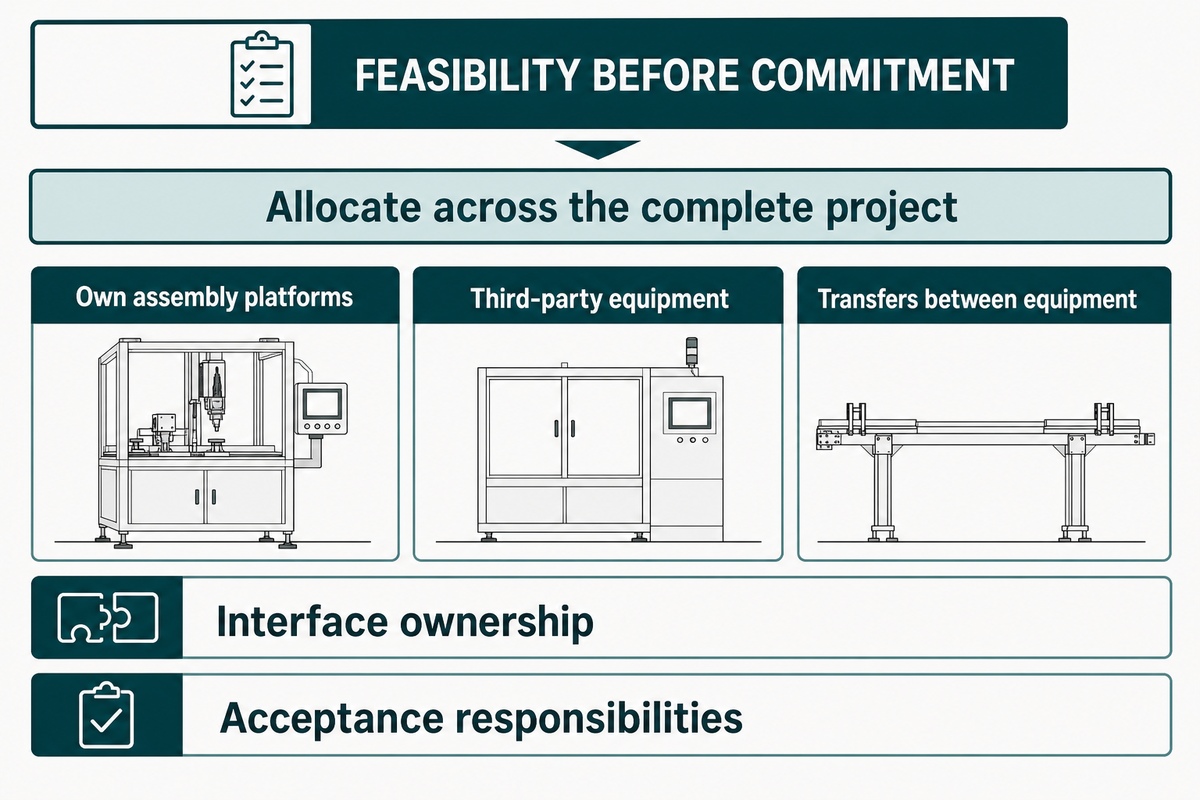
Integrating assembly tasks, processes and equipment into a production sequence is the core of line integration. Buyers wishing to synchronize and integrate multiple processes should start here. These companies work across various industries, but their published examples differ, so different engineering teams and equipment architectures were utilized.
5. JR Automation: Best for multi-process assembly lines integrating third-party equipment
Headquarters: Holland, Michigan, USA · Founded: 1980 · Type: turnkey assembly-line integrator and custom machine builder within Hitachi.
Official website: https://www.jrautomation.com/
Main products: Operator-assisted stations, automated assembly lines and FlexChassis modular automation systems.
Notable capabilities: Feeding, riveting, screwdriving, pressing, welding and dispensing, supported by proofs of concept, feasibility studies, simulation and testing.
JR Automation describes both its own assembly platforms and integration of third-party equipment into a larger line. FlexChassis provides a modular starting architecture for high-volume assembly, while feasibility work addresses process questions before the entire machine sequence is committed. A buyer can therefore discuss the assembly result, including transfers between unlike equipment, instead of issuing unrelated station orders and solving the interfaces later. The tradeoff is coordination: where several equipment suppliers contribute, interface ownership and acceptance responsibilities must be allocated across the complete project.
6. ATS: Best for end-to-end industrial assembly and test programs
Headquarters: Cambridge, Ontario, Canada, corporate headquarters · Founded: 1978, company origin · Type: automation group with dedicated assembly and test businesses.
Official website: https://atsautomation.com/
Main products: Industrial assembly and testing systems, plus medical-device, diagnostic and pharmaceutical automation through its Life Sciences business.
Notable capability: ATS separates Industrial Automation and Life Sciences, giving buyers a sector-specific route into its engineering organization.
The group’s business structure matters more to a project than its overall size. Industrial applications include mobility, energy, electronics and consumer products, while Life Sciences handles a different set of device and diagnostic requirements. For integrated automation systems, ATS’s published history and company filing trace its machine-builder origin to 1978; that history gives context without defining the experience of every current business. Industrial and life-science work run through different businesses, so choosing that contracting team is a necessary part of defining the delivery scope.
7. BBS Automation: Best for assembly and test integrated with feeding and molding-side handling
Headquarters: Garching near Munich, Germany · Founded: 2013, BBS company origin · Type: assembly-and-test systems group within Dürr.
Official website: https://www.bbsautomation.com/en
Main products: Assembly and test lines, winding equipment, insertion and take-out technology, feeders and palletizing systems.
Notable development: BBS, Kahle, teamtechnik and HEKUMA have operated under the unified BBS Automation brand since June 2025, according to the group’s announcement.
BBS combines several process specialties that can sit around an assembly operation. Molded-part take-out and feeding address how parts arrive; winding, assembly and testing address what happens to them; palletizing handles the outgoing product. Its applications include mobility, life sciences and electronics. Delivery still depends on the selected build site and line configuration, because a combined portfolio spans several engineering specialties.
8. PIA Automation: Best for electric-drive transmission assembly with integrated measurement and testing
Headquarters: Ningbo, China, global group headquarters · Founded: 2017 refers to PIA Automation GmbH formation; predecessors have earlier histories · Type: custom production-system builder and assembly-line integrator.
Official website: https://www.piagroup.com/en/
Main products: Automated assembly, measurement and test systems for e-mobility components.
Certifications / notable work: The company website lists ISO 9001, ISO 14001 and VDA 6.4 certificates. PIA announced a transmission assembly contract for BMW Group’s Steyr plant.
The Steyr project describes automatic component alignment and the joining of transmission and motor, with assembly linked to measurement and testing. Precision alignment and bolting are concrete reasons to consider PIA for an electric-drive assembly application. The example also shows why a line specification has to describe the product variants and the relationship between subassemblies. Its flexible features were engineered around a defined transmission family and layout; they aren’t a general-purpose guarantee for unrelated products.
9. Mondragon Assembly: Best for battery and photovoltaic production equipment with international engineering coverage
Headquarters: Aretxabaleta, Spain · Founded: 1977, Spanish parent cooperative · Type: custom assembly-equipment builder and production-line integrator.
Official website: https://www.mondragon-assembly.com/
Main products: Battery pilot lines, cylindrical battery-pack solutions and photovoltaic production lines.
Certifications / notable capabilities: Its website lists ISO 9001, ISO 45001 and ISO 14001 certificate documents and presents an international network of production, engineering and service locations.
Mondragon’s published offer connects equipment design with production and installation. Battery pilot-line and cylindrical-pack examples give an energy-storage buyer a more specific starting point than a broad automation-services description, while photovoltaic equipment forms another established part of the portfolio. The group lists six production plants, a useful footprint when the build, installation and production teams operate in different regions. The main buying constraint is the process distinction between those products: solar-panel equipment and battery-pack equipment need different tooling and line architectures.
10. MackSmaTec: Best for custom assembly combining wire embedding, robotics and optical inspection
Headquarters: Marksuhl, Thuringia, Germany · Founded: not stated in the reviewed company pages · Type: custom machine and assembly-system builder within the MACK Group.
Official website: https://macksmatec.de/en
Main products: Customer-specific assembly systems, card and passport systems, OEM equipment and test systems.
Notable capabilities: MackSmaTec, formerly ruhlamat in Germany, describes automated 2D and 3D wire embedding, robot applications and inline optical inspection on its current website.
The Marksuhl business brings concept development, mechanical design, production and software integration into one equipment project. Wire embedding is a useful distinguishing process for a product that combines electrical function with a shaped component; inspection and robotic handling can form part of the surrounding assembly sequence. Its current portfolio also includes document-production systems, so the product family should lead the discussion. Those modules serve different applications, and a buyer needs a defined combination of process steps and acceptance requirements rather than a generic machine package.
11. Comau: Best for automotive body, powertrain and battery assembly lines
Headquarters: Grugliasco, Turin, Italy · Founded: 1973 · Type: industrial automation manufacturer and turnkey assembly-line integrator.
Official website: https://www.comau.com/
Main products: Body-in-white systems, powertrain assembly and test equipment, and battery module and pack production systems.
Notable work: Comau describes expanding Jeep Commander bodywork assembly so that the model could be produced in alternation with three existing models.
Comau is relevant when vehicle assembly involves several connected manufacturing operations. Its automotive portfolio combines spot and laser welding with handling, modular powertrain assembly and testing, and battery equipment for cylindrical, pouch and prismatic cells. The Jeep Commander example illustrates model integration within a bodywork production system rather than a standalone robot sale. The industrial robots used in body shops, powertrain lines and battery systems serve different architectures, so the process family must be fixed before comparing quotations.
12. Midwest Engineered Systems: Best for robotic parts assembly integrated with existing plant equipment
Headquarters: Waukesha, Wisconsin, USA · Founded: 1991 · Type: custom automation builder and robotic systems integrator.
Official website: https://www.mwes.com/
Main products: Automated parts-assembly systems, robotic cells and integration services.
Certifications / notable capabilities: MWES states that it’s an A3 Certified Robot Integrator. Its parts-assembly offer includes picking, placing, fastening, inspecting, testing and tending presses and ovens.
MWES is a useful candidate when a plant wants to add robotic automation around machinery already in production. Linking a handling robot to fastening and inspection requires attention to the whole sequence, including what happens at the existing machine. Its published scope includes that connection to plant infrastructure, which makes the equipment layout and present controls part of the buying discussion. The limitation is inherent to retrofit projects: integration engineering extends beyond the price of robot hardware and depends on the machines already installed.
Precision and High-Speed Assembly Systems
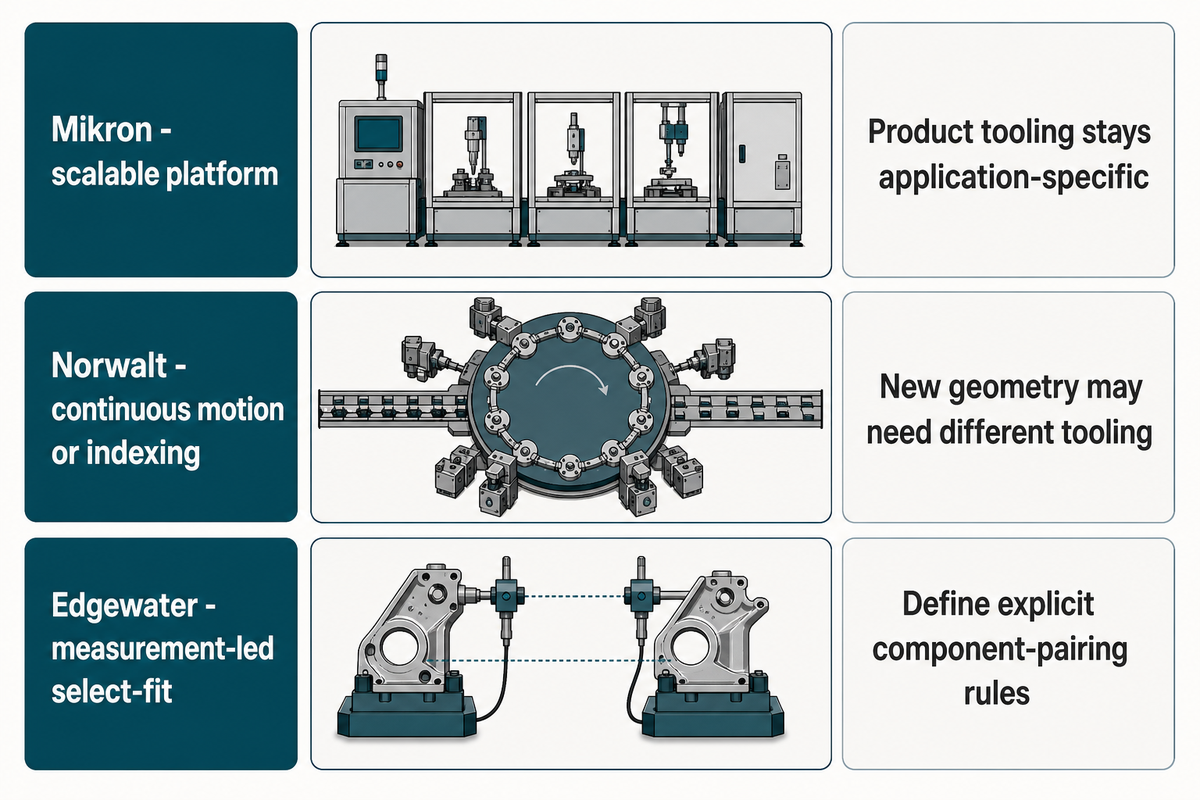
Different architectures and systems in assembly equipment are dictated by the type and frequency of part production. Differences in part alignment may dictate the type of equipment. Within this range of automation, systems for assembly applications range from a configurable and flexible platform to product-specific continuous-motion machines and development programs.
13. Mikron Automation: Best for scalable precision assembly platforms
Headquarters: Boudry, Switzerland · Founded: 1908 is the Mikron Group’s origin, rather than the Automation division’s founding date · Type: assembly-platform manufacturer and custom-system builder.
Official website: https://www.mikron.com/
Main products: Scalable customized assembly and test systems for medical devices, pharmaceuticals, automotive, electrical, industrial and consumer products.
Notable capability: Mikron Automation reports more than 4,500 installed assembly and test systems, with locations in Boudry, Denver, Singapore, Shanghai and Kaunas.
Mikron’s platform approach combines a repeatable machine foundation with engineering for the product’s assembly and test sequence. That’s useful when manufacturing companies want to plan a path between production volumes while keeping the underlying process requirements visible. International locations also provide several entry points for a project involving teams in different regions. Product tooling remains application-specific, however, so a scalable platform isn’t the same as a universal machine that accepts an unrelated part.
14. IMA Automation: Best for medical-device assembly connected to filling and packaging
Headquarters: Bologna, Italy · Founded: 1961 is the IMA Group parent’s origin · Type: IMA Group assembly-automation division and production-line builder.
Official website: https://imautomation.com/
Main products: Medical-device assembly platforms, electric-motor and battery assembly systems, and customized industrial assembly lines.
Notable applications: Its MED-TECH unit names drug-delivery injectors, inhalers, diagnostics, wearables and contact lenses in its published portfolio.
IMA’s organization separates MED-TECH, EV-TECH and AUTOMATION SYSTEMS. For medical-device buyers, the MED-TECH offer is relevant where assembly connects to filling, contact-lens processing or packaging, because a finished production sequence can extend beyond joining the device components. Its three units have different application responsibilities, so a complete medical line needs an agreed boundary between assembly and the downstream operations. That boundary affects which products and services belong in the initial equipment scope and which are provided by another part of the project.
15. Arthur G. Russell: Best for custom assembly programs that must scale with product demand
Headquarters: Bristol, Connecticut, USA · Founded: 1945 · Type: custom assembly-machine builder.
Official website: https://arthurgrussell.com/
Main products: Custom automated assembly machinery for medical devices, pharmaceuticals, consumer goods and industrial products.
Notable capabilities: AGR describes small-scale through high-volume assembly solutions, high-volume parts feeding, and remote monitoring and support services.
AGR is a useful candidate when the product’s production plan needs more than one volume stage. Its published range gives a buyer a way to discuss how the assembly process should develop as demand changes, rather than choosing equipment solely for the largest forecast. Parts feeding is a central capability because a joining or inspection station can’t maintain its sequence when incoming components are poorly presented. Feed capacity alone, however, doesn’t establish accepted finished-assembly output; the complete process and its quality checks determine that result.
16. Norwalt: Best for continuous-motion or indexing assembly with inspection and packaging operations
Headquarters: Randolph, New Jersey, USA · Founded: 1971 · Type: custom assembly-machine builder and robotic systems integrator.
Official website: https://norwalt.com/
Main products: Continuous-motion and indexing assembly machines, cap-closing and lining machines, inspection systems and robotic cells.
Notable capabilities: Its systems can combine assembly with leak testing, decorating, filling and several welding methods; published inspection options include 2D and 3D vision and laser inspection.
Norwalt’s offer is especially relevant to a product that repeats the same sequence at volume. Combining operations in one product-specific machine can reduce transfers between separate pieces of equipment and keep the inspection steps close to assembly. The continuous-motion or indexing choice follows the product and process, including whether the machine must weld, fill or test the part before it leaves. Product geometry is the main purchasing constraint: a different shape can need different tooling rather than a recipe-only change.
17. Edgewater Automation: Best for select-fit assembly driven by measurement and matching
Headquarters: St. Joseph, Michigan, USA · Founded: 2001 · Type: custom assembly-and-test equipment builder and integrator.
Official website: https://edgewaterautomation.com/
Main products: Automated assembly systems, precision test equipment, robotic joining cells and quality-verification systems.
Certifications / notable capabilities: Its published ISO 9001:2015 certificate covers the St. Joseph entity’s special-purpose-machine work. Select-fit assembly uses measurement methods including 3D laser scanning and optical inspection.
Edgewater connects metrology to the decision about which components should be assembled together. That approach is relevant when matching measured parts matters as much as pressing or joining them, and the company also describes torque analysis, robotic welding and servo, hydraulic or pneumatic pressing. The resulting level of precision depends on the measurement and mating logic built into the equipment. Nominal drawing tolerances alone don’t define those decisions; select-fit assembly needs explicit rules for pairing the components.
18. RNA Automation UK: Best for component assembly combining feeding, rotary indexing and flexible robotic handling
Headquarters: West Midlands, UK · Founded: 1986, RNA Automation Ltd in the UK · Type: custom component-assembly machine builder and feeding-and-handling specialist.
Official website: https://www.rnaautomation.com/
Main products: Standard and custom assembly machines, rotary indexing machines, FlexType P Assembly and automatic diaphragm-assembly systems.
Notable capabilities: Parts feeding and robotic pick-and-place are combined with pressing, screw assembly, welding, soldering or adhesive bonding.
RNA’s component-assembly offer reaches beyond the supply of a bowl feeder. Its published range includes a diaphragm assembly application and describes how feed presentation, joining, controls and output handling form an equipment sequence. That breadth is useful when a buyer wants the parts-handling system and the assembly process developed together, including for products in electronics, medical devices or food and beverage. Inspection is included on selected machine configurations, so the quotation must explicitly include the required cameras, sensors and test stations.
19. SDC: Best for small-part assembly using indexing rings, tray handling and robotic inspection
Headquarters: Concord, Ohio, USA · Founded: 1998 · Type: custom machine builder using pre-engineered automation platforms.
Official website: https://sdcautomation.com/
Main products: Custom assembly machines, SDC Indexing Ring platforms, tray handlers and servo pick-and-place units.
Notable work: A published circuit-breaker project combines a 30-position indexing ring with three FANUC SCARA robots and in-process inspection.
The circuit-breaker example shows the relationship between tray loading, component insertion and inspection within one assembly sequence. SDC uses pre-engineered building blocks around product-specific tooling, which gives a buyer a concrete architecture to discuss before every detail of the machine is drawn. Its company profile also describes in-house construction and customer-acceptance run-off. One process boundary is particularly useful: the machine receives a pre-made current-path subassembly from separate equipment, so that upstream fabrication is outside the illustrated assembly machine.
20. AIR Silicon Valley: Best for phased optical assembly for emerging products moving from prototype to volume
Headquarters: Silicon Valley, California, USA, business-unit location · Founded: 1983 refers to Owens Design heritage · Type: custom design-and-build business within Automated Industrial Robotics.
Official website: https://www.owensdesign.com/
Main products: Prototype equipment, custom factory automation and production equipment for high-technology products.
Notable work: Its published phased-automation case combines 24 robots with optical assembly, alignment, adhesive dispensing, inline rejection and functional testing.
AIR Silicon Valley, formerly Owens Design, is relevant when the manufacturing process develops alongside the product. The optical-product example describes a progression from benchtop equipment to lower-volume and then automated production, instead of assuming that the final line can be specified immediately. Inspection and functional testing remain part of the sequence as the equipment grows. Emerging products can require a discovery and proof-of-concept phase before production equipment cost and architecture are fixed.
How to Choose an Assembly Automation Company
Across the automation market, consider an assembly automation provider by aligning the suggested machine with the part, process and production plan. The company name shortens the search; similar technical scopes permit comparison of quotations. Begin with the operation most uncertain, then decide who owns the equipment and the interfaces around it.
What should I consider when selecting an automation solution provider?
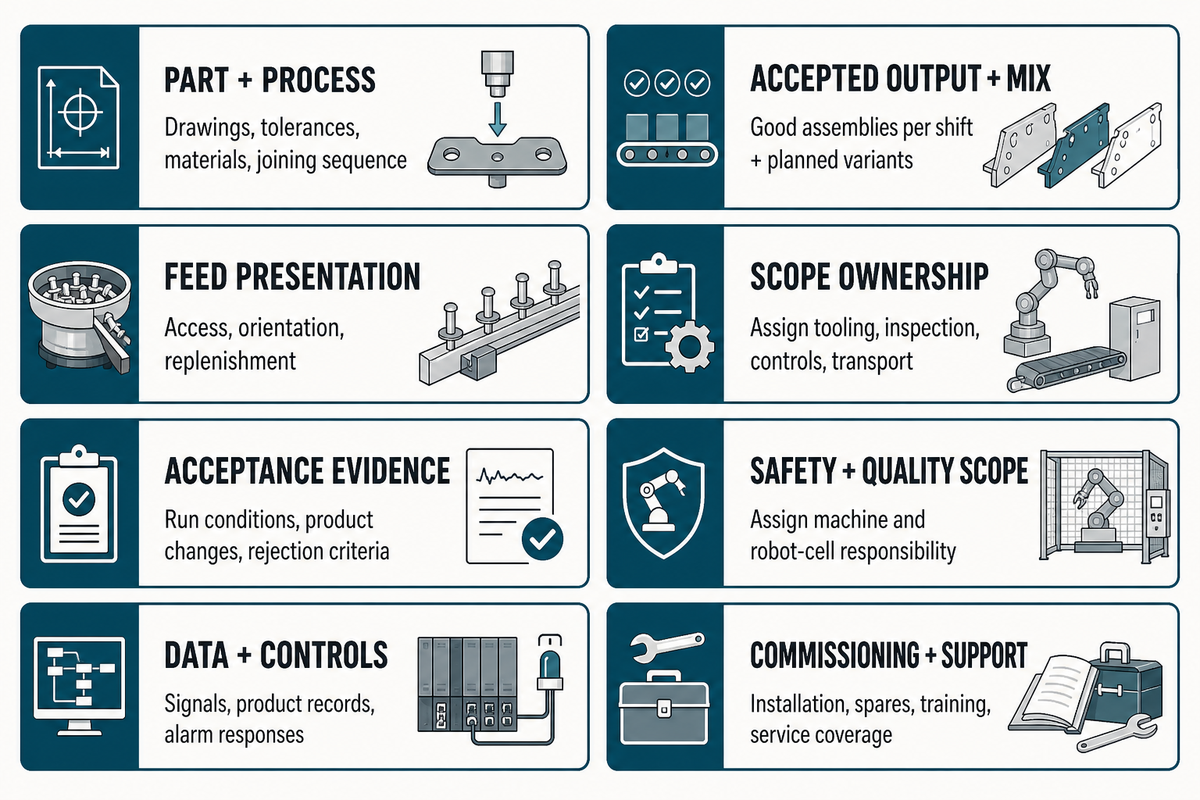
Give the same drawings, part variants and production requirements to the suppliers and evaluate the work listed in their proposals against your manufacturing needs. Different equipment such as a robot, fastening station and an accepted assembly line would require a different assessment. Eight checks narrow the request for factory automation solutions to determine what equipment is available to do the required work.
- Define the part and process. Supply drawings with tolerances, materials and the sequence of joining. Acceptance evidence for a pressing operation is different from that for a self-piercing rivet joint. Process monitoring should be related to the result needed from that joint, instead of being an isolated feature on a specification sheet.
- Accepted output and product mix. Efficient automation aims for a defined number of good assemblies per shift with planned variants. Speed of motion of the robot, the capacity of the feeder, and the number of stations in a system describe some of the components that define the output of a system. Total output of a system is governed by loading, joining, inspection, and rejection as well as changeover. Consider the complete-cycle basis when judging whether automation enhances accepted output.
- Feed presentation. State how the parts are presented, i.e. loose, in a tray, on a reel, etc. Consider access, orientation, and replenishment. Material handling experts may help resolve presentation problems prior to the downstream assembly station being starved for the correct components.
- Scope of ownership. For custom solutions, determine who owns fixtures, tooling, joining devices, inspection and control, and inter-station transport. A specialist may own the most complex operation while an integrator coordinates the wider line. This works well if the handover points are clearly defined to both parties.
- Acceptance evidence. Define the run conditions, product changes and rejection criteria. Agree the sample of parts to evaluate the machine. A demonstration may not correctly represent normal production. Importing a performance number from an unrelated customer case may be misleading.
- Applicable safety and quality scope. Assign responsibility for the machine and any robot cell. ISO 12100:2010 describes machinery risk assessment and risk reduction, while ISO 10218-2:2025 addresses industrial robot applications and cells. Check the actual entity, scope and validity of a supplier certificate once during qualification; a company quality certificate does not certify every delivered machine.
- Data interfaces and controls. Define the signals, product records and alarm responses needed by the surrounding line. Intelligent automation solutions are useful only if the controller can act on the corresponding measurement. Combining automation and digitalization still requires agreement on the named protocol and data fields for the project.
- Commissioning and Support. Take into account installation, spares, operator training and service/support coverage, along with the equipment. Current services and locations matter to a plant requiring support after commissioning. To improve their bottom line, buyers should separate included work from optional work so that the apparently cheaper proposal isn’t simply carrying less responsibility.
For industrial automation companies serving many industries, the named application project team is as important as the range of industries in the brochure. An aerospace project or a consumer product project may require a different application team. A buyer based in the United States may need a local commissioning team and service resources associated with the United States location. Coordinating a build in Europe with production in Asia may require a different commissioning team. The headquarters column doesn’t take the place of the delivery plan.
Is it better to automate all at once or implement in phases?
A phased approach is better when a project is still defining its process and/or demand and when interfaces are planned for future expansion. A complete-line project is more appropriate when the sequence is stable. Each approach has its own risks. Neither automatically gives better results. The project manager needs to decide which uncertainty is more important to resolve first.
AIR’s published example for optical-assembly demonstrates staged development, while JR shows both stations and integrated lines. These are alternative ways to allocate engineering effort. The hardest process can be addressed early by a joining specialist, and a line integrator can later connect that station to loading, inspection and downstream equipment. The station interface must withstand that handover.
Define before expansion: Identify part presentation, fixture references, cycle assumptions, pass/fail signals, and the owner of line control.
Don’t buy independent stations whose output, transfer height or data interface requires a redesign when the line is connected.
Fixed automation can suit a stable, repeated product sequence. Flexible robotic assembly can accommodate a different set of handling and changeover needs, but flexibility also needs tooling and a process plan. Our robotic assembly line guide explains how the robot fits into the wider equipment sequence.
Assembly line automation also has to connect to the upstream manufacturing process. CNC systems or molding machines may supply components without being part of the assembly purchase. Determine what arrives at the first station and what leaves the last one to decide how much of the factory automation systems project ought to be included in the initial order.
FAQ
Which is the best assembly automation company for my application?
The best fit is the company whose documented process and delivery scope match your parts.
A joining-station specialist can suit a defined riveting operation, while a line integrator can coordinate several processes and their interfaces. Use the comparison table to shortlist relevant builders, then compare their proposed tooling, feeding, inspection and commissioning responsibilities. Company size alone doesn’t establish application suitability, and one successful project doesn’t make every offered configuration equivalent. The proposed system must fit your product and production plan.
Who is the largest assembly automation company in the world?
The evidence used here does not establish a single comparable global size ranking.
Groups report revenue across different combinations of robots, software, packaging, services and assembly equipment, so group revenue doesn’t measure the assembly business alone. This list organizes suppliers by documented capability and application rather than claiming an overall size winner. For a large program, compare the contracting business, its delivery facilities and the specific scope it proposes. The largest organization isn’t automatically the most suitable builder for a bounded station.
What is the difference between an assembly machine manufacturer and a supplier?
A manufacturer designs or builds equipment; supplier is a broader commercial description.
The term supplier can include a distributor or an integrator, as well as the original machine builder. An integrator may build its own stations and combine third-party equipment into a line. Those roles overlap, so identify who owns machine design, tooling, controls, process acceptance and line integration before treating quotations as equivalent. A clear delivery boundary is more useful than choosing between labels on company websites.
How much does a custom automated assembly system cost?
Cost follows the processes and responsibilities included in the system.
The reviewed sources don’t establish a comparable price range. Ask suppliers to price the same part variants, feeding, tooling, inspection and acceptance scope, with commissioning and optional equipment identified separately. A station quote and a complete-line quote can’t be compared by headline price alone.
When is a specialist joining-station supplier the best fit?
A specialist fits a defined joining purchase with the surrounding responsibilities already allocated.
For SIMITCH, the relevant offer is a self-piercing riveting station with associated rivet feeding and project-defined interfaces. A buyer who also needs unrelated assembly operations should allocate that additional equipment and integration scope as part of the wider project.
Can robots be used for small-part assembly?
Yes, when the part presentation, tooling and process suit robotic assembly.
SDC’s circuit-breaker example and RNA’s component-assembly offer illustrate different applications. Robot motion capability alone doesn’t establish reliable feeding or an acceptable finished assembly. The fixture, joining operation and inspection sequence must work together at the required production conditions.
Shortlist the Supplier That Fits Your Assembly Scope
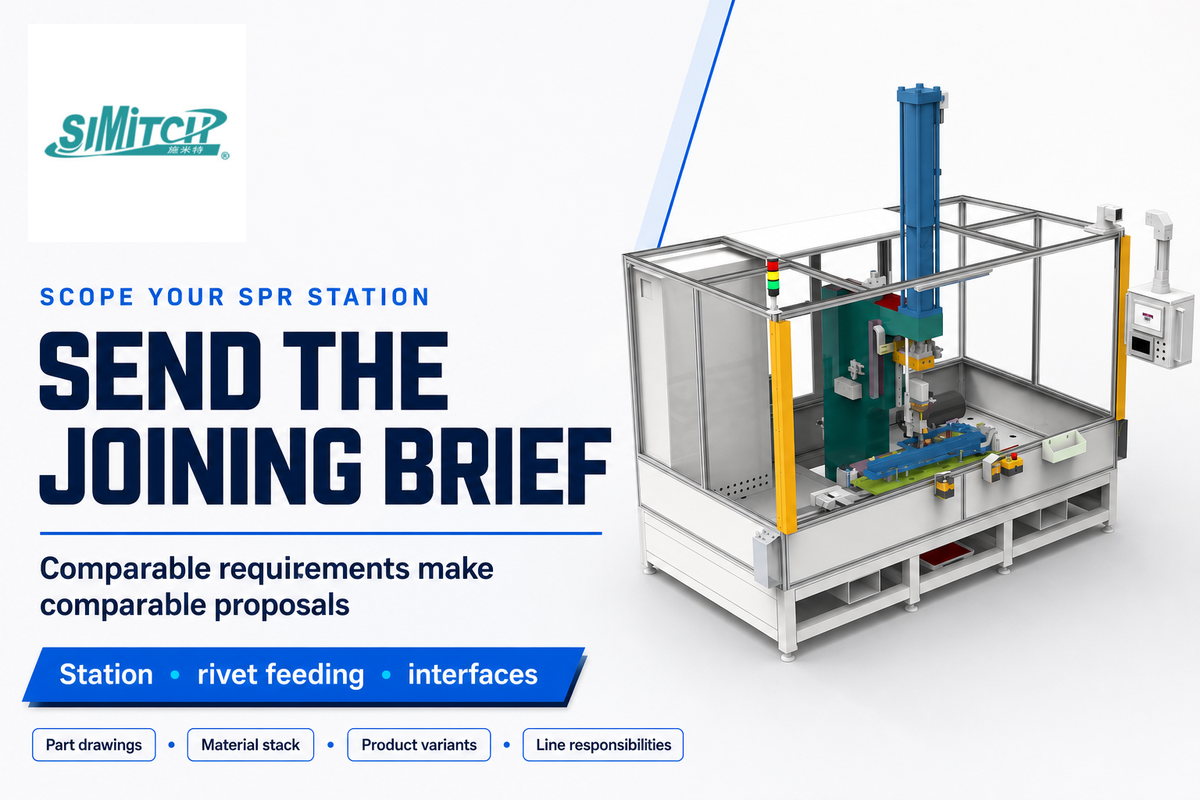
For assembly, you need a supplier to take responsibility. You could choose from a fastening specialist, a precision platform builder or a line integrator. Fastening specialists and precision platform builders charge for different amounts of work, so you need to make a fair comparison. Look at a number of companies with published processes that are relevant to you, and compare proposals against the same requirements and parts.
For a defined self-piercing riveting application, SIMITCH’s servo riveting assembly systems provide the station, rivet-feeding and interface discussion route. The broader riveting equipment range helps identify the equipment family before the project is specified. Send the part drawings and joining requirements with the planned material stack, product variants and surrounding line responsibilities so the proposed station can be scoped around the application.
References & Sources
- ISO 12100:2010: machinery risk assessment and risk reduction International Organization for Standardization, public scope and current status.
- ISO 10218-2:2025: industrial robot applications and robot cells International Organization for Standardization, public scope and edition information.
WHY WE WRITE THIS
About SIMITCH
SIMITCH develops sheet-metal joining equipment for clinching, riveting, servo pressing, pneumohydraulic drive and hot-melt connection applications. Our engineering team starts with the material stack, access envelope, cycle target and acceptance method before recommending a machine route.
Founded in 2006 in Taicang, Jiangsu, SIMITCH combines research and development, in-house production and global sales. These guides turn field experience into practical decision support for process engineers, plant teams and industrial buyers.
OUR EXPERIENCE
Since 2006
Equipment engineering, machining, assembly and joint validation under one manufacturing system.
OUR EXPERTISE
Five joining routes
Clinching, riveting, SPR, precision press-fit and hot-melt connection for production lines.