Get in touch with Suzhou Simitch Machinery Co., Ltd Company

Choosing between a blind rivet vs solid rivet depends on back-side access, load cycle, and volume of assembly. Use a blind rivet when only one side of the joint is accessible and rated load meets the stress. Use a solid rivet when access to both sides exists and full hole filling or repeatable automated cycles are needed.
Per ISO 15977:2002, standard open-end blind rivets span 2.4 mm to 6.4 mm, while aircraft repair guidance under FAA AC 43.13-1B specifies a driven solid-rivet shop head diameter of 1.5 times the shank diameter.
Unit fastener price rarely determines total joint cost alone. Commercial 1/8-inch aluminum open-end blind and 1100F solid rivets can carry the same distributor box prices in modest industrial scale packs. Labor head count, tooling tonnage, sealing leak pathways, and alloy grade determine actual joint performance.
Here are peer reviewed shear test findings, a three-path watertightness validation, a worked out 1,000 joint cost table, and the 4-Gate Access-Load-Seal-Volume Rivet Selector.
Blind Rivet vs Solid Rivet at a Glance
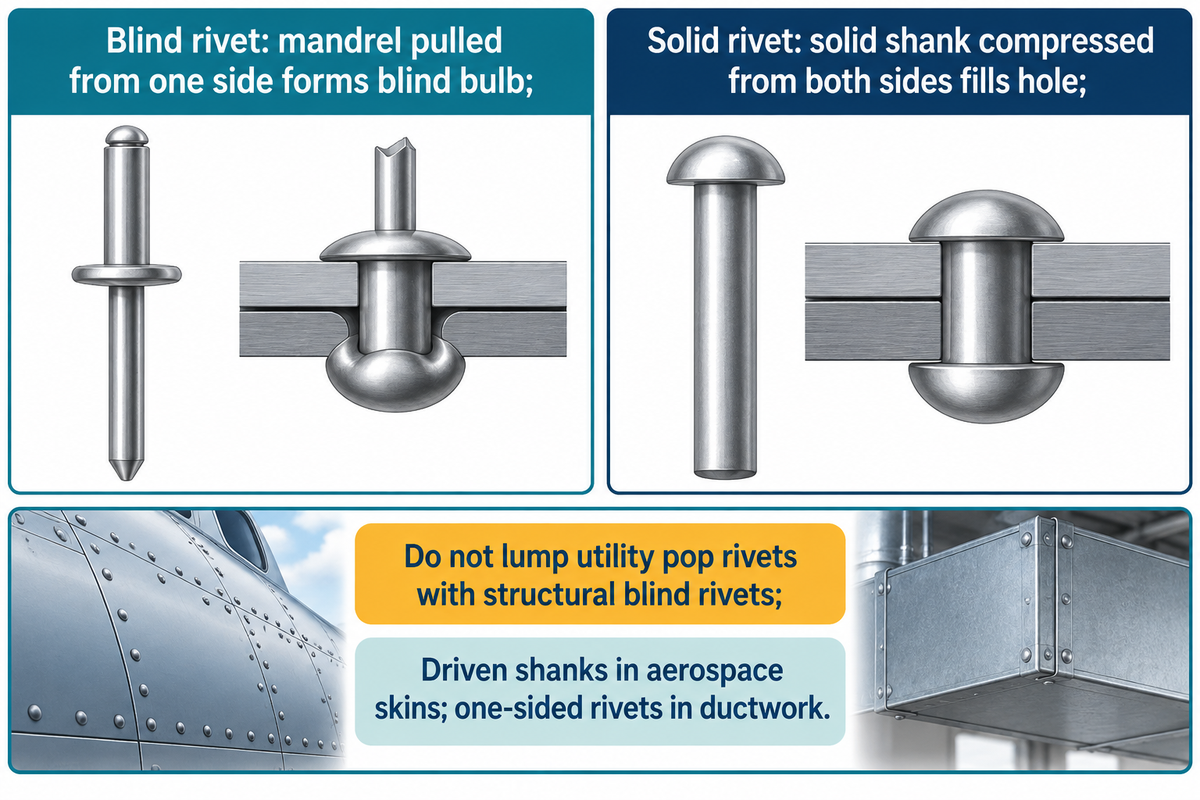
Blind rivets and solid rivets are distinguished first by assembly access and shank operation. A blind rivet pulls a central mandrel through a hollow rivet body from one side, resulting in a formed bulb on the blind side. A solid rivet employs one solid metal shank that’s compressed from both sides until the shank swells to fill the hole tightly.
Many engineers dismiss blind rivets wholesale as non-structural hardware. That shortcut lumps thin-walled utility pop rivets together with mechanically locked structural blind rivets. Table 1 compares both rivet families across ten engineering and procurement metrics so you can screen out the wrong fastener quickly. For semi-tubular, drive, and split designs, see our overview of broader rivet types and structural families.
| Comparison Dimension | Blind Rivet (Open, Closed, Structural) | Solid Rivet (Cold-Driven / Orbital) |
|---|---|---|
| Access Required | One side only; blind side needs open cavity clearance for bulb expansion | Access to both sides for bucking bar, squeezer yoke, or press anvil |
| Construction | Two-piece rivet body and a mandrel that snaps at preset pull load | One-piece solid shank with preformed factory head |
| Hole Filling | Partial expansion in open-end styles; tighter radial expansion in structural styles | Full radial shank swell fills the clearance hole tightly when driven properly |
| Measured Joint Load / Strength | DX51D+Z275 steel joint tests (4.8×8 mm DIN 7337, MDPI 2025): 2,923–3,589 N single-lap; 4,088–6,020 N double-lap | Continuous solid cross-section carries high shear and cyclic load; depends on alloy (1100 vs 2117-T4) |
| Vibration & Fatigue | Friction-lock stems can loosen or rattle; mechanical-lock structural models resist pull-out | High vibration durability; interference fit props the hole and lowers cyclic stress |
| Watertightness | Open-end leaves an open bore; closed-end seals core only for low-pressure splash | Strong mechanical seal when shank fills hole and seam uses sealant |
| Setting Force & Tooling | Hand plier, battery, or pneumatic-hydraulic rivet gun pulls mandrel | ~345 lbf (3/32 in) to ~615 lbf (1/8 in) per EAA summary; gun/bucking bar, squeezer, or orbital press |
| Installation Crew & Process | One operator installs from the accessible front side with minimal setup | Manual bucking often needs two operators; C-frame squeezers and presses allow fast single-operator cycles |
| Commercial Unit Price (1/8 in Al) | $47.00/1,000 open-end (RivetsOnline); $59.60/1,000 closed-end (Bolt Depot), Nov 2026 | $47.00/1,000 or $210.00/5,000 box tier (1100F, RivetsOnline, Nov 2026) |
| Relevant Documents | ISO 15977:2002 (2.4–6.4 mm open-end); ISO 14589:2000 (testing ≤6.4 mm); IFI-126 (closed-end) | ASME B18.1.1 (dimensions); EN 6104:2026 (aerospace QA); FAA AC 43.13-1B (repair guidance) |
These differences between blind rivets and solid rivets help you understand why driven shanks are used in aerospace skins and frames for heavy vehicles and one-sided fasteners in HVAC ductwork and enclosed cabinets. When comparing bolted, welded, and riveted joints, check rear access first, as geometry that blocks access cuts the shortlist immediately.
What Is a Blind Rivet?
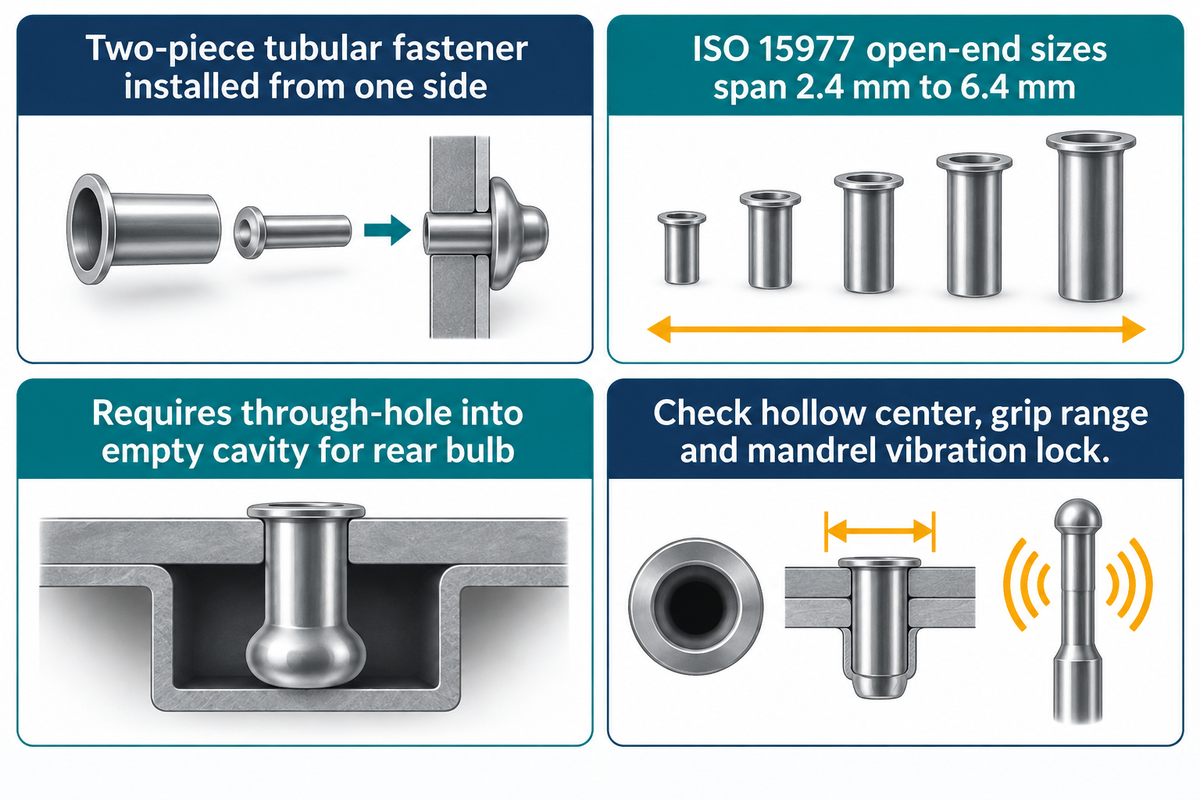
A blind rivet is a two-piece tubular fastener that is installed from one side with the rear face blocked. Using ISO 15977:2002, open-end break-pull blind rivets are available with an aluminum alloy sleeve and a steel mandrel between 2.4 mm and 6.4 mm in diameter. Pulling the steel mandrel through the tube creates a rear bulb before snapping the stem cleanly.
The sleeve of a blind rivet is like a metal drywall anchor, inserted through holes that are aligned from the front face. A hand- or air-powered rivet tool latches to the stem and pulls it back while bracing the flanged end.
The wider-head mandrel expands the rear sleeve into a second head, draws the sheets together, and snaps off when pulling force hits a predetermined limit. The MIT D-Lab fastener guidelines paint these pulled rivets as semi-permanent thin-metal fasteners, since removing one ruins the sleeve. See our guide on how a blind rivet sets from one side for a cutaway view.
Different Types of Blind Rivets
Each type of blind rivet weighs the unit price with strength, grip range and sealing. As stated by the ASSEMBLY Magazine Blind Riveting Handbook, break-mandrel designs can be a semifilled (nonstructural) or even filled-core (structural) construction:
- Open-end blind rivets use a standard tubular body that leaves a hollow center at the blind-side head after the mandrel snaps. They use a dome-head flange wider than the body to retain thin metal sheets.
- Closed-end (sealed) blind rivets employ a deep-drawn cup that wraps entirely around the mandrel head. A 1/8-inch aluminum/aluminum closed-end IFI-126 rivet listed on Bolt Depot (#15392) uses a #30 drill bit with a 1/16-inch to 1/8-inch grip range and lists 100 lbs shear and 110 lbs tensile strength.
- Multi-grip and peel blind rivets accept a broader range of sheet thicknesses and tolerate more hole oversize. Peel or tri-fold bodies give you split rear petals that distribute the clamping force on plastics or soft composites.
- Structural blind rivets keep a hardened mandrel inside the shear plane and hold it permanently with a mechanical lock ring or collar. Such a mechanical locking feature resists stem ejection from vibration cycling, though structural blind rivets cost far more than standard blind rivets.
Blind rivet installation packs real limitations alongside one-sided convenience. Open-end sleeves leave a hollow center, require close grip-range matching, and can lose loose mandrel heads under vibration. To match diameter and stack thickness before ordering, see our blind rivet diameter and grip-range sizing chart.
Can You Use a Rivet in a Blind Hole or Closed Tube Without Back-Side Access?
Yes for a standard pull-mandrel blind rivet in a hollow closed tube, no for a true dead-end blind hole drilled into a solid block. A pull-mandrel blind fastener requires a through-hole opening into an empty cavity so that the rear bulb can expand against the interior wall. Without that rear ledge, the mandrel pulls straight out or jams up in the hole.
Prior to ordering a pull-mandrel blind rivet for square tubing/extrusion, evaluate three limits. First, ensure the cavity behind the wall clears the entire un-set rivet tail length so the tail does not bottom out against the opposite wall. Second, ensure the combined sheet thickness is strictly within the printed grip range.
Third, if you must fasten into a solid block with a dead-end hole, switch to a drive-pin rivet, tapped screw, or press-in insert.
Are Blind Rivets and Pop Rivets the Same Thing?
All POP® rivets are blind rivets, but not all blind rivets are POP® rivets. POP® rivets are a trademarked name originally introduced by George Tucker Eyelet Co. The trademark is now owned by STANLEY Engineered Fastening.
Shop techs often use “pop rivet” as shorthand for open-end break-mandrel blind rivets.
On engineering drawings, exact wording counts. Writing pop rivets and blind rivets interchangeably on a bill of materials invites buyers to purchase utility aluminum rivets rather than structural blind rivets. Specify the applicable product standard (such as ISO 15977 or IFI-126) or proprietary structural series, the body and mandrel alloys, and the minimum shear and tensile ratings instead of generic nicknames.
What Is a Solid Rivet?
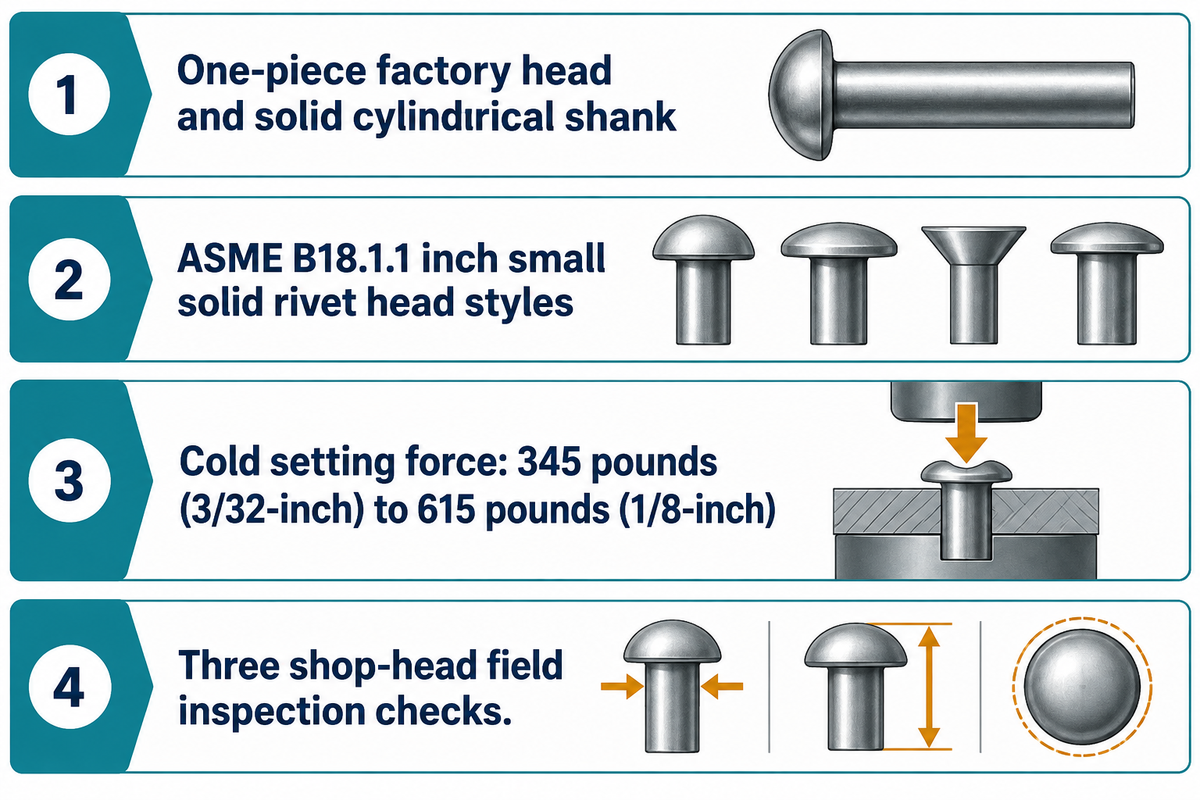
A solid rivet is a one-piece metal fastener having one factory head and a cylindrical solid shank which experiences a permanent deformation when compressed. Lacking any breakaway mandrel and hollow body, solid rivet installation is dependent on access to both sides. Enlarging the tail of the protruding solid rivet swells the shank to lock the hole and create a second shop head.
Think of squeeze fitting a short steel pin into a very tight hole until the pin fills every space. Dimensional formulas and head styles (flat, universal, countersunk, pan, and truss) follow ASME B18.1.1 for inch small solid rivets. Solid rivets are widely used in primary aircraft skins, structural bridges, heavy-duty truck frames, and mechanical linkages simply because a single piece of metal has no internal parts to come loose.
Solid rivets require clear bucking-bar or anvil access, so they are impractical inside sealed box sections unless you add service openings.
Production shops form solid rivets through three primary methods:
- A pneumatic rivet gun and bucking bar employs one technician who hammers the factory head while another braces the tail with a steel bucking bar. This more manual approach addresses wide aircraft panels but requires skill and two workers to work large assemblies.
- A C-frame pneumatic or hydraulic squeezer applies equal pressure to both heads with one smooth motion. Squeezers make uniform shop heads around panels, even close to the edge, when the throat is deep enough to clear the hole.
- Orbital and radial riveting presses knead the tenon progressively under controlled pressure instead of hitting it all at once. Per The Fabricator, an orbital riveting head tilted at 6 degrees on mild steel applies only about 20 percent of the force required for impact riveting. At that same 6-degree angle, orbital riveting induces a side load of about 10 percent of the downward forming force, while radial riveting minimizes side load on slender shanks.
For automated sizing, review orbital riveting machine kinematics for solid rivets.
How Much Force Does It Take to Set a Solid Rivet, and How Do You Inspect the Shop Head?
A 3/32-inch solid rivet uses about 345 pounds of force, a 1/8-inch about 615 pounds, according to Securit Metal Products from EAA builder guidance. Cold-setting force data varies widely with alloy hardness, increasing significantly from soft 1100 aluminum to 2117-T4 aircraft rivets or stainless steel. Before you approve a production setup, verify the finished shop head with a go/no-go gauge.
Sheet-metal aircraft repair practice documented by EAA Sport Aviation (citing FAA Advisory Circular 43.13-1B) defines three field inspection checks:
- Under AC 43.13-1B, the upset shop head must be at least 1.5 times the shank diameter wide and about 0.5 times the shank diameter high.
- If a 0.020-inch feeler gage slips under the factory rivet head during inspection, the rivet has stretched and signals joint damage.
- Standard inch drill sizes are a #40 bit for 3/32-inch rivets, #30 for 1/8-inch, #21 for 5/32-inch, and #11 for 3/16-inch. For automated tenon forming, The Fabricator notes that sizing the hole slightly larger than the outside diameter of the tenon lets the shank swell to fill the entire hole.
Key Differences Between Blind Rivets and Solid Rivets
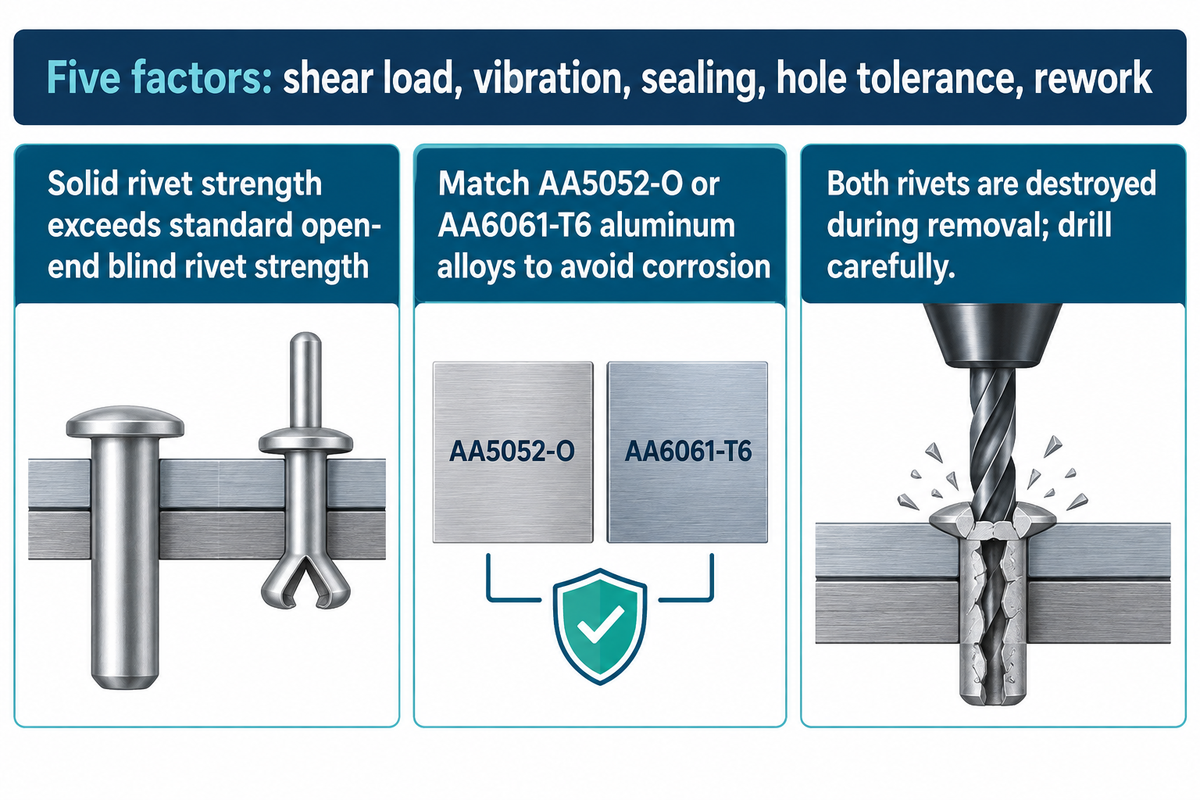
The five key engineering factors that determine blind rivets vs solid rivets in industrial assemblies are shear and tensile load paths, cyclic vibration characteristics, watertight leak paths, hole-size tolerances, and rework risk. Vague rules like “solid rivets are twice as strong” conceal key alloy, sheet-thickness, and mandrel-lock factors that change real-world joint failure modes.
Shear and Tensile Rivet Strength: Mandrel Break Plane vs Solid Shank
Solid rivet strength exceeds standard open-end blind rivet strength at the same diameter and alloy because the shank is a continuous solid cross-section at the shear plane. An open-end blind rivet leaves a hollow sleeve at the sheet interface when the mandrel breaks behind the shear plane. A structural blind rivet narrows this gap by mechanically locking its mandrel in the shear plane.
Standardized blind-rivet testing follows ISO 14589:2000 for nominal diameters up to 6.4 mm at 10 °C to 35 °C. That standard requires steel test plates with hardness of >=420 HV30 and hardened referee inserts of >=700 HV30. During shear and tensile tests, load is applied continuously at 7 mm/min to 13 mm/min until the specimen fails, and the maximum load is recorded as the ultimate shear or tensile load. Real thin-sheet joints often fail earlier because bending and sheet bearing enter the load path.
A January 2025 peer-reviewed study in MDPI Materials tested DIN 7337 4.8 × 8 mm blind rivets in DX51D+Z275 galvanized steel sheets across three load modes. The results demonstrate how single-lap bending and rivet alloy shift failure behavior:
| Loading Mode | A2/A2 Stainless Blind Rivet | St/St Galvanized Steel Blind Rivet | Observed Failure Mechanism |
|---|---|---|---|
| Single-Lap Shear (T1) | 3,589 ± 174 N (yield ~2,500 N) | 2,923 ± 114 N (yield ~2,000 N) | A2/A2 failed by slippage; St/St fractured; bending lowered strength |
| Double-Lap Pure Shear (T2) | 6,020 ± 129 N | 4,088 ± 125 N | A2/A2 tore the steel sheet first; St/St fractured at rivet shank |
| Pure Normal Tension (1.0 mm sheet) | 3,481 ± 71 N | 3,622 ± 66 N | Both rivets pulled through the deformed upper sheet |
| Pure Normal Tension (1.5 mm sheet) | 4,572 ± 25 N | 3,965 ± 63 N | St/St rivet failed; A2/A2 slipped through deformed sheet |
Two practical lessons stand out from those lab figures and field engineering reports. First, removing eccentric bending in double-lap pure shear raised A2/A2 capacity from 3,589 ± 174 N to 6,020 ± 129 N, where the galvanized steel sheet tore before the rivet failed. Second, alloy selection overrides generic labels when judging joint strength and durability. Aerospace liaison engineers on Eng-Tips note that soft 1100-series aluminum solid rivets don’t work-harden to the shear strength and tensile strength of 2117-T4 (“AD”) aircraft solid rivets. They also warn against assuming every solid rivet beats stainless structural rivets in bearing-critical joints. Check rivet design, alloy grade, and sheet thickness together.
Vibration Resistance and Fatigue Life
Correctly driven solid rivets generally perform better than standard friction-lock open-end blind rivets under cyclic vibration because the radial shank upset fills the hole and constrains sheet micro-slip. Joint clamp-up, hole fit, and mechanically locked blind architectures also influence fatigue life. Under sustained vibration, standard friction-held mandrels can loosen and fall out.
“Typically, the locking characteristics of a blind rivet are not as good as a driven rivet. Therefore, blind rivets are usually not used when driven rivets can be installed.”
Maintenance engineers and airframe builders spot this vibration gap on unwashed aluminum panels. Builders on Van’s Air Force report loose blind rivets “working and smoking,” leaving dark fretting streaks around the head where the hollow sleeve fails to prop the hole tightly. On Eng-Tips, liaison engineers flag a second failure mode in turbine inlets and enclosed housings. A shaken-loose mandrel stem or drilled-out blind tail creates loose metal debris inside rotating machinery. When back-side access is blocked in vibrating structural applications, use mechanically locked structural blind rivets (such as CherryMAX or NAS9307/NAS1398 classes) rather than friction-lock pop rivets.
Are Blind Rivets Watertight, and When Do Closed-End Types Replace Solid Rivets?
Standard open-end blind rivets leave a direct leak path through the center bore after the mandrel breaks, so they aren’t watertight unless the bore is sealed separately. Closed-end (sealed) blind rivets trap the spent mandrel within a solid cup to prevent center-core leakage, yet cover low-pressure splash sealing rather than rated pressure vessel sealing.
Audit all three fluid paths across sealed rivet joints prior to approving a drawing:
- Through the rivet core (Path 1): Open-end blind rivets leave an open center passage that requires secondary sealant to prevent water entry. Closed-end sealed blind rivets and solid rivets close this center path mechanically.
- Path 2-Radial clearance along the wall of the hole: Albany County Fasteners states in its FAQ that a closed cup “cannot seal a poor hole,” and oversized, oval, or burred holes allow water to migrate around the outside of the rivet body.
- Capillary seepage under the flange and between lapped sheets (Path 3): Thermal cycling and flexing of the sheets draw moisture under the rivet head. Close that path with an EPDM sealing washer, wet seam sealant or interference-fit upset solid rivet.
Aerospace fluid-tight blind designs are more than a closed cup. USPTO Patent US4789283A adds an outer ductile sealing jacket around a tubular rivet body and locks the pull-stem to shut off radial hole-wall leakage. Wet or marine aluminum joints also demand careful alloy matching to inhibit galvanic pitting.
A 2025 assessment in Frontiers in Materials highlights matching aluminum rivet alloys (such as AA5052-O or AA6061-T6) to aluminum panels to limit dissimilar-metal corrosion, a risk that steel mandrels can add. Closed-end aluminum rivets with aluminum mandrels work well in rain-shedding electrical enclosures and HVAC housings. Submerged tanks and pressurized vessels typically call for upset solid rivets with a seam sealant, welded seams, or engineered pressure-rated fittings.
Hole Size, Grip Range, and Thin or Soft Materials
Blind rivets are sensitive to oversized holes and an incorrect grip range. The ASSEMBLY Magazine Blind Riveting Handbook warns that an over-drilled hole lets the mandrel head pull straight through the sleeve. Fitting a blind rivet below its minimum grip range results in the same pull-through failure, leaving a burr and zero clamp load.
Maintain a hole centerline to sheet edge distance of at least one rivet diameter in general fabrication, and two diameters in structural aluminum.
Blind rivets also offer specialized head styles for thin or soft materials such as fiberglass, plastics, and thin aluminum skins. Large-flange, tri-fold blind rivets distribute the clamping pressure over a larger footprint in the rear allowing for less damage to the brittle panels. Cold-driven 3/32″ to 1/8″ solid rivets (roughly 345-615 lbf per EAA summaries) can fracture brittle plastics or cause buckling of thin gauges unless you incorporate washers and low-force controlled forming.
Measure total thickness of the materials, including paint, primer, and gasket, before calculating a grip code.
Removal and Field Serviceability
Blind and solid rivets are both destroyed during removal, and careless drilling can easily enlarge the parent hole. Drill only to the head-shank junction, punch the head off with a pin punch, and tap the shank out with an undersized punch.
Field engineers on Eng-Tips point out a costly maintenance trap when blind rivets serve as temporary repairs on solid-riveted structures. Installing and later removing a blind rivet can enlarge the original hole if drilling wanders or the sleeve spins. Mechanics may then need an oversize solid rivet that crowds minimum edge distance. Blind rivets may also spin in thin sheets if a hard steel mandrel stub catches the drill tip. For bit sizing and safe extraction steps, read our guide on drilling out blind and solid rivets safely.
Blind Rivet vs Solid Rivet Cost: Unit Price, Tooling, and Labor Economics
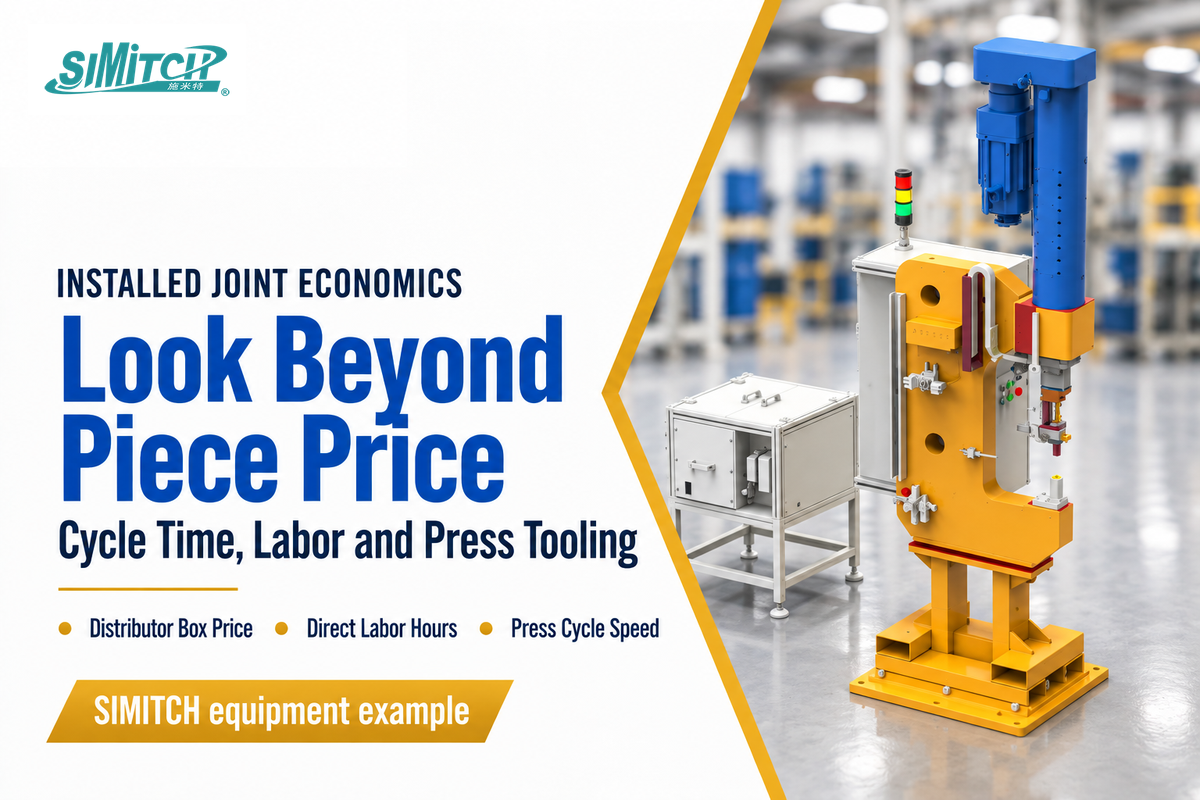
Solid rivets are not always less expensive per piece in commercial distributor lots, and manual bucking is often more expensive per installed joint than blind riveting. With 1/8-inch box prices close, press tooling, cycle speed, and headcount matter more than bare piece price.
Buyers often expect single-piece solid rivets to cost half as much as two-piece blind rivets. When commercial box prices sit close together, direct labor, tooling setup, and cycle time carry major weight alongside fastener material cost. Under May 2025 U.S. Bureau of Labor Statistics (BLS) data, general assemblers and fabricators earn a median base wage of $21.85 per hour ($45,450 per year). Transportation equipment assemblers earn a median of $50,790 per year, and aircraft structure assemblers earn $65,380 per year.
Worked Example, 1,000-Joint Installed Cost Breakeven Model: Suppose a sheet-metal shop fastens 1,000 accessible 1/8-inch aluminum joints. Assumed inputs: commercial November 2026 distributor list prices from RivetsOnline A125F0125A ($47.00/1,000 solid 1100F aluminum; $210.00/5,000), RivetsOnline PR46ASP ($47.00/1,000 open-end aluminum/steel blind; $210.00/5,000), and Bolt Depot #15392 ($59.60/1,000 closed-end aluminum blind). Direct labor uses the May 2025 BLS base wage of $21.85/hour, excluding employer payroll burden and overhead. Shop cycle assumptions are 6 seconds/joint for single-operator pneumatic blind pulling, 20 seconds/joint for two operators bucking solid rivets manually, and 3 seconds/joint for one operator on a benchtop orbital riveter or C-frame squeezer. Capital depreciation and custom fixtures are excluded to isolate direct variable cost per 1,000 joints.
| Assembly Route | Fastener BOM / 1,000 | Assumed Labor Hours | Direct Labor ($21.85/hr) | Direct Variable Total / 1,000 |
|---|---|---|---|---|
| Pneumatic Open-End Blind (1 Op, 6 s) | $47.00 (RivetsOnline list) | 1.67 hrs | $36.42 | $83.42 |
| Pneumatic Closed-End Blind (1 Op, 6 s) | $59.60 (Bolt Depot list) | 1.67 hrs | $36.42 | $96.02 |
| Manual Bucked Solid Rivet (2 Ops, 20 s) | $47.00 (RivetsOnline list) | 11.11 man-hrs | $242.78 | $289.78 |
| Benchtop Orbital / Squeezer Solid (1 Op, 3 s) | $47.00 (RivetsOnline list) | 0.83 hrs | $18.21 | $65.21 |
The arithmetic makes it all very clear. Manual two-man bucking is 2×1,000×20 seconds ÷3,600= 11.11 man-hours, $242.78 in base labor and $289.78 total per 1,000 joints. Pneumatic blind single-operator pulling reduces labor to 1.67 hours ($36.42) and total variable cost to $83.42.
Moving the accessible solid rivets to a benchtop orbital press or squeezer reduces labor to 0.83 hours ($18.21) and variable cost to $65.21. That’s $18.21 per 1,000 joints saved over open-ended blind rivets and $224.57 over manual bucking.
Airframe builders on Van’s Air Force report a similar practical shift: on accessible flanges where a rivet squeezer fits, they find solid rivets faster and easier to set cleanly than hand-pulled blind rivets. In mild-steel joints, 6-degree orbital forming uses roughly 20% of impact riveting force. The Fabricator notes that this lower-capacity machine footprint generally lowers capital investment, tooling cost, and maintenance when solid rivets are used in automated production. For repeatable high-volume assemblies, evaluate industrial riveting equipment configurations with automatic bowl feeding against tooling amortization and target takt time. Blind rivets are often the practical fastening solution for low-volume cabinets and field service, while automated solid rivets offer stronger variable-cost economics on open two-sided flanges.
Other Options Compared: When Neither Blind nor Solid Rivets Fit
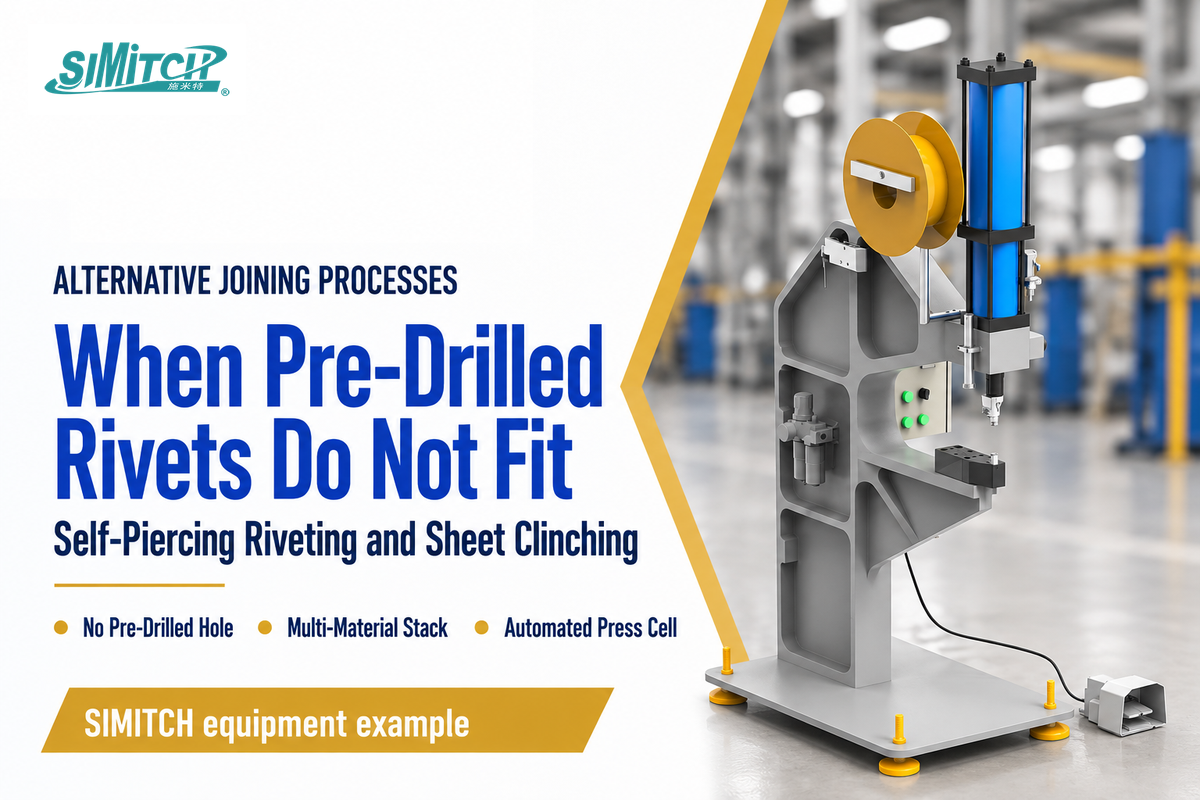
Neither blind nor solid rivets cover every sheet-metal joint. Beyond common types of rivets, five different types of fasteners and joining techniques bypass pre-drilled limitations, remove the need for consumables, or manage larger structural steel loads.
- Self-piercing riveting (SPR) pushes a semi-tubular rivet through the upper sheet and flares it inside the bottom sheet without a pre-drilled hole. TWI Global notes that SPR provides high shear strength, high fatigue life, medium peel strength, and the ability to join dissimilar aluminum-to-steel stacks where spot welds are not viable. A 3 mm upper-sheet pre-hole in hybrid adhesive-SPR joints increased the peak force by 12.79% and energy absorption by 35.71%, according to research reported in Frontiers in Materials (2025).
SIMITCH supplies self-piercing riveting (SPR) equipment for high-volume automotive sheet and battery-tray assemblies; see our self-piercing riveting process and joint validation of stack limits.
- Mechanical clinching cold-forms an interlocking button directly from the sheets using a punch and die. TWI Global assesses clinching with zero fastener consumables, low cost per joint, low risk of corrosion for coated steel, medium shear and fatigue strength, and low peel strength. Both SPR and clinching eliminate hole drilling while both also need two-sided C-frame die access and ductile bottom sheets, not closed single-sided tubes.
Examine SIMITCH’s fastener-free sheet metal clinching machines for instances where consumables cost has maximum sensitivity, such as thin-gauge ductwork or appliance framing.
- Semi-tubular rivets are designed with a partial hollow tip that rolls outward under lower setting force than full solid rivets. They are suitable for pivoting hinges, brake linings, and light electromechanical brackets where full solid-shank upset may distort fragile elements.
- A rivet nut is installed from one side like a blind fastener and provides internal machine threads for a removable bolt. Use a rivet nut whenever service covers need to be opened repeatedly without drilling out fasteners.
- ASTM F3125/F3125M:2026 specifies quenched and tempered steel bolts with grade-specific minimum tensile strengths of 120, 144, and 150 ksi (inch) and 830 and 1040 MPa (metric).
Blind Rivet or Solid Rivet: How to Choose for Your Assembly
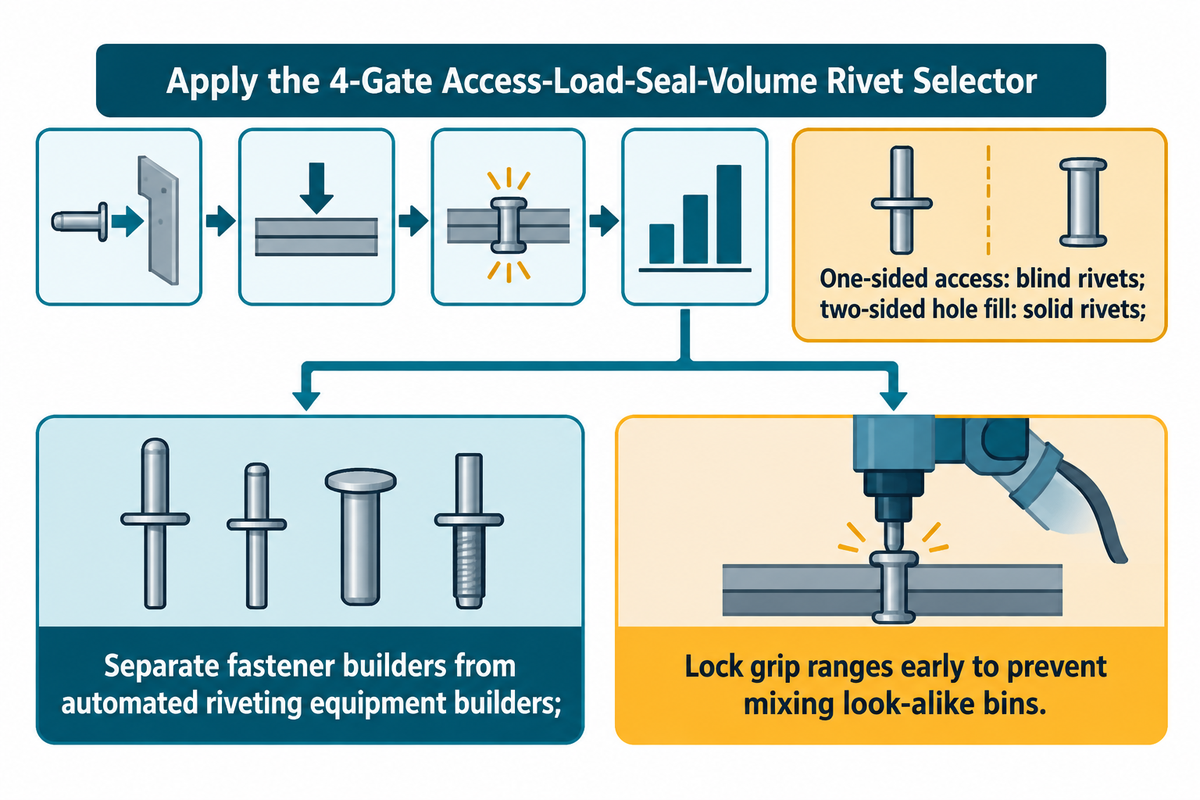
Select blind rivets for one-sided access if their rated load can handle the stress, or solid rivets for two-sided access if complete hole fill or repeatable automated cycles are important. Narrow down your choice using the following sequential gates: Access, Load & Vibration, Sealing & Corrosion, and Annual Volume.
The 4-Gate Access-Load-Seal-Volume Rivet Selector
Prior to locking your drawing callouts, employ the 4-Gate Access-Load-Seal-Volume Rivet Selector:
- Gate 1 (Access Geometry): Assess if a bucking bar, squeezer yoke, or C-frame anvil will reach into the back of the hole. When access is one-sided to a hollow tube or box, remove solid rivets, SPR, and clinching and use either pull-mandrel blind rivets or rivet nuts.
- Gate 2 (Load Mode & Vibration): Identify if the joint is subject to primary shear, cyclic fatigue, or heavy vibration. If so, and both sides are open, consider solid rivets (or SPR for automated thin sheets). If so, and access is on one side into a hollow cavity, consider mechanically locked structural blind rivets with the mandrel locked across the shear plane, and validate rated shear, tensile, and fatigue allowables for the joint.
- Gate 3 (Sealing & Galvanic Pair): If the joint must seal out water, dust, or spray, reject unsealed open-end blind rivets. For submerged or pressurized duty, use upset solid rivets with seam sealant (or engineered pressure fittings). For low-pressure splash enclosures, use closed-end blind rivets with EPDM washers and matched drill tolerances (such as a #30 drill for 1/8″ rivets), and match rivet alloy to parent metal in wet areas.
- Gate 4 (Annual Volume & Automation): At less than 50,000 joints/year or in field service, pneumatic blind rivets or hand squeezers keep setup low. At greater than 100,000 repeatable two-sided joints/year, consider orbital solid-riveting presses, SPR, or clinching cells versus tooling payback and takt time.
| Assembly Scenario | Recommended Option | Why It Fits | Key Limitation / Not Recommended When |
|---|---|---|---|
| 1. Closed square steel/Al tubing frame | Structural blind rivet | Sets from exterior wall with mechanically locked mandrel carrying shear | Fails if internal tube depth is shorter than un-set rivet tail |
| 2. Aircraft primary aluminum skin & spar | 2117-T4 (“AD”) or 7050-T73 solid rivet | Full hole filling, 1.5D inspection per FAA AC 43.13-1B, and EN 6104:2026 QA | Unusable without rear bucking clearance or approved access port |
| 3. Outdoor NEMA electrical enclosure | Closed-end blind rivet + EPDM washer | Blocks through-core splash and traps spent mandrel inside sealed cup | Leaks radially if holes are oversized/ragged or under vessel pressure |
| 4. Commercial HVAC galvanized ductwork | Open-end steel blind rivet or clinching | Fast one-sided field assembly (blind) or zero-consumable shop seams (clinching) | Unsealed open-end blind rivets leak air without duct mastic |
| 5. High-vibration bus/trailer chassis bracket | Solid rivet (orbital/press) or mechanical-lock structural blind | Resists friction-stem loosening and cyclic hole elongation | Avoid friction-lock utility pop rivets on primary chassis brackets |
| 6. Aluminum boat hull below waterline | 5056/2117 solid aluminum rivet + marine sealant | Full shank hole fill resists hull flexing and hydrostatic seepage | Avoid aluminum rivets with steel mandrels in saltwater due to galvanic pitting |
| 7. High-volume EV Al-to-steel battery tray | Self-piercing riveting (SPR) + adhesive | Zero pre-drilling, high fatigue life, joins dissimilar metals automatically | Requires two-sided robotic C-frame gun and ductile bottom sheet |
| 8. Plastic or fiberglass trim to thin metal | Large-flange peel / tri-fold blind rivet | Wide rear petals spread load on soft or brittle substrates | High cold-impact solid riveting can crack brittle composites without controlled forming |
| 9. Removable service access cover | Rivet nut + machine screw | One-sided installation with reusable threads for frequent opening | Adds bolt torque-control steps unnecessary on permanent seams |
| 10. Heavy structural steel beam splice | ASTM F3125/F3125M structural bolt | Grade-dependent min tensile 120/144/150 ksi (inch) and 830/1040 MPa (metric); pretension per connection design | Heavy steel splices must follow structural connection design rather than small sheet-metal rivets |
Procurement & Engineering RFQ Checklist: Fastener vs Machine Sourcing
Industrial supply chain divisions exist clearly between fastener builders (STANLEY/POP, GESIPA, Howmet/Huck, Cherry, National Rivet) and automated riveting equipment manufacturers (SIMITCH for servo riveting assembly systems, SPR, and clinching cells). It is seldom that one supplier offers certified aerospace fasteners and turnkey servo assembly presses. Make sure you include these 7 items in your RFQ so both parties can provide accurate quotations:
- Stack geometry: specify precise material alloys, individual sheet thicknesses, coatings or adhesives, and overall stack tolerance (mm or in).
- Access envelope: verify one sided blind cavity depth or two sided C frame throat depth and reach.
- Load and failure target: State required single-lap shear (N or lbf), tensile pull-out, and vibration lock minimums.
- Sealing and corrosion grade: Dry indoor, outdoor splash (closed-end + washer), or submerged/pressurized service, matched with rivet/mandrel alloys.
- Quality and product standards: list ISO 15977 for open end blind rivets, ASME B18.1.1 for small solid rivets, or EN 6104:2026 for aerospace inch-series solid rivets. Reference ISO 14589 separately when mechanical shear or tensile testing is required, and request batch certificates or force-displacement logging.
- Volume and takt time per year: state total joints per year, joints per assembly and target cycle time to size manual vs automated feed tooling.
- Sample joint validation: Request cross-section micrographs and pull test coupons on production sheet stock prior to freezing tooling.
To shortlist automated press integrators for a high-volume solid riveting, SPR, or clinching cell, compare the builders in our industrial riveting machine manufacturers comparison.
When selecting a rivet or planning to use a rivet on mixed-thickness subassemblies, lock grip ranges early to prevent operators from mixing up look-alike bins on the line.
Industry Outlook: Lightweighting, Aerospace Traceability, and Force-Monitored Riveting

Three industrial shifts (EV multi-material lightweighting, 2026 aerospace quality specifications, and closed-loop sensor monitoring) are changing the competitive landscape where blind rivets, solid rivets, and automated presses compete. Legacy methods, such as visual inspections or generic catalog callouts, aren’t enough to satisfy OEM auditors of EV battery packs or aerospace structures.
First, electric vehicle platforms mix low-ductility aluminum castings, high-strength steel, and composites where resistance spot welding fails. According to MarketsandMarkets, electric powertrains and lightweight vehicles are driving adoption of customized fasteners with specialized coatings, controlled preload, and thermal-cycling durability. The 2025 Frontiers in Materials review also notes expanding use of pre-holed SPR and friction self-piercing riveting (F-SPR) to join brittle light alloys without cracking bottom sheets.
Second, aerospace solid-rivet specifications advanced with EN 6104:2026 for inch-series solid rivets and slugs across five aluminum alloys (1050A-H14, 2017A-T42, 2117-T42, 5056A-H32, and 7050-T73). According to iTeh’s summary of EN 6104:2026, the standard references aerospace quality management certification (such as EN 9100), ISO 2859-1 acceptance sampling, ISO 7870 Statistical Process Control (SPC) control charts, and SAE AMS2770 heat-treatment checks. For 7050-T73 lots where applicable, shipment certificates include electrical conductivity and tensile strength results. On production lines, closed-loop press sensors, as disclosed in USPTO Patent US9015920B2, track real-time actuator and force-displacement signals during each upset cycle to catch bad joints immediately.
Published market estimates point to steady demand across both non-threaded fastener families. Global Market Insights (October 2026) values global industrial fasteners at $124.2 billion in 2024 and $129.2 billion in 2025, projecting $135 billion in 2026 and a 3.2% CAGR to $179.1 billion by 2035. Within that report, non-threaded fasteners (rivets, pins, washers, and clips) generated $28.4 billion in 2025 and are projected to reach 22% of revenue by 2035. By comparison, Coherent Market Insights estimates the 2026 global industrial fasteners market at $110.21 billion, projecting a 5.1% CAGR to $156.11 billion by 2033. Separately, DataIntelo estimates the global solid rivets segment at $4.8 billion in 2025, projecting a 5.7% CAGR from 2026 to 2034 to roughly $7.9 billion. If you’re planning a 2026 or 2027 riveting cell upgrade, specify force-displacement monitoring and SPC data export in your machine RFQ now; see our end-to-end industrial riveting process control guide for sensor setup details.
Frequently Asked Questions
Q: Are blind rivets as strong as regular solid rivets?
No, standard open-end blind rivets are less resistant to shear, tension, and cyclic fatigue than structural solid rivets of the same alloy and diameter.
A driven solid rivet expands radially to plug the hole with solid metal all across the shear plane. Normal open-end blind rivets create a hollow tube at the break of the stem. Mechanically locked structural blind rivets narrow that gap when the hardened mandrel is locked across the shear plane, but FAA AC 43.13-1B still prefers driven solid rivets where both sides are open.
Q: Why use blind rivets instead of solid rivets?
Use blind rivets when the back of the workpiece is enclosed or when single-operator installation speed outweighs maximum cyclic fatigue life.
Closed square tubes and double-walled cabinets prevent access for a bucking bar or press anvil, and field repairs and HVAC ducts can limit that access as well. Blind rivets can be installed from the front face in seconds by a single technician with a portable hand, battery, or pneumatic gun, reducing direct labor on low-volume or difficult-to-access jobs.
Q: What are the three types of rivets most commonly used in manufacturing?
The three main rivet families in industrial manufacturing are solid rivets, blind (pop) rivets and semi-tubular rivets.
Solid rivets serve high-strength aerospace skins and orbital-pressed assemblies with two-sided access. Blind rivets serve one-sided enclosures, ductwork, and field repairs in 2.4-6.4 mm ISO 15977 sizes. Semi-tubular rivets cover low-force pivots and brackets.
Automated automotive lines use self-piercing rivets (SPR) to remove pre-drilled holes in multi-material stacks.
Q: Can a solid rivet be installed from one side?
Not without rear access: upset deformation needs rigid rear support from a bucking bar, squeezer anvil, or press die so the shank can mushroom into a 1.5D shop head.
Q: Can blind rivets handle high vibration?
Standard friction-lock blind rivets have difficulty with high vibration, but mechanically-locked structural blind rivets perform well with moderate- to high vibration.
Open-end utility mandrels may rattle or fall out due to cyclic loads, so choose locked-stem structural models or driven solid rivets.
Q: Can a structural blind rivet replace a solid rivet size for size?
Never automatically; same nominal diameter doesn’t guarantee drop-in structural equivalency unless shear allowables, fatigue life, and hole tolerance are checked.
Even mechanically locked blind rivets like CherryMAX aren’t equal to driven 2117-T4 solid rivets in hole-fill propping, bearing stress concentration, or grip sensitivity. In regulated aerospace repairs under FAA AC 43.13-1B, using a blind fastener in place of a driven solid rivet requires approved repair data; increasing rivet diameter or strength grade alone doesn’t circumvent engineering approval. Check single-lap shear, sheet bearing limits, and edge distance allowables before approving any substitution.
Q: How do you remove blind rivets versus solid rivets without damaging the hole?
Use an undersized split-point drill to precisely drill up to the shoulder of the head-shank joint, shear or punch off the head flush, and remove the stub sleeve or pin.
For the solid rivet, center punch the head and withdraw the drill short of hitting the parent sheet. Drill only to the head-shank junction, pop the head off with a pin punch, then use a smaller punch (per EAA practice) to tap out the remaining shank. For the blind rivet, first push out any protruding steel mandrel stub so the drill tip remains centered, then drill the flange off while keeping the sleeve from spinning.
If extraction enlarges the hole, ream smooth and install the matching oversize rivet, checking edge distance.
Planning Automated Riveting or Clinching for High-Volume Production?
If your assembly has two-sided access and your annual volumes make riveting by hand too slow, SIMITCH engineers build servo orbital riveting systems, self-piercing riveting (SPR) cells, and fastener-free sheet-metal clinching machines with real-time force-displacement monitoring. Send us your sheet stack and cycle time target to assess SIMITCH industrial riveting equipment.
References & Sources
- Federal Aviation Administration (FAA), Advisory Circular AC 43.13-1B, Acceptable Methods, Techniques, and Practices – Aircraft Inspection and Repair, (Public Domain). https://www.faa.gov/documentLibrary/media/Advisory_Circular/AC_43.13-1B_w-chg1.pdf
- Beber et al., Determination of Mechanical Properties of Blind Rivet Joints Using Numerical Simulations and Experimental Testing, MDPI Materials (January 7, 2025): https://www.mdpi.com/1996-1944/18/2/229
- Du et al., “Research Progress on Riveting Processes of Low-Ductility Light Alloys for Carrier Tools” Frontiers in Materials (2025): https://www.frontiersin.org/journals/materials/articles/10.3389/fmats.2025.1686963/full
- U.S. Bureau of Labor Statistics (BLS), Occupational Outlook Handbook: Assemblers and Fabricators (May 2025 Wage Data): https://www.bls.gov/ooh/production/assemblers-and-fabricators.htm
- MIT D-Lab, Fasteners Guide: https://d-lab.mit.edu/sites/default/files/inline-files/D-Lab_Learn-It_Fasteners_Oct13.pdf
- ISO 14589:2000, Blind Rivets, Mechanical Testing (iTeh Standards Catalog): https://standards.iteh.ai/catalog/standards/iso/bc748b4e-a50d-46c9-997f-93884c22d719/iso-14589-2000
- ISO 15977:2002, Open End Blind Rivets with Break Pull Mandrel and Protruding Head, AlA/St (iTeh Standards Catalog): https://standards.iteh.ai/catalog/standards/cen/c22be32b-42f5-417b-a441-e34c83a3a574/en-iso-15977-2002
- EN 6104:2026, Aerospace Series: Rivets, Solid, in Aluminium or Aluminium Alloy, Inch Series, Technical Specification (iTeh Standards): https://standards.iteh.ai/articles/blog/latest-news/aerospace-standards-july-2026
- ASME B18.1.1, Small Solid Rivets (ASME Codes & Standards): https://www.asme.org/codes-standards/find-codes-standards/b18-1-1-small-solid-rivets
- ASTM F3125/F3125M:2026, Standard Specification for High Strength Structural Bolts and Assemblies (Intertek Inform): https://www.intertekinform.com/en-us/standards/astm-f-3125-f3125m-2026-161269_saig_astm_astm_4034376/
- Experimental Aircraft Association (EAA), Repairing Sheet Metal (Ron Alexander, Sport Aviation): https://www.eaa.org/eaa/aircraft-building/builderresources/while-youre-building/building-articles/metal/repairing-sheet-metal
- TWI Global, How do clinching and self-piercing riveting compare with spot welding for sheet materials?: https://www.twi-global.com/technical-knowledge/faqs/faq-how-do-clinching-and-self-piercing-riveting-compare-with-spot-welding-for-sheet-materials
- USPTO Patent US9015920B2, Riveting System and Process for Forming a Riveted Joint: https://patents.google.com/patent/US9015920B2/en
- USPTO Patent US4789283A, Fluid-Tight Blind Rivet: https://patents.google.com/patent/US4789283A/en
- ASSEMBLY Magazine, Assembly Handbook: Blind Riveting: https://www.assemblymag.com/articles/84047-assembly-handbook-blind-riveting
- The Fabricator, Advances in Riveting and Mechanical Fastening: https://www.thefabricator.com/thefabricator/article/assembly/advances-in-riveting-and-mechanical-fastening
- Albany County Fasteners, Closed End Rivets Technical FAQ: https://www.albanycountyfasteners.com/rivets/blind-rivets/closed-end-rivets
- RivetsOnline Catalog (Nov 2026 Accessed), 1/8×1/8 Flat Head 1100F Solid Aluminum Rivets (A125F0125A) and 1/8 Open-End Aluminum/Steel Blind Rivets (PR46ASP): https://www.rivetsonline.com/a125f0125a/a125f0125a, https://www.rivetsonline.com/aluminum-rivet-w-steel-mandrel/pr46asp
- Bolt Depot Catalog (Retrieved Nov 2026), IFI-126 1/8-in Closed-End Aluminum Blind Rivets (#15392): https://boltdepot.com/Product-Details?product=15392
- Global Market Insights (October 2026), Industrial Fasteners Market Report: https://www.gminsights.com/industry-analysis/industrial-fasteners-market
- Coherent Market Insights (November 2026), Industrial Fasteners Market Trends & Solid Rivet Demand: https://www.coherentmarketinsights.com/blog/industrial-automation-and-machinery/industrial-fasteners-market-trends-solid-rivet-demand-3225
- DataIntelo, Solid Rivets Market Report: https://dataintelo.com/report/solid-rivets-market
- MarketsandMarkets, Industrial Fasteners Market Press Release: https://www.marketsandmarkets.com/core/PressReleases/industrial-fasteners.asp
About this Technical Comparison: Mechanical test results, dimensional tolerances, and distributor price reference benchmarks have been verified against primary ISO/ASME/EN/ASTM standards, FAA Advisory Circular AC 43.13-1B, peer-reviewed 2025 laboratory testing, and November 2026 industrial catalogs. Final rivet diameter, alloy, and sheet bearing strength should always be validated on production coupons.
Reviewed by the SIMITCH technical team