Get in touch with Suzhou Simitch Machinery Co., Ltd Company


Automotive lightweighting is the controlled reduction of vehicle mass while preserving the safety, performance, manufacturing, cost, service, and recovery outcomes the vehicle still has to deliver. It is a system decision, not a contest to find the material with the lowest density.
Updated August 2026 · By XCX
A credible lightweighting proposal connects the kilograms removed to a vehicle-level benefit, a feasible joint route, a validation plan, and an end-of-life consequence. If any one of those links is missing, the mass number is a starting hypothesis rather than an approved business case.
Decision guide at a glance
- Define what a one-kilogram change means at vehicle level before changing a material.
- Compare materials as structural and manufacturing systems, not by density alone.
- Screen stack order, access, coatings, inspection, rework, and repair before selecting equipment.
- Carry every mass claim through a shared evidence record and staged release sequence.
- Treat all worksheet values in this guide as project inputs, never as industry benchmarks.
Automotive Lightweighting Is a System Decision, Not a Material Swap
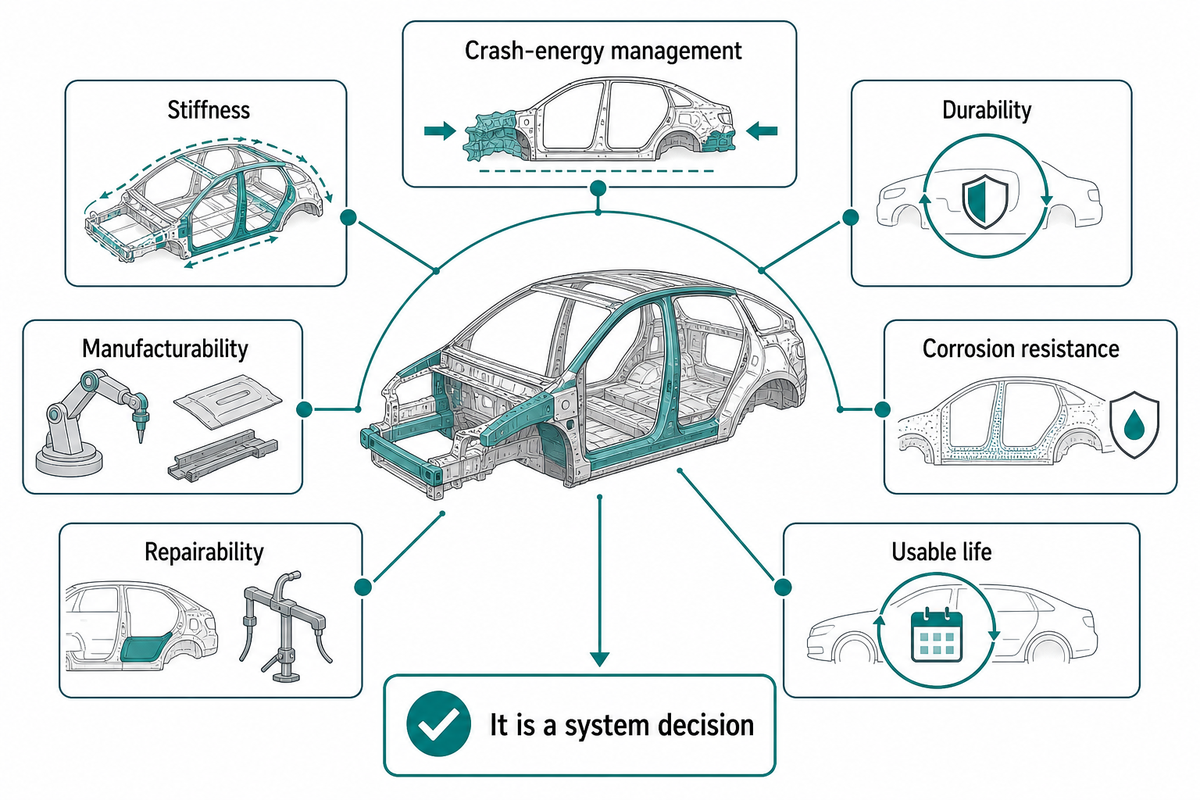
Automotive lightweighting means reducing the mass of a car or truck without giving up the functions that mass helped provide. Those functions include stiffness, crash-energy management, durability, manufacturability, corrosion resistance, repairability, and usable life. That retained-function boundary is the first screen for every later tradeoff.
Vehicle outcome
State the efficiency, range, payload, packaging, or performance result.
State the efficiency, range, payload, packaging, or performance result.
Structural function
Preserve the load path, stiffness, fatigue life, and crash requirements.
Preserve the load path, stiffness, fatigue life, and crash requirements.
Production route
Prove forming, joining, inspection, rework, and cell access.
Prove forming, joining, inspection, rework, and cell access.
Life-cycle boundary
Count production, use, repair, removability, reuse, and recovery.
Count production, use, repair, removability, reuse, and recovery.
“A material choice becomes a lightweighting strategy only when the mass saving survives the joint and recovery plan.”
Decision rule used in this guide
Terminology note: A lightweight vehicle, car lightweighting, and a lightweight material for cars all point to the same system question. Searches for automotive lightweighting examples, lightweighting meaning, and current trends in automotive lightweighting strategies and materials still require a functionally equivalent comparison.
What does automotive lightweighting mean?
In practical engineering terms, automotive lightweighting is controlled mass reduction at vehicle level. A lighter component qualifies only when its changed geometry, material, interfaces, and production route still satisfy the defined requirements of the automobile. The vehicle-level baseline keeps every proposal comparable.
Scope test: ask whether the proposal names a baseline part, the function retained, the vehicle architecture, the duty cycle, the joint concept, and the evidence still missing. A proposal that says only “aluminum saves 30 percent” has not yet defined a comparable system.
The United States Department of Energy describes lightweight materials as one route to improving fuel efficiency, but its research portfolio covers materials science, manufacturing processes, multi-material assembly, and recyclability together. That wider boundary is the useful one because advanced materials move loads and factory constraints at the same time.
Release rule: do not approve “use of lightweight material” as a standalone action. Approve a defined vehicle function, material system, joint route, validation sequence, and recovery assumption as one package.
Start With the Mass Budget: Where Does One Kilogram Change the Vehicle?
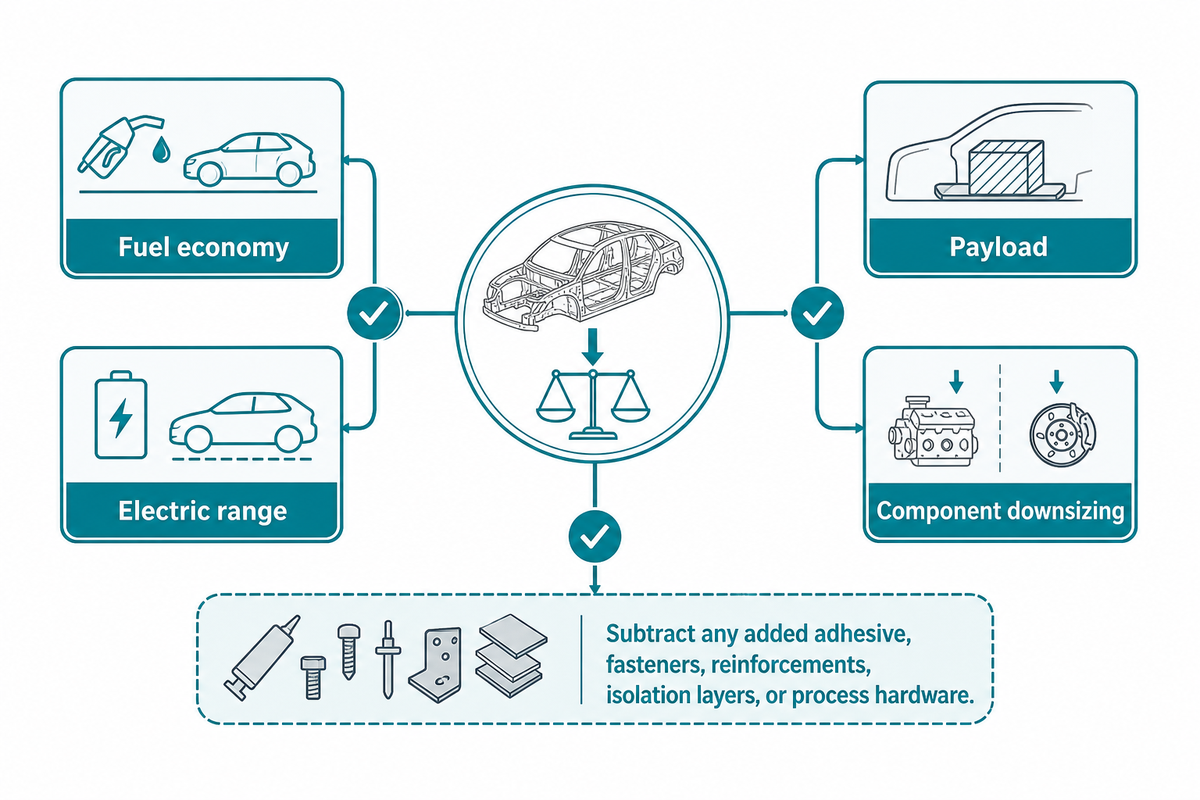
Name the desired outcome before trying to reduce weight. The same kilogram can improve fuel economy, preserve electric range, add payload, enable component downsizing, or create no measurable customer benefit, depending on where it is removed and how the vehicle is operated.
| Mass pathway | Primary question | Secondary effect to test | Evidence boundary |
|---|---|---|---|
| Combustion vehicle | Does lower vehicle weight reduce energy demand on the defined drive cycle? | Can brakes, suspension, or powertrain be resized? | Vehicle-level simulation and test |
| Electric vehicle | Does the saving improve range, payload, performance, or battery sizing? | Does a smaller battery remain possible after thermal and warranty margins? | Architecture and duty-cycle specific |
| Commercial vehicle | Can the saving become revenue payload without breaching axle limits? | Does the operating route actually use that payload? | Route and legal-load specific |
| Structural consolidation | Are parts and joints removed as well as mass? | What redundancy, repair, and tooling risk becomes concentrated? | Programme-specific comparison |
The United States Department of Energy states that a 10 percent vehicle weight reduction can deliver an estimated 6 to 8 percent improvement in fuel economy. DOE presents this as a general engineering estimate, not a current fleet measurement or a multiplier for a door, battery tray, or isolated bracket.
Mass-outcome pathway
- Freeze the baseline vehicle and duty cycle.
- Locate the kilogram and the function it supports.
- Calculate the primary energy or payload effect.
- Test whether secondary downsizing is physically and commercially available.
- Subtract any added adhesive, fasteners, reinforcements, isolation layers, or process hardware.
Electrification does not eliminate this discipline. Removing mass may reduce propulsion energy, yet battery size is constrained by peak power, charging strategy, thermal performance, degradation allowance, packaging, and target range, so a lighter part does not automatically authorize a smaller battery.
Procurement question: is the supplier being asked to quote a lighter part, a lighter assembled system, or a vehicle-level mass pathway? Put that scope in the request for quotation before comparing costs.
What Do Steel, Aluminum, Magnesium, and Composites Really Trade?
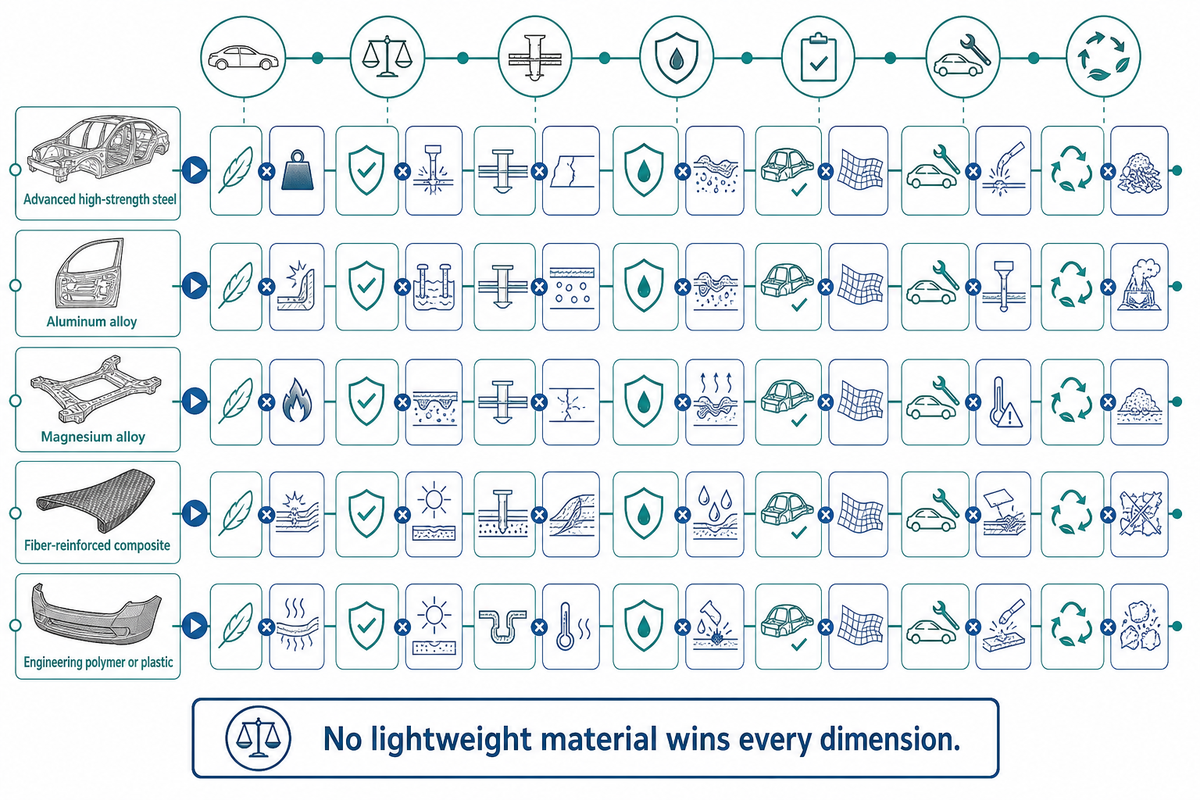
No lightweight material wins every dimension. Density affects mass potential, but stiffness, geometry, crash loading, formability, corrosion, joining, cost, repair, and recovery decide whether the potential survives in a real vehicle component. The mass budget above names the outcome; this comparison tests whether a material system can deliver it.
| Material family | Possible system advantage | Constraint that can reverse it | Evidence needed |
|---|---|---|---|
| Advanced high-strength steel | Higher strength can support thinner gauges while retaining familiar supply and recycling routes. | Springback, edge cracking, local stiffness, tool wear, and difficult joint stacks. | Forming window, crash load path, weld or mechanical-joint window. |
| Aluminum alloy | Lower density and established use in closures, castings, and structural parts. | Section growth for stiffness, galvanic interfaces, heat sensitivity, surface preparation, and repair. | Functionally equivalent geometry, interface isolation, joining and damage plan. |
| Magnesium alloy | Very low density for selected cast or formed components. | Corrosion management, temperature exposure, joining, supply, and end-of-life separation. | Application-specific environmental, process, and recovery evidence. |
| Carbon fiber and other fiber-reinforced composite | Directional stiffness and part integration can reduce overall weight. | Cycle time, inspection, hidden damage, joining inserts, repair, and material recovery. | Lay-up and cure route, impact/durability data, inspection and repair method. |
| Engineering polymer or plastic | Low mass, corrosion resistance, and functional integration for suitable components. | Creep, temperature, fire, permeability, fastening loads, and recycled-content variation. | Environment, retention, ageing, dimensional, and recovery tests. |
Engineering Vocabulary Map
| Programme lens | Terms engineers may encounter | Decision boundary |
|---|---|---|
| Objective | Vehicle lightweighting, lightweight automotive programmes, making cars lighter, a lighter car or lightweight car, weight savings, reduce the weight, and reduce vehicle weight. | Tie every phrase to a measured vehicle outcome. |
| Design | Lightweight design, automotive design, materials and structures, strength and stiffness, high performance, high strength-to-weight ratio, light yet strong, and lightweight performance. | Compare functionally equivalent geometry and loads. |
| Metal systems | Automotive materials, advanced lightweight materials, lightweight structural materials, lighter materials, lightweight alloys, aluminum and steel, and materials such as high-strength steel. | Do not infer a system result from density. |
| Composite systems | Composite materials, polymer composites, carbon fiber reinforced systems, plastic materials, and materials like hybrid laminates. | Include cure, inspection, joining, repair, and recovery. |
| Factory route | Automotive manufacturing, material use, using lightweight materials, a multi-material lightweight vehicle, lightweight solutions, and materials used for vehicles. | Prove access, control, rework, and traceability. |
| Energy outcome | Fuel consumption, better fuel efficiency, improved fuel efficiency, improving the efficiency, and energy to accelerate. | Keep the architecture and duty cycle explicit. |
| Trend language | Automotive lightweighting trends, a trend in the automotive industry, and the fact that lightweighting also shifts joining and recovery risk. | Do not turn terminology into a growth forecast. |
A 2025 case study published in Machines illustrates why a density ranking is not enough: within that study’s defined design and manufacturing assumptions, a low-alloy steel concept produced the preferred balance rather than an automatic aluminum win. The finding is case-specific, but the reasoning is general—compare functionally equivalent systems.
Functionally equivalent means: the concepts carry the same loads, meet the same stiffness and crash intent, include all reinforcements and joints, fit the same package, and use a production route that can actually be validated. Only then should their mass and cost be compared.
How should you choose an automotive lightweighting strategy?
Start with the vehicle outcome and load case, then compare at least two functionally equivalent concepts. For each concept, record geometry, gauge, material grade, forming route, stack order, access, joint family, corrosion isolation, inspection, repair, and recovery. Keep the same functional boundary for every option.
Decision sequence: screen structural function first, manufacturing feasibility second, life-cycle and programme economics third. A concept that fails an access or corrosion screen should not receive a precise cost score, because its production definition is incomplete.
Use sensitivity ranges where data are not yet fixed, and assign an owner to every open item. The best strategy is the one whose mass benefit survives the identified constraints with evidence appropriate to the programme stage, not the one with the most impressive density number.
Common comparison error: counting a thin steel panel against a thick aluminum casting, or a single composite molding against several fully joined metal parts, without normalizing their functions and interfaces.
How Does Lightweighting Change the Joining Plan?
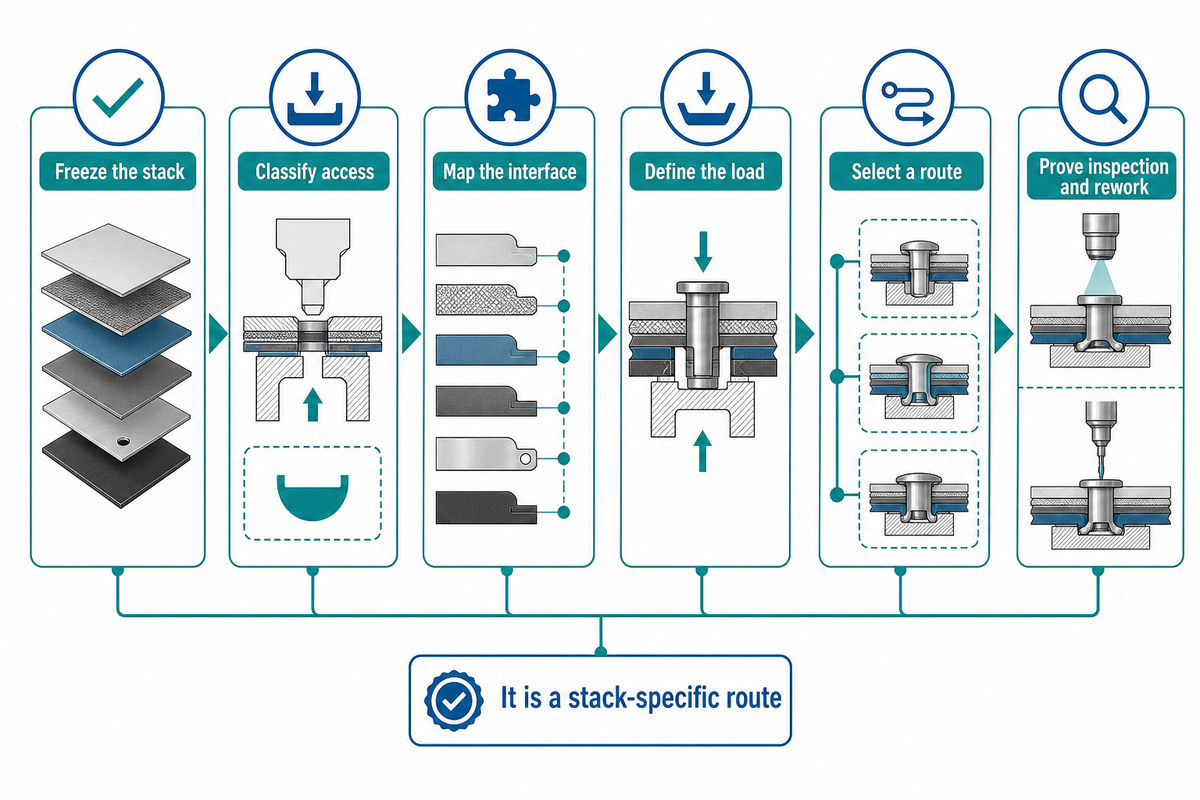
A material stack is not ready for release until its stack order, access, coatings, adhesive layer, loads, thermal exposure, inspection, rework, and repair route have a feasible joining concept. Physical access can disqualify a process before material compatibility is even discussed. Once the material options narrow, access and interface conditions decide which concepts remain feasible.
- Freeze the stack — specify every sheet, casting, coating, adhesive, sealant, and local reinforcement in order.
- Classify access — identify joints with two-sided tool access, one-sided access, obstructed die support, or installation after a cavity closes.
- Map the interface — check galvanic couples, coating damage, heat exposure, surface contamination, adhesive gaps, and moisture paths.
- Define the load — separate static, fatigue, peel, crash, vibration, and sealing duties rather than using one pull value.
- Select a route — only now compare welding, bonding, clinching, riveting, threaded fastening, or a hybrid joint.
- Prove inspection and rework — state how the joint is checked in cycle and what happens when it is outside the window.
This article isn’t a generic process catalogue. Readers with that separate scope will be able to compare metal joining methods, while cold-forming options and clinching machines are stand-alone equipment and feasibility studies.
When self-piercing riveting enters the screen
Self-piercing riveting can join selected dissimilar sheet stacks without drilling a separate hole, but the result depends on sheet sequence, thickness, strength, ductility, rivet geometry, die geometry, force window, sealant or adhesive, and access to the die side. It is a stack-specific route, not a universal answer to mixed materials.
For an equipment handoff, Simitch’s public page groups its self-piercing riveting machines into pneumatic-hydraulic, computer-numerical-control servo-driven, and automated flexible systems. Those families and published specifications are Simitch first-party claims; independent joint validation still has to be performed on the customer’s actual materials.
Do not quote from a material name alone. The minimum useful handoff includes drawings, sample materials, stack order, access, acceptance criteria, and the intended starting rivet, die, and force window.
Use the Weight-Join-Recovery Triangle Before Concept Approval
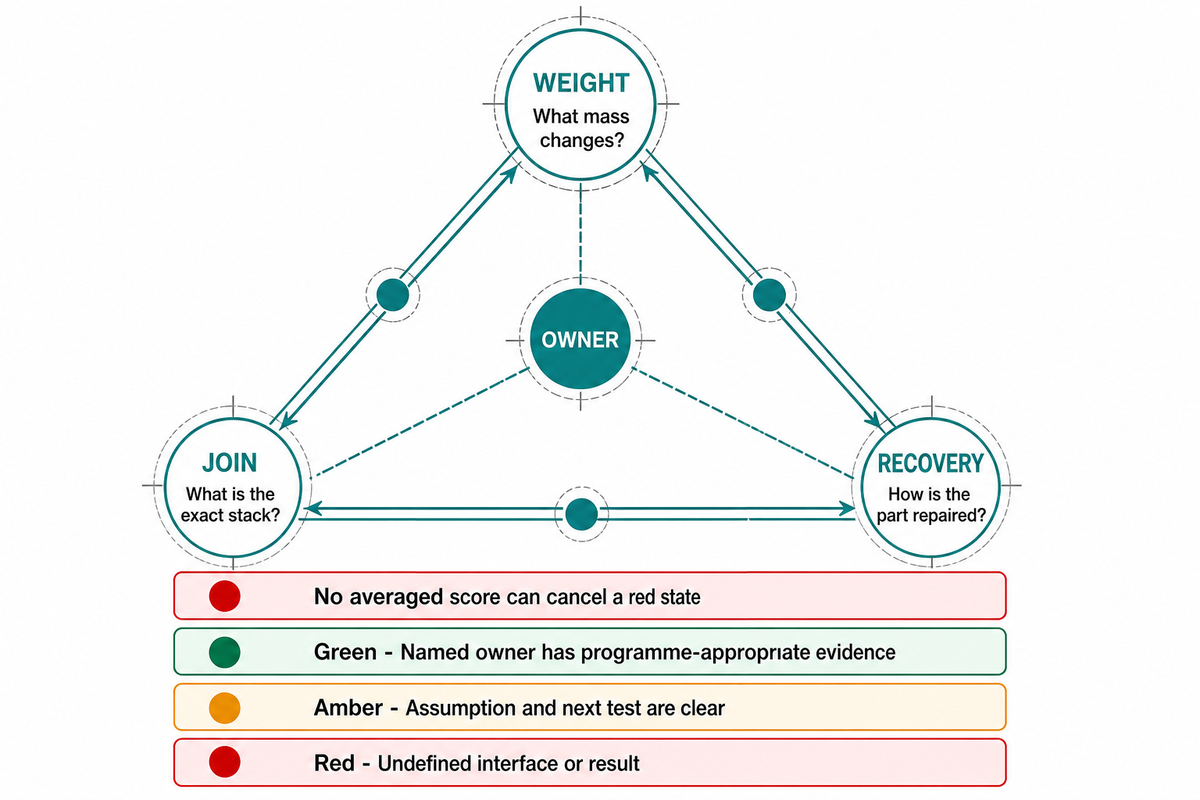
The Weight-Join-Recovery Triangle is an original Simitch project worksheet for aligning engineering, quality, finance, and procurement. It is not a published standard or independently validated scoring model, and it deliberately avoids universal weights. It gives each unresolved item a visible owner.
3-Axis Weight-Join-Recovery Triangle
Weight–Join–Recovery Triangle
WEIGHT
What mass changes?
Which vehicle outcome moves?
Are secondary savings available?
What additions return mass?
What mass changes?
Which vehicle outcome moves?
Are secondary savings available?
What additions return mass?
JOIN
What is the exact stack?
Can tools reach both sides?
How is the interface protected?
How is the joint inspected and reworked?
What is the exact stack?
Can tools reach both sides?
How is the interface protected?
How is the joint inspected and reworked?
RECOVERY
How is the part repaired?
Can materials be separated?
What contaminates the stream?
Who owns end-of-life evidence?
How is the part repaired?
Can materials be separated?
What contaminates the stream?
Who owns end-of-life evidence?
Assign each question a green, amber, or red evidence state. Green means a named owner has programme-appropriate evidence; amber means the assumption and next test are clear; red means the concept relies on an undefined interface or result.
| Role | Question it owns | Evidence source | Approval consequence |
|---|---|---|---|
| Product engineering | Does the lighter system preserve function and load paths? | Design record, simulation, and physical test. | Freeze a functionally equivalent concept. |
| Manufacturing engineering | Can tools reach, join, and repeat the defined stack? | Access study, tolerance trial, and cell evidence. | Release a feasible joining route. |
| Corrosion engineering | Does the interface remain isolated through exposure and repair? | Conditioned joints, sections, and environmental results. | Approve or redesign the barrier. |
| Plant quality | Can production signals identify an unacceptable joint? | Signal-to-section correlation and audit records. | Set monitoring and reaction limits. |
| Finance | Do compared costs share the same programme boundary? | Tooling, labour, scrap, warranty, and avoided-cost records. | Approve comparable economics. |
| Procurement | Are supplier offers based on identical inputs? | Bound drawings, stack, access, cycle, and acceptance record. | Issue a traceable quotation package. |
| Service engineering | Can the joint be removed and replaced without new damage? | Documented repair trial and post-repair checks. | Define repair limits. |
| Recovery owner | Can joined streams be separated and recovered? | Dismantling trial and recycler evidence. | Record the end-of-life route. |
| Programme manager | Are red items owned before concept approval? | Signed risk register and next-test dates. | Approve, redesign, or carry a named risk. |
The triangle prevents one team from declaring success by moving an unsolved problem to another team. It also keeps a recoverability weakness visible across the life-cycle boundary when a consolidated lightweight component looks attractive on part count and assembly time.
Gate logic: no averaged score can cancel a red state. Resolve it, redesign around it, or record an explicit programme decision to carry it with a named owner.
What Breaks First in Mixed-Material Joints?
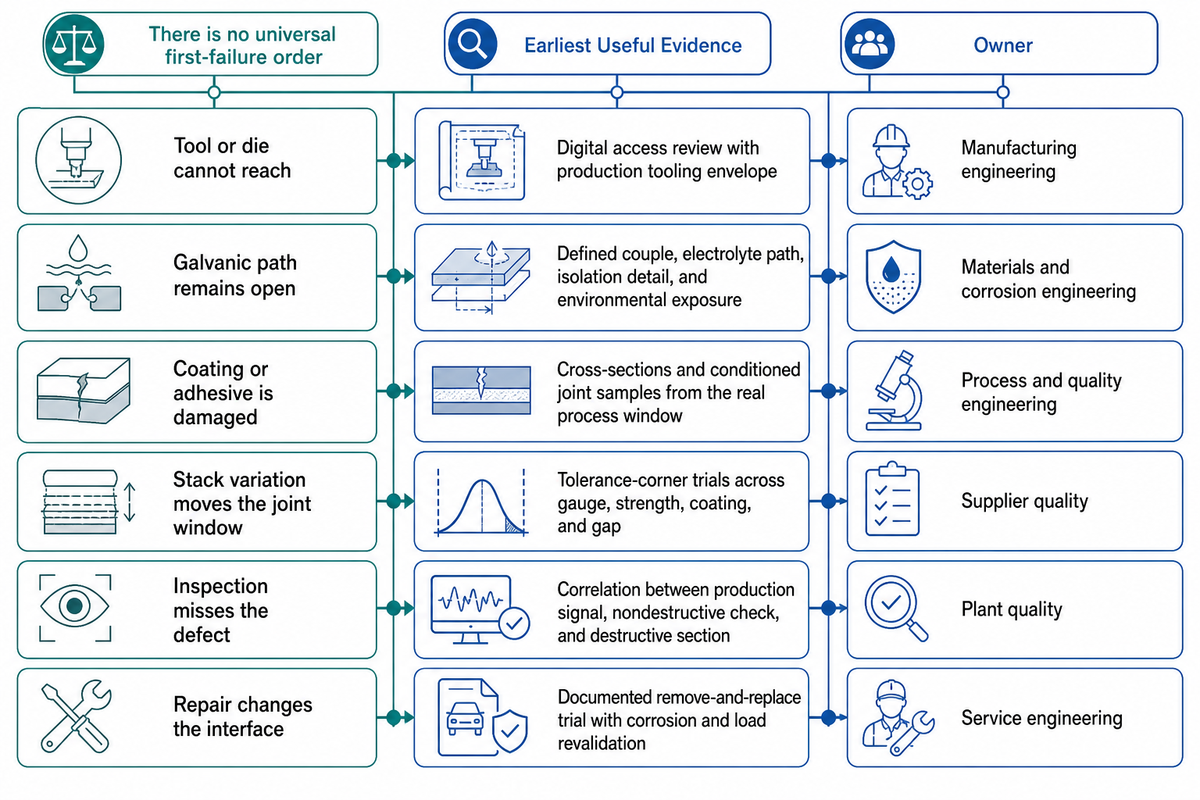
There is no universal first-failure order for mixed-material joints. Access, galvanic isolation, coating damage, adhesive cure, stack variation, die-side support, inspection, and repair can fail independently, and the first observed failure changes with the stack, process, environment, and load. The Triangle identifies the owner; this section defines the evidence each owner needs.
| Failure mode | Earliest useful evidence | Owner | Release consequence |
|---|---|---|---|
| Tool or die cannot reach | Digital access review with production tooling envelope. | Manufacturing engineering | Process route is infeasible before coupon testing. |
| Galvanic path remains open | Defined couple, electrolyte path, isolation detail, and environmental exposure. | Materials and corrosion engineering | Interface design must change or receive a validated barrier. |
| Coating or adhesive is damaged | Cross-sections and conditioned joint samples from the real process window. | Process and quality engineering | Nominal static strength is insufficient for release. |
| Stack variation moves the joint window | Tolerance-corner trials across gauge, strength, coating, and gap. | Supplier quality | Add controls, widen the window, or narrow incoming limits. |
| Inspection misses the defect | Correlation between production signal, nondestructive check, and destructive section. | Plant quality | No monitored production release. |
| Repair changes the interface | Documented remove-and-replace trial with corrosion and load revalidation. | Service engineering | Repair route and limits must be defined. |
ASTM G82 explains that greater galvanic-series separation frequently indicates greater corrosion severity, but not always. It does not supply a universal automotive distance threshold, so a material pair cannot be cleared from a ranking alone.
Counter-example from published testing: a 2024 study of 1.2 mm AA6022 aluminum joined to 2.0 mm galvanized HSLA340 steel found different initial corrosion locations and effects for self-piercing-riveted and resistance-spot-welded specimens. That result supports configuration-specific testing, not a general ranking of which process always fails first.
A good coupon still doesn’t clear the system because vehicle components see load combinations, moisture paths, temperature cycles, production variation, and repair events that a single tensile-shear test can’t imitate. The deeper qualification inputs belong in the guide to sheet metal fastening inputs.
Evidence discipline: separate a standard’s scope, a research paper’s tested configuration, a supplier’s published specification, and the programme’s own acceptance criteria. None can silently substitute for another.
Build the One-Kilogram Decision Dossier
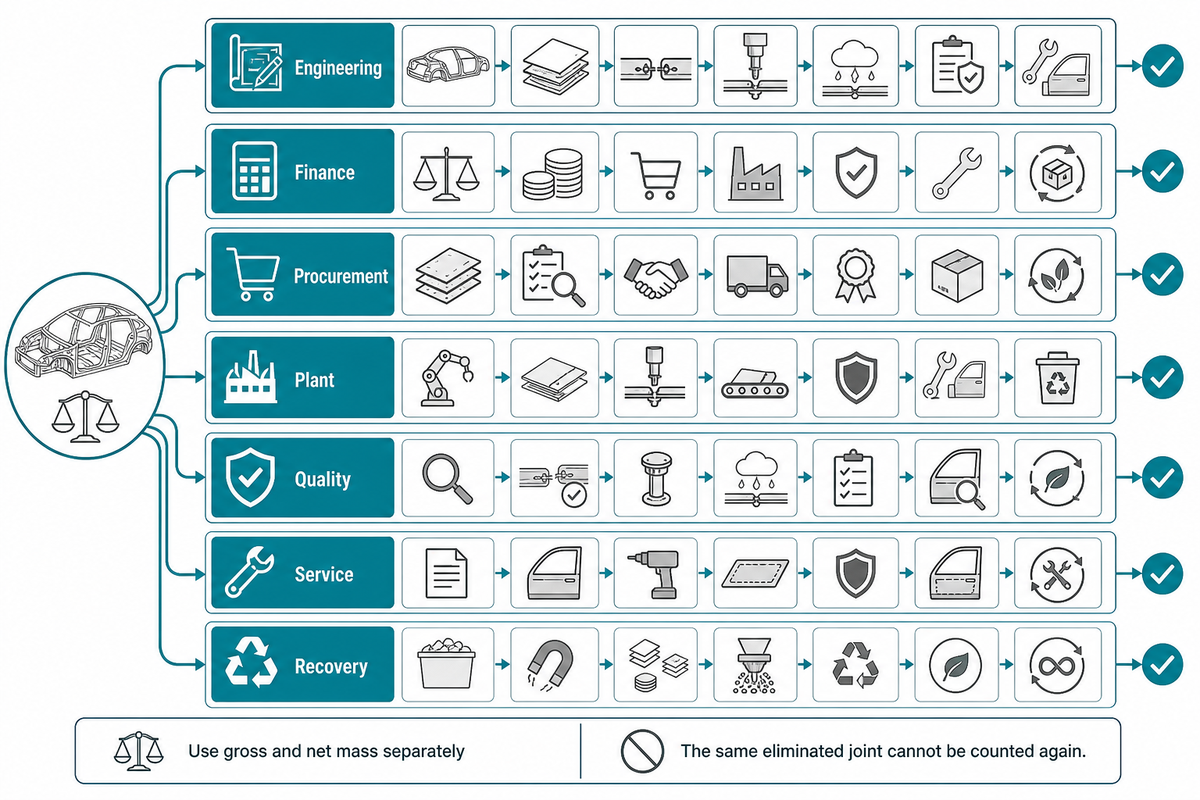
The One-Kilogram Decision Dossier is an original project worksheet that carries the same lightweighting claim across engineering, finance, procurement, plant, quality, service, and recovery reviews. It is a normalization record, not an industry standard. The failure-mode screen above supplies the red and amber items that enter the dossier.
| Decision category | Illustrative entry | Status |
|---|---|---|
| Baseline and proposed mass | Illustration only: 12.4 kg baseline; 11.1 kg concept; 1.3 kg gross saving. | Input—confirm by controlled weigh record. |
| Vehicle outcome | Preserve target range while releasing payload allowance. | Assumption—vehicle simulation required. |
| Part and joint count | Illustration: 5 parts to 3; 18 joints to 12. | Derived from current design revision. |
| Material and stack | Proposed aluminum outer / galvanized steel reinforcement / adhesive layer. | Input—grades and coatings not yet frozen. |
| Access class | Ten joints have two-sided access; two are obstructed after closing. | Red—route for two joints unresolved. |
| Joining route | Hybrid adhesive plus mechanical joining candidate. | Amber—coupon window not established. |
| Cycle and equipment | No production cycle entered. | Open—do not price a station yet. |
| Inspection | Force-displacement trace plus sampled sections proposed. | Amber—correlation study required. |
| Rework and scrap | Joint removal may damage both sheets. | Red—approved rework absent. |
| Corrosion evidence | Isolation concept drawn; environmental result unavailable. | Amber. |
| Repair route | Service section boundary not defined. | Red. |
| Recovery route | Adhesive and mixed-metal separation route under review. | Amber. |
| Source and owner | Design revision D; owners named by function. | Update after each gate. |
The illustrative concept saves 1.3 kilograms gross, but it is not ready for approval because two joints lack a route, rework is undefined, and service repair has no boundary. Those red states are more decision-relevant than a precise material-price comparison made too early.
How to use the dossier
- Freeze one baseline revision and one proposed revision.
- Mark every value as input, assumption, derived result, measured result, or unresolved evidence.
- Use gross and net mass separately; count added fasteners, adhesive, isolation, and reinforcement.
- Do not compare supplier quotes until their stack, access, cycle, and acceptance boundaries match.
- Keep red items visible through concept approval; never average them away.
The dossier also guards against double counting. If part consolidation eliminates joints and permits secondary system savings, those savings can be noted, but the same eliminated joint cannot be counted again as a separate recovery or cycle benefit without a known equation.
Private-data boundary: no Simitch or customer plant dataset was supplied for this article. All worksheet numbers above are explicitly hypothetical and demonstrate the method only.
Validate the Concept Before Production Release
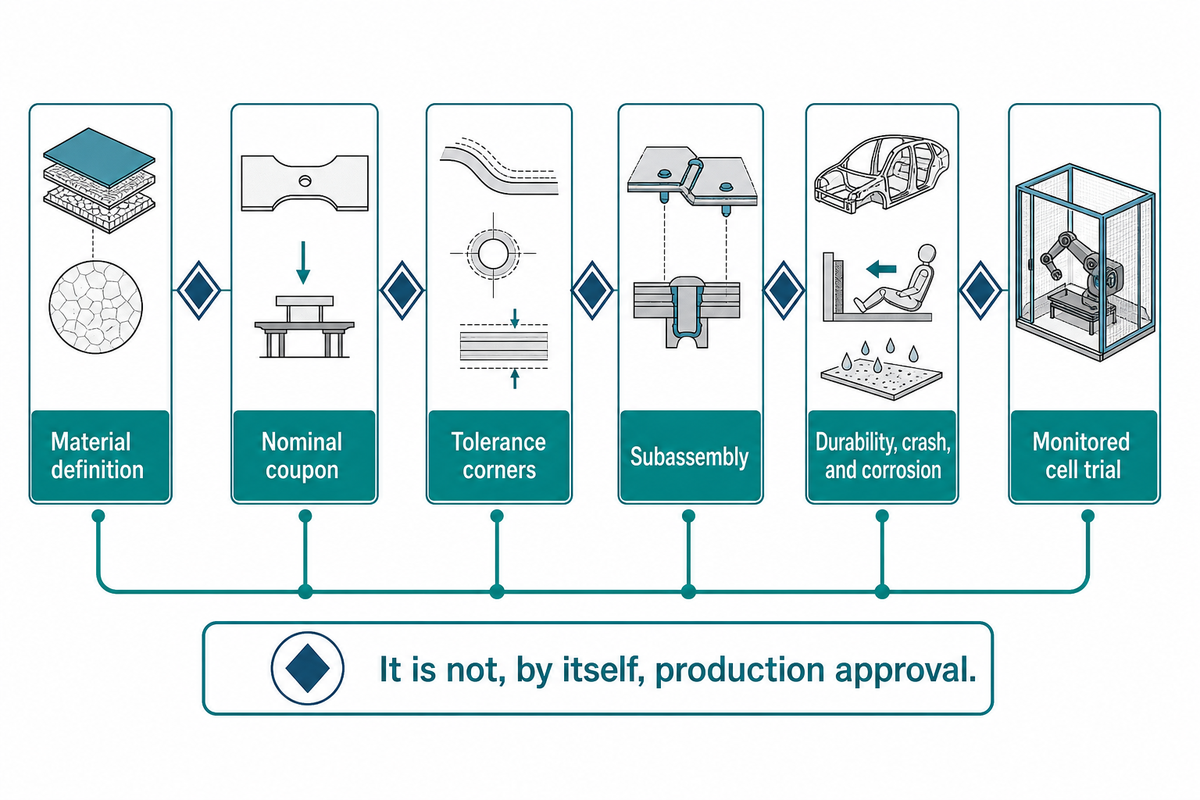
Advance a lightweight joint from material definition to coupon, tolerance-window, subassembly, durability and corrosion, then monitored cell trials. Each stage needs a named pass record before equipment or production release moves forward. The dossier turns its open items into the pass records used here.
- Material definition — freeze grades, thicknesses, coatings, surface condition, stack order, and joining consumables.
- Nominal coupon — establish an initial rivet, die, force, weld, adhesive, or hybrid-joint window on representative material.
- Tolerance corners — test the combinations of gauge, strength, gap, coating, adhesive, temperature, and tool wear expected in production.
- Subassembly — prove access, distortion, load path, datum effects, and inspection on representative geometry.
- Durability, crash, and corrosion — apply programme-specific loads and environments, including repaired conditions where required.
- Monitored cell trial — correlate process signals with joint quality, cycle, feeding, maintenance, traceability, and rework before release.
That sequence connects the material decision to body-in-white manufacturing stages without turning this article into a line-layout guide. The resulting documentation can establish a bounded focus for a discussion of riveting equipment and integration.
Sample-trial and request-for-quotation checklist
- Part drawings and current revision
- Physical sample materials
- Grade, thickness, coating, and surface condition
- Exact stack order and adhesive or sealant
- Tool-side and die-side access envelope
- Load cases and acceptance criteria
- Target cycle and production volume boundary
- Inspection and traceability requirement
- Permitted rework and scrap disposition
- Corrosion, durability, and repair conditions
Simitch’s public SPR page asks customers to provide drawings and sample materials so a starting rivet, die, and force window can be developed. That is an equipment-trial input, not proof that an untested stack meets vehicle durability, crash, corrosion, or production requirements.
Release boundary: a successful nominal sample is evidence for the next test stage. It is not, by itself, production approval.
What Changes Next: Electrification, Part Consolidation, and Circularity
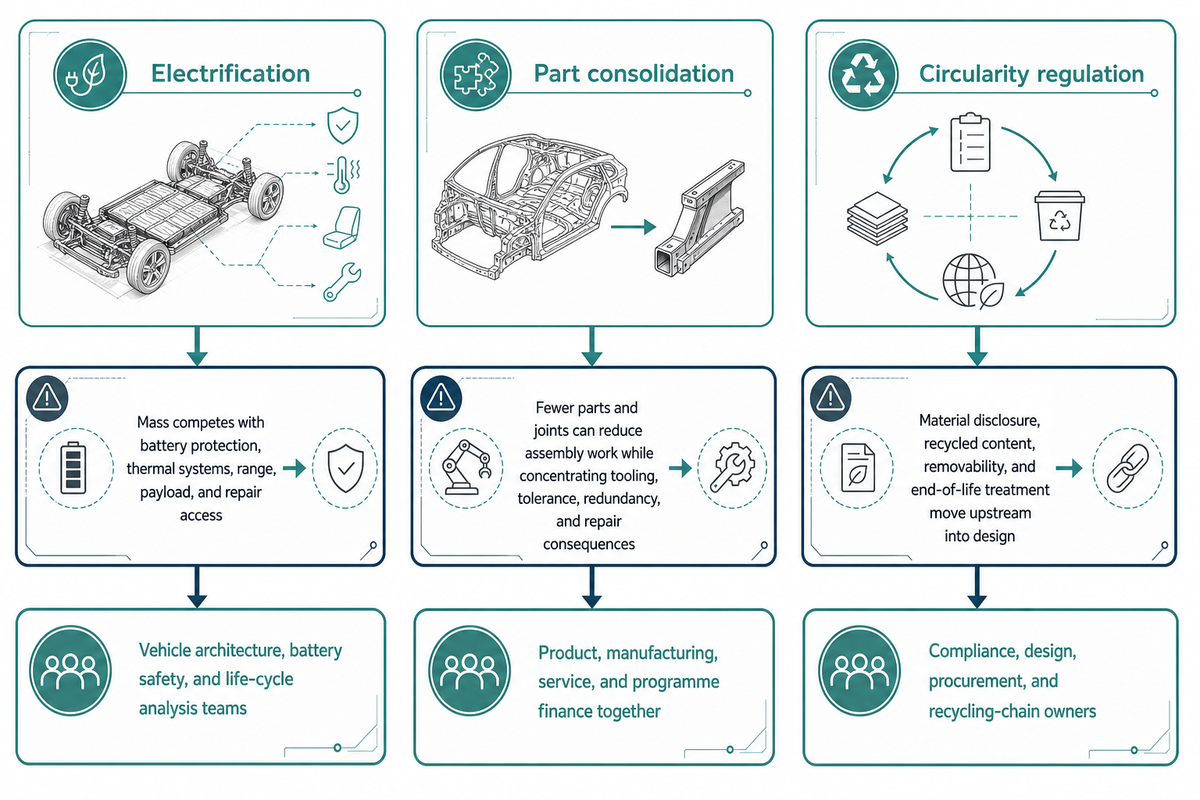
Electrification changes where mass matters; part consolidation changes where manufacturing risk sits; circularity rules change who owns material and recovery evidence. None of those drivers eliminates the need for a stack-specific joining and validation route. The same release sequence still applies as these drivers shift risk.
| Driver | Risk that shifts | New evidence owner |
|---|---|---|
| Electrification | Mass competes with battery protection, thermal systems, range, payload, and repair access. | Vehicle architecture, battery safety, and life-cycle analysis teams. |
| Part consolidation | Fewer parts and joints can reduce assembly work while concentrating tooling, tolerance, redundancy, and repair consequences. | Product, manufacturing, service, and programme finance together. |
| Mixed materials | Interface protection, separation, inspection, and rework become system requirements. | Materials, quality, supplier, and recovery owners. |
| Circularity regulation | Material disclosure, recycled content, removability, and end-of-life treatment move upstream into design. | Compliance, design, procurement, and recycling-chain owners. |
An Oak Ridge National Laboratory-hosted ULSAB case page reports 96 major parts and 158 total parts for that project, compared with more than 200 in the conventional comparison. The same source notes less redundancy and a need for closer tolerances, showing why fewer parts and joints can move risk rather than simply delete it.
Current European direction: the European Commission announced new automotive circularity rules in August 2026 covering vehicle design, production, collection, and end-of-life treatment, with recycled-plastic targets of 15 percent from 2032 and 25 percent from 2036. These are future European requirements, not a claim about Simitch certification or a global material mandate.
Life-cycle comparisons also need a declared boundary. The Department of Energy’s GREET research programme spans material and vehicle production, batteries, operation, energy pathways, facilities, and end-of-life, which is why a lighter use phase cannot be assumed to settle the total-emissions result.
Safety boundary: vehicle safety includes both self-protection and collision-partner protection. A dated National Highway Traffic Safety Administration evaluation is useful for defining that fleet-compatibility question, but it does not provide a current universal material ranking.
The measured United States search demand for the focus term is low and stable across both the recent window and a 60-month history, so this article does not manufacture a growth story. The decision pressure comes from vehicle architecture and regulation, not from keyword momentum.
Practical outlook: expect more programme-specific combinations of advanced steels, aluminum, castings, composites, polymers, adhesives, and mechanical joints, and more demand for evidence that follows the interface through production, service, and recovery.
Frequently Asked Questions
What is the simplest definition of automotive lightweighting?
Answer
Automotive lightweighting is the controlled reduction of vehicle mass while preserving the required safety, performance, manufacturing, durability, repair, and recovery outcomes. It includes material, geometry, joining, validation, and life-cycle decisions; substituting a lower-density material without proving those functions is not a complete lightweighting strategy. The baseline is a functionally equivalent vehicle system, not an isolated material sample.
Which materials are used to make cars lighter?
Answer
Automakers use advanced high-strength steels, aluminum and magnesium alloys, fiber-reinforced composites, engineering polymers, plastics, and hybrid material systems. No family is universally best: geometry, stiffness, crash duty, forming, joining, corrosion, cost, repair, and recovery determine which material or combination fits a particular component. The chosen family must also fit the programme’s supply and validation constraints.
How does advanced thermoforming contribute to automotive lightweighting?
Answer
Advanced thermoforming can turn heated polymer or composite sheet into complex, integrated lightweight components, potentially reducing part and fastener count. Its value depends on material distribution, tooling, heating and cooling control, cycle time, dimensional stability, inserts, inspection, and repair, so it must be compared as a production system rather than by finished-part mass alone.
Does a lighter vehicle always use less energy?
Answer
Not automatically. The effect depends on vehicle architecture, duty cycle, speed, regenerative braking, payload, aerodynamics, powertrain efficiency, and whether secondary component downsizing is available.
Why must joining be evaluated before a lightweight material is released?
Answer
A material can meet its part-level targets yet fail as an assembly because tools cannot reach the joint, dissimilar materials create a corrosion path, coatings or adhesive disturb the process window, or the plant cannot inspect and rework the result. The stack order, access class, interface, load, tolerance range, inspection, and repair route therefore belong in concept approval. Joining feasibility turns a material proposal into a manufacturable system definition.
Can self-piercing riveting support a mixed-material vehicle concept?
Answer
Yes, for suitable stacks, but the result is conditional. The material sequence, gauges, strengths, coatings, rivet and die geometry, force window, adhesive, access, loads, corrosion exposure, and inspection plan all require stack-specific trials.
Have a lightweight sheet stack that must move from concept to a controlled joining trial? Send the drawings, sample materials, stack order, access envelope, and acceptance criteria so Simitch can review the equipment-trial boundary within its disclosed joining scope.
About Simitch
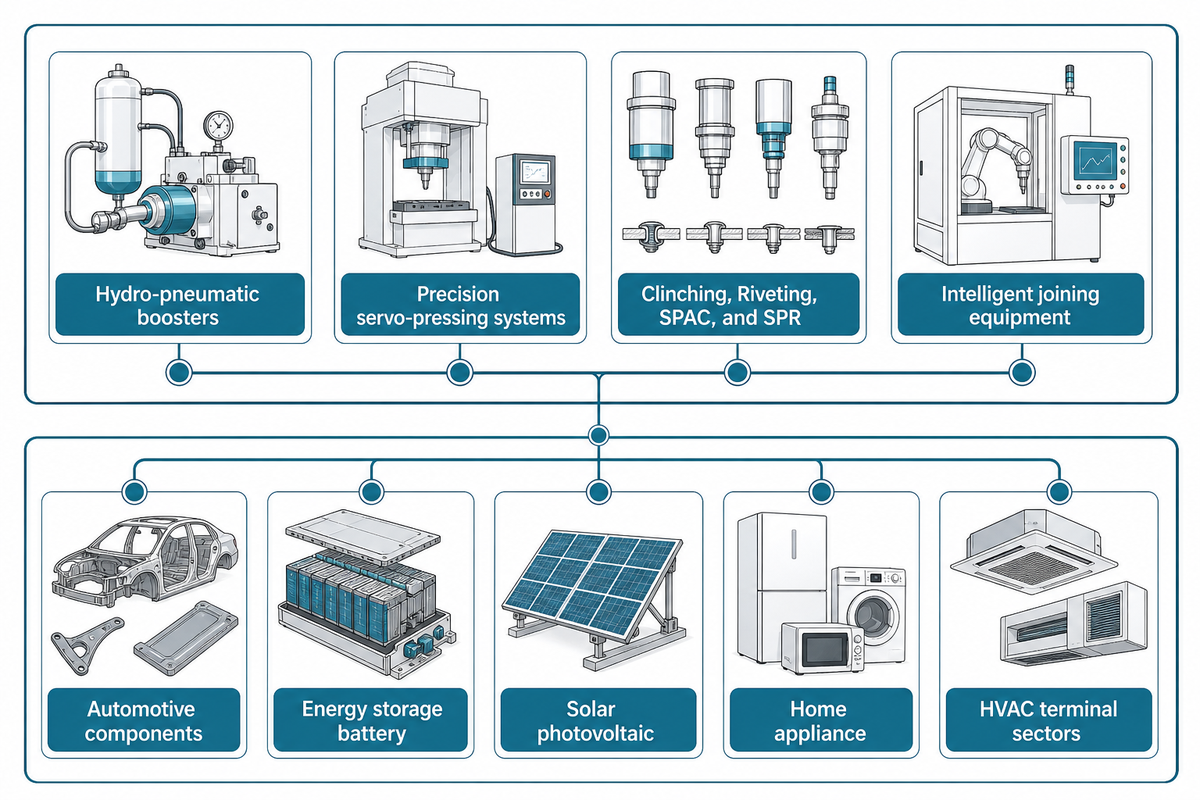
Established in September 2006, Simitch is located in Taicang, Jiangsu—a region renowned as a hub for German enterprises. The company specializes in intelligent joining equipment, focusing on applications such as hydro-pneumatic boosters, precision servo-pressing systems, and lightweight sheet metal joining technologies for the automotive industry (including Clinching, Riveting, SPAC, and SPR).
For independent sector context, the NIST Center for Automotive Lightweighting is cited only for the industry problem, not as validation of Simitch company claims.
Our diverse client base spans the automotive components, energy storage battery, solar photovoltaic, home appliance, and HVAC terminal sectors. We primarily provide our customers with intelligent joining equipment and comprehensive system-level solutions.
Simitch remains steadfast in its core principles: honoring commitments, cultivating deep expertise within the industry, fostering both craftsmanship and talent, and striving for excellence in every product. We are dedicated to delivering high-quality products and exceptional service to industries across the board.
About This Article
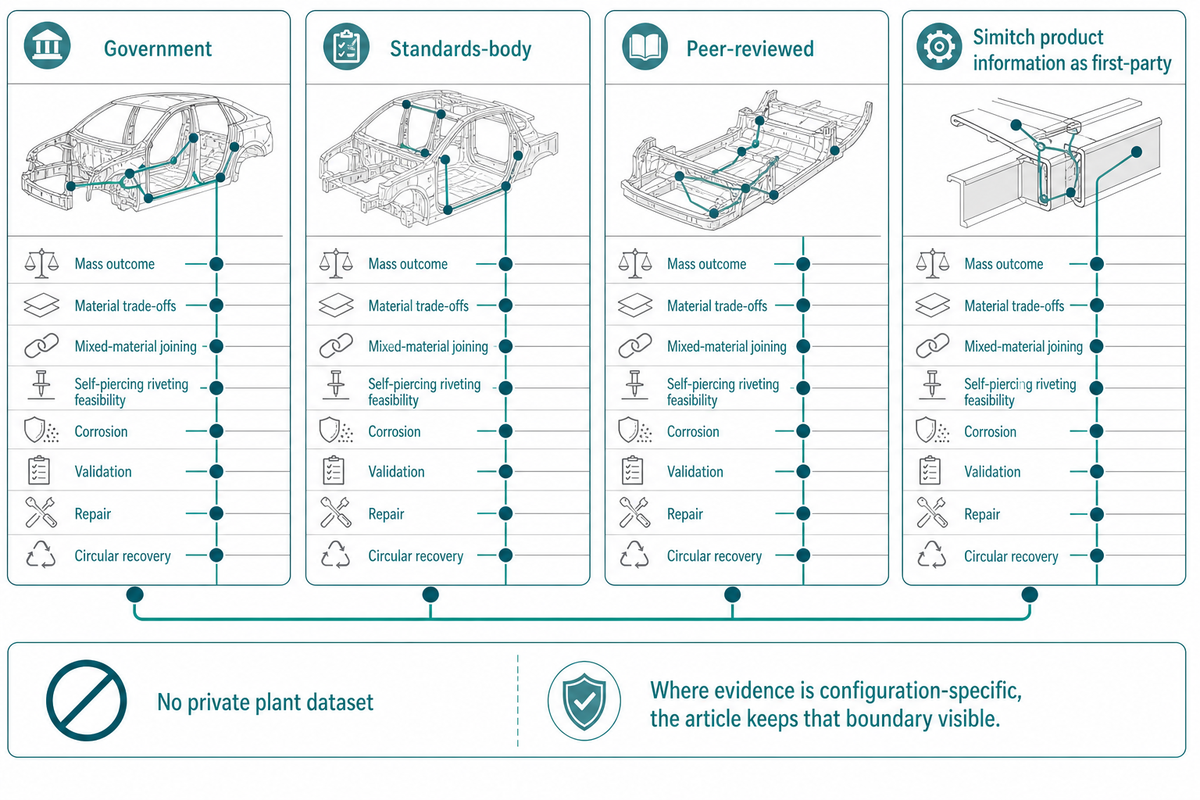
This guide uses current government, standards-body, research, and peer-reviewed sources for load-bearing statements, and labels Simitch product information as first-party. No private plant dataset, customer result, price, minimum order, lead time, certification, capacity, or universal failure rate was supplied or invented.
Method note: the Weight-Join-Recovery Triangle and One-Kilogram Decision Dossier are original project worksheets created for decision support. Their questions are evidence prompts, and their illustrative entries are not validated benchmarks.
Where evidence is configuration-specific, the article keeps that boundary visible. Source dates, European regulatory scope, first-party ownership, hypothetical values, and the distinction between a sample trial and vehicle-level validation remain explicit.
Search evidence note: the live result set returned no People Also Ask entries, so the FAQ combines measured related searches, a content-question corpus, and relevant engineering follow-ups without pretending all six questions came from that feature.
References & Sources
- New NIST research center helps auto industry lighten up · National Institute of Standards and Technology
- Lightweight materials for cars and trucks · U.S. Department of Energy
- Lightweight materials research · Oak Ridge National Laboratory
- Automotive lightweight material and manufacturing case study, 2025 · Machines
- Real-world barriers to implementing lightweighting technologies · Center for Automotive Research
- Corrosion behavior of steel-aluminum joints made by two joining processes, 2024 · PubMed Central
- ASTM G82, development and use of a galvanic series · ASTM International
- ULSAB project design summary · Oak Ridge National Laboratory-hosted resource
- New rules for a more circular European automotive sector, 2026 · European Commission
- Light-duty vehicle evaluation and safety analysis boundary · National Highway Traffic Safety Administration
- GREET life-cycle assessment research · U.S. Department of Energy
- Electric-vehicle circularity and life-cycle research, 2024 · World Electric Vehicle Journal
- Techniques for joining steel and aluminum · ASSEMBLY Magazine
- Steel-aluminum joint behavior review · Journal of Manufacturing Science and Engineering
- Self-piercing riveting system families and trial inputs · Simitch, first-party product information

![Hot-Melt Connection Molds & Equipment Guide [2026]](https://simitch.com/wp-content/uploads/2026/09/hot-melt-connection-molds-equipment-guide-featured-768x512.png)