Get in touch with Suzhou Simitch Machinery Co., Ltd Company

Last updated: October 2026
The best clinching machine manufacturer depends on the application: TOX suits monitored production lines, BTM offers tooling-led equipment options, and Ductformer addresses duct flange assembly. SIMITCH supplies application-built HVAC and appliance equipment. The 15 companies below cover portable tools, stationary presses and custom systems, with different tooling, access and integration requirements.
Quick Picks by Application
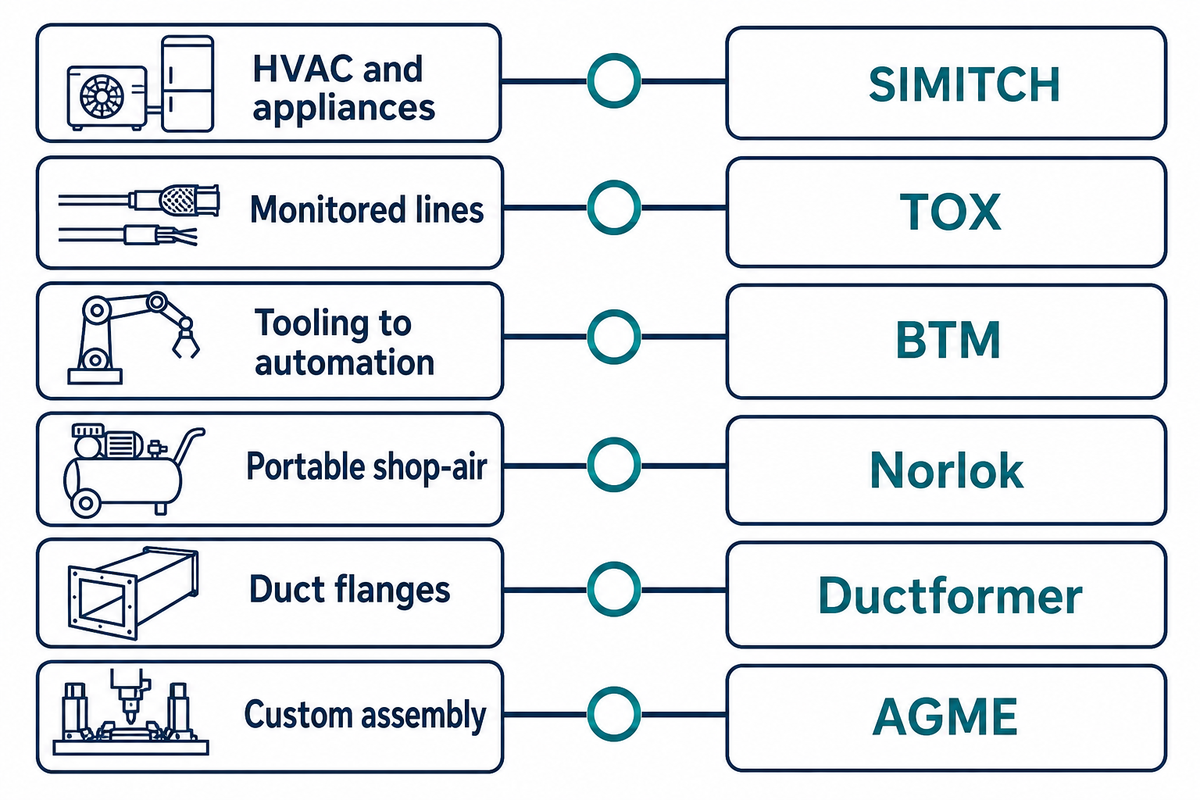
An appliance panel and a duct corner pose different demands on the joining head. With the assembly you make, you need to narrow the format of your equipment. These picks identify documented applications. They don’t rank joint strength, delivery speed or service quality across suppliers.
- Best for application-built HVAC and appliance sheet-metal assembly: SIMITCH. Its application routes cover HVAC and appliance joining with portable and stationary equipment choices.
- Best for monitored stationary and robotic clinching lines: TOX. ElectricDrive and MultiControl belong to a joining-system platform that extends beyond a single workstation.
- Best for a tooling-led route from hand tools to automation: BTM. Tog-L-Loc tooling appears in portable, fixed and integrated equipment.
- Best for portable shop-air clinching: Norlok. The Watson family targets work where a portable head can move around the assembly.
- Best for HVAC duct flange and corner assembly: Ductformer. DFTL machines address specific duct-shop fastening operations.
- Best for clinching within a custom multi-process assembly machine: AGME. It builds systems that integrate ECKOLD clinching technology.
Disclosure: This guide is published by SIMITCH. We list ourselves first because this is our website, not because we claim to be the market leader. The other 14 manufacturers are grouped by what they’re best for, in no particular order within each group.
How We Selected These Clinching Machine Manufacturers
Selection required an identifiable organization responsible for manufacturing or integrating complete industrial rivetless sheet-metal clinching equipment, supported by an official product page. Company information was verified against official websites and public sources in October 2026. The selection excludes trading companies, distributors, sourcing platforms, directories, media websites, and used equipment dealers. The result shows businesses in North America, Europe, Asia and Australia. There’s no country quota.
The clinching equipment industry includes joining-technology manufacturers, application-specific machine builders and custom-system integrators. A company can build a complete machine around another manufacturer’s tooling; that relationship is identified where documented. Böllhoff and its Attexor entity count as one entry. Manufacturers of self-clinching fastener insertion equipment alone, or machines restricted to other joining processes, fall outside this comparison.
What is a clinching machine?
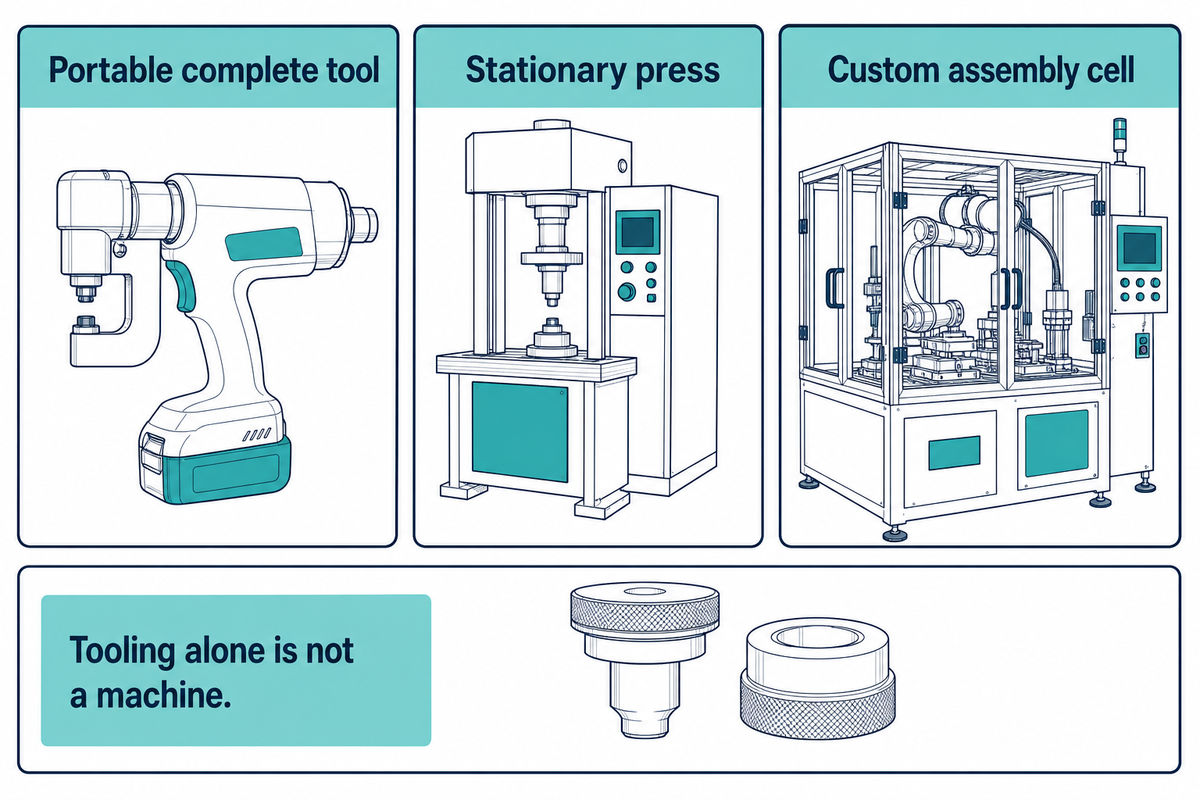
Overlapping sheet metal can be joined in a clinching machine by applying pressure between a matched punch and die. The rivetless clinching process uses the sheets themselves rather than an added fastener or welding heat. A mechanical interlock is achieved between the sheets. A complete portable tool or a stationary press can be used for the job, along with robot-mounted tongs or a customized assembly cell.
A drive unit or a loose die set alone isn’t a complete machine. The equipment must bring the tooling to the joint and apply the required forming action within the part’s access envelope. For a broader explanation of machine formats and operation, the clinching equipment guide covers that background. The comparison here concentrates on who builds the equipment and which purchasing requirements their published ranges address.
15 Clinching Machine Manufacturers Compared
The entries include established joining platforms and specialized builders focused on a particular area of sheet-metal fabrication. A broad range of product options and a machine for a narrow application answer different customer procurement requirements. The advantages below describe documented features of clinching equipment. The drawbacks describe the application scope or configuration work that follows from these features.
15-Company Clinching Equipment Comparison
A comparison of complete clinching equipment providers by application, machine scope, tooling responsibility, and purchasing constraints.
| No. | Company Name | Headquarters | Founded Year | Best For | Brief Introduction | Equipment and Joining Scope | Key Advantages | Potential Disadvantages | Official Website |
|---|---|---|---|---|---|---|---|---|---|
| 1 | SIMITCH | Taicang, Suzhou, China | 2006 | Application-built HVAC and appliance sheet-metal assembly | Clinching press manufacturer offering suspended tongs and fixed presses for application-specific sheet-metal work. | CRH03 tongs; CEC and PC fixed clinching presses | CRH03: 45 kN / 75 kN; CEC: 506 mm throat | Part-specific configuration needed before like-for-like quote comparison | simitch.com |
| 2 | TOX | Weingarten, Germany | 1978 | Monitored stationary and robotic clinching lines | Joining-system manufacturer combining clinching tongs, drives and controls for production equipment. | Clinching tongs, ElectricDrive and MultiControl | MultiControl coordination of up to 15 joining tongs | Cell engineering needed for multi-tong installations | tox.com |
| 3 | BTM | Marysville, Michigan, USA | 1966 | A tooling-led route from hand tools to automation | Manufacturer of clinching tooling and complete equipment, including its Tog-L-Loc joining technology. | HHP hand tools, MCP presses, multi-point and in-die systems | Tooling and equipment available across several production formats | Hand-tool access and capacity remain configuration-specific | btmcomp.com |
| 4 | ECKOLD | St. Andreasberg, Germany | 1936 | Complex access and configurable clinching systems | Clinching tools and systems manufacturer with portable, stationary and custom equipment. | MCD 30/50 AH, MZD 25/3 PH, MFG 500/150 E | Standard machines plus custom frames and robotic plants | Tool selection changes with sheet count and material stack | www.eckold.de |
| 5 | Böllhoff | Bielefeld, Germany | 1877 | Portable-to-automated RIVCLINCH applications | Fastening and assembly group supplying rivetless RIVCLINCH systems, including its Attexor business. | RIVCLINCH 0201 IP, Automation E and modular C-frames | Pneumatic portable and electric automated equipment options | Access differs by system; 0201 IP jaw depth is 20 mm | www.boellhoff.com |
| 6 | Norlok | Brantford, Ontario, Canada | 1994 | Portable shop-air clinching and sheet metal workshops | Canadian clinching equipment manufacturer serving portable joining, workshop and channel-letter applications. | Watson, Letterlok 3000, EZ Clinch and Surelok | Shop-air portable operation; selected stainless-steel tooling options | Watson material capacities vary with model and tooling | norlok.com |
| 7 | Jurado | Italy | 1999 | Portable hydraulic-booster clinching clamps | Portable-tool manufacturer with clamp formats for moving the joining head around sheet-metal assemblies. | Python, Pirana and Mouse clinching clamps | Python: 35 kN thrust; 3.7 kg clamp including handle | Python total-stack limits differ between mild steel and stainless | juradousa.com |
| 8 | Neumatica | Bangalore, India | 1992 | Custom clinching around difficult sheet metal profiles | Assembly and pressing equipment builder offering Klinch-Loc systems and custom joining solutions. | Klinch-Loc KLK series and custom assembly machines | Documented complex-profile applications and components up to 1000 mm | Application-led range lacks one universal off-the-shelf capacity | www.neumaticaglobal.com |
| 9 | Ductformer | St. Louis, Missouri, USA | Not publicly disclosed | HVAC duct flange and corner assembly | Duct-fabrication machinery manufacturer with a dedicated clinching range for duct-shop fastening. | DFTL machines for corners and TDFC/TDC flanges | Duct-specific application layout and standard laser locator | Focused duct-shop scope rather than general automotive assembly | ductformer.com |
| 10 | Mid-Rivers Machinery | St. Peters, Missouri, USA | Not publicly disclosed | Deep-throat fixed clinching for sheet metal shops | Air Cam machine builder supplying its own presses with identified BTM clinching tooling. | AC-3-26 Air Cam and channel-letter clinchers; BTM tooling | AC-3-26: 26-inch throat; published 28–14 gauge mild-steel range | Published AC-3-26 capacity applies to mild steel | midriversmachinery.com |
| 11 | Ticklay Engineering | Thomastown, Victoria, Australia | 1989 | Thin-sheet HVAC and duct fabrication in Australia | Sheet-metal fabricator and application-specific clincher builder using BTM joining tools. | Pneumatic sheetmetal clincher with BTM tools | Adjustable throat in a thin-sheet workshop machine | Capacity of up to 0.7mm thick | www.ticklayengineering.com.au |
| 12 | Heron | Guangzhou, China | 1991 (business origins) | Custom clinching cells alongside wider joining automation | Metal-joining equipment and automation manufacturer offering complete machines and BTM tooling products. | 8T and 15T machines, servo guns and air-oil units | Standard/custom equipment with optional monitors and sensors | Machine and tooling responsibilities span distinct technology suppliers | heron-welder.com |
| 13 | Computerized Cutters | Plano, Texas, USA | 1994 | Rivetless channel-letter return-to-back assembly | Sign-fabrication machine manufacturer supplying pneumatic equipment for joining metal channel-letter parts. | Accu-Clinch machines for aluminum and light-steel letters | Bottom-punch/top-die layout for return-to-back joining | Metal-letter scope; separately offered SPR equipment uses rivets | computerizedcutters.com |
| 14 | Press Lock | Ontario, Canada | 2020 | Canadian-built workshop clinchers across several frame formats | Clinching and riveting equipment manufacturer building bench, floor, handheld and channel-letter machines in Ontario. | T-Rex, Thor, LockNess and MooseJaw equipment families | T-Rex 4660: 40 kN / 65 kN; bench and handheld families | Clinching and self-piercing-riveting configurations must be distinguished | www.presslocktech.com |
| 15 | AGME | Eibar, Spain | 1948 | Clinching integrated into a custom multi-process assembly machine | Special assembly machine builder integrating an identified partner’s clinching technology into complete systems. | Custom assembly machines incorporating ECKOLD clinching | Documented gasket, seat-cushion and battery-component assembly applications | Custom integration rather than a proprietary clinching-tool platform | www.agme.net |
Sources: the manufacturers’ published company and equipment pages; Norlok’s founding year is also documented by EMC Canada. Specifications describe the named equipment, not independently measured comparative performance. The Heron date refers to business origins, while Böllhoff’s date refers to the group’s history.
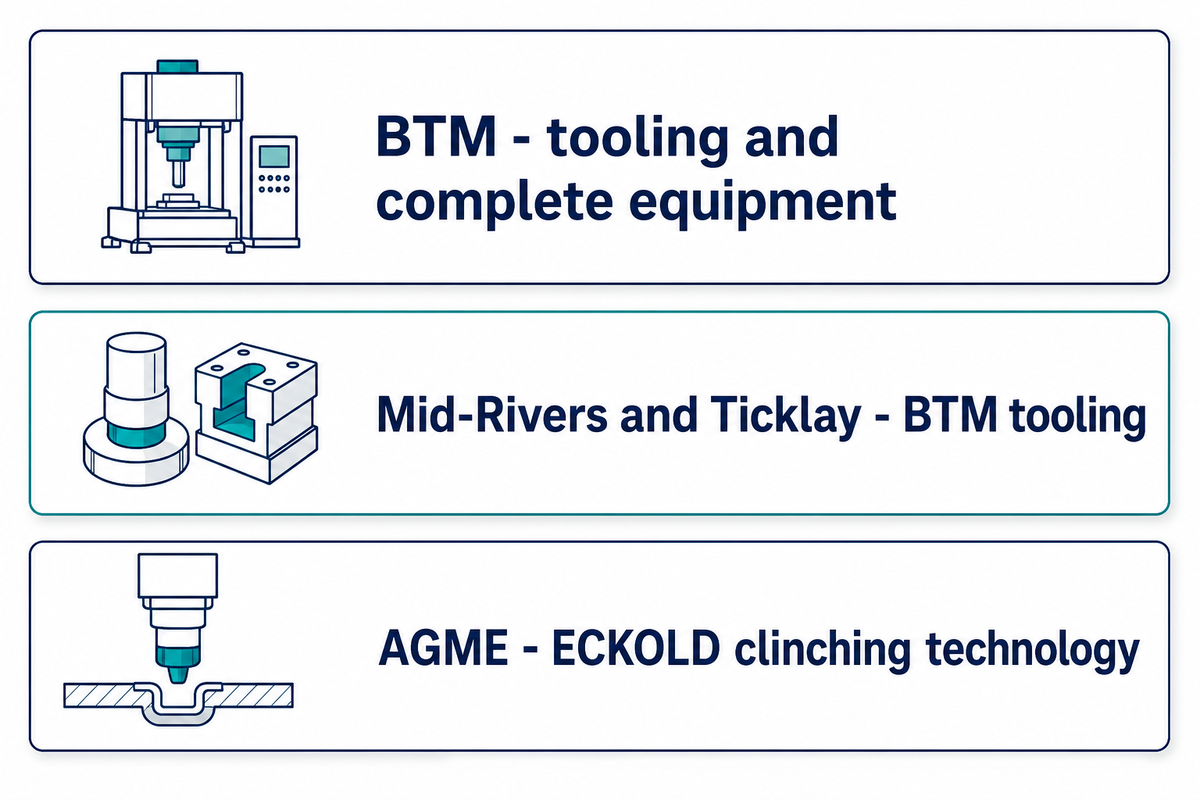
Reading across the table helps separate the joining process from the machine around it. BTM can supply both, while Mid-Rivers and Ticklay identify BTM tooling in equipment they build. AGME combines ECKOLD clinching with its own assembly-machine engineering. Those distinctions explain why two quotations can share a tooling name but contain very different frames, fixtures, controls and service responsibilities.
Multi-Application Clinching Systems
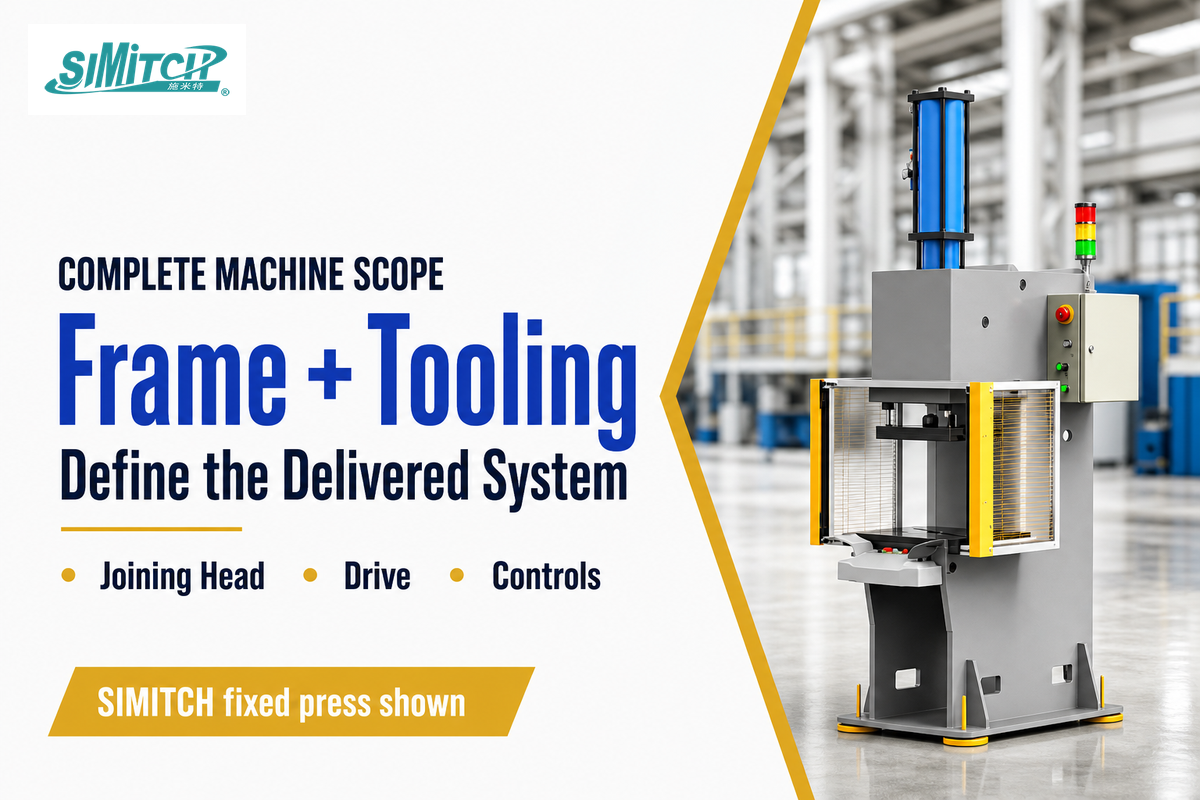
These manufacturers offer equipment in multiple formats or configurable system platforms. Their ranges cover the transition from a manually positioned joint to integrated production. The practical differences are in the available frame, joining head, drive and control arrangement as well as the manufacturer responsible for the tooling.
1. SIMITCH: Best for application-built HVAC and appliance sheet-metal assembly
Headquarters: Taicang, Suzhou, China · Founded: 2006 · Type: clinching press manufacturer
Official website: simitch.com
Main products: CRH03 suspended tongs; CEC and PC fixed presses; portable handheld clinching equipment
Equipment scope and tooling relationship: complete application-configured presses and tooling for sheet-metal assembly
Notable work: SIMITCH publishes CRH03 force options of 45 kN and 75 kN. Its CEC specification lists 78 kN, a 506 mm throat and a 933 mm working height; the PC floor-press family spans 78 kN to 990 kN.
SIMITCH organizes its offer around the part being assembled, with HVAC and household appliances among its named applications and both movable joining heads and fixed presses in its published range. The company’s clinching equipment configurations give buyers starting formats, while the stated model dimensions make the distinction between moving a tool to the work and presenting a panel to a press more concrete. Its application-selection process uses material stack, part geometry, load requirements, access and production timing to define a configuration. The purchasing limitation is that this approach requires part-specific tooling and configuration work, so a buyer seeking a fixed, interchangeable catalogue machine needs that scope defined before comparing quotations.
2. TOX: Best for monitored stationary and robotic clinching lines
Headquarters: Weingarten, Germany · Founded: 1978 · Type: joining-technology and equipment manufacturer
Official website: tox.com
Main products: clinching tongs, ElectricDrive and MultiControl
Equipment scope and tooling relationship: TOX joining technology, drives, tongs and control systems for stationary or robotic installations
Certifications / notable work: the German headquarters website lists ISO 9001:2015 and ISO 14001:2015; TOX states that MultiControl can manage up to 15 joining tongs in one line.
TOX connects the joining head to a wider controls platform, which makes its range relevant when a production line needs several coordinated joining stations rather than one manually operated press. According to its system page, ElectricDrive and MultiControl form part of that equipment architecture, so monitoring and the drive belong in the initial system discussion. The 15-tong figure describes a control-system capability, not finished-part output, because each assembly still has its own handling and joining sequence. A multi-tong installation requires application-specific tooling and cell integration, making it a more involved purchase than a standalone tool for occasional workshop use.
3. BTM: Best for a tooling-led route from hand tools to automation
Headquarters: Marysville, Michigan, USA · Founded: 1966 · Type: clinching tooling and equipment manufacturer
Official website: btmcomp.com
Main products: Tog-L-Loc tooling, HHP hand tools, MCP presses and automated systems
Equipment scope and tooling relationship: BTM develops joining tooling and supplies portable, stationary, multi-point and in-die equipment.
Certifications / notable work: BTM Company LLC’s published ISO 9001:2015 certificate is valid through November 19, 2027.
BTM’s equipment catalogue connects its Tog-L-Loc technology with several ways of carrying out the joint, including hand tools, presses and machinery integrated into another production operation. That range is useful for manufacturers deciding whether an established joint should remain a manually positioned operation or become part of an automated assembly sequence. BTM tooling also appears in machines built by other companies in this list, so its role extends beyond the complete machines sold under its own name. The relevant limitation is configuration-specific access: a particular HHP hand-tool frame and die arrangement has a defined work envelope, and that portable configuration doesn’t represent the reach or capacity of BTM’s wider equipment range.
4. ECKOLD: Best for complex access and configurable clinching systems
Headquarters: St. Andreasberg, Germany · Founded: 1936 · Type: clinching tools and systems manufacturer
Official website: www.eckold.de
Main products: MCD 30/50 AH, MZD 25/3 PH and MFG 500/150 E standard machines
Equipment scope and tooling relationship: ECKOLD clinching technology in portable and stationary machines, custom frames and robotic plants
Certifications / notable work: its website publishes entity-specific ISO 9001 and ISO 14001 certificates alongside its standard-machine and custom-system offerings.
ECKOLD’s published range spans individual portable or stationary machines and engineered installations, giving it a practical place on shortlists where a bent profile or restricted joining position drives the equipment layout. The named standard machines provide identifiable starting points, while custom frames and robotic plants extend the range to assemblies that require another approach to handling or access. ECKOLD is also the clinching technology partner named by AGME, a separate machine builder included below. Selection remains dependent on sheet count, material and individual thicknesses: a catalogue tool that reaches the joint location isn’t automatically the appropriate punch-and-die combination for every stack placed inside it.
5. Böllhoff: Best for portable-to-automated RIVCLINCH applications
Headquarters: Bielefeld, Germany · Founded: 1877 · Type: fastening and assembly systems manufacturer
Official website: www.boellhoff.com
Main products: RIVCLINCH 0201 IP, Automation E and modular C-frame systems
Equipment scope and tooling relationship: rivetless RIVCLINCH technology and equipment; Böllhoff and Attexor are counted together here.
Certifications / notable work: group quality pages list ISO 9001:2015 and other location-specific certifications. Böllhoff specifies its 0201 IP at 25 kN and 6 bar, with a 2.9 kg work head and maximum thicknesses of 2.5 mm for mild steel or 1.8 mm for stainless steel; Automation E has 67 kN total force.
RIVCLINCH gives Böllhoff a dedicated metal-joining range that includes a compact portable tool and equipment intended for automated installations. According to the product page, the 0201 IP provides a 20 mm jaw depth, a useful example of how a small tool’s physical access differs from a configurable C-frame system. Automation E belongs to the electric automated side of the offering, so the group is relevant to purchasers considering either handheld operation or integration into a production cell. The limitation is the difference between those access envelopes: the 0201 IP’s shallow reach restricts that model’s joint locations, but it doesn’t define the reach of all Böllhoff clinching systems.
HVAC and Workshop Clinching Equipment
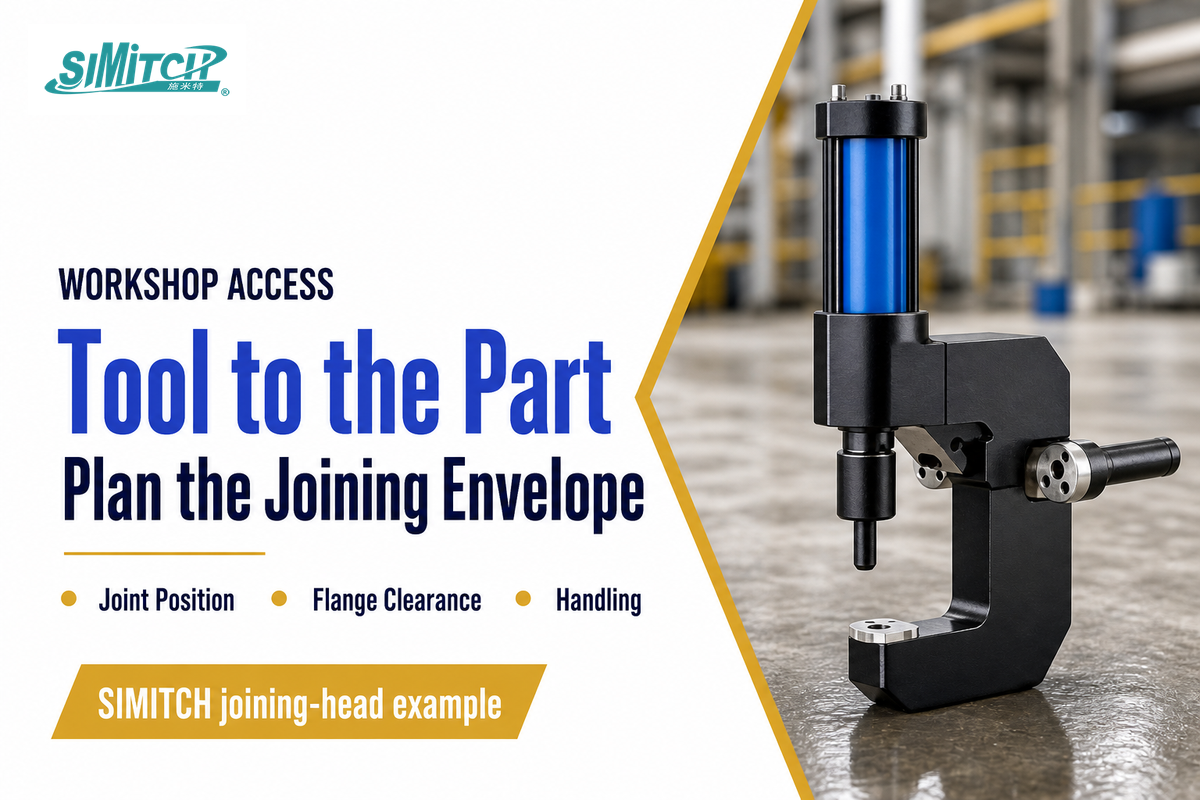
Workshop equipment often needs to work in the assembly sequence used by a fabricator. A portable clamp moves around the workpiece; a fixed press requires the workpiece to move into its throat. Duct corners, return flanges, and deep panel joints help workers visualize the difference before forming force or power enters the picture.
6. Norlok: Best for portable shop-air clinching and sheet metal workshops
Headquarters: Brantford, Ontario, Canada · Founded: 1994 · Type: clinching equipment manufacturer
Official website: norlok.com
Main products: Watson portable clinchers, Letterlok 3000, EZ Clinch and Surelok floor machines
Equipment scope and tooling relationship: complete portable and stationary clinching machines for workshop and sign-fabrication applications
Notable work: Norlok lists Watson capacity up to two layers of 14-gauge (2 mm) sheet, or two layers of 18-gauge (1.25 mm) stainless steel with optional tooling. The portable equipment operates from shop air.
Norlok combines portable joining equipment with dedicated workshop machines, allowing buyers to distinguish a movable clinching head from a floor-mounted production station within one manufacturer’s range. The Watson family is especially relevant where a large assembly is easier to leave in place while an operator brings the tool to each joint, and Letterlok 3000 identifies a separate channel-letter application. Watson capacity and stainless-steel suitability depend on the selected model and tooling, so the portable family shouldn’t be treated as having one material rating shared by every configuration.
7. Jurado: Best for portable hydraulic-booster clinching clamps
Headquarters: Italy · Founded: 1999 · Type: portable clinching tool manufacturer
Official website: juradousa.com
Main products: Python, Pirana and Mouse clinching clamps
Equipment scope and tooling relationship: portable hydraulic-booster clamp systems for rivetless sheet-metal joining
Notable work: Jurado publishes 35 kN thrust and a 3.7 kg clamp weight including the handle for Python, with maximum air pressure of 6 bar, maximum hydraulic pressure of 360 bar and a stated tool cycle time of 0.8 s.
Jurado’s clamp-based range suits assemblies where bringing the joining head to the work is more practical than feeding the entire part through a stationary press. Python’s published weight describes the clamp with its handle, making it a more useful handling reference than a number presented without the included equipment, while its thrust figure describes the tool rather than the strength of a finished joint. The detailed Python specification table gives maximum total thicknesses of 3.0 mm for mild steel and 2.4 mm for stainless steel. Those different material limits are the purchasing constraint: the steel and stainless figures aren’t interchangeable, and neither represents a universal capacity for every combination of sheets or coatings.
8. Neumatica: Best for custom clinching around difficult sheet metal profiles
Headquarters: Bangalore, India · Founded: 1992 · Type: assembly and pressing equipment manufacturer
Official website: www.neumaticaglobal.com
Main products: Klinch-Loc KLK series and custom assembly solutions
Equipment scope and tooling relationship: complete clinching machines and application-specific pressing or assembly equipment
Notable work: the company’s clinching page describes custom machines for complex bent profiles and components up to 1000 mm.
Neumatica places Klinch-Loc within a wider assembly and pressing business, with published examples that emphasize the shape of the part rather than a single general-purpose machine format. Complex bent profiles can make the route into a joint as important as the force applied there, which explains this builder’s fit for work that needs a custom frame or arrangement. The stated component size of up to 1000 mm describes its documented application scope; it isn’t a sheet-thickness rating or a claim that every point on a component is accessible. Because the offering is application-led, the overall range description doesn’t supply one off-the-shelf capacity that a buyer can apply to every Klinch-Loc installation.
9. Ductformer: Best for HVAC duct flange and corner assembly
Headquarters: St. Louis, Missouri, USA · Founded: Not publicly disclosed · Type: duct-fabrication equipment manufacturer
Official website: ductformer.com
Main products: DFTL clinching machines
Equipment scope and tooling relationship: complete machines for duct corners and TDFC/TDC flange joining
Notable work: Ductformer lists a standard laser locator for its DFTL clinching equipment.
Ductformer’s DFTL range is built around recognizable duct-shop operations, making its application description more specific than a general claim to join metal. The published combination of corner and flange work, together with a laser locator for positioning, gives fabricators a concrete starting point when their recurring task is assembling those duct features. A buyer comparing DFTL equipment with a portable clamp is therefore comparing different ways to present and locate the duct joint, even though both use mechanical joining. DFTL’s limitation follows directly from that focus: it’s a duct-shop fastening machine, rather than a general automotive assembly platform intended to coordinate varied components through a multi-station production cell.
10. Mid-Rivers Machinery: Best for deep-throat fixed clinching for sheet metal shops
Headquarters: St. Peters, Missouri, USA · Founded: Not publicly disclosed · Type: Air Cam press and clinching machine manufacturer
Official website: midriversmachinery.com
Main products: Air Cam AC-3-26 and channel-letter clinchers
Equipment scope and tooling relationship: Mid-Rivers builds the machine; its AC-3-26 product page identifies standard BTM tooling.
Notable work: AC-3-26 has a published 26-inch throat and a 28 to 14 gauge mild-steel capacity range. Mid-Rivers specifies connection to shop air at 80–100 psi.
The AC-3-26 is a fixed-machine option for sheet-metal shops that need to bring a joint farther inside the part to the punch and die. Its 26-inch throat is a defined machine dimension, while the standard BTM tooling statement clearly separates the Air Cam machine builder from the joining-tool technology supplier. Mid-Rivers also lists channel-letter clinchers, giving its machinery range another identifiable fabrication application rather than only an unconfigured press. The material limitation is specific: AC-3-26’s published capacity concerns mild steel, so that gauge range doesn’t establish the corresponding capacity for stainless steel, aluminum or a mixed-material stack with different forming behavior.
11. Ticklay Engineering: Best for thin-sheet HVAC and duct fabrication in Australia
Headquarters: Thomastown, Victoria, Australia · Founded: 1989 · Type: sheet-metal fabricator and clincher builder
Official website: www.ticklayengineering.com.au
Main products: pneumatic sheetmetal clincher with BTM tools
Equipment scope and tooling relationship: Ticklay manufactures the clinching machine and identifies BTM as the tooling supplier.
Notable work: its product page describes an adjustable throat, workshop air up to 100 psi and advertised capacity up to 0.7 mm.
Ticklay’s background in sheet-metal fabrication is reflected in a clincher aimed at the thin-sheet work of HVAC and duct shops. The adjustable throat addresses machine setup around the workpiece, while the explicit BTM tooling relationship tells the buyer which part of the joining system belongs to another manufacturer. This is an application-specific machine-building offer within an Australian fabrication business, with a narrower published description than the multi-format joining platforms earlier in the list.
Specialized and Custom Assembly Machines
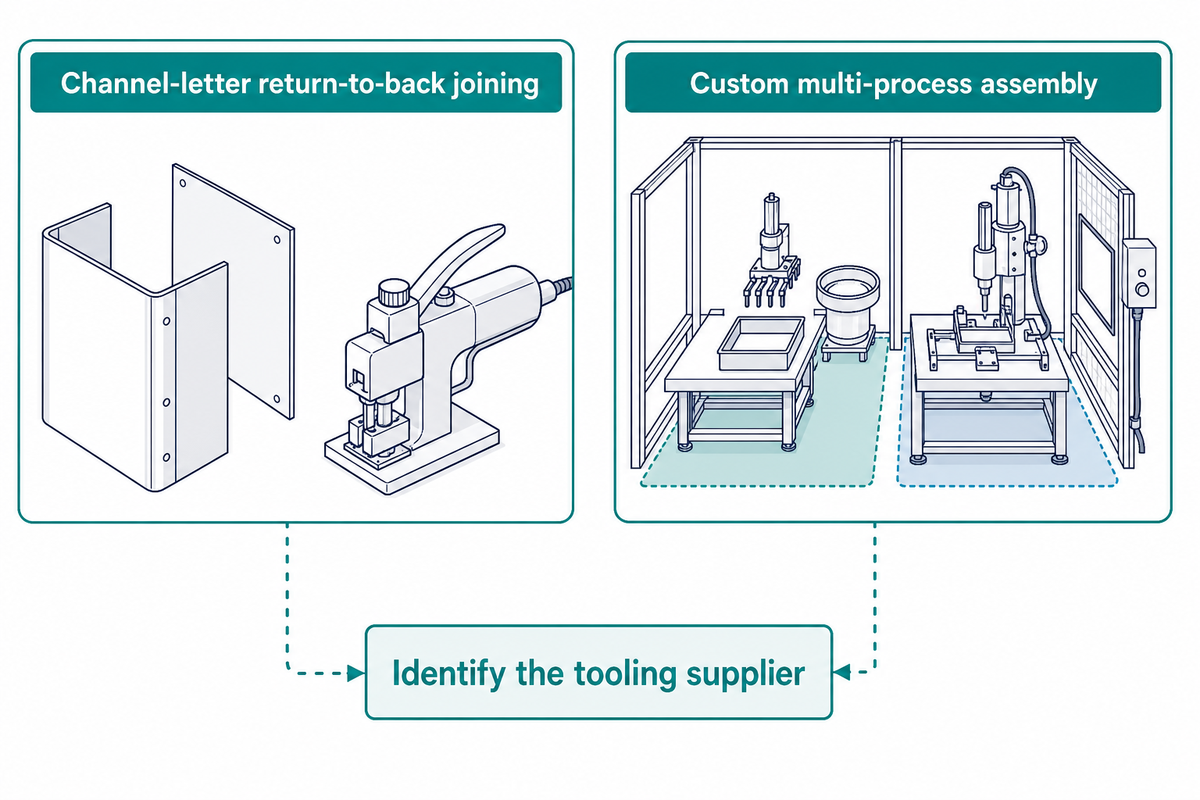
Specialized builders can address a repeatable geometry or incorporate joining into a larger sequence. Two categories covered in this report are dedicated equipment for the sign making sector and workshop use, as well as custom machines incorporating clinching with other production tasks. The role descriptions are separate from the ownership of the underlying joining tooling.
12. Heron: Best for custom clinching cells alongside wider joining automation
Headquarters: Guangzhou, China · Founded: 1991 business origins · Type: metal-joining equipment and automation manufacturer
Official website: heron-welder.com
Main products: 8T and 15T clinching machines, servo guns and air-oil units
Equipment scope and tooling relationship: standard and custom machines; the clinching catalogue also includes BTM tooling products.
Certifications / notable work: Heron states ISO 9001:2015 certification on its website and lists optional monitors and sensors for its equipment.
Heron combines clinching equipment with a broader metal-joining automation business, which makes it relevant when the machine forms one operation within a larger assembly project. Its catalogue names both conventional machine formats and servo guns, giving the buyer a clearer picture of possible equipment forms than a single general automation claim. The company’s stated history traces its business origins to 1991, rather than identifying that year as the incorporation date of its current legal entity. The quotation boundary needs particular attention because complete-machine engineering and BTM tooling appear in the same offering: the delivered system can involve separate machine and tooling suppliers with different technical responsibilities.
13. Computerized Cutters: Best for rivetless channel-letter return-to-back assembly
Headquarters: Plano, Texas, USA · Founded: 1994 · Type: sign-fabrication machine manufacturer
Official website: computerizedcutters.com
Main products: Accu-Clinch channel-letter fastening machines
Equipment scope and tooling relationship: complete pneumatic machines for joining aluminum or light-steel channel-letter components
Notable work: the published Accu-Clinch design places the punch below the work and the die above it for return-to-back joining.
Computerized Cutters applies rivetless clinching to sign production, where the shaped return must be attached to the letter back within the available working space. Its bottom-punch/top-die layout is a concrete machine feature tied to that operation, and the stated aluminum or light-steel application keeps the material scope focused on the metal parts described by the manufacturer. For a sign shop, that defined task is more informative than comparing the machine with a larger press solely by force. The limitation is the joining route and material application: Accu-Clinch serves metal channel letters, while the separately offered SPR equipment uses rivets for other back materials and shouldn’t be treated as the same rivetless process.
14. Press Lock: Best for Canadian-built workshop clinchers across several frame formats
Headquarters: Ontario, Canada · Founded: 2020 · Type: clinching and riveting equipment manufacturer
Official website: www.presslocktech.com
Main products: T-Rex, Thor desktop and floor machines, LockNess and MooseJaw
Equipment scope and tooling relationship: bench, floor, channel-letter and handheld equipment built in Ontario
Notable work: Press Lock lists T-Rex 4660 with 40 kN and 65 kN options, alongside the 40 kN T-Rex 4830 InReach and 72 kN T-Rex Titan 8660.
Press Lock’s range gives workshop buyers several physical formats to consider, including equipment intended to sit on a bench, stand on the floor or move to the assembly. According to its website, the machines are built in Ontario, and the named families give procurement teams identifiable products to discuss instead of only a general custom-engineering offer. The combination is relevant when a shop performs more than one sheet-metal assembly task and wants to compare the handling implications of different machine forms. Its range also includes self-piercing riveting, so the limiting purchase distinction is process selection: a riveting configuration and a rivetless clinching configuration can’t be assumed to use the same tooling or produce the same joint.
15. AGME: Best for clinching integrated into a custom multi-process assembly machine
Headquarters: Eibar, Spain · Founded: 1948 · Type: custom assembly machine builder and system integrator
Official website: www.agme.net
Main products: special assembly machines integrating ECKOLD clinching
Equipment scope and tooling relationship: AGME builds and integrates the assembly machine; ECKOLD supplies the identified clinching technology.
Certifications / notable work: AGME announced renewal of its ISO 9001 quality certificates in 2023; published clinching applications include head gaskets, seat cushions and battery-component assembly.
AGME belongs on a shortlist when the required purchase is a complete assembly machine incorporating clinching alongside other operations. Its official technology-partner page names ECKOLD directly and describes component applications, giving the integration role a clearer basis than a generic claim to automate manufacturing. The value of this route lies in organizing the handling and joining tasks around the finished assembly rather than choosing a standalone head in isolation. AGME’s limitation is correspondingly specific: it’s a custom-system choice using a partner’s clinching technology, rather than a separate proprietary clinching-tool platform for buyers seeking only a standard tool family.
How to Choose a Clinching Machine Manufacturer
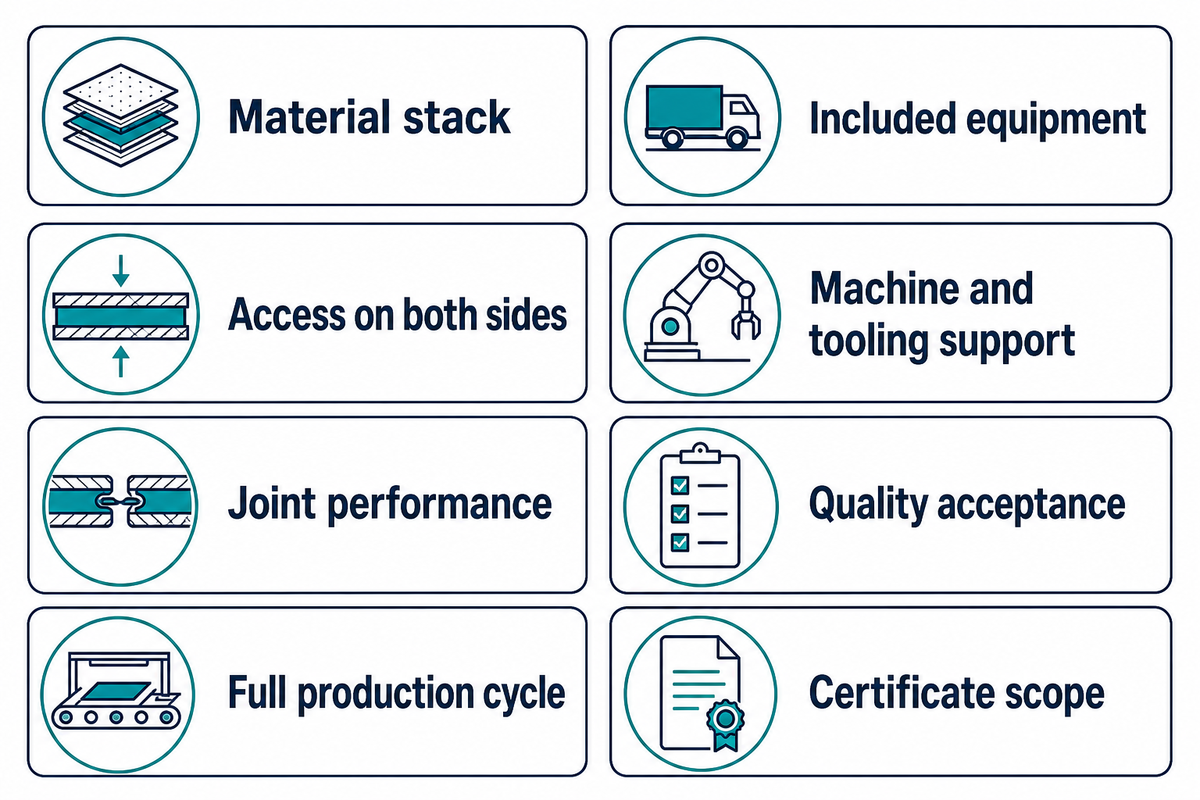
A machine that can be configured to make a defined part provides a basis for a useful quote. The eight checks that follow help in distinguishing a machine that can apply force from a system configured to make the required joints. The inputs help builders customize equipment. The costs of tooling, fixtures and integration become evident before comparing nominal machine prices.
- Identify the entire material stack. Give sheet grade, individual thicknesses, sequence and coating including product variant differences. Request sample results for joints using that stack. Nominal total thickness doesn’t answer if the punch acts through thin or thick sheet, or if the materials interlock as designed. Keep separate application data for aluminum, mild steel and stainless steel.
- Show access on both sides of every joint. Supply drawings with flange widths, joint positions and surrounding bends, then request an access study tied to the proposed fixture. Throat depth measures one part of the envelope; the die still needs clearance and the tool must enter and leave the joint. Compare portable clinching tools with fixed equipment using the assembly’s geometry and handling needs.
- Define the joint need separately from machine force. Indicate load direction and required strength and pertinent service conditions, then agree on the sample evaluation and acceptance criteria. The forming force of a press (rated in kN) doesn’t assess the finished joint and assign it a load rating. Coating condition and mixed-metal corrosion performance depend on the proposed material combination and can’t be inferred from a general claim about rivetless joining.
- Analyze the entire production cycle. Cover all aspects of loading, positioning, clamping, clinch operation, releasing, and unloading. Specify the number of joints per part and the changeover sequence; don’t just assume that one stroke time equates to the finished part throughput time. Automatic positioning may change the handling sequence, but production efficiency comparisons of the various systems under review still require a common starting and ending point for all the proposed systems.
- Itemize the supplied equipment. Ask for the machine, matched punch-and-die sets, fixture, guarding, controls and utility requirements to be listed as included, optional or excluded. Record air pressure and air-supply requirements where applicable, and distinguish a hydraulic power arrangement from a pneumatic or electric drive. Published stationary clinching press families provide a starting point; the quoted configuration defines the delivered equipment.
- Assign machine and tooling support. Identify who builds the frame and controls, who supplies the joining tools, and who handles replacement parts. Include tool identification, maintenance instructions, spare-part availability, installation and training in the quotation comparison. A BTM tool installed in another builder’s machine, or ECKOLD technology integrated by AGME, creates a different support arrangement from buying the entire package directly from the technology owner.
- Agree how production quality will be demonstrated. Request a representative sample of joints and define the measurements/tests for acceptance. If force or displacement monitoring is offered, define the conditions it records and what happens when a trace falls out of the acceptable window. A monitored curve supports process control, but the relationship between that curve and joint performance is qualified by the application.
- Check the scope of standards and certificates once. Read the applicable certificate’s entity, site, activity, and validity, rather than treating an ISO reference as an approval of a particular joint. The public DVS catalogue lists DVS 3420 from April 2021, covering clinching basics, component design, metallic materials, technology, and quality assurance. This is a process reference and not a machine certification. This guide cites the public catalogue description.
What is a Servo-Driven Clinching Machine?
A servo-driven clinching machine incorporates a servo-controlled drive to move the joining tool through its working cycle. The controller determines motion based on equipment configuration and appropriate systems capture process data. Servo control describes how the machine is driven; joint strength still depends on the material stack, matched tooling and the formed joint.
Specify required motion, monitoring and production interfaces and then compare drive labels. A product-family page mentioning servo equipment, however, doesn’t establish the force range, control functions or precision of an unnamed model. The same is true for pneumatic clinching: the drive description, in and of itself, doesn’t describe the full tooling, fixture and access arrangement.
A purchasing sequence can keep those decisions in order:
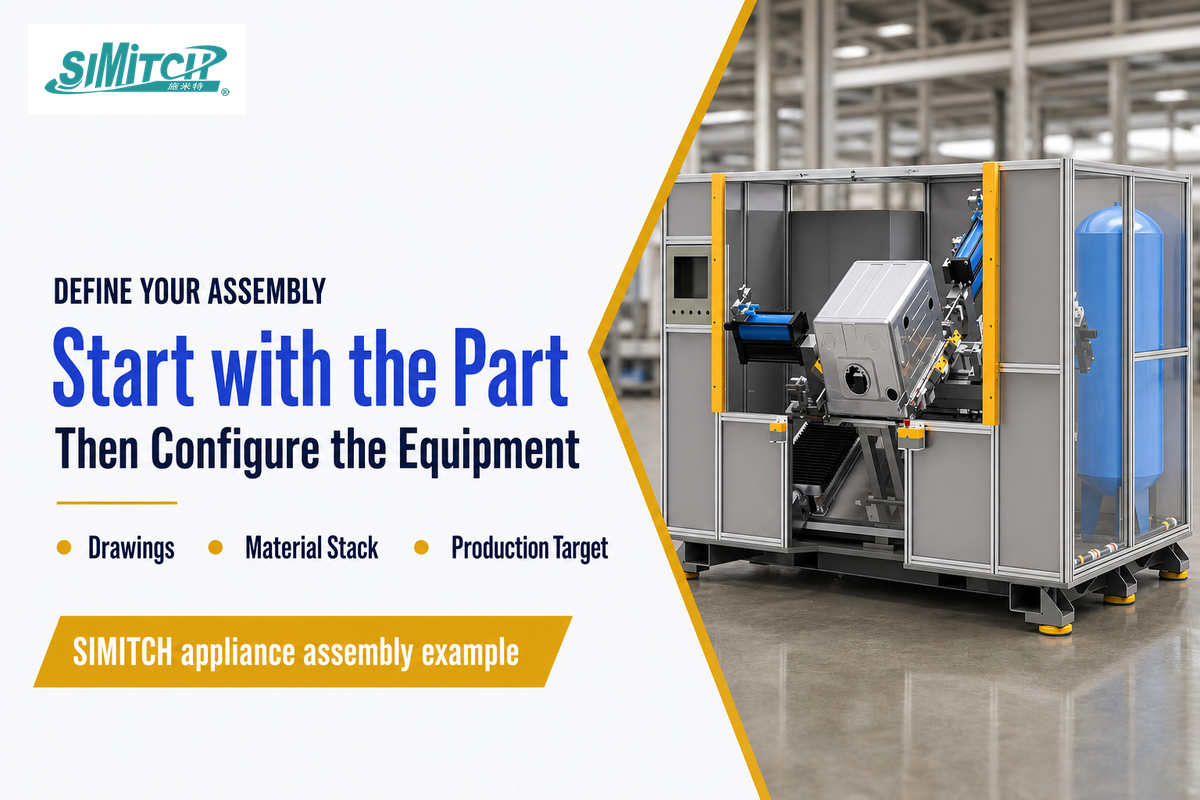
- Define the assembly. Provide drawings, material stack and the required joint performance.
- Approve the application. Review sample results and access with the proposed tooling and fixture.
- Compare the complete scope. Align equipment, cycle assumptions and service responsibilities before placing the order.
FAQ
Which is the best clinching machine manufacturer for my project?
The best manufacturer is the one whose equipment fits your material stack, joint access and production system.
TOX, BTM and ECKOLD offer broad joining ranges, while ductwork and sign-making specialists address narrower tasks. SIMITCH’s stated application fit is HVAC and appliance sheet-metal assembly. A suitable shortlist begins with those differences, then compares the complete machine and tooling configuration for the same part. Company size or a larger force rating alone does not settle that choice.
Who is the largest clinching machine manufacturer in the world?
Comparable public sales figures for rivetless clinching equipment do not establish a largest manufacturer in this guide.
A diversified group’s total revenue includes activities outside clinching and would not measure its position in this equipment category accurately. The companies also differ in what they sell: proprietary tooling, complete machines or custom integration. Documented equipment scope and an agreed application result provide a more useful basis for buying than an unsupported size ranking across those business models.
What is the difference between a clinching machine manufacturer and a supplier?
A manufacturer builds or integrates the machine, while a machine supplier may distribute equipment made by someone else.
Tooling ownership is a separate question. Mid-Rivers and Ticklay describe machines using BTM tooling, while AGME names ECKOLD as its clinching technology partner. These companies can therefore be responsible for complete equipment without owning the underlying joining technology. The distinction affects the technical scope of the order and the route for machine service, replacement tools and application support.
How much does a clinching machine cost?
Clinching machine prices depend on format, tooling, fixtures and automation scope.
A portable clamp and a robot-equipped cell are different purchases. Compare itemized quotations for the same part, cycle requirement and included equipment.
Which suppliers are best for HVAC ductwork?
Ductformer, Mid-Rivers and Ticklay publish equipment directly relevant to duct-shop assembly.
Norlok, Jurado, ECKOLD and Böllhoff also offer portable or stationary options. The useful distinction is how the machine reaches the flange or corner and handles the stated material stack. Ductformer’s DFTL addresses duct-specific operations, while a deeper fixed throat or a movable clamp serves a different handling arrangement. Access behind an assembled duct remains part of the equipment choice.
Is a rivetless clinching machine the same as a self-clinching fastener press?
Rivetless clinching forms an interlock from the sheets; a self-clinching fastener press installs a separate component.
Nuts, studs and standoffs belong to the latter category. A riveting machine also uses a different joining route. The sheet-metal joining methods guide explains the wider process choices.
Discuss Your Sheet-Metal Joining Application
Key takeaway
A useful clinching shortlist matches the material stack and joint access to a complete machine, with tooling ownership and integration responsibilities clearly identified.
The best fit starts with your assembly requirements. Send SIMITCH the part drawings, material grades, individual thicknesses, joint positions and production target for HVAC or appliance sheet-metal work. Include access restrictions and required joint loads so the discussion can address a defined configuration. Contact SIMITCH about your clinching application with those details.
References & Sources
Publicly available company information and product specifications attributed to manufacturers are located within the companies’ About, History, product and Quality pages of their official web sites. Application-fit evaluations are subjective reviews of published offerings. This study doesn’t include hands-on evaluation, measured quality rankings or a market-share survey.
- DVS: mechanical joining publications including the public catalog description of DVS 3420 (April 2021).
- EMC Canada: Norlok Technology Inc. member spotlight, supporting the company’s 1994 founding date.
![Hot-Melt Connection Molds & Equipment Guide [2026]](https://simitch.com/wp-content/uploads/2026/09/hot-melt-connection-molds-equipment-guide-featured-768x512.png)